
TL;DR
A jobsite safety equipment list covers everything from hard hats and harnesses to trench boxes and GFCIs, all mapped to OSHA’s construction standards under 29 CFR 1926. OSHA’s Focus Four hazards (falls, struck-by, electrocution, caught-in/between) account for over 56% of construction fatalities, and the right equipment prevents each one. This glossary defines every critical piece of safety equipment, explains the regulation behind it, and adds practical context for concrete, asphalt, and site work crews. The 2025 PPE fit rule now requires all protective equipment to properly fit each individual worker.
Jobsite Safety Equipment Checklist (Quick Answer)
Every construction jobsite should have safety equipment that protects workers from OSHA’s Focus Four hazards: falls, struck-by incidents, electrocution, and caught-in/between accidents.
A complete jobsite safety equipment list typically includes:
Equipment Category | Examples | Primary OSHA Hazard |
|---|---|---|
Personal Protective Equipment | Hard hats, safety glasses, gloves, respirators | Struck-by, silica exposure |
Fall Protection | Harnesses, SRLs, guardrails, anchors | Falls |
Site Safety Equipment | Fire extinguishers, first aid kits, eyewash stations | Emergency response |
Trenching Equipment | Trench boxes, shoring, gas monitors | Cave-ins |
Electrical Safety | GFCIs, insulated tools, LOTO kits | Electrocution |
Heavy Equipment Safety | Backup alarms, ROPS, seat belts | Struck-by |
Hazard Communication | SDS, labels, warning signs | Chemical hazards |
OSHA requires employers to perform a hazard assessment before selecting safety equipment, train workers on proper use, inspect equipment regularly, and replace damaged or improperly fitting PPE.
Why This Glossary Exists
Nearly 6.5 million people work at over 250,000 construction sites across the United States on any given day. In 2023, 1,075 of those workers were killed on the job, roughly one in five of all worker deaths across all industries. The four leading causes, what OSHA calls the Focus Four or Fatal Four, were responsible for more than 56% of those deaths: falls (33.5%), struck-by incidents (11.4%), electrocution (8.4%), and caught-in/between accidents (5.4%).
Every piece of equipment on this jobsite safety equipment list exists to prevent one or more of those outcomes. This isn’t a shopping list. It’s a reference tool that defines each item, ties it to the specific OSHA standard that requires it, and explains how it applies in real-world conditions, particularly for commercial concrete, asphalt paving, and site development work.
Each glossary entry is tagged with the Focus Four hazard it addresses so you can quickly map your equipment inventory to the risks actually present on your site.
Spending on safety equipment is also a financial decision. Proper compliance directly affects workers’ comp premiums, project timelines, and penalty exposure. For guidance on managing those costs strategically, see this contractor overhead reduction guide.
Construction Safety by the Numbers
Statistic | Value |
|---|---|
Construction workers | 6.5 million |
Active jobsites | 250,000+ |
Worker fatalities (2023) | 1,075 |
Falls | 33.5% |
Struck-by | 11.4% |
Electrocution | 8.4% |
Caught-In/Between | 5.4% |
How to Choose the Right Jobsite Safety Equipment
Every construction site has different hazards, so the required equipment depends on the work being performed.
A simple process is:
H3: Step 1 – Perform a Hazard Assessment
Identify fall hazards, electrical hazards, excavation work, traffic exposure, silica dust, and moving equipment.
H3: Step 2 – Apply OSHA’s Hierarchy of Controls
Remove hazards where possible before relying on PPE.
H3: Step 3 – Select OSHA-Compliant Equipment
Choose equipment that meets OSHA requirements and any referenced ANSI or ASTM standards.
H3: Step 4 – Verify Proper Fit
Following OSHA’s 2025 PPE rule, every employee must receive correctly fitting PPE.
H3: Step 5 – Train Workers
Workers must understand inspection, maintenance, storage, and replacement procedures.
Section 1: Personal Protective Equipment (PPE)
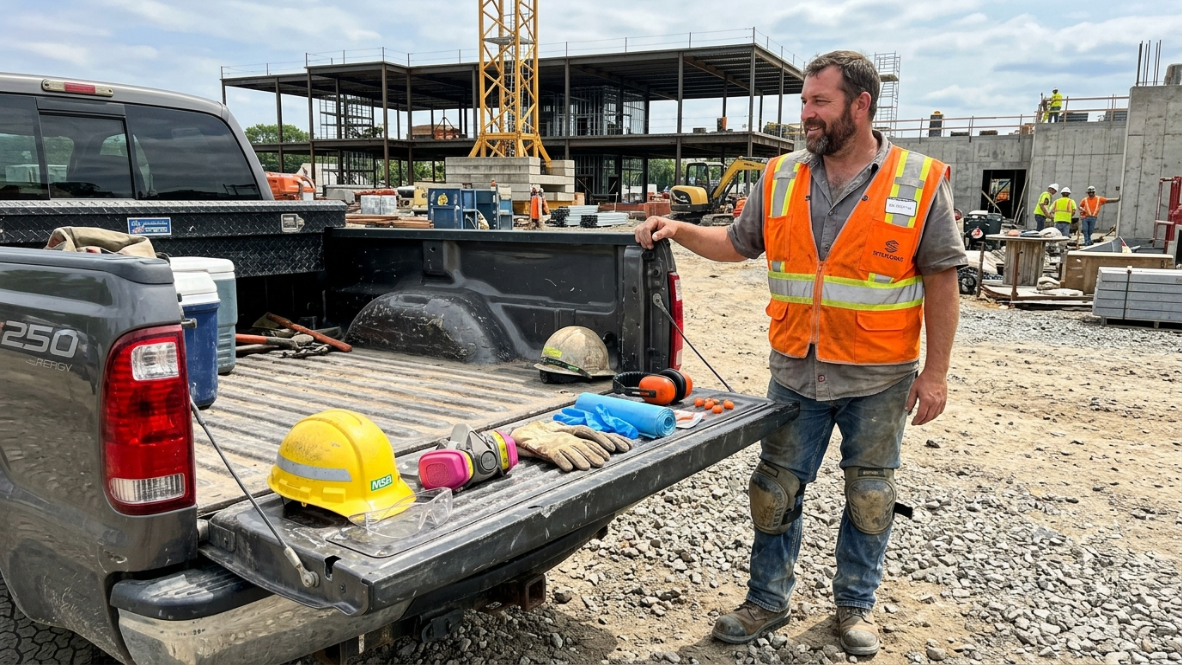
PPE is the last line of defense in what OSHA calls the Hierarchy of Controls (defined in Section 8 below). Engineering controls and safe work practices come first. But when those aren’t enough to eliminate a hazard, PPE is what stands between a worker and an injury.
Hard Hat / Safety Helmet
Definition: Rigid headgear designed to protect against impact from falling objects and, depending on the type, lateral blows.
OSHA Reference: 29 CFR 1926.100
Practical Note: Type I helmets protect only the top of the head. Type II helmets protect the top and sides. For structural concrete formwork, tilt panel construction, and any work near overhead loads, Type II helmets (from manufacturers like KASK or Milwaukee) offer significantly better protection. Practitioners on Reddit’s r/Construction forum frequently recommend Type II helmets for formwork crews, noting that side impacts from stripped forms and swinging loads are more common than many safety plans account for.
Focus Four Tag: Struck-By
Safety Glasses / Goggles / Face Shield
Definition: Eye and face protection designed to guard against impact, splash, dust, and radiant energy depending on the type.
OSHA Reference: 29 CFR 1926.102
Practical Note: Safety glasses handle flying debris from general construction. Goggles are required when dust or liquid splash is the primary hazard, common during concrete cutting and grinding. Face shields are necessary for grinding, cutting with abrasive wheels, and working with hot asphalt. A face shield alone is not sufficient; it must be worn with safety glasses or goggles underneath.
Focus Four Tag: Struck-By
High-Visibility Vest (Hi-Vis)
Definition: Fluorescent and retroreflective garment that makes workers visible to equipment operators and vehicle traffic.
OSHA Reference: ANSI/ISEA 107 (referenced by OSHA for construction zones); MUTCD standards for roadway work.
Practical Note: For asphalt paving on active roadways, Class 3 hi-vis garments (covering both torso and limbs) are standard. Class 2 vests are typically adequate for enclosed jobsites like parking lot work or building construction. The distinction matters because struck-by incidents from vehicles are among the top killers in road construction.
Focus Four Tag: Struck-By
Safety Boots / Steel-Toe Boots
Definition: Protective footwear with impact-resistant toe caps and puncture-resistant soles, rated under ASTM F2413.
Practical Note: For concrete crews, waterproof boots are essential since fresh concrete is highly alkaline (pH 12-13) and causes chemical burns with prolonged skin contact. Metatarsal guards add protection for workers handling heavy rebar bundles or structural steel. Asphalt crews need heat-resistant soles because fresh hot-mix asphalt can exceed 300°F.
Focus Four Tag: Struck-By, Caught-In/Between
Work Gloves
Definition: Hand protection selected based on the specific hazard present. Types include cut-resistant, chemical-resistant, impact-resistant, and heat-resistant gloves.
Practical Note: This is one area where “one glove fits all” thinking gets workers hurt. Rebar crews need ANSI A4 or higher cut-resistant gloves. Concrete finishing crews need chemical-resistant nitrile or neoprene gloves to prevent alkaline burns. Demolition crews need impact-resistant gloves with TPR (thermoplastic rubber) knuckle guards. Asphalt workers handling hot-mix need heat-rated gloves.
Focus Four Tag: Caught-In/Between, Struck-By
Hearing Protection (Earplugs / Earmuffs)
Definition: Devices that reduce noise exposure to prevent permanent hearing loss. Available as insertable plugs, over-ear muffs, or combination systems.
OSHA Reference: 29 CFR 1926.52 (noise exposure limits); 29 CFR 1926.101 (hearing protection)
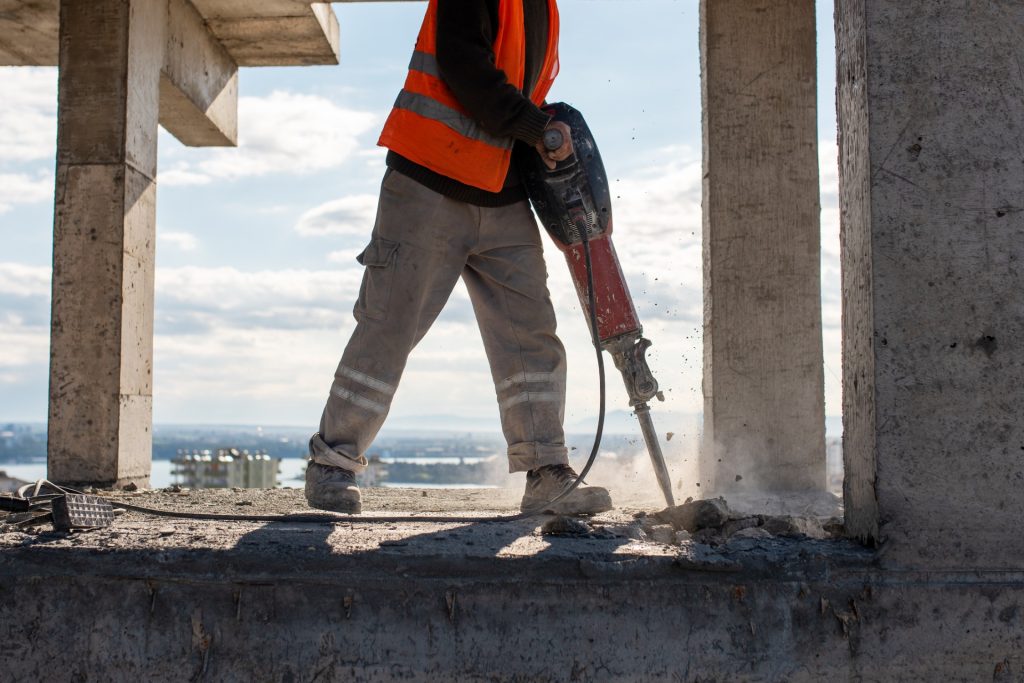
Practical Note: Concrete cutting with a wet saw, jackhammering, and asphalt milling operations routinely exceed OSHA’s 85 dB action level. Many workers underestimate cumulative exposure. A concrete saw at close range can produce 100+ dB, enough to cause permanent damage in under 15 minutes. Earmuffs with a Noise Reduction Rating (NRR) of 25 or higher are standard for these operations.
Respiratory Protection / Respirator
Definition: A device worn over the nose and mouth (or the entire face) to filter or supply clean breathing air in environments with airborne hazards.
OSHA Reference: 29 CFR 1910.134 (respiratory protection program, applicable to construction); 29 CFR 1926.1153 (respirable crystalline silica)
Practical Note: Silica dust from concrete cutting, grinding, and demolition is one of the most serious chronic health hazards in construction. OSHA’s silica rule (Table 1 of 29 CFR 1926.1153) specifies exact engineering controls and respirator requirements for each task. Employers must maintain a written respiratory protection program. This isn’t optional, and it’s one of the most frequently cited violations during inspections. Practitioners on construction safety forums consistently note that half-face respirators with P100 filters are the minimum for any dry-cutting concrete operation.
Focus Four Tag: N/A (chronic health hazard, not Focus Four, but critically important)
PPE Fit Requirement (2025 Rule)
Definition: OSHA’s updated standard requiring that all PPE in construction must “properly fit each affected employee,” effective January 13, 2025.
OSHA Reference: 29 CFR 1926.95 (amended)
Practical Note: This rule change addresses a long-standing problem. Standard-sized PPE often doesn’t fit workers with smaller frames, larger builds, or different body proportions. A harness that doesn’t fit properly can shift during a fall and fail to arrest it. Oversized goggles let debris in around the edges. The rule means employers must stock multiple sizes and verify fit during initial issuance and periodic inspections. Field supervisors should document fit verification. This is not a suggestion; it’s an enforceable standard.
When sourcing PPE that meets fit requirements across varied crew sizes, a structured vendor selection process helps ensure your suppliers can actually deliver the range of sizes needed.
Knee Pads
Definition: Protective pads worn over the knees to prevent injury during prolonged kneeling work.
Practical Note: Often missing from generic safety equipment lists, but essential for concrete finishing and flatwork crews. Hours of kneeling on hardened concrete or rebar mats causes chronic knee injuries. Hard-shell knee pads with gel or foam inserts are standard for trowel crews. Some contractors now require them as mandatory PPE for any slab-on-grade pour.
Which Safety Equipment Protects Against Each OSHA Hazard?
OSHA Hazard | Required Equipment |
|---|---|
Falls | Harnesses, SRLs, guardrails, anchors, hole covers |
Struck-by | Hard hats, hi-vis clothing, backup alarms, spotters |
Electrocution | GFCIs, insulated tools, LOTO kits |
Caught-In/Between | Trench boxes, machine guards, shoring |
Silica Dust | Respirators, wet cutting systems |
Noise | Earplugs, earmuffs |
Chemical Exposure | Gloves, goggles, face shields |
Section 2: Fall Protection Equipment
Fall protection, specifically 29 CFR 1926.501 (General Requirements), is the most frequently cited standard during federal OSHA inspections year after year. Falls account for one-third of all construction deaths. This category of your jobsite safety equipment list deserves the most attention.
Personal Fall Arrest System (PFAS)
Definition: A system designed to stop a worker who has already begun falling. Consists of three components: a full-body harness, a connecting device (lanyard or self-retracting lifeline), and an anchorage point.
OSHA Reference: 29 CFR 1926.502(d)
Practical Note: All three components must be present and properly connected for the system to work. A harness without a rated anchorage point is not fall protection. The system must limit maximum arresting force on the worker to 1,800 pounds and prevent contact with any lower level.
Focus Four Tag: Falls
Full-Body Harness
Definition: The body-worn component of a PFAS, designed to distribute fall arrest forces across the thighs, pelvis, chest, and shoulders.
Practical Note: Body belts are no longer allowed for fall arrest (only for positioning). Harnesses must be inspected before each use for frayed webbing, damaged buckles, and corrosion on D-rings. Under the 2025 fit rule, harnesses must be properly sized for each worker. This is the single most common fit issue flagged on jobsites.
Focus Four Tag: Falls
Self-Retracting Lifeline (SRL)
Definition: A connecting device that automatically adjusts its length as a worker moves and locks instantly when a fall occurs, similar to a car seatbelt.
Practical Note: SRLs limit free-fall distance to about 2 feet, compared to up to 6 feet with a standard lanyard. They’re preferred for structural concrete work at height because they allow more freedom of movement while providing faster fall arrest.
Focus Four Tag: Falls
Guardrail System
Definition: A barrier installed along open edges, platforms, and walkways to physically prevent workers from falling.
OSHA Reference: 29 CFR 1926.502(b)
Practical Note: Top rail height must be 42 inches (plus or minus 3 inches). The system must withstand 200 pounds of force applied in any outward or downward direction at any point along the top edge. Guardrails are the preferred fall protection method because they require no action from the worker.
Focus Four Tag: Falls
Safety Net
Definition: A mesh net system installed below a work surface to catch falling workers.
OSHA Reference: 29 CFR 1926.502©
Practical Note: Nets must be installed as close as practicable under the work surface, no more than 30 feet below. They’re less common in commercial concrete work but used in bridge construction and large structural steel projects.
Focus Four Tag: Falls
Hole Cover
Definition: A physical cover placed over floor holes, roof openings, or skylight openings to prevent workers from falling through.
OSHA Reference: 29 CFR 1926.502(i)
Practical Note: Covers must be able to support twice the weight of workers, equipment, and materials that may be imposed on them. They must be secured against accidental displacement and marked with the word “HOLE” or “COVER.” On concrete slab pours with embedded openings for elevator shafts or mechanical penetrations, hole covers must be installed immediately after forms are stripped.
Focus Four Tag: Falls
Warning Line System
Definition: A rope, wire, or chain barrier erected on a low-slope roof to mark the boundary beyond which fall protection is required.
OSHA Reference: 29 CFR 1926.502(f)
Practical Note: Warning lines must be set at least 6 feet from the roof edge. They’re not standalone fall protection; they define a zone. Workers inside the warning line area (closer to the edge) must use guardrails, safety nets, or a PFAS. Used primarily during rooftop mechanical installations and waterproofing.
Focus Four Tag: Falls
Anchorage Point / Anchor Connector
Definition: A secure point of attachment for a PFAS, capable of supporting at least 5,000 pounds per attached worker (or designed with a safety factor of 2 under the supervision of a qualified person).
Practical Note: This is where many fall protection systems fail in practice. Tying off to a conduit, pipe, or vent stack that can’t support the load isn’t fall protection, it’s a false sense of security. Engineered anchorage points, whether permanent or temporary, must be verified for each application.
Focus Four Tag: Falls
Section 3: Site Safety Equipment
These items support general jobsite safety and emergency response. They’re required regardless of what specific trade work is underway.
First Aid Kit
Definition: A collection of medical supplies for treating minor injuries and stabilizing serious injuries until professional medical help arrives.
OSHA Reference: 29 CFR 1926.50
Practical Note: OSHA requires at least one first aid kit “reasonably accessible” to each worksite. For multi-area projects (like large site development with simultaneous concrete, excavation, and paving operations), multiple kits placed at central locations are the practical answer. Kits should be checked weekly and restocked after each use.
Fire Extinguisher
Definition: A portable device that discharges an extinguishing agent to suppress or extinguish fire.
OSHA Reference: 29 CFR 1926.150
Practical Note: At minimum, a fire extinguisher must be available within 100 feet of any temporary building, storage area, or activity involving flammable materials. For hot-work operations (welding, cutting), a fire watch with an extinguisher is mandatory for at least 30 minutes after work ends. Asphalt kettle operations require extinguishers rated for Class B fires (flammable liquids).
Emergency Eyewash Station
Definition: A device that delivers a controlled flow of clean water to flush contaminants from the eyes.
OSHA Reference: 29 CFR 1926.50(g), referencing ANSI Z358.1
Practical Note: Required wherever workers handle corrosive materials. Fresh concrete, concrete admixtures, form release agents, and asphalt emulsions all qualify. Portable eyewash stations are standard on commercial concrete jobsites. They must deliver at least 15 minutes of flushing capacity and be accessible within 10 seconds of the hazard.
Safety Data Sheets (SDS) Binder
Definition: A collection of standardized documents detailing the hazards, handling procedures, and emergency measures for each chemical or hazardous substance on the jobsite.
OSHA Reference: 29 CFR 1926.59 (Hazard Communication Standard)
Practical Note: Employers must maintain an SDS for every hazardous substance on site and make them accessible to workers at all times. For concrete contractors, this includes admixtures, curing compounds, form oils, epoxies, sealers, and fuel. An organized SDS binder (or digital equivalent) at the jobsite trailer is the standard approach.
Barricades and Safety Fencing
Definition: Physical barriers that restrict access to hazardous areas such as excavation perimeters, active pour zones, and demolition areas.
Practical Note: Plastic mesh safety fencing around open excavations is common, but it must be supported and visible. For active concrete pours, barricades keep unauthorized personnel away from crane swing zones and freshly placed concrete edges where fall-in hazards exist.
Focus Four Tag: Falls, Struck-By
Traffic Control Devices (Cones, Signs, Flagging)
Definition: Equipment used to direct vehicle and pedestrian traffic safely around or through active construction zones.
OSHA Reference: MUTCD (Manual on Uniform Traffic Control Devices), referenced by OSHA for roadway construction.
Practical Note: Critical for asphalt paving on active roadways. The setup, which includes channelizing devices, advance warning signs, arrow boards, and flaggers, must follow an approved Traffic Control Plan. Struck-by incidents from vehicles are one of the leading killers in road construction.
Focus Four Tag: Struck-By
For contractors running multiple jobsites, consolidating safety equipment purchases through a vendor program can reduce per-unit costs and ensure consistent quality across all crews.
Air Horn / Emergency Alarm System
Definition: An audible alarm system used to signal an emergency evacuation or immediate danger on the jobsite.
Practical Note: Required on large jobsites where verbal communication can’t reach all workers. Especially important during large concrete pours, crane operations, and any multi-story structural work. Establish distinct signals: one blast for general alarm, three short blasts for evacuation.
Section 4: Excavation and Trenching Safety Equipment
Trenching and excavation are among the most hazardous construction operations. Trench collapses can bury a worker under thousands of pounds of soil in seconds. This equipment category is directly relevant to storm pipe installation, drainage system work, and foundation excavation.
Trench Box / Trench Shield
Definition: A prefabricated steel or aluminum structure placed inside a trench to protect workers from cave-in by shielding the work area.
OSHA Reference: 29 CFR 1926 Subpart P
Practical Note: Required (along with other protective systems like sloping or shoring) for trenches 5 feet deep or more. Trench boxes are the most common protection method for utility and pipe installation because they can be repositioned as the work progresses. Workers must never be inside the trench while the box is being moved.
Focus Four Tag: Caught-In/Between
Hydraulic Shoring System
Definition: A system of hydraulic cylinders and plates installed against trench walls to prevent collapse.
Practical Note: Used in situations where a trench box can’t fit or where the trench is wider than standard shields accommodate. Installation and removal must follow the manufacturer’s specifications exactly.
Focus Four Tag: Caught-In/Between
Atmospheric Monitoring Equipment
Definition: Portable instruments that detect hazardous atmospheres (oxygen deficiency, combustible gases, toxic gases) in confined spaces and deep excavations.
Practical Note: Required before any worker enters a permit-required confined space. In deep excavations (over 12 feet) or those near landfills, gas lines, or contaminated soil, atmospheric monitoring is essential before entry. A four-gas monitor (oxygen, LEL, CO, H2S) is the standard tool.
Focus Four Tag: Caught-In/Between
Competent Person (Excavation)
Definition: A person designated by the employer who is capable of identifying existing and predictable hazards in the excavation and has the authority to take prompt corrective measures to eliminate them.
OSHA Reference: 29 CFR 1926.650(b)
Practical Note: This is a role, not a piece of equipment, but it’s one of the most important terms on any jobsite safety equipment list. The competent person must inspect the excavation daily, after every rainstorm, and after any event that could increase the hazard. Without a designated competent person on site, OSHA considers the excavation non-compliant regardless of what protective systems are installed.
Section 5: Electrical Safety Equipment
Nearly all construction work involves some electrical hazard. Electrocution is the third leading cause of construction fatalities in the Focus Four.
Ground Fault Circuit Interrupter (GFCI)
Definition: A device that shuts off electrical power within milliseconds when it detects current leaking through an unintended path, such as through a worker’s body.
OSHA Reference: 29 CFR 1926.405(a)(2)(ii)
Practical Note: GFCIs must be used on all 120-volt, single-phase, 15- and 20-ampere temporary power circuits on construction sites. This includes every extension cord, power tool, and temporary outlet. Testing GFCIs before each shift is a basic but frequently skipped step.
Focus Four Tag: Electrocution
Lockout/Tagout (LOTO) Kit
Definition: A set of locks, tags, hasps, and blocking devices used to isolate energy sources on equipment that is being serviced or repaired.
OSHA Reference: 29 CFR 1926.417
Practical Note: LOTO applies whenever a worker could be injured by the unexpected startup of a machine or the release of stored energy. On a concrete jobsite, this applies to batch plants, conveyors, mixers, and pumps. Each worker performing maintenance must apply their own lock; one lock per person, no exceptions.
Focus Four Tag: Caught-In/Between, Electrocution
Insulated Tools / Voltage-Rated Gloves
Definition: Hand tools and gloves specifically manufactured and tested to protect against electrical shock at rated voltages.
Practical Note: Required for any work on or near energized electrical systems. Voltage-rated gloves must be inspected for pinholes and damage before every use and tested in a lab at specified intervals depending on their voltage class.
Focus Four Tag: Electrocution
Arc Flash Protection
Definition: Specialized PPE (including arc-rated face shields, hoods, and flame-resistant clothing) designed to protect against the thermal energy released during an electrical arc flash event.
Practical Note: Arc flash protection is required when working on or near energized electrical panels and switchgear. The required protection level is determined by an arc flash hazard analysis. This is more relevant during electrical tie-in work on commercial projects than during typical concrete or paving operations, but site superintendents should know the term.
Focus Four Tag: Electrocution
Section 6: Heavy Equipment Safety
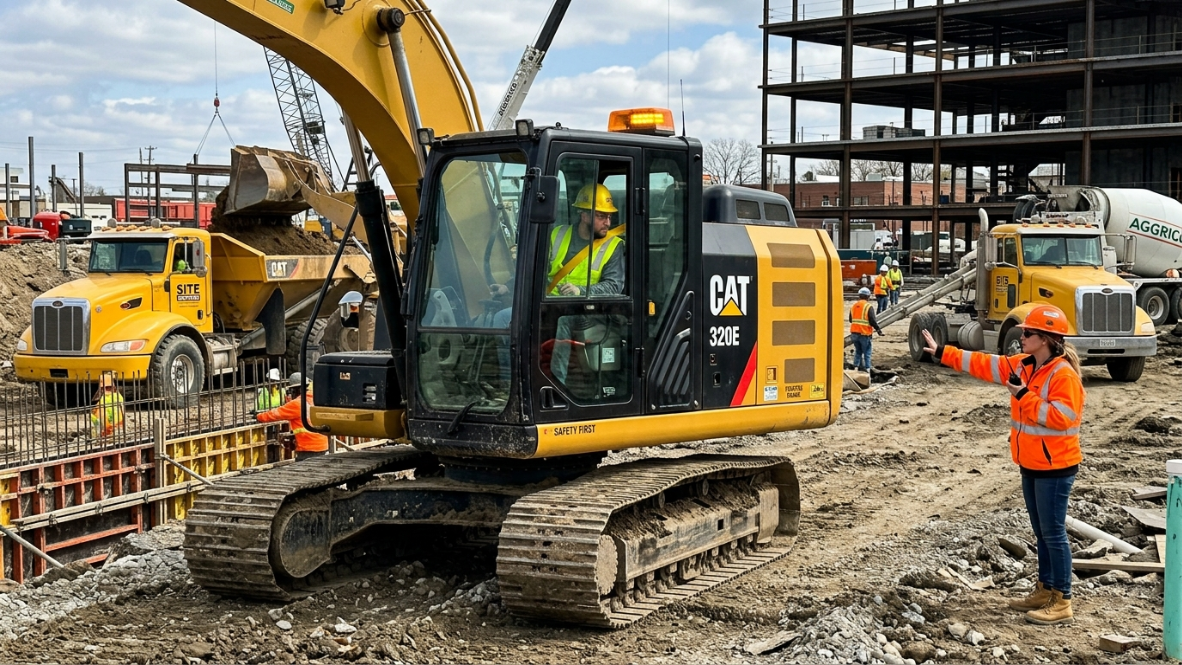
Construction vehicles and heavy equipment are involved in a significant share of both struck-by and caught-in/between fatalities.
Rollover Protective Structure (ROPS)
Definition: A frame or cab structure installed on heavy equipment (loaders, dozers, excavators, rollers) to protect the operator in the event of a rollover.
OSHA Reference: 29 CFR 1926.1000–1003
Practical Note: ROPS are effective only when the operator wears the seat belt. A rollover without a seatbelt can throw the operator out of the cab or into the ROPS frame itself. Both components must be present and used.
Focus Four Tag: Struck-By, Caught-In/Between
Backup Alarm / Proximity Detection System
Definition: An audible alarm that sounds when equipment is in reverse, or an electronic system that detects objects and workers in the equipment’s blind zones.
Practical Note: Standard backup alarms are required on all construction vehicles. On noisy jobsites (concrete demolition, milling operations), alarms alone may not be sufficient. Proximity detection systems and camera systems are increasingly common as supplemental protection. Some practitioners on LinkedIn construction safety groups argue that camera systems should be considered mandatory on any jobsite with more than five pieces of mobile equipment.
Focus Four Tag: Struck-By
Spotter
Definition: A trained worker who guides equipment operators through areas where visibility is limited or pedestrian workers are present.
Practical Note: Required during backing operations, crane lifts near workers, and equipment operation near excavation edges. The spotter must maintain constant visual contact with the operator and use agreed-upon hand signals. A spotter who is distracted or out of position is worse than no spotter at all because the operator assumes someone is watching.
Focus Four Tag: Struck-By
Seat Belt / Restraint System
Definition: A lap belt or harness that secures the equipment operator in the seat during operation.
Practical Note: Required on all construction vehicles equipped with ROPS. Seems obvious, but enforcement data shows that seatbelt non-use in heavy equipment is surprisingly common. Make it a termination-level offense, not a verbal warning.
Focus Four Tag: Caught-In/Between
Section 7: Signage and Hazard Communication
OSHA Safety Signs (Danger, Warning, Caution)
Definition: Standardized signs that communicate specific levels of hazard severity on the jobsite.
OSHA Reference: 29 CFR 1926.200
Practical Note: “Danger” signs (red, black, and white) indicate an immediate hazard that could cause death or serious injury. “Warning” signs (orange) indicate a hazard that could cause death or injury. “Caution” signs (yellow) indicate a hazard that could cause minor or moderate injury. Using the wrong sign category is a citable violation.
GHS-Compliant Chemical Labels
Definition: Labels following the Globally Harmonized System of Classification and Labelling of Chemicals, including standardized pictograms, signal words, and hazard statements.
OSHA Reference: 29 CFR 1910.1200 (HazCom 2012, applicable to construction)
Practical Note: Every secondary container of a hazardous chemical on the jobsite must be labeled. For concrete work, this applies to admixture jugs, curing compound containers, and form release oils. If you transfer a chemical to a different container, it needs a GHS label. No exceptions.
Hazard Communication Program (HazCom)
Definition: A written program that identifies all hazardous chemicals on the jobsite, provides SDS for each, ensures proper labeling, and establishes worker training protocols.
OSHA Reference: 29 CFR 1926.59
Practical Note: This isn’t just a binder on a shelf. Workers must be trained on the hazards of the specific chemicals they’ll encounter on each project. When new products arrive on site, training must be updated. The HazCom program is one of OSHA’s most commonly cited standards across all industries.
Section 8: Key Regulatory Terms Every Contractor Should Know
These terms aren’t equipment, but understanding them is essential to building and auditing a complete jobsite safety equipment list.
OSHA 29 CFR 1926
The federal construction safety standards. This is the regulatory framework that governs virtually every piece of equipment described in this glossary. Part 1926 covers everything from PPE to excavation to electrical safety to fall protection.
Focus Four / Fatal Four
OSHA’s designation for the four hazard categories responsible for the majority of construction deaths: Falls (33.5%), Struck-By (11.4%), Electrocution (8.4%), and Caught-In/Between (5.4%). Eliminating just these four causes would save an estimated 625 lives per year. Every safety equipment decision should be evaluated against these four hazards.
Hierarchy of Controls
The OSHA-recognized framework for controlling workplace hazards, ranked from most effective to least effective: Elimination, Substitution, Engineering Controls, Administrative Controls, and PPE. PPE is the last resort, not the first response. A guardrail (engineering control) is always preferred over a harness (PPE) because it requires no worker action to be effective.
General Duty Clause
Section 5(a)(1) of the OSH Act. It requires employers to provide a workplace “free from recognized hazards that are causing or are likely to cause death or serious physical harm.” OSHA uses this clause to cite employers for hazards that aren’t covered by a specific standard.
Competent Person
A person designated by the employer who can identify existing and predictable hazards and has the authority to take immediate corrective action. Required by OSHA for excavation, scaffolding, fall protection, and many other areas. This is not a certificate you hang on the wall. It requires demonstrated knowledge and real authority on site.
Serious vs. Willful vs. Repeat Violation
These are OSHA’s violation classifications, and they carry very different penalties:
Serious violation: The employer knew or should have known about the hazard. Maximum penalty: $16,550 per violation (2025).
Willful violation: The employer intentionally or knowingly disregarded the requirement. Maximum penalty: $165,514 per violation (2025).
Repeat violation: Same standard violated within 5 years. Same maximum as willful.
To put this in perspective, the highest proposed OSHA penalty of 2025 was issued to Sound Construction Inc., a concrete and earthwork contractor, totaling $1,224,798 across seven willful and four serious violations. That’s not an abstract risk. It’s a real number imposed on a company doing the same type of work many readers of this article perform.
Understanding how safety compliance connects to your financial position is critical. For a broader view, explore these cost management strategies that frame safety investment as a business decision, not just a regulatory obligation.
OSHA Jobsite Safety Inspection Checklist
Inspect the following at the beginning of every shift:
Item | Verify |
|---|---|
PPE | Proper fit, no damage |
Harnesses | Labels present, webbing intact |
Anchors | Rated and secure |
Extension cords | No cuts or exposed wiring |
GFCIs | Tested |
Fire extinguishers | Charged and accessible |
SDS Binder | Complete and accessible |
Trench Protection | Installed correctly |
Equipment Alarms | Functional |
First Aid Kit | Fully stocked |
Making the List Work: Daily Inspection Discipline
Owning the right equipment isn’t the same as using it properly. The most dangerous jobsite is one where the safety equipment exists but nobody checks it.
Build these habits into every shift:
Before work starts: Inspect all PPE for damage, dirt, and proper fit. Replace anything compromised. Check that fall protection harnesses have no frayed webbing or bent hardware. Test GFCIs. Verify fire extinguisher pressure gauges.
During work: The competent person should monitor changing conditions, especially in excavations after weather events, near equipment operating zones, and at fall exposure points. Atmospheric monitoring in confined spaces must be continuous, not just at entry.
End of shift: Account for all safety equipment. Note what needs replacement. Document inspections. This documentation isn’t busywork; it’s your defense in an OSHA inspection and your evidence of a genuine safety culture.
One project manager shared in a YouTube walkthrough on construction safety audits that the single biggest gap he finds during site visits isn’t missing equipment but expired or damaged equipment that nobody pulled from service. The stuff is there. It just doesn’t work anymore.
For contractors managing operational efficiency across multiple projects, building inspection protocols into daily startup routines prevents the small oversights that lead to shutdowns, injuries, and citations.
When Should Safety Equipment Be Replaced?
Equipment | Replace When |
|---|---|
Hard Hat | Impacted, cracked, UV damaged |
Harness | Damaged or after fall arrest |
Lanyard | After any fall |
SRL | After activation |
Gloves | Torn or contaminated |
Respirator Filters | According to manufacturer schedule |
Fire Extinguisher | Failed inspection or discharged |
Safety Glasses | Scratched or cracked |
GFCI | Fails testing |
Trade-Specific Equipment Notes
Generic safety equipment lists treat every jobsite the same. They’re not. Here’s what matters most for specific commercial construction trades.
Concrete Work: Alkaline-resistant gloves and waterproof boots (fresh concrete pH of 12-13 causes chemical burns). Silica respirators for any cutting or grinding. Knee pads for finishing crews. Eye protection rated for dust and splash. Vibration-dampening gloves for operators running concrete vibrators for extended periods.
Asphalt Paving: Heat-resistant boot soles (hot-mix asphalt exceeds 300°F). Class 3 hi-vis for roadway work. Sun protection (wide-brim hard hat attachments, UV-rated safety glasses, sunscreen). Face shields when working near asphalt kettles. Hearing protection during milling operations.
Excavation and Site Work: Trench boxes or shoring for anything over 5 feet. Atmospheric monitors near contaminated soil or deep excavations. Traffic control devices when working near active roads. Proximity detection systems on equipment operating near open trenches.
When procuring PPE and safety equipment for specialized trade work, specifications matter more than price. A chemical-resistant glove rated for concrete alkali is not interchangeable with a general-purpose work glove.
Most Common Jobsite Safety Equipment Mistakes
Some of OSHA’s most frequently cited construction violations involve equipment that is available but used incorrectly.
Common issues include:
Workers not wearing eye protection.
Harnesses connected to improper anchor points.
Damaged lanyards remaining in service.
Missing trench protection.
Expired fire extinguishers.
Missing GFCIs on temporary power.
Improper respirator fit testing.
PPE that does not properly fit employees.
Missing SDS documentation.
Unlabeled chemical containers.
Employer vs Worker Safety Responsibilities
Employer Responsibilities | Worker Responsibilities |
|---|---|
Provide PPE | Wear PPE correctly |
Train employees | Inspect PPE before use |
Replace damaged equipment | Report hazards |
Perform hazard assessments | Follow safety procedures |
Maintain documentation | Use equipment properly |
Frequently Asked Questions
What is the most commonly cited OSHA violation in construction?
Fall Protection, General Requirements (29 CFR 1926.501), has been the most frequently cited standard during federal OSHA inspections for years running. This includes missing guardrails, lack of personal fall arrest systems, and uncovered holes on elevated work surfaces.
What PPE changed under the 2025 OSHA rule?
The PPE Fit Requirements Final Rule, effective January 13, 2025, updated 29 CFR 1926.95 to explicitly require that all PPE must “properly fit each affected employee.” This means employers must provide multiple sizes and verify fit, particularly for harnesses, hard hats, gloves, and respirators.
At what height is fall protection required on a construction site?
Fall protection is required at 6 feet above a lower level on construction sites. This applies to any leading edge, hole, formwork, or elevated surface. The specific method (guardrails, nets, or PFAS) depends on the work being performed.
What is the maximum OSHA fine for a willful safety violation?
As of 2025, the maximum penalty for a willful or repeated OSHA violation is $165,514 per violation. Serious violations carry a maximum of $16,550 each. These amounts are adjusted annually for inflation.
What is a competent person on a construction jobsite?
A competent person is someone designated by the employer who can identify existing and predictable hazards in the work environment and has the authority to take immediate corrective action. OSHA requires a competent person for excavation, scaffolding, fall protection planning, and several other high-hazard activities.
What is the Focus Four in construction safety?
The Focus Four (also called the Fatal Four) are the four leading causes of construction fatalities identified by OSHA: Falls, Struck-By incidents, Electrocution, and Caught-In/Between hazards. Together, they account for more than 56% of all construction worker deaths.
Do I need a respiratory protection program for concrete cutting?
Yes. Any operation that generates respirable crystalline silica above the action level (25 μg/m³ as an 8-hour time-weighted average) requires respiratory protection as specified in 29 CFR 1926.1153. Concrete cutting, grinding, and demolition almost always exceed this threshold. A written respiratory protection program per 29 CFR 1910.134 is mandatory.
How often should jobsite safety equipment be inspected?
PPE should be inspected before each use by the worker wearing it. Fall protection equipment (harnesses, lanyards, SRLs) requires pre-use inspection plus periodic formal inspection per manufacturer recommendations. Fire extinguishers need monthly visual checks and annual professional servicing. GFCIs should be tested before each day’s use. Excavation protective systems must be inspected daily by the competent person.
Recent Comments