
TL;DR
Construction PPE procurement is the process of sourcing, purchasing, and managing personal protective equipment for jobsite workers. It involves matching gear to specific hazards through job hazard analysis, meeting OSHA standards (including the January 2025 proper fit rule), evaluating suppliers on compliance before price, and tracking inventory across trades. The global construction PPE market reached $10.82 billion in 2024 and is growing at 7.4% annually.
Construction PPE Procurement at a Glance
Construction PPE procurement is the process of identifying workplace hazards, selecting OSHA-compliant protective equipment, verifying supplier certifications, purchasing correctly sized PPE for every worker, and managing replacement throughout a project.
A compliant PPE procurement program should always follow these steps:
Step | What Happens | Why It Matters |
|---|---|---|
Assess hazards | Complete a Job Hazard Analysis (JHA) | Determines required PPE |
Identify standards | Match equipment to OSHA, ANSI, ASTM, or NIOSH requirements | Ensures compliance |
Verify suppliers | Review certifications and Declaration of Conformity | Reduces liability |
Size workers | Collect worker measurements before ordering | Required under OSHA’s 2025 fit rule |
Purchase PPE | Order role-specific equipment | Avoids overbuying |
Distribute PPE | Issue equipment and document receipt | Creates compliance records |
Inspect and replace | Monitor wear, damage, and expiration | Maintains worker protection |
The goal is not simply buying protective equipment. Effective PPE procurement ensures every worker receives properly fitting equipment that matches their job hazards while meeting federal safety requirements and controlling long-term procurement costs.
What Construction PPE Procurement Actually Means
Construction PPE procurement covers every step between identifying what protective gear your workers need and getting that gear on their bodies, in the right size, meeting the right standard, at a cost that doesn’t wreck your project budget. It starts well before any purchase order gets written.
Unlike buying commodity materials where specifications are straightforward, PPE buying sits at the intersection of safety compliance, purchasing logistics, and federal regulation. Get it wrong, and you face OSHA fines, project delays from injuries, or workers who quietly stop wearing gear that doesn’t fit. Get it right, and the $29.74 average cost per worker becomes one of the highest-ROI line items on a project.
The January 2025 OSHA proper fit rule has made this topic more urgent. Construction employers must now provide PPE that actually fits each worker, a requirement that general industry has followed for years but that construction is only now catching up to. This rule forces procurement teams to think about sizing, inclusivity, and worker-specific needs before placing orders.
For a broader look at how PPE purchasing fits into your overall buying strategy, see our construction material procurement guide.
This glossary defines the key terms procurement managers, safety directors, and project leads need to know, organized by category: equipment types, regulations, procurement process, costs, and fit requirements.
PPE Category Definitions
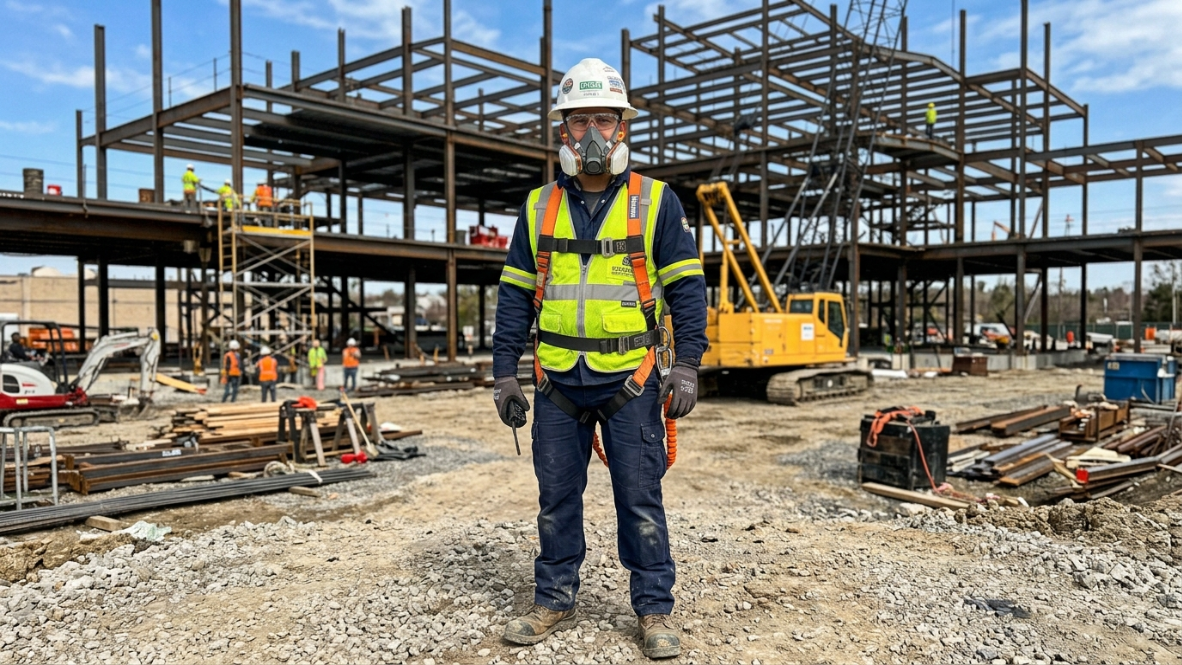
Every construction PPE procurement decision starts with understanding what you’re buying and which standard governs it.
Head Protection (Hard Hats and Safety Helmets)
Hard hats protect against falling objects, electrical contact, and lateral impacts. The governing standard is ANSI Z89.1, which classifies hard hats by type and class. Type I protects the top of the head only. Type II protects both the top and sides. Class E (electrical) is rated to 20,000 volts, Class G (general) to 2,200 volts, and Class C (conductive) offers no electrical protection.
For procurement, the key decision is whether to standardize on Type I or invest in Type II helmets, which cost more but address the struck-by hazards that remain a leading cause of construction fatalities.
Eye and Face Protection
Safety glasses, goggles, and face shields fall under ANSI/ISEA Z87.1. The “Z87+” marking indicates impact-rated protection. Procurement teams need to stock multiple types: safety glasses for general debris, goggles for chemical splash or dust-heavy operations, and face shields for grinding or cutting.
Hearing Protection
OSHA mandates hearing protection when noise levels hit 85 dBA over an eight-hour shift. The Noise Reduction Rating (NRR) printed on packaging tells you how many decibels the device reduces exposure by, though real-world performance is typically lower than lab-tested numbers. Earplugs and earmuffs serve different situations: earplugs work better under hard hats, while earmuffs are easier to monitor for compliance since supervisors can see them.
Respiratory Protection
Respirators require NIOSH approval, not just ANSI compliance. Categories range from disposable N95 filtering facepiece respirators to half-face and full-face elastomeric respirators with replaceable cartridges. Procurement must account for fit testing (a federal requirement for tight-fitting respirators) and cartridge replacement schedules. On silica-heavy operations like concrete cutting, respiratory protection is not optional.
Hand Protection
Gloves are classified under ANSI/ISEA 105, which assigns cut resistance levels from A1 (light) to A9 (extreme). Material selection depends on the hazard: leather for abrasion, nitrile for chemical handling, cut-resistant synthetics for steel work. Hand protection was the dominant PPE segment in 2025, accounting for over 28% of global revenue share.
Foot Protection
Safety footwear follows ASTM F2413 and must meet impact and compression resistance requirements. Steel-toe boots remain common, but composite-toe options are lighter and don’t conduct cold or set off metal detectors. Metatarsal guards add protection across the top of the foot for heavy material handling. For procurement, the sizing challenge here is significant because poorly fitting boots cause blisters, fatigue, and workers reverting to non-compliant footwear.
Fall Protection
Harnesses, lanyards, self-retracting lifelines (SRLs), and anchor points make up the fall protection category. OSHA requires fall protection at six feet in construction. This is often the most expensive PPE category per unit and the most critical, given that falls accounted for approximately 39% of the 1,075 construction fatalities in 2023.
High-Visibility Apparel
ANSI/ISEA 107 defines three classes based on the amount of background and retroreflective material. Class 1 covers low-traffic environments, Class 2 is the construction standard for most jobsites, and Class 3 is required for workers near high-speed traffic. Procurement must consider whether vests, T-shirts, or jackets best suit the climate and layering needs of the crew.
Protective Clothing
This catch-all category includes flame-resistant (FR) clothing for hot work, coveralls for paint or chemical operations, and rain gear. FR clothing follows NFPA 2112 or ASTM F1506 depending on the application. Replacement cycles matter here because FR protection degrades with washing and wear.
Regulatory and Compliance Terms
Construction PPE procurement operates inside a regulatory framework that dictates what you must buy, who pays for it, and what happens when you fall short.
29 CFR 1926.95
This is the core OSHA standard for PPE in construction. It requires employers to assess workplace hazards, select appropriate PPE, and ensure workers are trained on proper use. The December 2024 revision added explicit language requiring that PPE properly fits each construction worker, effective January 13, 2025.
The 2025 Proper Fit Rule
Before this rule, construction was the only major industry without explicit fit language in its PPE standard. The update aligns construction with general industry requirements that have existed for decades. For procurement, the implications are concrete: you must gather size data before ordering, stock a wider range of sizes, and document that every worker received gear that fits. OSHA estimates the rule costs employers an average of $52 per employee.
According to NIOSH research, many women in construction reported that their protective equipment fit them poorly. The rule benefits not only women but also workers with disabilities and those at the far ends of the size spectrum.
Job Hazard Analysis (JHA)
A JHA breaks each task into its component steps and identifies the hazards at each step. It is the required starting point for any defensible PPE program. Without a JHA, procurement is guesswork. With one, it becomes a bill of materials driven by actual exposure data. Our procurement planning checklist covers how this analysis feeds into broader purchasing workflows.
ANSI (American National Standards Institute)
OSHA requires many PPE categories to meet ANSI standards, but here’s something most procurement teams don’t realize: ANSI compliance is self-declared. There is no ANSI inspector visiting factories to verify claims. As one fall protection industry analysis put it, “ANSI works on the honor system. They think that if ANSI has certified the product as compliant, as the label says, it must perform as predicted. For too many fall protection products, that’s simply not true.” Practitioners on Reddit and industry forums regularly flag this gap, warning that the label alone is not proof of testing.
This means procurement teams should request a Declaration of Conformity from every supplier and verify that the testing lab holds proper accreditation.
NIOSH
The National Institute for Occupational Safety and Health approves respirators. Unlike ANSI’s voluntary model, NIOSH approval involves actual lab testing and certification. Every respirator used on a construction site should carry a NIOSH approval number that procurement can verify.
OSHA Construction Focus Four
Falls, struck-by incidents, electrocution, and caught-in/between hazards account for the majority of construction fatalities. PPE procurement decisions should map directly to these four hazard categories, because they represent the highest-risk exposures your workers face daily.
Employer Payment Obligation
Under 29 CFR 1926.95(d), employers must provide PPE at no cost to workers, with very limited exceptions (such as safety-toe boots and prescription safety glasses in some cases). This is not discretionary. The obligation extends to replacement PPE when gear wears out, becomes damaged, or no longer fits.
Understanding these procurement risks in construction helps protect your company from compliance gaps and the penalties that follow.
Construction PPE Procurement Workflow
Step 1: Perform a Job Hazard Analysis
Review every task
Identify hazards
Document findings
Step 2: Match PPE to Hazards
Head
Eye
Respiratory
Hearing
Foot
Fall
Step 3: Verify Product Compliance
ANSI
ASTM
NIOSH
OSHA
Step 4: Select Qualified Suppliers
Certifications
Inventory
Delivery
Warranty
Support
Step 5: Collect Worker Sizes
Gloves
Boots
Helmets
Harnesses
FR clothing
Step 6: Purchase
Step 7: Issue PPE
Step 8: Inspect
Step 9: Replace
Procurement Process Terms
These terms define the workflow from hazard identification to gear on worker, which is where construction PPE procurement either functions smoothly or breaks down.
PPE Bill of Materials
A PPE bill of materials translates your JHA results into a purchasing document. It lists every item required by trade, task, and project phase. Think of it as the link between the safety plan and the purchase order. A concrete crew needs cut-resistant gloves, rubber boots, and safety glasses. A steel erection crew needs fall harnesses, welding helmets, and FR clothing. The bill of materials makes these differences explicit and prevents the common mistake of ordering a generic kit for everyone.
Role-Based Procurement
Construction PPE becomes expensive when every worker receives every item. It becomes unsafe when every worker gets the same light-duty kit. Role-based procurement is the practical middle ground: define a baseline package for site entry, then layer task-specific gear based on the trade and exposure. A laborer on a concrete pour doesn’t need the same equipment as a crane operator, and forcing identical kits wastes money while potentially leaving higher-risk workers under-protected.
Baseline PPE Package
The minimum kit required for anyone stepping onto a construction site, regardless of their task. Typically includes a hard hat, safety glasses, high-visibility vest, gloves, and safety-toe boots. Everything above the baseline is added based on the worker’s specific role and the hazards they face.
Bulk PPE Procurement
Buying in large quantities reduces unit costs but creates real problems. Overstocking ties up capital, consumes storage space, and creates the risk of products expiring or degrading before use. Glove compounds break down. Hard hat shells become brittle from UV exposure even in storage. Effective bulk procurement requires demand forecasting based on historical usage data, employee turnover rates, and project schedules.
For strategies on managing these tradeoffs, our construction supply cost reduction strategies guide covers practical approaches.
Total Cost of Ownership (TCO)
The true cost of PPE extends well beyond the purchase price. TCO includes shipping, storage, distribution labor, replacement frequency, training time, and the cost of injuries that occur when cheap gear fails. A $15 pair of gloves that lasts two months costs more per year than a $30 pair that lasts six months. Higher-quality gear also correlates with lower injury rates, which reduces workers’ compensation claims and the project delays that follow every incident.
Supplier Qualification
Before comparing prices, verify that the supplier’s products meet required standards. This means checking product certifications, requesting test reports, confirming lab accreditation, and evaluating the supplier’s ability to maintain consistent stock levels. A cheaper product that cannot prove certification is not a savings. It is a compliance and liability risk.
See our vendor selection criteria checklist for a structured approach to evaluating PPE suppliers.
Declaration of Conformity (DOC)
A DOC is a written statement from the manufacturer asserting that a product meets a specific standard. Because ANSI compliance is self-declared, the DOC is the key document your procurement team should request and keep on file. It should reference the specific standard (e.g., ANSI Z89.1-2014), identify the testing lab, and be signed by an authorized representative.
PPE Inventory Management
Tracking what you have, where it is, what’s been issued, and when reorders need to happen. Good inventory management uses historical consumption data, project-phase forecasting, and automatic reorder triggers. Poor inventory management leads to jobsite stockouts that either halt work or force workers to operate without proper protection, both of which cost far more than the PPE itself.
PPE Procurement Checklist
Procurement Task | Required | Recommended |
|---|---|---|
Job Hazard Analysis | ✔ | |
PPE Bill of Materials | ✔ | |
Worker sizing records | ✔ | |
Supplier qualification | ✔ | |
Declaration of Conformity | ✔ | |
Inventory tracking | ✔ | |
Barcode/RFID tracking | ✔ | |
Automated reordering | ✔ | |
Fit verification log | ✔ | |
Replacement schedule | ✔ |
Cost and Budget Terms
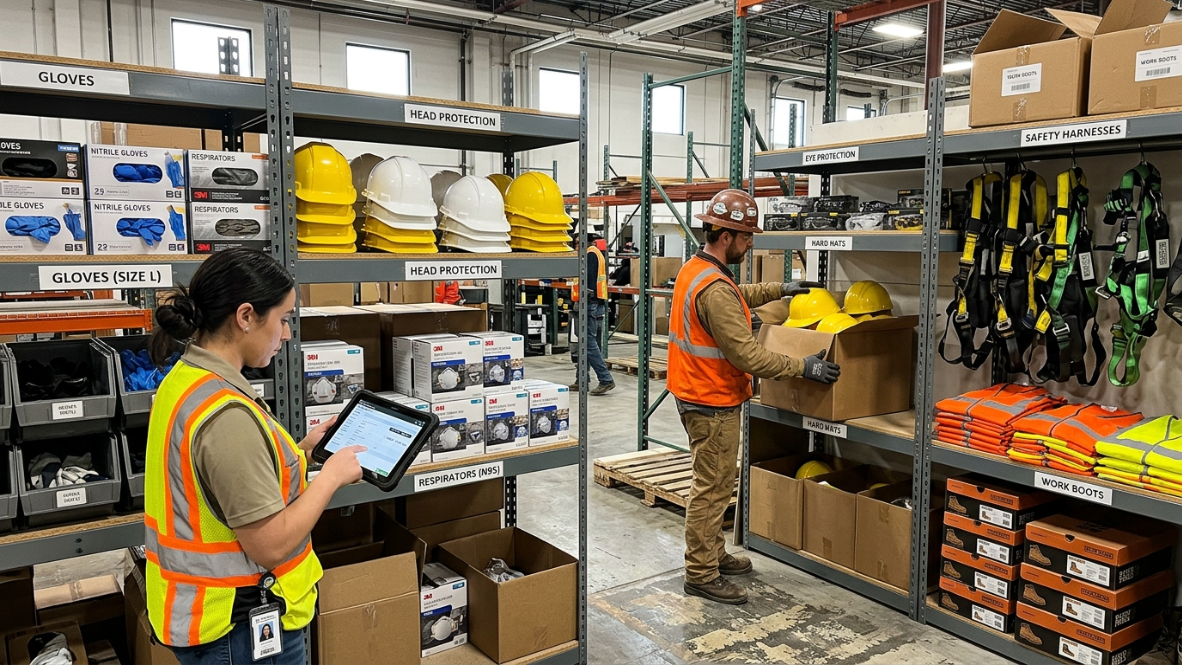
PPE represents a small fraction of total project cost, but mismanaging it creates expenses that dwarf the purchase price.
Per-Worker PPE Cost
OSHA’s Federal Register analysis estimates an average cost of $29.74 to outfit a construction employee, with each employee wearing an average of 2.6 items of employer-provided PPE. The 2025 fit rule adds approximately $52 per employee for sizing adjustments. At the project level, PPE budgets for mid-to-large jobs can range from $50,000 to $150,000 or more depending on hazard profiles and crew size.
Replacement Cycle
PPE doesn’t last forever. Hard hats degrade from UV exposure (most manufacturers recommend replacement every two to five years, or sooner if damaged). Fall protection harnesses must be removed from service after any arrest event. Gloves wear through. Respirator cartridges expire. Procurement plans need built-in replacement schedules, not just initial purchase quantities. Understanding procurement KPIs and metrics can help track replacement timing and optimize reorder cycles.
Workers’ Compensation ROI
The National Safety Council estimates that a workplace injury costs employers $30,000 on average. Liberty Mutual’s research suggests that each dollar invested in injury prevention returns $2 or more in reduced costs. At $29.74 per worker for basic PPE versus $30,000 per injury, the math is not close. PPE procurement is not an expense. It is the cheapest insurance on the jobsite.
OSHA Compliance Penalty Schedule
Current OSHA penalties for PPE violations are steep. General violations carry fines of up to $16,131 per violation. Willful or repeated violations can reach $161,323 per violation. For a multi-trade site where 50 workers lack compliant PPE, a single OSHA inspection can generate six-figure penalties. General contractors bear particular exposure here because they hold compliance responsibility across subcontractors on the jobsite.
Explore our guide on construction procurement savings to find ways to reduce PPE costs without cutting compliance corners.
Fit and Sizing Terms
The 2025 OSHA rule turned fit from a best practice into a legal obligation. These terms now carry procurement weight.
Fit Testing
For respirators, fit testing is a specific protocol (either quantitative or qualitative) that verifies the seal between the facepiece and the wearer’s face. This is not optional for tight-fitting respirators and must be performed annually or whenever a worker’s face shape changes significantly (weight loss, dental work, scarring). Beyond respirators, the new fit rule effectively requires that all PPE categories be evaluated for proper fit, even if there’s no formal testing protocol.
Size Matrix
A size matrix maps your workforce’s sizing needs before you write a purchase order. For a crew of 40, you might need small through 3XL in vests, multiple glove sizes, and a range of boot widths. Building this matrix before ordering prevents the common problem of receiving cases of medium gloves when your crew skews large, or stocking only men’s sizing when women are on the team.
Gender-Specific PPE
OSHA’s fit rule was partly motivated by the reality that many women in construction reported PPE fitting them poorly. Standard “unisex” gear is often designed around male body dimensions. Procurement teams now need to source PPE designed for different body types, including harnesses with female-specific sizing, gloves in smaller sizes, and safety glasses that fit narrower faces. This isn’t a diversity initiative. It is a compliance requirement.
Universal Fit vs. Sized PPE
Some PPE categories (like safety glasses with adjustable temples or one-size earplugs) can work across most workers. Others absolutely cannot. Harnesses, respirators, gloves, and boots require individual sizing. Procurement teams that try to minimize SKUs by defaulting to universal fit are now taking on regulatory risk under the 2025 rule.
Market Context
The global construction PPE market reached $10.82 billion in 2024 and is projected to hit $16.30 billion by 2030, growing at a 7.4% CAGR. The broader PPE market (all industries) was valued at $90.42 billion in 2025. The U.S. market alone is expected to reach $26.06 billion by 2026.
This growth is driven by stricter regulations (like the 2025 fit rule), increasing construction activity, and growing awareness that injury prevention pays for itself. For procurement managers, the takeaway is clear: suppliers are competing for your business in a growing market, which gives buyers leverage to negotiate on price, service levels, and inventory support.
Contractors looking to maximize that leverage should explore vendor cost negotiation strategies that apply directly to PPE supplier relationships.
Practical Takeaway
Construction PPE procurement starts with the hazard assessment, not the shopping list. Every purchase decision should trace back to a documented JHA that identifies what protection each worker needs, in what size, meeting what standard.
Compliance is the floor. The proper fit rule, employer payment obligation, and ANSI verification requirements are minimum thresholds. The actual goal is keeping every worker on your site safe, productive, and protected by gear they’ll actually wear because it fits and functions correctly.
Role-based procurement, verified supplier compliance, and total cost of ownership thinking separate the contractors who manage PPE well from those who end up on the wrong side of an OSHA inspection or, worse, an injury investigation.
For a structured approach to building the vendor relationships that support consistent PPE supply, explore our contractor vendor procurement guide.
Frequently Asked Questions
What does construction PPE procurement include?
Construction PPE procurement covers the full cycle of identifying required protective equipment through a job hazard analysis, sourcing products that meet OSHA and ANSI standards, evaluating and qualifying suppliers, placing orders in correct sizes, managing inventory on the jobsite, and tracking replacement needs. It is not just purchasing. It encompasses compliance verification, fit planning, and distribution.
Who pays for PPE on a construction site?
The employer pays. Under 29 CFR 1926.95(d), employers must provide workers with required PPE at no cost, including replacements when gear wears out or is damaged. Very limited exceptions exist for items like prescription safety glasses or safety-toe boots that workers may also use off the job, but even those exceptions have conditions.
What changed with the 2025 OSHA PPE fit rule?
Effective January 13, 2025, OSHA now explicitly requires that construction employers provide PPE that properly fits each worker. This applies to all categories: hard hats, gloves, glasses, harnesses, respirators, vests, and more. The rule aligns construction with the general industry standard that has been in place for years. It means procurement teams must collect sizing data before ordering and stock a wider range of sizes.
How do I verify that PPE products actually meet ANSI standards?
Request a Declaration of Conformity (DOC) from the manufacturer or supplier. ANSI compliance is self-declared, meaning no third party automatically verifies every product. The DOC should reference the specific standard, identify the accredited testing laboratory, and carry an authorized signature. Don’t assume the ANSI label on the product packaging is sufficient proof.
How much does it cost to outfit a construction worker with PPE?
OSHA estimates the average cost at $29.74 per worker for basic PPE (approximately 2.6 items). The 2025 fit rule adds roughly $52 per employee for sizing adjustments. Project-level PPE budgets for mid-to-large jobs typically range from $50,000 to $150,000 depending on crew size and hazard exposure. These costs are small compared to the $30,000 average cost of a single workplace injury.
What OSHA penalties apply to PPE violations?
General violations can result in fines up to $16,131 per violation. Serious violations carry a minimum penalty of $1,190. Willful or repeated violations range from $11,524 to $161,323 per violation. On a jobsite with multiple workers out of compliance, penalties add up fast.
What is role-based PPE procurement?
Role-based procurement assigns a baseline PPE package (hard hat, glasses, vest, gloves, boots) to everyone who enters the site, then adds task-specific gear based on each worker’s trade and exposure. A welder gets FR clothing and a welding helmet. A roofer gets fall protection. This approach reduces waste by not issuing unnecessary gear while ensuring each worker has protection matched to their actual hazards.
Are general contractors responsible for subcontractor PPE compliance?
Yes. General contractors are legally responsible for ensuring PPE compliance across the entire jobsite, including subcontractor crews. This means verifying that subcontractors provide proper PPE, documenting training and distribution, and conducting equipment checks. On multi-trade projects, this has significant procurement and coordination implications.
Recent Comments