
TL;DR
Construction cost management is the discipline of estimating, budgeting, tracking, and controlling every dollar spent on a construction project from design through closeout. With 9 out of 10 projects experiencing cost overruns averaging 28%, mastering this process is not optional. It spans seven stages, from value engineering through post-project review, and depends heavily on procurement strategy, which accounts for 40% to 70% of total project spending.
Nine out of ten construction projects blow their budgets. The average overrun sits at 28%, and McKinsey estimates that global construction inefficiencies cost $1.6 trillion every year. For an industry where net profit margins typically range from just 3% to 7%, those numbers are existential threats, not just inconveniences.
Construction cost management is the discipline that stands between a profitable project and a financial disaster. This guide breaks down what it actually means, how it works across the project lifecycle, who owns it, and where most teams fall short.
At a Glance: Why Construction Projects Overrun
Construction cost management is the process of planning, tracking, and controlling a project’s financial resources to prevent overruns. In 2026, the primary drivers of budget failures include:
Estimating Errors: Responsible for 32% of all cost overruns.
Procurement Inefficiency: Materials and labor account for 40%–70% of total project spend.
The Information Gap: Latency in pay applications creates a “fog” of data that delays corrective action.
Schedule Slippage: Time-related overhead is the single largest secondary driver of cost inflation.
What Is Construction Cost Management?
Construction cost management is the process of estimating construction costs, establishing a cost baseline and budget, monitoring and forecasting costs as work unfolds, and reporting on spending to stakeholders throughout the project lifecycle. The Project Management Institute (PMI) frames it simply as a method to “predict future expenditure to avoid going over budget.”
That definition sounds straightforward, but the discipline covers far more ground than most people realize. It’s worth distinguishing it from three related terms that often get used interchangeably:
Budget management looks at total money flowing in and out of a project. Cost management specifically addresses the “money out” side, ensuring expenditures stay within financial boundaries.
Cost control is the execution-phase activity of tracking actual spend against the plan and correcting deviations. It’s a subset of cost management, not a synonym.
Job costing is an accounting method that allocates all costs to a specific project for profitability analysis. It’s a tool used within cost management, not the discipline itself.
Understanding these distinctions matters because conflating them leads to gaps. A contractor who thinks “cost control” covers the full picture will miss the upstream work (estimating, value engineering, procurement planning) that determines whether the budget was realistic in the first place.
Why Construction Cost Management Matters
Key Cost Drivers & Impact Metrics (2025–2026)
The following table highlights why disciplined management is critical in the current economic landscape.
Cost Category | Impact on Total Budget | Typical Variance | Primary Risk Factor |
Direct Materials | 35% – 50% | 8% – 12% | Commodity price volatility (Steel/Asphalt) |
Direct Labor | 20% – 30% | 5% – 15% | Productivity gaps & labor shortages |
General Conditions | 5% – 15% | 10% – 20% | Schedule delays & site management |
Contingency | 5% – 10% | Variable | Scope creep & unforeseen site conditions |
The statistics on construction budget performance are grim. A KPMG study found that only 31% of construction projects came within 10% of their budgets. McKinsey reports that major projects can exceed budgets by as much as 80% while overrunning schedules by around 20%. And 32% of cost overruns trace directly back to estimating errors, the very first stage of the cost management process.
These numbers become alarming when you consider the margins. With net profit margins ranging from 3% to 7% for most construction businesses, a 10% overrun on a mid-size project can wipe out all profit and then some.
The flip side is equally compelling. On a $500,000 project with a 10% profit margin, reducing costs by just 1% increases net profit by approximately 9%. That kind of gain doesn’t require revolutionary changes. It requires disciplined cost management and smart contractor purchasing leverage across materials, labor, and subcontractor agreements.
Property owners and general contractors increasingly favor contractors who demonstrate cost discipline. Winning repeat work and long-term relationships depends on delivering projects on budget, not just on time.
Types of Construction Costs
A construction cost is any expense required to plan, build, and deliver a project. Every cost falls into one of four categories.
Direct Costs
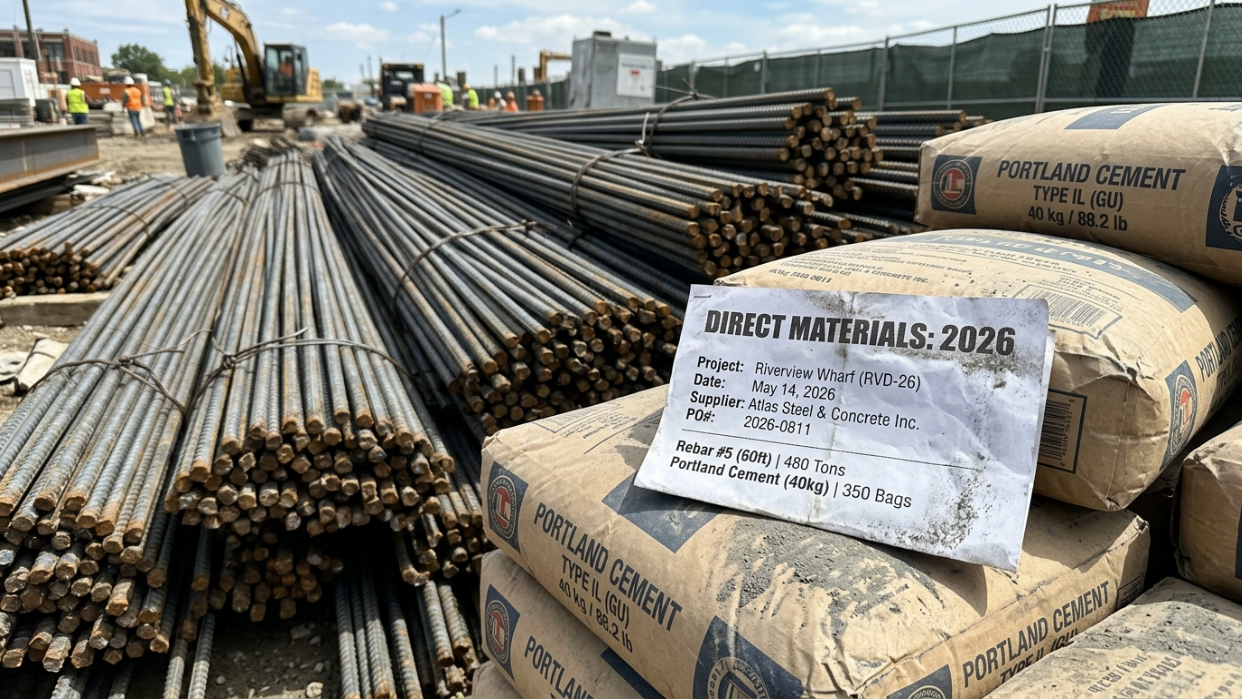
These are the expenses tied directly to physical construction: labor wages, materials (concrete, rebar, asphalt, lumber), heavy equipment rental or ownership costs, and subcontractor fees. On a concrete paving project, for example, direct costs include the ready-mix concrete, reinforcement steel, finishing labor, and equipment like laser screeds or concrete pumps.
Indirect Costs (General Conditions)
Also called general conditions, these cover preconstruction costs, construction organization costs, and project operating costs. Think site supervision salaries, temporary facilities (trailers, portable restrooms), safety equipment, permits, and insurance. They don’t tie to a specific trade but are necessary to keep the project running.
Overhead
Overhead includes the expenses of running a business that aren’t chargeable to a single project: office rent, administrative salaries, accounting, vehicle fleets, and business insurance. Contractors typically spread overhead across active projects as a percentage of revenue.
Contingency
Contingency reserves are risk-based allowances for unforeseen events. Material price spikes, weather delays, unexpected soil conditions, and design errors all fall here. A well-managed project budgets contingency explicitly rather than hoping nothing goes wrong. For materials like asphalt, where oil price fluctuations can swing costs significantly, contingency planning is particularly important.
Having the right construction safety and PPE on site is also an indirect cost that protects against injury-related budget disruptions, a line item often underestimated in initial budgets.
The Construction Cost Management Process
Construction cost management follows seven stages that map to the project lifecycle, turning broader construction cost optimization strategy into day-to-day execution. Skipping or shortchanging any stage creates downstream problems that compound as work progresses.
Stage 1: Design and Value Engineering
Cost management starts before anyone breaks ground. During architectural and engineering design, value engineering evaluates materials, systems, and design alternatives to achieve required performance at the lowest reasonable cost. A structural engineer might compare post-tension slab construction to conventional reinforced slabs, weighing material costs against labor savings and structural performance.
The decisions made here lock in roughly 80% of total project costs. Once design is finalized and permits are pulled, changing course gets exponentially more expensive.
Stage 2: Estimating and Takeoff
Construction takeoff is the systematic process of reviewing drawings and specifications to measure and quantify the full project scope. Estimators calculate quantities of concrete (in cubic yards), steel reinforcement (by tonnage), asphalt (by square footage and depth), labor hours by trade, and equipment requirements.
This stage is where 32% of overruns originate. Rushed takeoffs, outdated unit pricing, missed scope items, and over-reliance on “rules of thumb” rather than actual project data all contribute. Strong estimating depends on historical cost data from completed projects, not just published cost guides.
Stage 3: Budgeting and Baseline
The approved estimate becomes the cost baseline, the financial reference point against which all actual spending is tracked. The budget includes direct costs, indirect costs, overhead allocation, profit margin, and contingency reserves.
A critical distinction: the estimate predicts what things will cost; the budget authorizes what the project is allowed to spend. When these two numbers diverge at the start (typically because someone cuts the estimate to win the bid), cost management becomes damage control rather than proactive planning.
Stage 4: Procurement and Contract Negotiation
Procurement guides subcontractor selection, material purchasing, and contract negotiation. This stage is massively underemphasized in most cost management discussions, which is surprising given that procurement typically accounts for 40% to 70% of a construction company’s total spending according to a 2023 McKinsey report.
Smart procurement decisions at this stage, such as grouping material orders across multiple projects for bulk discounts, negotiating volume-based pricing with suppliers, or joining contractor group purchasing organizations, can shift project economics before a single truck rolls onto the site.
Stage 5: Cost Tracking and Forecasting
Once work begins, the project manager tracks actual costs against the baseline, evaluates change orders, and forecasts costs at completion. This is where most projects either maintain control or lose it.
The challenge is timeliness. In construction, the lag between actual work and financial record-keeping is significant. The pay application process means that when materials are delivered or labor is performed, the financial implications may not be documented until the next pay cycle, sometimes weeks later. Project managers end up making financial decisions based on incomplete or outdated information.
Weekly cost reviews (or daily on large projects) using standardized cost codes help close this gap. The goal is catching variances early enough to correct them, not discovering overruns at the end.
Stage 6: Cost Reporting
Cost reporting gives construction teams a real-time picture of where the project stands financially. Key metrics include actual costs versus estimated costs, cost variance by category, percent complete versus percent spent, and forecast at completion.
Good reporting isn’t just backward-looking. It should highlight trends, flag categories trending over budget, and give decision-makers enough lead time to adjust. A PMI study found that poor communication leads to one-third of construction project failures, and cost reporting is one of the most important communication channels on any project.
Stage 7: Post-Project Review and Lessons Learned
Every completed project, especially those that went over budget, is a learning opportunity for future construction cost management. Post-project reviews should update cost databases, refine estimating methods, and involve both office staff and field teams.
Key metrics to track include bid-to-actual cost ratios, variance percentages by cost category, and recurring cost overages by trade or material type. This data becomes the foundation for more accurate estimates on the next project, creating a virtuous cycle of improvement.
Key Roles in Construction Cost Management
Project Manager (Contractor Side)
On the contractor’s side, the project manager is ultimately responsible for cost management during execution. While estimators prepare the initial pricing, the PM owns the project budget once work begins. This role is accountable for cost tracking, forecasting, change order evaluation, and protecting profit margins. If costs exceed the approved budget, the project manager has to explain why and implement corrective action.
Owner’s Representative (Owner Side)
On the owner’s side, responsibility typically rests with the owner’s representative, development manager, or commercial manager overseeing the capital investment. This person ensures the contractor’s spending aligns with the approved scope and budget.
Cost Estimator
Estimators prepare the initial cost projections that become the project budget. Their accuracy determines the starting point for everything that follows.
Quantity Surveyor / Cost Manager
In some cases, a dedicated construction cost manager (also called a quantity surveyor) works with contractors, clients, and project managers. These specialists focus exclusively on budget adherence and proactively address trends that threaten financial health. They also identify savings opportunities across all aspects of the operation.
Project Controls Manager
On larger projects, a project controls manager integrates cost data with schedule data to provide a unified view of project health. This role often applies earned value management techniques.
Integrating Cost Management with Project Frameworks
Modern cost management does not exist in a vacuum. To ensure 2026 regulatory compliance and efficiency, it must integrate with:
BIM (Building Information Modeling): 5D BIM allows for real-time cost estimation linked to 3D models.
Safety Compliance: Incorporating OSHA 2026 penalty structures (where willful violations now cap at $165,514) into contingency planning is essential for risk mitigation.
ESG Reporting: Tracking material sourcing to meet B Lab V2 Standards or the EU Empowering Consumers Directive (EmpCo) for sustainable procurement.
Common Challenges in Construction Cost Management
The Pay Application Lag
Construction’s unique payment processing method creates an inherent information gap. When concrete is poured or asphalt is laid, the financial implications might not appear in official records for weeks. Project managers operate in a fog, making decisions based on data that’s always slightly stale.
Change Order Mismanagement
Practitioners on construction forums describe how easily change orders slip through the cracks when systems are fragmented. One estimator shared how paper-based changes get “left on someone’s desk” and never reach the supervisor or material dealer, turning every unpriced modification into absorbed margin. Formalizing change order workflows with clear approval chains is one of the highest-return investments a contractor can make.
Material Price Volatility
Asphalt prices swing with oil markets. Concrete costs fluctuate with cement and aggregate availability. Steel prices have been volatile for years. Without strong contractor vendor partnerships and forward-looking procurement strategies, material price spikes can demolish a budget that looked healthy at bid time.
Schedule Slippage
The most consistent driver of cost overruns is schedule slippage. Time on a construction project is money, and when the schedule drifts, overhead accumulates, labor costs inflate, and the gap between planned and actual spend widens in ways that are difficult to recover mid-project. A two-week delay on a project with $15,000 per week in general conditions costs adds $30,000 before anyone addresses the root cause.
Field-Office Communication Disconnect
When field crews and office staff operate in silos, cost data becomes unreliable. Materials get ordered without purchase orders, labor hours are tracked inconsistently, and scope changes happen in the field without corresponding budget adjustments.
Scope Creep
The founder of a construction technology company described how, early in his career, working on thin margins and agreeing to additional scope too easily created serious budget problems. He noted that underestimating the commercial risk behind subcontractor commitments “is one of the fastest ways to lose control of a project’s profitability.” This pattern is extremely common, especially among contractors trying to grow by winning competitive bids.
Construction Cost Management Best Practices
Build budgets from historical data. Published cost guides provide a starting point, but your own completed project data is far more accurate. Track actual costs by trade, material, and project type so each new estimate benefits from real experience.
Track costs weekly. On large projects, daily tracking is appropriate. Waiting for monthly reports guarantees that problems are discovered too late to fix cheaply. Standardized cost codes make this practical by ensuring everyone categorizes expenses the same way.
Formalize change order protocols. Every change, no matter how small, needs documentation, pricing, and approval before execution. The cost of administering this process is trivial compared to the margin lost when unpriced changes accumulate.
Optimize procurement aggressively. Since procurement represents 40% to 70% of spending, even small improvements create outsized results. Strategies include grouping material orders across projects for bulk discounts, joining construction procurement alliances to access volume pricing, and developing a formal construction purchasing strategy rather than buying project-by-project.
Use multi-trade contractors where possible. Working with a single firm that handles multiple trades (concrete, asphalt, site work, ADA compliance) reduces subcontractor coordination costs, minimizes scheduling conflicts between trades, and streamlines communication. The fewer handoffs between companies, the fewer opportunities for cost-inflating miscommunication.
Conduct post-project cost audits. Compare bid amounts to actual costs for every project. Identify patterns in which cost categories consistently run over or under. Share findings with estimators and project managers so the entire organization improves.
Tools and Techniques
Cost Breakdown Structure (CBS)
A CBS organizes all project costs into a hierarchical structure, typically aligned with the work breakdown structure. It allows teams to track costs at whatever level of detail the project requires, from high-level phases down to individual material line items.
Earned Value Management (EVM)

Earned value management is a method for tracking ongoing project performance that integrates scope, schedule, and cost data. It relies on three values:
Planned Value (PV): The authorized budget for work scheduled to be completed by a given date.
Actual Cost (AC): The total cost incurred for work performed by that date.
Earned Value (EV): The authorized budget for work actually completed by that date.
Comparing these three numbers reveals whether a project is ahead or behind schedule, over or under budget, and what the likely cost at completion will be. Despite being one of the most powerful monitoring techniques available, EVM is almost entirely absent from most construction cost management guides. For projects over $1 million, it’s worth learning and applying.
Construction Management Software
Software platforms that integrate estimating, budgeting, cost tracking, and reporting have become standard on commercial projects. The category includes everything from enterprise platforms to field-focused mobile apps. The key is choosing tools that your team will actually use consistently, not the platform with the most features.
Predictive Analytics and AI
Machine learning models are increasingly used to assess historical performance, weather trends, labor productivity patterns, material pricing, and equipment usage. These tools can flag potential overruns 30, 60, or 90 days in advance, giving project teams a wider window to respond before budgets drift off course. As of 2025, adoption is still early in commercial construction, but the technology is maturing rapidly.
Construction Cost Management vs. Related Terms
Term | Definition | Relationship to Cost Management |
|---|---|---|
Budget Management | Overseeing total money in and out | Broader financial oversight that includes cost management |
Cost Control | Tracking and correcting spend during execution | A subset of cost management, focused on the execution phase |
Job Costing | Allocating all costs to a specific project | An accounting method used within cost management |
Value Engineering | Optimizing design for cost efficiency | An early-stage cost management tool |
Earned Value Management | Integrating scope, schedule, and cost metrics | An advanced monitoring technique within cost management |
How Procurement Strategy Supports Cost Management
Most discussions of construction cost management focus on estimating and tracking while barely mentioning procurement. This is a major blind spot. When procurement accounts for 40% to 70% of total spending, the prices you pay for materials and subcontractor services determine whether your budget works or doesn’t.
Effective procurement strategies for cost management include:
Bulk purchasing across projects. Grouping material orders from multiple active projects to qualify for volume discounts. A contractor running three concrete paving projects simultaneously can negotiate better ready-mix pricing by consolidating volume with one supplier.
Group purchasing organizations. Vendor buying groups and purchasing cooperatives allow contractors to pool their buying power with other companies, accessing pricing that would otherwise require much larger individual volumes. This is particularly effective for commodities like fuel, safety equipment, and common construction materials.
Supplier relationship management. Long-term partnerships with key suppliers create pricing stability, priority scheduling, and better terms. Transactional, bid-every-time relationships leave money on the table.
Just-in-time delivery. Coordinating material deliveries to arrive when needed (not weeks early) reduces storage costs, damage risk, and working capital tied up in inventory sitting on site.
Strategic sourcing. Developing a formal construction sourcing strategy means evaluating suppliers based on total cost of ownership, not just unit price. Reliability, delivery performance, and payment terms all affect actual project costs.
For contractors looking to strengthen their procurement position, CNBA’s group purchasing programs provide access to national pricing agreements across a wide range of construction materials and services.
Frequently Asked Questions
What is the difference between construction cost management and construction cost control?
Cost management is the broader discipline that covers the entire project lifecycle, from estimating and budgeting through tracking, reporting, and post-project review. Cost control is the execution-phase activity within cost management where teams monitor actual spending, identify variances, and take corrective action. Cost control is a subset of cost management, not a separate practice.
Who is responsible for construction cost management on a project?
On the contractor’s side, the project manager owns the budget once construction begins and is accountable for tracking, forecasting, and protecting margins. On the owner’s side, the owner’s representative or development manager oversees the capital investment. Larger projects may also involve estimators, quantity surveyors, and project controls managers.
Why do construction projects go over budget so often?
The most common causes are estimating errors (responsible for 32% of overruns), scope creep, change order mismanagement, material price volatility, schedule delays, and poor communication between field and office teams. The construction industry’s unique pay application cycle also creates information lags that make real-time cost management difficult.
How does procurement affect construction cost management?
Procurement typically represents 40% to 70% of total construction spending. The prices negotiated for materials, equipment, and subcontractor services set the floor for project costs. Strategies like bulk purchasing, group purchasing organizations, and strategic supplier partnerships can meaningfully reduce costs before construction even begins.
What is earned value management in construction?
Earned value management (EVM) is a technique that integrates scope, schedule, and cost data to measure project performance objectively. It compares planned value, actual cost, and earned value at any point during construction to determine whether the project is on track financially and whether corrective action is needed.
How can small contractors improve their cost management?
Start with three fundamentals: build estimates from your own historical project data rather than relying solely on published guides, track costs weekly using standardized cost codes, and formalize your change order process so nothing gets executed without documentation and approval. On the procurement side, joining a contractor purchasing cooperative can give smaller firms access to volume pricing they couldn’t negotiate alone.
What is the biggest driver of construction cost overruns?
Schedule slippage. When timelines extend, overhead accumulates, labor costs inflate, equipment sits idle, and the gap between planned and actual spend widens faster than most teams can recover. Controlling the schedule is inseparable from controlling costs.
How much can better cost management improve profitability?
On a $500,000 project with a 10% profit margin, reducing costs by just 1% increases net profit by approximately 9%. Across a portfolio of projects, systematic cost management improvements compound quickly, especially when paired with smarter procurement and fewer change order losses.

Recent Comments