
TL;DR
Contractor vendor programs are structured arrangements that formalize relationships between contractors and the companies they buy from or work for. The term covers at least four distinct program types: preferred vendor programs, prequalification programs, group purchasing organizations (GPOs), and national contractor networks. Each works differently and carries different tradeoffs. GPOs tend to deliver the most direct financial impact for contractors, with documented savings of 10% to 20% on materials.
“Contractor vendor programs” is one of those construction industry phrases that sounds specific but actually refers to several very different things. Search for it and you’ll find an insurance company’s preferred contractor list, a general contractor’s subcontractor application page, a group purchasing organization for builders, and a national paving network’s recruitment form, all using the same terminology.
That confusion is the problem this guide solves. Below is a clear breakdown of what contractor vendor programs actually are, the four main types, how each one works in practice, and how to decide which is worth your time and money.
Explore CNBA membership to see how a contractors’ buying group works in practice.
Contractor Vendor Programs: Direct Answer
Contractor vendor programs are structured business arrangements that connect contractors with suppliers, project owners, insurers, or purchasing organizations to improve pricing, simplify procurement, reduce risk, or generate project opportunities.
The four main types are:
Preferred Vendor Programs → More project referrals in exchange for pricing and process controls
Vendor Prequalification Programs → Required screening to qualify for project work
Group Purchasing Organizations (GPOs) → Lower material costs through collective buying power
National Contractor Networks → Shared branding and project pipelines
For most contractors:
Need lower material costs → choose a GPO
Need more jobs → choose a Preferred Vendor Program
Need access to commercial bids → complete Prequalification
Need less sales effort → join a National Network
Quick takeaway: Contractors focused on profit margin usually benefit most from purchasing programs, while contractors focused on growth often prioritize referral and network programs.
What Is a Contractor Vendor Program?
A contractor vendor program is any structured arrangement between contractors and vendors (or between contractors and the organizations that manage them) designed to formalize the relationship, improve commercial terms, or streamline how work gets done.
The “vendor” part of the phrase adds a layer of confusion worth addressing upfront. In construction, a vendor is technically a company that supplies materials. They may never set foot on a jobsite. They store, ship, and deliver products. A subcontractor, by contrast, performs work on the project site: plumbing, painting, concrete, electrical.
In practice, the line blurs constantly. As NetSuite’s vendor management guide notes, general contractors often use “vendor management” to describe their procedures for managing subcontractors, who they also call vendors or trade partners. This is why the term “contractor vendor programs” can legitimately refer to programs involving either material suppliers or subcontractors.
For a broader look at how contractor buying arrangements fit together, see this overview of construction procurement alliances.
Types of Contractor Vendor Programs
There are four main categories. They overlap in places, but each serves a fundamentally different purpose.
Preferred Vendor Programs

A preferred vendor program is a curated list of approved contractors or service providers maintained by an insurance company, property manager, or general contractor. In exchange for a steady stream of referrals, vendors agree to follow the program operator’s guidelines, work within pre-approved pricing, and meet documentation and timeliness standards.
Property management firms use these programs to ensure consistent quality across their portfolios. One common approach involves a tracking and ranking system that scores contractors on performance metrics, then funnels future work to top performers.
The insurance version is more controversial. Practitioners in online forums frequently point out that the “extra criteria” insurance companies or third-party administrators impose can handcuff a contractor. Pricing limitations, documentation burdens, and approval bottlenecks slow down the work. As Bankrate reported in their analysis, preferred vendor programs aren’t inherently bad, but they can introduce complexity, confusion, and sometimes unintended consequences.
For contractors, the tradeoff is clear: you get a pipeline of work, but at margins someone else largely controls.
Vendor Prequalification Programs
Prequalification is the screening phase where potential contractors get evaluated before they’re allowed to bid on or perform work. It covers financial stability, safety records, licenses, certifications, past performance, and insurance coverage. The goal is to filter out unqualified firms before any work starts, reducing construction procurement risks for project owners.
Typical documentation requirements include:
Scope of work and previous project experience
Contractor references
Proof of insurance with certificate of insurance (COI)
Bonding capacity and letter of surety
W-9 taxpayer identification
Contractor business license
Three years of financial statements or tax returns
OSHA 200/300 safety reports
Written safety policy
Many contractors conflate prequalification with the vendor program itself. They shouldn’t. Prequalification is the gateway. The program is the ongoing relationship structure that follows.
One real cost to watch: full-featured prequalification platforms like ISNetworld charge subcontractors $875 or more per year just to register. That annual fee shrinks bidder pools and prices out small and minority-owned firms, which is a structural problem the industry hasn’t solved.
Group Purchasing Organizations (GPOs)
A GPO pools the buying power of multiple contractors to negotiate better material pricing than any single firm could get alone. GPOs establish relationships with material suppliers and brand manufacturers, simplifying the purchasing process for members and allowing them to compete on cost with large national companies.
This is where the numbers get compelling. Among Fortune 1000 companies participating in buying consortiums, 85% report savings of 10% or more. One construction GPO reported distributing $16 million in rebates to its members in a single year. Safety and PPE sourcing through GPO contracts can cut costs 10% to 20% while improving compliance with safety specifications.
The model has deep roots in healthcare, where nearly 90% of US hospitals use GPO services. But adoption is growing fast in construction, manufacturing, and hospitality.
A builder quoted by Pro Builder captured the catalyst perfectly: “It wasn’t until my framer came to me and said, ‘You’re paying way too much for lumber,’ that I started to look for a buying group.”
For a deeper look at how contractor GPOs work, read this contractor group purchasing organization guide.
National Contractor Networks
Companies like Pave America and Kansas Asphalt operate programs where local contractors join a national execution network. The national brand handles marketing, sales, and client relationships, then routes projects to local firms that meet their quality standards.
These programs differ from the others in a key way: the contractor typically gives up brand independence. Pave America, for example, does not work with third-party contractors. Local firms operate under the national brand’s umbrella, following their processes and pricing structures.
For contractors who want steady project flow without marketing overhead, national networks can work well. But they come with less pricing autonomy and, often, exclusivity requirements. Understanding how national pricing programs set rates helps contractors evaluate whether the tradeoff makes sense.
Quick Comparison
Program Type | Who Runs It | Contractor Gets | Contractor Gives Up | Best For |
|---|---|---|---|---|
Preferred Vendor | Insurer, property manager, GC | Steady referrals | Pricing flexibility, autonomy | Firms needing consistent volume |
Prequalification | Project owner, GC | Access to bid on projects | Time, registration fees | All contractors pursuing commercial work |
GPO | Buying group organization | Lower material costs, rebates | Some supplier choice | Firms spending heavily on materials |
National Network | National brand | Project pipeline, marketing | Brand identity, pricing control | Local firms wanting less business development |
Which Contractor Vendor Program Is Best?
Contractor Situation | Recommended Program | Why |
|---|---|---|
Small contractor with inconsistent work | Preferred Vendor | Builds project pipeline |
Contractor spending heavily on materials | GPO | Immediate cost reduction |
Commercial subcontractor | Prequalification | Required to access projects |
Local company wanting growth | National Network | Marketing and sales support |
Established contractor protecting margins | GPO + selective prequalification | Better economics |
Rule of thumb: If annual material spend exceeds 15–20% of revenue, evaluate purchasing programs first before chasing more work.
How Contractor Vendor Programs Work in Practice
The Onboarding Process
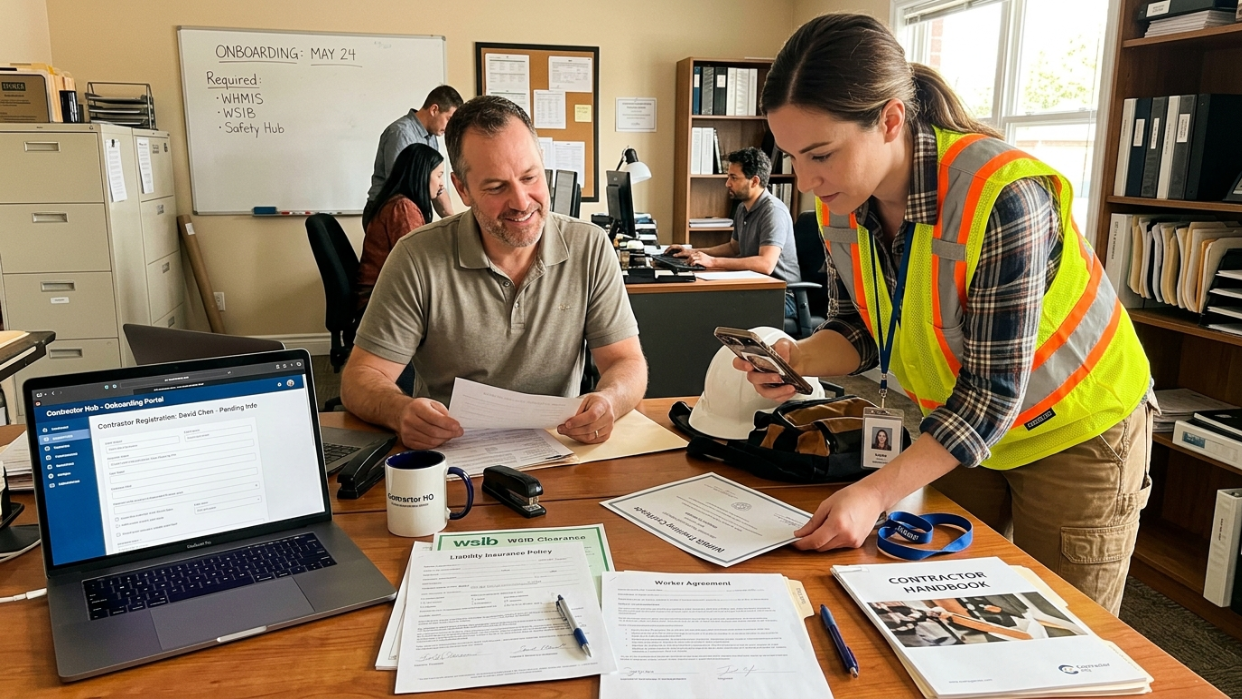
Regardless of program type, joining a contractor vendor program starts with documentation. Expect to provide proof of insurance, financial records, safety history, and references. For prequalification-heavy programs, the review process can take weeks. For GPOs, onboarding is usually simpler since the focus is on purchasing volume rather than field performance.
Construction tech adoption has climbed 20% year over year according to Deloitte’s 2023 analysis, and the average general contractor now runs 6.2 digital tools. Vendor management platforms, compliance tracking software, and procurement systems are increasingly part of the infrastructure behind these programs.
Ongoing Compliance and Performance Monitoring
Once you’re in, staying in requires ongoing effort. Preferred vendor programs track metrics like response time, job completion rates, customer satisfaction scores, and claims documentation quality. Property management firms typically run quarterly or annual reviews, dropping underperforming contractors and elevating strong ones.
For risk-focused organizations, contractor compliance programs govern how well a contractor operates within the terms of their contract. At least five major risk categories (safety incidents, insurance lapses, regulatory violations, quality failures, and financial instability) can be significantly reduced through structured compliance monitoring.
Payment Structures and Contract Terms
This is where contractor vendor programs get real. Payment terms matter more than the program label.
Before signing into any vendor program, review the contract for payment timing. If you see a pay-when-paid clause, ask the client to remove it. Pay-when-paid means the GC or program operator doesn’t have to pay you until they get paid by the project owner, which can stretch your receivables for months.
Poor contract management can cause companies to lose up to 9% of annual revenue. For a contractor doing $5 million a year, that’s $450,000 bleeding out through bad terms, missed change orders, and delayed payments.
As one practitioner quoted by the U.S. Chamber of Commerce put it: “Money is a language, and people will only do business with people who can speak money fluently. You have to establish trust and credibility, as this will determine the terms of your partnership and favorable rates.”
For strategies on negotiating better pricing with vendors, check this vendor cost negotiation guide.
Typical Costs and Expected ROI
Program Type | Typical Cost | Time to Value | Primary ROI |
|---|---|---|---|
Preferred Vendor | Low–Moderate admin overhead | 30–90 days | More projects |
Prequalification | Registration + admin time | Project-dependent | Access to bidding |
GPO | Membership or purchasing commitment | Immediate | Material savings |
National Network | Revenue share / operational changes | 60–180 days | Stable project flow |
Contractors should estimate annual impact before joining:
Estimated annual value = (Projected savings + additional revenue) − (fees + admin costs + margin concessions)
Benefits of Contractor Vendor Programs
For Contractors
Steady work pipeline. Preferred vendor and national network programs reduce the feast-or-famine cycle. Instead of chasing every bid, contractors in well-run programs receive project referrals directly.
Lower material costs. GPOs deliver the most measurable financial benefit. Members of organizations like CBUSA (which includes about 540 builders, 1,200 vendors, and 13 national manufacturers across 33 markets) get pricing that individual contractors simply cannot negotiate alone. One builder explained the dynamic: “When CBUSA, who has national relationships with 84 Lumber, gets involved, they listen differently.”
Vendor rebates. Beyond upfront discounts, many GPO programs distribute rebates based on collective purchasing volume. These rebates can add up to significant annual returns. For more on maximizing these, read this guide on contractor vendor rebates.
Reduced marketing costs. When a program feeds you work, you spend less on advertising, sales staff, and business development.
For Property Owners and General Contractors
Risk reduction. Only half of construction companies report finishing projects on time, and 87% say their work faces increasing scrutiny, according to a KPMG survey. Vendor programs with prequalification requirements weed out underperforming contractors before they cause problems.
Consistent quality. Scoring and ranking systems create accountability. Contractors know their performance directly affects future work assignments.
Streamlined procurement. Rather than sourcing and vetting contractors for every project, program operators maintain a ready pool. This speeds up project kickoff and reduces administrative overhead.
Multi-trade contractors who handle multiple disciplines (concrete, asphalt, site work, and more) benefit disproportionately from broad vendor programs, since they can participate across several categories simultaneously.
Risks and Watchouts
Contractor vendor programs are not universally beneficial. Here are the traps to watch for.
Reduced pricing flexibility. Insurance-style preferred programs and national networks often cap what you can charge. If material prices spike or project conditions change, you may be locked into rates that don’t cover your costs.
Pay-when-paid clauses. As mentioned above, these shift financial risk from the program operator to the contractor. They’re common in subcontractor agreements and preferred vendor contracts.
Limited supplier choice in GPO programs. GPOs negotiate contracts with specific suppliers. If you prefer a different brand or have an existing supplier relationship, the GPO’s contracted vendors may not align with your preferences.
Over-reliance on a single program. Building your entire revenue stream around one preferred vendor program or national network is dangerous. If the program operator loses a major client or changes their contractor roster, your pipeline disappears overnight.
Quality pressure from price compression. When programs push contractors to compete primarily on cost, quality suffers. The lowest bid wins the referral, but cutting corners on materials or labor creates long-term liability.
Contractor Vendor Program Decision Matrix
Question | Yes | No |
|---|---|---|
Are material costs your biggest problem? | GPO | Continue |
Is inconsistent lead flow hurting growth? | Preferred Vendor | Continue |
Are you trying to bid commercial work? | Prequalification | Continue |
Do you want less marketing responsibility? | National Network | Continue |
Do you want pricing freedom? | Avoid Preferred/National | Consider GPO |
Most contractors eventually participate in more than one type.
Red Flags Before Joining Any Contractor Vendor Program
Walk away or investigate further if you see:
Exclusivity requirements with unclear exit terms
Pay-when-paid clauses
Required pricing with no escalation protection
Long payment cycles (60–120+ days)
Mandatory software fees
Unclear referral volume promises
One-sided dispute resolution language
No published contractor success metrics
A good program should improve economics—not just increase activity.
How to Choose the Right Contractor Vendor Program
Not every program fits every contractor. Here’s how to evaluate them.
Match the program to your trade specialty. A GPO makes sense if you spend heavily on materials. A preferred vendor program works if you need volume and don’t mind pricing constraints. National networks suit firms that want to reduce marketing overhead.
Read the contract before you sign. Understand payment terms, exclusivity requirements, performance metrics, and termination clauses. Pay special attention to who bears risk when projects go sideways.
Evaluate geographic coverage. Regional contractors should confirm that the program operates in their service area. A national GPO with no supplier presence in your market won’t help.
Consider GPOs for material cost savings. For most contractors, a group purchasing organization delivers the clearest return on investment. The math is straightforward: if you’re spending $500,000 a year on materials and a GPO saves you 15%, that’s $75,000 back in your pocket. Learn more about purchasing leverage for contractors.
Look at what you’re giving up. Every program involves tradeoffs. Preferred vendor programs trade margin for volume. GPOs trade supplier flexibility for savings. National networks trade brand identity for pipeline. Decide which tradeoff you can live with.
Talk to existing members. The best due diligence is a conversation with contractors already in the program. Ask about payment timing, the actual volume of referrals, and how disputes get handled.
For contractors ready to explore group purchasing options and reduce material costs, CNBA’s membership programs provide a starting point built specifically for the construction industry.
Frequently Asked Questions
What is the difference between a vendor and a subcontractor in construction?
A vendor supplies materials but typically does not perform work on the jobsite. A subcontractor performs physical work on the project site, such as plumbing, painting, or concrete placement. In practice, general contractors often use the terms interchangeably when discussing vendor management.
How much can contractors save through a group purchasing organization?
Documented savings range from 10% to 20% on materials, depending on the category and purchasing volume. Some GPOs also distribute annual rebates. One construction GPO reported distributing $16 million in member rebates in a single year.
Do I have to use a preferred vendor if my insurance company recommends one?
No. In most cases, insurance preferred vendor programs are optional. You typically have the right to choose your own contractor. However, using a preferred vendor may streamline the claims process.
How much does it cost to join a prequalification platform?
Costs vary widely. Full-featured platforms like ISNetworld charge subcontractors $875 or more per year. Simpler systems may be free or charge a lower annual fee. Some general contractors manage prequalification internally at no cost to the subcontractor.
Can small contractors benefit from vendor programs?
Yes, but the type matters. GPOs are particularly valuable for smaller firms because they provide access to pricing normally reserved for high-volume buyers. Preferred vendor programs can also help small firms secure consistent work, though the margin compression may sting more when overhead is tight.
What documents do I need to join a contractor vendor program?
Most programs require proof of insurance (COI), business licenses, W-9, financial statements or tax returns for the past three years, OSHA safety reports, references, and a summary of previous work experience. Bonding capacity documentation is common for larger programs.
Are contractor vendor programs worth the time investment?
It depends on your business model. Contractors spending significant money on materials should strongly consider a GPO. Firms that struggle with inconsistent work volume may benefit from preferred vendor or national network programs. The key is matching the program type to your specific pain point rather than joining everything available.
How do contractor vendor programs reduce risk for project owners?
They create a pre-vetted pool of contractors with verified insurance, safety records, and financial stability. This shifts much of the screening burden away from individual projects and reduces the chance of hiring an unqualified contractor who causes delays, safety incidents, or legal issues.

Recent Comments