
TL;DR
Construction vendor cost negotiation in 2026 requires more than asking for a discount. With nonresidential inputs up 3.6% year over year and tariff-driven volatility hitting steel and asphalt, contractors need specific plays: early-pay discounts, index-cap clauses, stored-materials billing, rental fee audits, and buying group leverage. This guide covers 17 field-tested negotiation tactics, each with the exact ask, the math behind it, and the contract language to back it up.
How to Negotiate Construction Vendor Costs in 2026
To successfully negotiate construction vendor costs in 2026, contractors must move beyond simple price haggling and implement structural concessions. The most effective strategies include:
1. Financial Incentives: Leveraging 2/10 Net 30 early-pay discounts for a 37% annualized ROI.
2. Risk Mitigation: Using Index-Cap clauses (pegged to BLS PPI) to limit commodity volatility to ±10%.
3. Operational Levers: Utilizing Stored-Materials Billing (AIA §9.3) to lock in pricing through early bulk buys.
4. Volume Aggregation: Joining a Construction GPO to access pre-negotiated “Tier 1” pricing.
The Bottom Line: Aim for a 3–5% reduction through standard negotiation and an additional 5–15% by addressing “hidden” costs like rental surcharges and freight terms.
Why Construction Costs Feel Sticky Right Now
Before getting into tactics, it helps to understand the pricing environment contractors face in 2026.
According to AGC analysis, inputs to nonresidential construction rose 3.6% over 12 months through November, outpacing increases in what contractors can charge on bids. Tariffs are a primary driver. The BLS Producer Price Index for building materials wholesaling and machinery rental showed continued upward movement in early 2026. And steel sheet and plate prices continued climbing into the new year, putting pressure on suppliers to push increases downstream.
That’s the backdrop. Suppliers have reasons to raise prices. But contractors have specific, proven ways to push back, trade value, and protect margins. What follows are 17 construction vendor cost negotiation plays that work because they change the equation, not just the ask.
At-a-Glance: Six High-Impact Negotiation Plays Compared
Play | Typical Savings | Best For | Key Ask | Main Risk | Proof |
|---|---|---|---|---|---|
Early-pay discounts | 2% per invoice (37% annualized) | Recurring suppliers | 2/10 Net 30 or dynamic scale | Taking discount when cost of capital is higher | |
Index-cap clause | Avoids 10%+ swings | Asphalt, steel, fuel | ±10% quarterly cap tied to PPI | Admin burden, wrong index selection | |
Stored-materials billing | Cash flow relief for early buys | Large material purchases | AIA §9.3 compliance | Storage cost, insurance, title transfer | |
Bid leveling | 3-7% avoidance of scope leak | Sub buyout | Compliance matrix, line-item structure | Upfront time investment | |
Rental fee audit | 5-15% reduction on long rentals | Equipment rental | Waive/cap adders, align insurance | Potential damage exposure | |
Buying group/GPO | Pre-negotiated pricing + rebates | Contractors with thin individual leverage | Member pricing and rebate schedule | Commitment compliance |
The Foundation: Build Your BATNA and a Should-Cost Model
Every construction vendor cost negotiation falls apart without two things: a credible alternative (your BATNA) and a should-cost model that proves you’ve done the homework.
Build the should-cost model first. Break the vendor’s price into materials, labor, overhead, logistics, and margin. Validate each component against the BLS Producer Price Index and commodity benchmarks. Then present your analysis to the supplier and ask for their feedback. This isn’t adversarial. It’s a conversation grounded in data. For a deeper framework on structuring your sourcing approach, see this construction sourcing strategy guide.
Negotiate from a clear BATNA. Your best alternative to a negotiated agreement is the floor for what you’ll accept. If you have no alternative, you have no leverage. Qualified second sources, buying group pricing, and even the option to re-spec materials all count.
A critical reality check from practitioners on Reddit: buyers who push for 20-25% reductions without changing specs, volume, or terms almost always get it back later through quality cuts, change orders, or fees. Expect 3-5% from normal negotiation. To get more, you need to change the equation.
Table: 2026 Material Index Benchmarking for Negotiations
Use these BLS Producer Price Index (PPI) categories to validate supplier price increases. If their “ask” exceeds the index trend, use this as your data-backed “No.”
Material Category | BLS PPI Code (Industry Standard) | 2026 Trend Expectation | Negotiation Lever |
Steel Mill Products | WPU1017 | Volatile (Tariff Impact) | Quarterly Index Caps |
Ready-Mix Concrete | WPU1321 | Steady Increase | Volume Commitments |
Paving Mixtures (Asphalt) | WPU1361 | Crude Oil Dependent | State DOT Linkage |
Construction Machinery | WPU111 | Rising | Rental Fee Audits |
Lumber & Wood | WPU081 | Cyclical | “Or Equal” Substitutions |
The 17 Plays
1. Early-Pay Discounts (2/10 Net 30 and Dynamic Discounting)
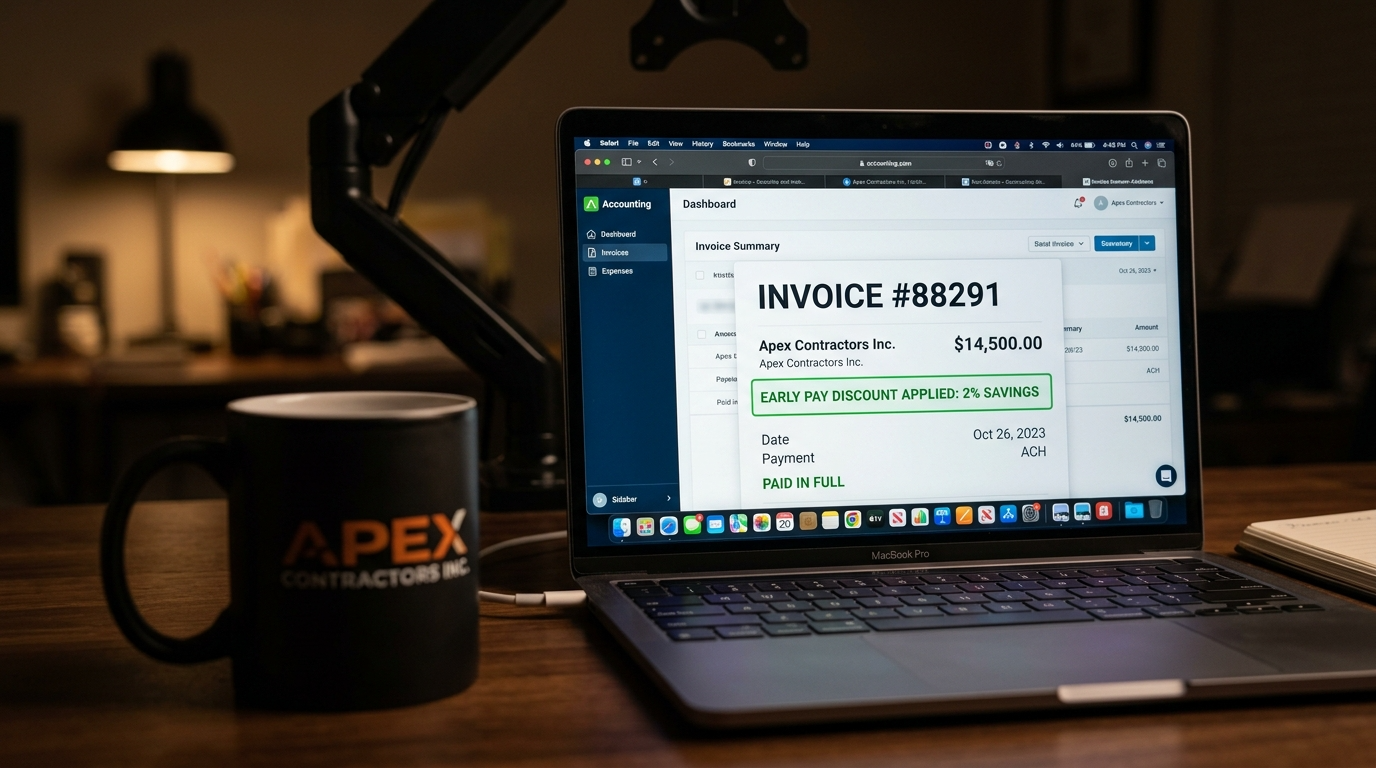
Best for: Recurring material suppliers where you have adequate cash flow.
What to ask: “If we pay by Day 10, can we take 2% off? Day 20, 1% off?” Structure it as a dynamic discounting scale rather than a single threshold.
Where it saves: The annualized return on a 2/10 Net 30 discount is roughly 36-37%. The formula: (2%/98%) × (365/20) ≈ 37.2%. If your cost of borrowing is below that rate, take the discount every time.
How to implement: Capture discount terms in your vendor master file. Flag invoices automatically for early payment when the APR exceeds your cost of capital.
Watch-outs: Not every supplier sees uptake on early-pay offers. Practitioners on Reddit note that many customers ignore 2/10 Net 30 terms entirely unless the process is structured and communicated clearly. Also, if your margins are thin and cash is expensive, the math may not work. Do the APR calculation before committing.
For more on maximizing vendor discount and rebate programs, read this contractor vendor rebates guide.
2. Price-Indexed Contracts Tied to BLS PPI or DOT Binder Indexes
Best for: Asphalt, steel, fuel, and other commodity-driven materials with volatile pricing.
What to ask: An indexation clause pegged to the relevant PPI series code or state DOT binder index, with a floor and ceiling, quarterly adjustment cadence, and symmetric movement (prices go down too, not just up).
Where it saves: Prevents suppliers from locking in peak pricing or demanding blanket mid-year increases. State DOTs already use this: NYSDOT, GDOT, and MoDOT all publish formulaic asphalt price adjustment mechanisms that normalize indexation in paving contracts.
How to implement: Propose clause skeleton language: “Unit prices adjust quarterly by the change in [BLS PPI code or DOT PG binder index], capped at ±10%; decreases flow down as credits.”
Watch-outs: Indexation must be bilateral. If you only index upward, you’ve built in a one-way ratchet. Pick the right index series (the BLS publishes a price adjustment guide for contracting parties that helps match materials to codes). Administrative overhead is real but manageable with quarterly reviews.
3. Formal Escalation Clauses (ConsensusDocs 200.1)
Best for: Long-duration projects with volatile input costs where both parties need margin protection.
What to ask: Propose ConsensusDocs 200.1 or similar published standard language for material escalation. Make it bilateral so both sides share risk.
Where it saves: Protects you from eating cost increases on fixed-price contracts that run 12+ months. Also gives suppliers confidence to hold pricing longer because they know they have a mechanism if costs spike.
How to implement: Attach as a rider to your subcontract or supply agreement. Define the trigger (percentage change threshold), the index, the effective date, and the documentation required.
Watch-outs: Owners may resist escalation clauses. Present the alternative: inflated contingencies baked into every bid. A transparent escalation mechanism often costs the owner less than the risk premium contractors add when they’re forced to eat volatility.
4. Stored-Materials Billing to Fix Cash Flow and Unlock Discounts
Best for: Large material purchases where early buying locks in a lower price.
What to ask: Use AIA A201 §9.3 to bill the owner for materials stored on-site or off-site, with proof of title, insurance, and bonded storage. This lets you commit to an early-buy price or take early-pay terms without bleeding cash.
Where it saves: Bridges the gap between when you need to pay the supplier and when the owner pays you. If you can buy three months early at 5% less, stored-materials billing funds that advantage.
How to implement: Submit stored-material claims with your regular pay applications. Include a bill of sale, storage facility insurance certificate, labeled photographs, and transfer-of-title language. Collect lien waivers from the supplier upon payment.
Watch-outs: Practitioners on Reddit report that price holds are typically only 30 days unless you pre-buy or store materials. Stored-materials billing combined with escalation clauses is a stronger position than hoping for extended holds.
5. “Or Equal” Substitutions and Value Engineering
Best for: Specified materials where a functionally equivalent product costs significantly less.
What to ask: Follow the substitution/“or equal” procedures in the contract. Submit a complete package showing spec compliance, performance data, code compliance, warranty equivalence, lifecycle cost comparison, and schedule impact.
Where it saves: This is structured cost reduction, not haggling. A legitimate substitution that saves 15% on a major material line item can move tens of thousands of dollars without a scope fight.
How to implement: Build an apples-to-apples submittal. Architects on Reddit note that “or equal” requests increase their workload, so incomplete submittals get rejected or delayed. Make it easy to say yes.
Watch-outs: Some specs are proprietary for good reason. Don’t substitute safety-critical or performance-critical products just for price. Focus VE effort on high-cost commodity items where multiple manufacturers meet the performance standard.
6. Vendor-Managed Inventory (VMI) or Consignment on Recurring Consumables
Best for: Multi-site programs or repetitive projects with steady consumable use (fasteners, MRO supplies, safety equipment).
What to ask: Supplier-managed bins with min/max levels, weekly replenishment, and consignment billing on usage. Track stockout rate and inventory turns as KPIs.
Where it saves: Industrial VMI case studies show roughly 30% inventory reduction plus significant administrative time savings. For construction programs running multiple active sites, the reduction in purchase order volume alone justifies the effort.
How to implement: Start with one high-volume category (safety supplies or fasteners). Give the supplier usage data and access to replenish. Agree on pricing tiers and a minimum commitment period.
Watch-outs: VMI works best at some scale and requires data sharing. Smaller single-project operations may not generate enough volume to interest suppliers. The supplier gains visibility into your consumption, which can be a trade-off.
7. Blanket Purchase Agreements (BPAs) and Price Holds
Best for: Categories where you buy the same materials repeatedly across multiple projects within a year.
What to ask: Pre-negotiated rates locked for 6-12 months, with volume tiers that improve pricing as cumulative purchases grow. Include a 60-90 day pre-expiry renewal trigger where you seek a price-down review against the relevant index.
Where it saves: Eliminates re-quoting on every project. Locks in today’s pricing when you expect costs to rise. Creates leverage at renewal because the supplier has become accustomed to your volume.
How to implement: Identify your top 10 spend categories by annual dollar volume. Approach each primary supplier with a BPA proposal that commits a minimum annual volume in exchange for fixed pricing and delivery priority.
Watch-outs: If the market falls, you can be locked in above market. Build re-opener clauses or index caps to protect against this. Review BPAs quarterly against spot pricing.
8. Most-Favored-Customer (MFN) Language
Best for: Long-term supply relationships where you want assurance that competitors aren’t getting better pricing for comparable volumes.
What to ask: Parity pricing for comparable customers buying similar volumes in your region. Define the comparator group clearly (same product, same volume tier, same region). Carve out distress sales, pilot programs, and government contracts.
Where it saves: Prevents a supplier from quietly discounting to a competitor while holding your price steady. Gives you automatic price protection over the life of the agreement.
How to implement: Add MFN language to your BPA or master supply agreement. Specify the audit mechanism (quarterly self-certification by the supplier, or annual review against published price lists).
Watch-outs: MFN clauses carry antitrust considerations. Keep them reasonable in scope. Don’t demand pricing that ignores legitimate volume or logistics differences.
9. Freight and Delivery Terms That Kill Hidden Costs
Best for: Any material purchase where delivery represents a meaningful portion of total cost (concrete, aggregates, steel, heavy equipment).
What to ask: Clarify whether pricing is FOB Origin or FOB Destination under UCC. Determine who pays freight, who bears transit risk, and whether delivery charges are included in the unit price or added separately. Small wording changes can move thousands per truckload.
Where it saves: A material quote that looks 3% cheaper might actually cost more once delivery is added. Consolidating deliveries, switching to FOB Destination (where the supplier bears risk until it reaches your site), or negotiating prepaid freight on volume commitments all reduce landed cost.
How to implement: Require all quotes to state delivered pricing, not just plant pricing. Compare on a landed-cost basis.
Watch-outs: “FOB” means different things under Incoterms vs. UCC. Be explicit about which framework applies. Don’t assume.
10. Rental Adders You Should Negotiate Out
Best for: Any project with significant equipment rental duration, especially long-term crane, excavator, or lift rentals.
What to ask: Review the full rental terms and conditions (United Rentals, Sunbelt, Herc, all have them). Request line-item disclosure of environmental fees, damage waiver/RPP charges, PM surcharges, refuel charges, and delivery/pickup fees. Then negotiate.
Where it saves: Environmental fees, PM surcharges, and damage waivers are not government-imposed fees. They’re negotiable line items that can add 5-15% to the base rental rate. On a six-month crane rental, that’s real money.
How to implement: If your COI already covers equipment damage, waive the rental protection plan. Cap environmental and PM fees at a fixed dollar amount. Confirm all delivery, pickup, and standby charges in writing before the rental starts.
Watch-outs: Declining damage waivers shifts risk to your insurance policy. Confirm your deductible and coverage limits. Make sure your broker is aware of the equipment values you’re renting.
The 2026 Rental Cost Audit Checklist
Before signing a long-term equipment lease, check for these “soft costs” that inflate the headline rate:
[ ] Environmental Fees: Often a flat %; ask for a $50 cap per billing cycle.
[ ] RPP (Rental Protection Plan): Waive this if your COI (Certificate of Insurance) covers “Rented/Leased Equipment.”
[ ] Refuel Rates: Negotiate a “Market + 10%” rate instead of the standard $9.00/gallon penalty.
[ ] Transportation Surcharge: Ensure “Delivery” includes “Pickup.”
[ ] PM (Preventative Maintenance) Fee: Request this be waived for rentals under 30 days.
11. Bid Leveling and Quote Structure Requirements
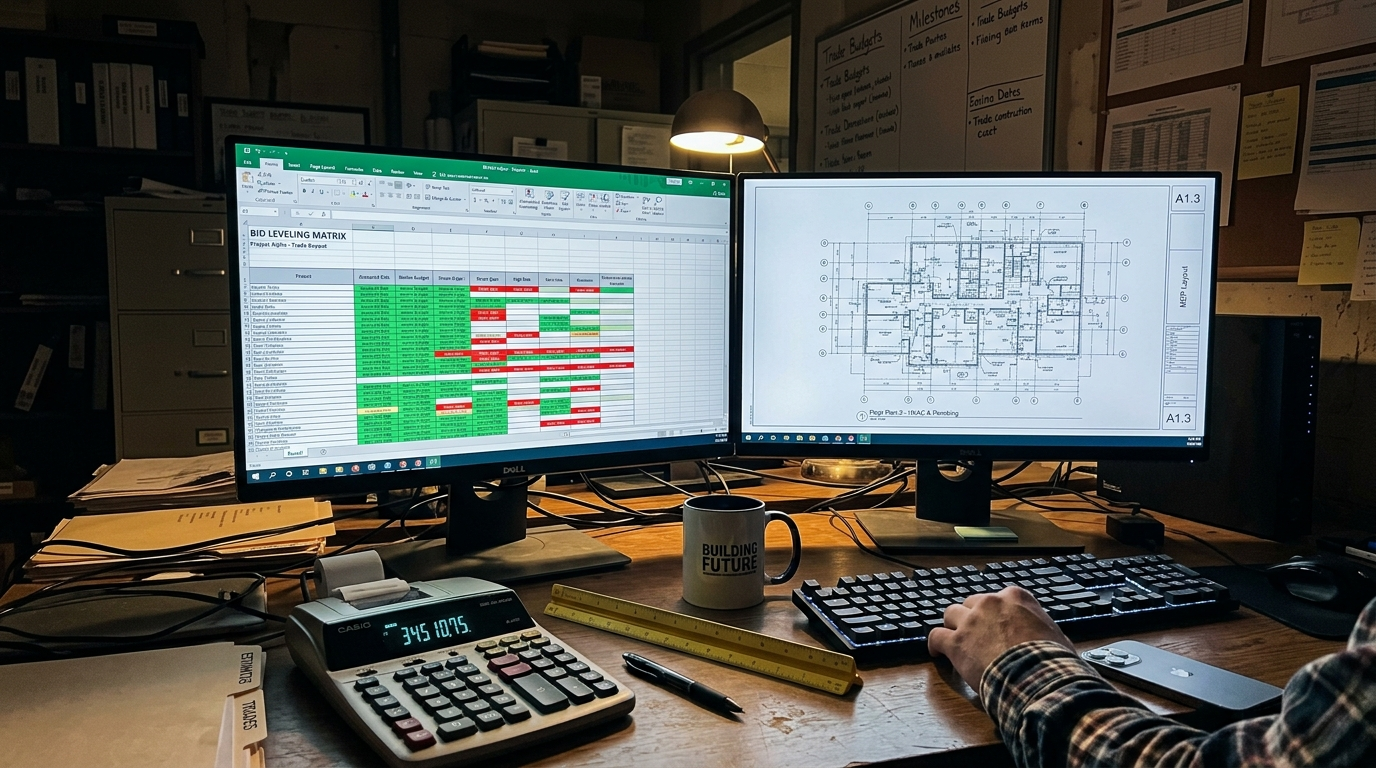
Best for: Subcontractor buyout and any multi-quote material purchase.
What to ask: Require a compliance matrix and line-item structure from every bidder. Normalize exclusions, qualifications, and alternates so you’re comparing the same scope.
Where it saves: Practitioners on Reddit consistently describe manual comparison chaos as one of the biggest sources of cost leakage. The lowest freeform bid often excludes scope that the second-lowest includes. Bid leveling avoids 3-7% in “scope leak” compared to taking the lowest unstructured number.
How to implement: Issue your RFQ with a required response template. Reject vague or non-conforming bids. Use a leveling spreadsheet that maps each bidder’s inclusions, exclusions, and unit rates side by side.
Watch-outs: This takes more upfront time but saves multiples of that time in change order disputes later. For a broader framework on structuring your purchasing process, see these construction purchasing strategy best practices.
12. Dual-Source Where Risk Is High, Single-Source Where Scale Wins
Best for: Category-level sourcing decisions where you’re choosing between concentration and diversification.
What to ask: For high-risk, long-lead, or disruption-prone items (specialty steel, custom precast, imported fixtures), maintain two qualified sources. For high-volume commodity categories where you can aggregate spend, single-source with MFN and index caps to maximize pricing leverage.
Where it saves: Dual-sourcing rarely lowers headline price on its own. Research suggests its primary ROI is risk mitigation, not cost reduction. But it keeps your primary supplier honest on pricing because they know you can shift volume.
How to implement: Map your spend categories by risk (supply disruption likelihood, lead time, substitution difficulty) and by leverage (your volume relative to the supplier’s total sales). High-risk categories get dual sources. High-leverage, low-risk categories get single-source BPAs.
Watch-outs: Admin costs rise with dual sourcing. Don’t dual-source low-value commodity items just for principle.
13. Buying Group and GPO Leverage
Best for: Contractors whose individual volume doesn’t command top-tier pricing.
What to ask: Pre-negotiated member pricing and annual rebate schedules through a construction buying group or group purchasing organization.
Where it saves: Buying groups aggregate the purchasing power of many contractors to negotiate pricing and rebates that no individual member could achieve alone. The savings come from both upfront discounts on materials and supplies, and year-end rebates based on collective volume. For details on how contractor GPO networks deliver savings, see this GPO savings guide.
How to implement: Identify which vendor categories a buying group covers. Compare member pricing against your current rates. Start purchasing through the group’s programs and track rebate accruals.
Watch-outs: Public cooperative contracts like Sourcewell are limited to public-sector entities. Private contractors need construction-specific buying groups. Commitment compliance matters: groups work because members direct spend through program vendors.
If your individual construction vendor cost negotiation leverage is thin, a buying group is the fastest path to pricing that reflects combined volume. Explore how CNBA’s contractor buying group works and how to join.
14. Payment Term Trades That Don’t Crush Cash Flow
Best for: Suppliers where you have flexibility on payment timing and want to trade it for price.
What to ask: Quantify the trade explicitly: “We’ll accept Net 60 at +0.5% unit price, or Net 30 at -1%.” Keep it transparent and documented.
Where it saves: Suppliers have a cost of capital too. If they’re borrowing at 8% and you offer to pay 30 days faster, that’s worth something. Quantifying the exchange prevents vague promises and ensures both sides know what they’re getting.
How to implement: Run the math on your side first. What does 30 extra days of float cost you versus what discount you’re getting? If the discount’s APR exceeds your cost of capital, take the shorter terms.
Watch-outs: Don’t promise faster payment than your project cash flow supports. Late payments after promising early payment destroy supplier trust and eliminate future concessions.
15. Unit Prices, Allowances, and Alternates as Negotiation Safety Valves
Best for: Scopes where quantities are uncertain or where the owner wants flexibility at award.
What to ask: Use unit prices to pre-price change-prone scopes so adjustments happen at agreed rates, not through adversarial change orders. Provide additive and deductive alternates to give owners choice without scope fights.
Where it saves: Pre-priced unit rates eliminate the “gotcha” markup that comes with change orders negotiated under pressure. Alternates let you show the owner the cost impact of specification choices before commitment.
How to implement: Identify the three to five scope areas most likely to change in quantity. Propose unit prices for those items alongside your lump sum. Structure alternates as add/deduct with clear descriptions and pricing.
Watch-outs: Unit prices work in your favor only if the estimated quantities are reasonable. Wildly understated quantities paired with low unit prices can create problems at true-up.
16. Supplier SLAs and Scorecards with Consequences
Best for: Long-term vendor relationships where delivery performance directly affects your project schedules and costs.
What to ask: Track on-time delivery (OTD), on-time in-full (OTIF), and defect rates. Tie price discussions to delivered performance. Build service credits for misses: if a supplier’s late delivery causes you to pay overtime or rent standby equipment, they should share that cost.
Where it saves: A supplier who’s 5% cheaper but delivers late 20% of the time costs you more than the reliable option. SLAs make the total cost of ownership visible and give you data for the next negotiation cycle.
How to implement: Start with a simple scorecard: OTD percentage, defect rate, lead time accuracy. Share it quarterly. Use it at renewal to justify price adjustments or volume shifts.
Watch-outs: Scorecards only work if you track the data consistently. Build the tracking into your receiving process. For a broader view on building productive supplier relationships with accountability, see this guide on how to build contractor-vendor partnerships.
17. Don’t Negotiate After the Game Has Started
Best for: Every construction vendor cost negotiation, period.
What to ask: Do your pushing during buyout, with clean scopes and competitive tension in play. Once a sub is mobilized or a supplier has committed production capacity, your leverage evaporates.
Where it saves: Practitioners on Reddit are blunt about this: when subs are already on site, “negotiation” tends to come from somewhere, usually quality, change orders, or delayed pay applications. The savings are illusory.
How to implement: Front-load your negotiation effort into the buyout phase. Use competitive bidding, bid leveling, and all the plays above before you issue a subcontract or purchase order. After award, focus on managing scope and performance, not squeezing price.
Watch-outs: Experienced subs and suppliers on contractor forums note that “good subs rarely cut base price after award”, and if they do, it pops out elsewhere. Negotiate scope and value during buyout. Manage execution after.
The Give/Get Checklist: Send This Before Every Negotiation
Effective construction vendor cost negotiation follows a simple rule: every give requires a documented get. Before you sit down with a supplier, map your concessions against your asks.
What you give:
Faster payment (Net 10 or Net 15 instead of Net 30)
Longer agreement term (12-24 months)
Annual volume commitments
Consolidated categories (single-source more spend)
What you get:
Base price reduction (target 3-5% for reasonable negotiations)
Index cap (±10% band with symmetric movement)
Freight prepaid on volume orders
MFN parity pricing
90-day price-hold window
Waiver or reduction of rental adders
Consignment or VMI on consumables
Annual rebate tied to volume achievement
Document the exchange explicitly. This is standard procurement practice. For a detailed framework on structuring these trade-offs, see this contractor purchasing leverage guide.
Three Emails That Save Contractors Money
Construction vendor cost negotiation doesn’t always happen in a conference room. Some of the most effective moves are straightforward written requests.
Email 1: The “Index-Cap” Proposal (for asphalt/steel suppliers)
Cite the relevant state DOT index mechanism as a neutral benchmark. Propose a ±10% quarterly adjustment band. Reference the FHWA escalation methodology to normalize the concept. Most paving suppliers are already familiar with DOT indexation and will recognize this as reasonable.
Email 2: The “Stored Materials” Request (to the owner)
Quote AIA A201 §9.3 and explain how billing for stored materials lets you commit to an early-buy discount that benefits the project. Include your documentation package: bill of sale, insurance certificate, labeled photos, and transfer-of-title language.
Email 3: The “Fees Disclosure” Request (to rental companies)
Ask for a complete line-item breakdown of all charges beyond the base rental rate: environmental fees, refuel charges, damage waiver/RPP, PM surcharges, delivery, pickup, and standby. Then negotiate each one individually.
When Market Data Helps You Say “No”
If the BLS PPI for inputs to construction is flat or declining while a supplier seeks a blanket 10% mid-year increase, you have the data to push back. Counter with PPI tables, AGC market summaries, and steel or asphalt spot pricing. Ask for a category-level review with specific justification rather than accepting an across-the-board adder.
This is where construction vendor cost negotiation becomes data-driven rather than emotional. Suppliers respect contractors who show up with market intelligence. They know a bluff when they hear one, and they know homework when they see it.
Putting It All Together
These 17 plays aren’t meant to be used all at once. Pick the three or four that apply to your biggest spend categories and your current pain points. If material volatility is eating your margins, start with Plays 2, 3, and 4 (indexation, escalation, stored materials). If you’re losing money on equipment rentals, start with Play 10. If your individual volume doesn’t command attention from suppliers, Play 13 is the fastest path to better pricing.
The common thread across all of them: you’re not asking for a favor. You’re changing the terms of the exchange, offering something real (volume, speed, commitment, data) and asking for something specific in return.
For contractors ready to stop negotiating alone, explore how a contractor buying group can amplify your purchasing leverage. And for a comprehensive view of how collective purchasing works across the construction industry, read this contractor collective purchasing guide.
Frequently Asked Questions
What is the typical savings range from construction vendor cost negotiation?
Normal negotiation on price alone typically yields 3-5% unless you change the equation through volume commitments, payment terms, or specification changes. Structural plays like buying group membership, early-pay discounts, and rental fee audits can layer additional savings of 2-15% depending on the category.
Should contractors use escalation clauses or fixed pricing?
It depends on project duration and market conditions. For projects under six months in a stable market, fixed pricing is simpler. For longer projects or volatile categories like asphalt and steel, bilateral escalation clauses (like ConsensusDocs 200.1) protect both parties and often result in lower initial pricing because the supplier isn’t padding for risk.
Can private contractors use public cooperative purchasing contracts?
No. Public cooperatives like Sourcewell are limited to public-sector entities. Private contractors should look at construction-specific buying groups or GPOs that aggregate purchasing power across member contractors and negotiate vendor programs accessible to private businesses.
How do I know if an early-pay discount is worth taking?
Calculate the annualized return. A 2/10 Net 30 discount equals roughly 37% annualized. If your cost of borrowing or cost of capital is lower than that rate, take the discount. If your cash is expensive or your project cash flow is tight, the discount may not pencil out.
What’s the biggest mistake contractors make in vendor negotiation?
Negotiating after the game has already started. Once a subcontractor is mobilized or a supplier has committed production capacity, your leverage is gone. Front-load your construction vendor cost negotiation effort into the buyout phase when competitive tension is highest and switching costs are low.
How does bid leveling differ from just taking the lowest bid?
Bid leveling normalizes quotes so you’re comparing identical scopes. The lowest unstructured bid often excludes items that other bidders include, creating 3-7% in hidden cost overruns. Requiring a compliance matrix and line-item structure from every bidder makes the true low bid visible.
Are environmental fees and damage waivers on equipment rentals negotiable?
Yes. These are vendor-imposed charges, not government fees. Review the rental company’s terms and conditions and negotiate each line item. If your insurance already covers equipment damage, you can waive rental protection plans. Environmental and PM surcharges can often be capped at a fixed dollar amount.
When should a contractor consider joining a buying group?
When your individual purchasing volume doesn’t command top-tier pricing from suppliers. Buying groups aggregate member spend to negotiate pricing and rebates that no single contractor could achieve alone. They’re especially valuable for mid-size contractors who spend enough to benefit from scale but not enough to negotiate national accounts independently.
Recent Comments