
TL;DR
Construction operational cost savings come from eliminating recurring waste, not just trimming one-time project budgets. The 15 strategies below, from group purchasing and preventive maintenance to fleet telematics and lean construction, each include real dollar figures and percentage ranges. Most contractors can start with low-effort wins like joining a purchasing alliance (10-15% material savings) or switching to preventive equipment maintenance ($1 spent saves $5 later) before tackling higher-effort changes like construction technology overhauls. The data is clear: 85% of projects experience cost overruns, and the ones that don’t are almost always the ones that attack operational costs systematically.
What are the most effective construction operational cost savings in 2026?
The most effective construction operational cost savings come from five core areas: Procurement (Group Purchasing saves 10–15%), Asset Preservation (Preventive pavement maintenance is 4x cheaper than replacement), Workforce Efficiency (Multi-trade coordination protects 9% of margins), Technology (Telematics reduce fuel waste by up to 35%), and Risk Mitigation (Safety programs return $4–$6 for every $1 invested). Focusing on recurring waste—rather than one-time budget cuts—is the key to long-term profitability.
Why Operational Cost Savings Matter More Than Project-Level Cuts
McKinsey estimated that global construction inefficiencies cost $1.6 trillion annually, with overruns ranging from 20% to 45%. The average overrun across projects in twenty countries over seventy years sits at 28%.
Those numbers are staggering. But here’s what most articles about construction cost reduction get wrong: they focus entirely on project-phase budgets. They talk about value engineering and bid negotiations, then stop.
Operational costs are different. They’re the recurring expenses that compound month after month: equipment maintenance, fuel, labor coordination, insurance premiums, pavement repairs, compliance penalties. These costs don’t end when a project wraps. They persist for the life of the asset and the business.
This article separates genuine construction operational cost savings from one-time budget tricks. Every strategy below includes a specific savings range, the type of organization it serves best, and what happens if you do nothing. Whether you manage a portfolio of commercial properties, run a general contracting firm, or oversee a warehouse, the math applies. The difference between a profitable operation and a struggling one often comes down to how well you manage these 15 areas.
For contractors focused on smarter procurement as a starting point, this construction purchasing strategy best practices guide breaks down the fundamentals.
At-a-Glance Comparison: 15 Strategies Ranked by Savings and Effort
Strategy | Typical Savings Range | Best For | Effort Level | Payback Timeline |
|---|---|---|---|---|
Group Purchasing (GPO) | 10-15% on materials + rebates | All contractors buying materials | Low | Immediate |
Multi-Trade Coordination | 9-10% budget/margin protection | Property owners managing multiple trades | Medium | Per-project |
Preventive Pavement Maintenance | 3-5x vs. reconstruction | Commercial property portfolios | Low-Medium | 1-3 years |
Pre-Construction Planning | 10-15% change order avoidance | Large-scale projects | High | Per-project |
Construction Technology | 20-30% capital efficiency | Mid-to-large contractors | Medium-High | 6-12 months |
Safety Programs | $4-$6 return per $1 invested | All construction businesses | Medium | 12-24 months |
QC / Rework Reduction | 5-10% of project cost saved | Contractors with quality issues | Medium | Per-project |
Equipment Maintenance | 12-18% cost reduction vs. reactive | Equipment-heavy operations | Medium | 3-6 months |
Fleet Telematics | 13-35% fuel reduction | Fleets with 10+ vehicles | Medium | 3-6 months |
Supplier Negotiation | 5-15% variable | All materials purchasers | Low | Immediate |
ADA Compliance (proactive) | $75K-$230K+ in avoided fines | Commercial property owners | Medium | Immediate risk avoidance |
Off-Peak Scheduling | 10-15% labor savings | Flexible-timeline projects | Low | Per-project |
Lean Construction | Systemic (varies widely) | Process-driven organizations | High | 6-18 months |
Industrial Concrete Maintenance | 50-70% vs. replacement | Warehouse/distribution/manufacturing | Medium | Immediate |
Paperless Systems | 5+ hours/week saved per person | Administrative-heavy operations | Medium | 3-6 months |
Now let’s get into each one.
1. Group Purchasing for Materials and Equipment
Best for: Any contractor or property owner who regularly buys materials, equipment, or supplies and wants immediate savings without changing workflows.
Typical savings: 10-15% on materials and equipment, plus annual cash rebates.
Procurement is where the most accessible construction operational cost savings hide. Most contractors buy materials independently, paying whatever their local supplier quotes. They leave thousands on the table every year simply because they lack purchasing volume.
By joining a Group Purchasing Organization (GPO), contractors typically save 10-15% on materials and equipment, gain access to annual cash rebates, and reduce procurement administrative time by up to 60%. This works because the GPO aggregates buying power across many members, negotiating pricing that individual contractors could never access alone.
This isn’t a fringe strategy. Buildertrend, one of the most widely used construction software platforms, specifically recommends group purchasing organizations as a proven cost-saving tool. Standardizing safety product sourcing through a GPO contract alone can cut costs 10-20% while improving compliance with specifications.
Key implementation points:
No minimum purchase requirements in most GPO programs
Rebates stack on top of discounted pricing
Works for everything from PPE to heavy equipment parts
Administrative time savings free up staff for revenue-generating work
Limitations to consider:
Product selection may be limited to approved vendors
Switching suppliers can disrupt established relationships
Some GPOs charge membership fees that need to be weighed against savings
Cost of inaction: A contractor spending $500,000 annually on materials at retail pricing leaves $50,000-$75,000 on the table before rebates are even counted.
If you’re unfamiliar with how these programs work, the contractor group purchasing organization guide explains the mechanics and what to look for in a buying alliance.
2. Multi-Trade Contractor Coordination
Best for: Commercial property owners and facility managers juggling multiple subcontractors on maintenance and construction projects.
Typical savings: 9-10% budget and margin protection through reduced coordination waste.
A 2024 study from Dodge Construction Network found that 33% of contractors identify coordination issues as the root cause of quality challenges. Those coordination breakdowns lead to an average 9% budget increase and 10% erosion in annual profit margin.
The numbers get worse. Contractors reported an average of seventeen daily interactions with other companies on their projects. Nearly half of those interactions, eight on average, involve conflicts. And 98% of contractors in the U.S. and Canada experienced serious quality issues (errors, omissions, rework) within the past three years.
Multi-trade contractors offer a single point of contact across disciplines. Instead of coordinating separate concrete, asphalt, site work, and ADA remediation subcontractors, you work with one company that self-performs multiple trades. This reduces communication breakdowns, schedule conflicts, and finger-pointing when issues arise.
Key implementation points:
Look for contractors that self-perform across concrete, paving, site work, and specialty items
Single-source accountability eliminates coordination overhead
Faster mobilization when one crew handles multiple scopes
Fewer change orders from miscommunication between trades
Limitations to consider:
Multi-trade contractors may not be available in all regions
Specialized or niche work may still require separate subcontractors
Pricing transparency can be harder to evaluate across bundled scopes
For more on how contractor alliances create benefits beyond simple cost reduction, that resource covers the operational advantages in detail.
3. Preventive Pavement Maintenance Programs
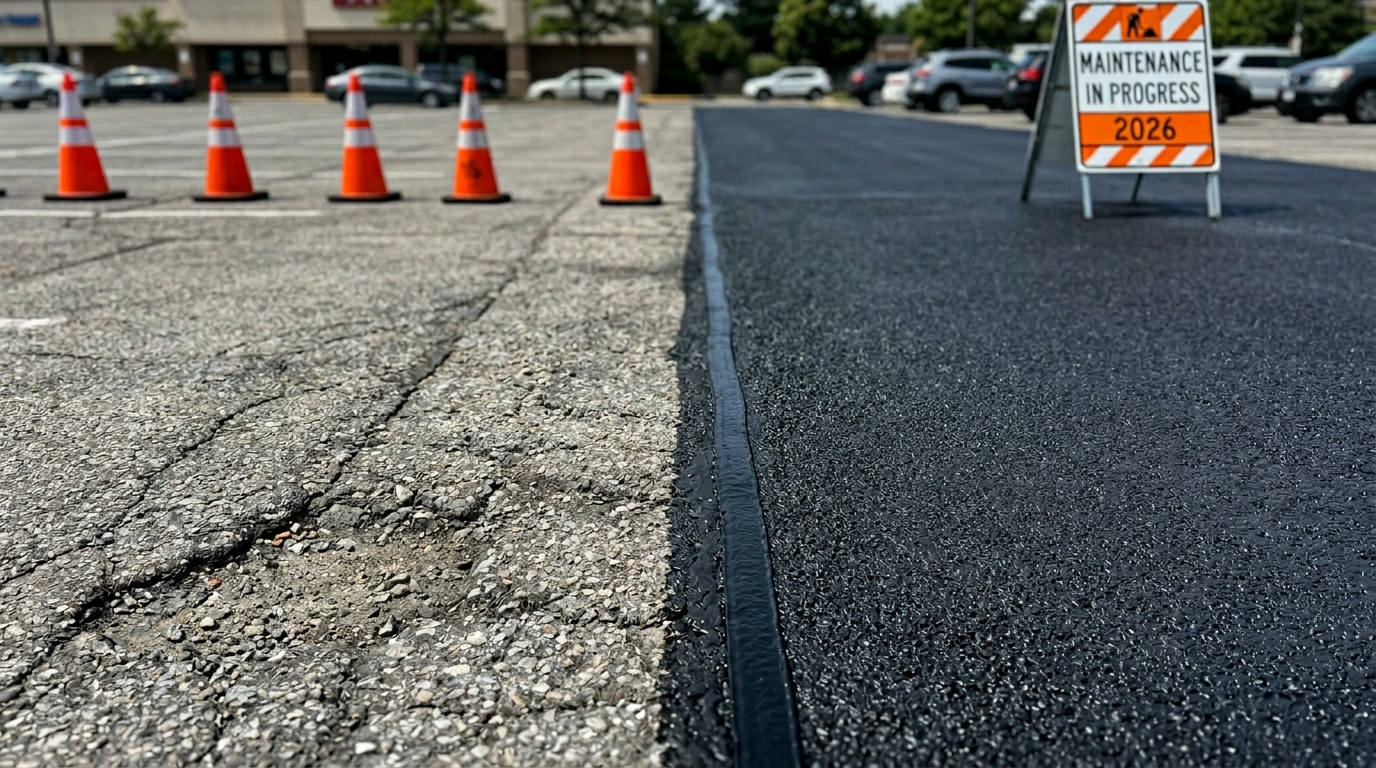
Best for: Commercial property owners with parking lots, truck courts, and roadways who want to stretch every dollar of their pavement budget.
Typical savings: 3-5x more cost-effective than waiting for reconstruction.
Pavement is one of the largest capital assets for commercial and industrial properties, yet most owners treat it reactively. They wait until potholes form, then pay emergency repair rates. This approach is dramatically more expensive.
According to the FHWA, preventive treatments applied on a regular schedule are four to five times more cost-effective than allowing pavement to deteriorate to the point of reconstruction. The cost differences are stark:
Maintenance Type | Average Cost | Lifespan Extension |
|---|---|---|
Crack Sealing | $0.50-$3/linear foot | 3-5 years |
Sealcoating | $0.25-$0.50/sq ft | 5-7 years |
Pothole Patching | $100-$400 each | Temporary |
Full Replacement | $4-$10/sq ft | 15-20 years |
Crack sealing costs $0.50-$3 per linear foot, while repairing the potholes that form from neglected cracks runs $100-$400 each. Sealcoating can add 5-7 years to asphalt life at a fraction of replacement cost.
Key implementation points:
Establish a 3-5 year maintenance schedule with annual inspections
Budget for sealcoating every 2-3 years and crack sealing annually
Address drainage issues before they accelerate deterioration
Use pavement management software to track condition and forecast costs
Limitations to consider:
Requires upfront budgeting for maintenance that “looks optional”
Timing depends on weather windows, particularly in northern climates
Severely deteriorated pavement may be past the point where preventive methods work
Cost of inaction: A 100,000 sq ft parking lot that needs full replacement at $4-$10/sq ft costs $400,000-$1,000,000. A preventive maintenance program for the same lot runs a fraction of that annually.
4. Pre-Construction Planning to Minimize Change Orders
Best for: Owners and general contractors managing large-scale commercial or industrial projects where scope changes are common.
Typical savings: 10-15% of contract value in avoided change orders.
On major projects, change order costs can represent 10-15% of the contract value, and a higher frequency of changes can reduce productivity by 10-30%. Average errors and omissions from architects and engineers alone add 3-5% to the construction budget.
The fix isn’t complicated, but it requires discipline. Better pre-construction planning, thorough design reviews, constructability analyses, and early involvement of key subcontractors catches problems on paper instead of in the field.
One commercial development in Texas saved an estimated $2.1 million by shifting from deep pilings to spread footings during the value engineering phase. That change was only possible because the team invested time in pre-construction analysis.
Key implementation points:
Conduct formal constructability reviews before breaking ground
Involve key trades early in design to catch conflicts
Use BIM for clash detection to identify MEP and structural conflicts digitally
Establish a clear change order approval process with cost thresholds
Limitations to consider:
Extended pre-construction timelines can delay project start
Requires experienced personnel who can identify issues early
Doesn’t eliminate all changes, as owner-directed scope changes will still occur
Cost of inaction: A $10 million project with typical change order rates loses $1-$1.5 million to avoidable scope changes.
5. Construction Technology for Project Management
Best for: Mid-to-large contractors and property owners managing multiple projects simultaneously who need better visibility into costs and schedules.
Typical savings: 20-30% improvement in capital efficiency; 5+ hours saved per person per week.
Construction professionals spend 35% of their time on non-productive activities. That’s over 14 hours per week wasted on finding project information, resolving conflicts, and managing mistakes. The operational cost savings from addressing this waste are significant.
Procore reports that nearly half of all optimized users save five or more hours per week on project coordination and data management. Documented results from firms that have fully adopted construction technology show 20-30% improvement in capital efficiency and 18% reduction in maintenance costs. One project saved $90,000 through improved material management alone.
Key implementation points:
Start with project management platforms that centralize communication and documents
Use digital takeoffs for more accurate estimates and fewer cost overruns
Track equipment and labor in real-time to identify utilization gaps
Invest in training (construction companies typically allocate 1-5% of annual revenue to technology)
Limitations to consider:
Adoption resistance from field crews is real and common
ROI takes 6-12 months to materialize fully
75% of construction companies provide employees with mobile devices, but only 21.7% actively use mobile apps, suggesting implementation is harder than purchase
Cost of inaction: At an average fully-loaded labor cost of $50-$70/hour, 14 wasted hours per person per week adds up to $36,000-$50,000 per employee annually.
6. Safety Programs That Lower Insurance and Injury Costs
Best for: Every construction business, but especially those with Experience Modification Rates (EMR) above 1.0 who are paying surcharges on workers’ comp premiums.
Typical savings: $4-$6 return for every $1 invested in safety.
The business case for safety programs goes well beyond avoiding injuries. Studies on the direct costs of injuries and illnesses demonstrate that employers can save $4 to $6 for every $1 invested in an effective workplace safety program. Indirect costs, including lost productivity, training replacements, and project delays, can be up to 10 times higher than direct costs.
Over 60% of CFOs surveyed by OSHA reported that each $1 invested in injury prevention returns $2 or more. The average cost of a single lost-time injury in construction is $35,000.
Your EMR directly multiplies your workers’ comp premiums. An EMR below 1.0 means you’re paying less than average. Above 1.0 means surcharges. Every recordable incident pushes that number higher for years.
Key implementation points:
Conduct weekly toolbox talks and formal safety audits
Invest in proper PPE and ensure compliance (a construction safety and PPE essentials guide covers the must-haves)
Track near-misses, not just incidents, as leading indicators
Tie safety performance to supervisor evaluations and bonuses
Limitations to consider:
Payback takes 12-24 months as EMR adjustments lag behind improvements
Requires consistent management commitment, not just a poster on the wall
Smaller firms may lack dedicated safety staff
Cost of inaction: One serious injury at $35,000+ in direct costs, multiplied by 10x in indirect costs, can wipe out an entire project’s profit margin. Elevated EMR rates compound the damage for years.
7. Quality Control Programs to Reduce Rework
Best for: Contractors experiencing repeat defects, punch list overruns, or client callbacks that eat into margins.
Typical savings: 5-10% of project cost; up to 300% reduction in productivity losses.
Rework accounts for 1-20% of total project cost, with most studies clustering between 4-10%. Beyond direct costs, rework creates up to 300% of a project’s productivity losses when you factor in schedule disruption, crew reassignment, and material waste.
The solution is structured quality control. Companies with consistent QA/QC processes keep rework costs under control 56% of the time, compared to far lower rates for companies without formal programs.
Poor communication causes project failure 33% of the time according to PMI research. Most rework traces back to unclear instructions, missing information, or unchecked assumptions.
Key implementation points:
Implement formal inspection checklists at each phase milestone
Require photo documentation before work is covered
Hold daily coordination meetings with all active trades
Use digital punch list tools to track and close deficiencies in real time
Limitations to consider:
QC programs add administrative time that field teams may resist
Requires management buy-in to enforce inspection holds
Won’t fix rework caused by design errors upstream
Cost of inaction: On a $5 million project, rework at the low end (4%) costs $200,000. At the high end (10%), it’s $500,000 gone.
8. Equipment Utilization and Preventive Maintenance
Best for: Equipment-heavy operations with owned fleets where unplanned downtime and reactive repairs are common.
Typical savings: 12-18% over reactive maintenance; each $1 spent on PM saves $5 later.
Reactive maintenance, fixing equipment after it breaks, is the most expensive approach. Companies that switch to preventive maintenance save between 12% and 18%, and each dollar spent on PM saves an average of $5 in future repairs.
Predictive maintenance, using sensors and data to anticipate failures, pushes savings even further. It can yield cost savings of 8-12% over preventive maintenance and up to 40% over reactive maintenance. For a 25-unit fleet, this translates to roughly $1.075 million in annual savings through reduced premature parts replacement and fewer unplanned downtime events.
Key implementation points:
Establish maintenance schedules based on manufacturer recommendations and operating hours
Track maintenance costs per machine to identify underperforming assets
Train operators on daily pre-use inspections
Consider telematics for automated maintenance alerts
Limitations to consider:
Upfront investment in tracking systems and technician time
Predictive maintenance requires sensor installation and data infrastructure
Small fleets may not justify the overhead of sophisticated programs
Cost of inaction: A single major equipment failure can cost $10,000-$50,000 in repair and rental replacement, plus project delays that ripple across the schedule.
9. Fleet Telematics for Fuel Cost Reduction
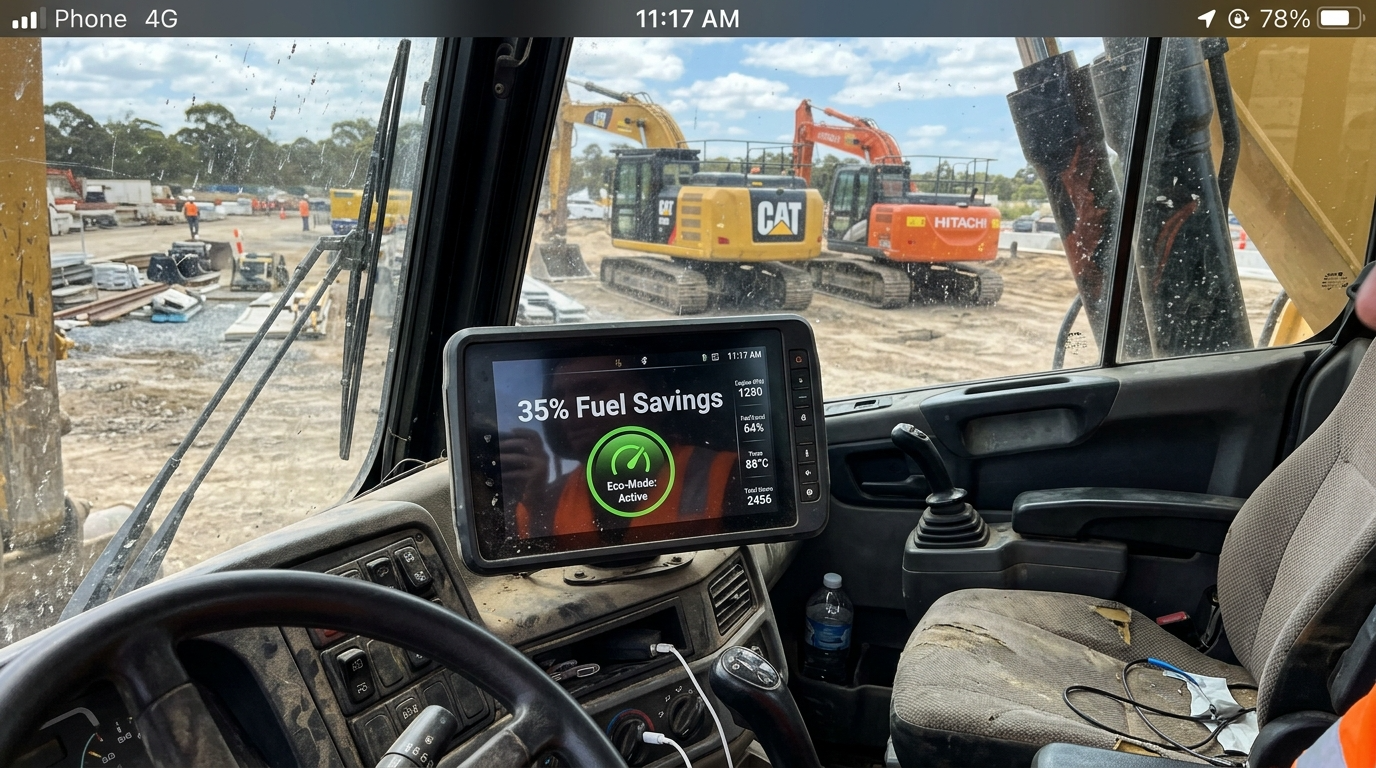
Best for: Contractors with 10+ vehicles or pieces of heavy equipment where fuel is a significant line item.
Typical savings: 13-35% fuel reduction.
An estimated 10-30% of the fuel consumed by construction equipment goes to nonproductive idling. Engines running while machines sit unused is pure waste. Telematics systems can reduce nonproductive idling by 10-15% on average, and top-performing companies achieve 13% fuel savings and 10% mileage reduction through connected data.
More advanced implementations using AI-based optimization, targeted driver coaching, and real-time monitoring report fuel consumption reductions of 25-35%.
Key implementation points:
Install GPS and engine monitoring on all fleet vehicles and heavy equipment
Set idle-time thresholds with automatic alerts
Use routing optimization for delivery and mobilization
Review weekly fuel reports to identify outliers and coach operators
Limitations to consider:
Monthly subscription costs per unit can add up for large fleets
Driver pushback on monitoring is common
Data is only valuable if someone reviews it and takes action
Cost of inaction: A fleet of 20 pieces of heavy equipment consuming $300,000 annually in fuel wastes $30,000-$90,000 on nonproductive idling alone.
10. Smarter Supplier Contracts and Comparison Shopping
Best for: All contractors and property owners who purchase materials regularly but haven’t revisited their supplier relationships recently.
Typical savings: 5-15%, variable by category.
Cat Rentals recommends buying “dynamically,” comparing prices from different sellers for every project or at least every few months, rather than defaulting to a single supplier out of habit. It’s a simple concept most contractors ignore.
At the same time, long-term contracts and bulk purchasing agreements help projects stay on budget by locking in pricing before market fluctuations hit. The key is knowing when to lock in and when to shop around.
The best approach combines both tactics: negotiate framework agreements with preferred suppliers for commodity items, then comparison shop for specialty or high-cost materials on a per-project basis.
Key implementation points:
Request competitive bids from at least three suppliers for major material purchases
Negotiate volume discounts and early-payment terms
Build long-term contractor vendor partnerships that create mutual value
Use a GPO or purchasing leverage program to access pre-negotiated pricing without doing the legwork yourself
Review supplier contracts annually, not just when problems arise
Limitations to consider:
Constant price shopping takes time and can strain relationships
Lowest price doesn’t always mean best value (quality, delivery reliability matter)
Market volatility can make locked-in contracts either beneficial or costly depending on timing
Cost of inaction: Paying 10-15% more than necessary on a $200,000 material order means $20,000-$30,000 in avoidable costs per project.
11. Proactive ADA Compliance
Best for: Commercial property owners and facility managers responsible for publicly accessible buildings, parking lots, and walkways.
Typical savings: $75,000-$230,000+ in avoided fines per violation.
This is less about savings and more about avoiding catastrophic costs. A first ADA violation can result in a fine of up to $75,000, increasing to $150,000 for subsequent violations according to the Department of Justice. Some sources report first-violation penalties reaching $115,231, with second offenses at $230,464.
Beyond fines, non-compliance triggers lawsuits (ADA lawsuits have increased every year for the past decade), reputational damage, and retrofitting expenses that far exceed what proactive compliance would have cost.
Key implementation points:
Conduct an ADA compliance audit of all properties annually
Prioritize parking lot striping, accessible ramps, signage, and tactile warning installations
Address curb ramp transitions and door hardware in older facilities
Document all compliance work for legal protection
Limitations to consider:
Full compliance in older buildings can be expensive
Regulations vary by jurisdiction and change over time
Compliance audits require specialized knowledge
Cost of inaction: A single lawsuit can cost $50,000-$200,000+ in legal fees and settlements, on top of the fines. Two violations at a property could exceed $300,000 in penalties alone.
12. Strategic Off-Peak Scheduling
Best for: Property owners and contractors with flexible timelines who can shift project starts to lower-demand seasons.
Typical savings: 10-15% on labor costs.
Scheduling isn’t just about weather. It’s about market dynamics. Winter starts may save 10-15% on labor because demand for crews drops and contractors are hungrier for work. Off-peak scheduling also offers lower material costs and reduced competition for resources.
The trade-off is real though. Cold weather protection can add 10-20% for weather-sensitive scopes. Net savings depend entirely on what type of work you’re doing.
Key implementation points:
Plan pavement and concrete work for shoulder seasons (early fall, late spring) for optimal conditions
Schedule interior renovations during winter when exterior trades are slow
Lock in contractor commitments earlier when scheduling off-peak
Factor in productivity adjustments for extreme temperatures
Limitations to consider:
Cold weather adds protection costs for concrete and asphalt work
Material delivery can be less reliable during winter months
Not all project types benefit from off-peak scheduling
13. Lean Construction Principles
Best for: Process-driven organizations willing to invest in cultural change for systemic operational improvements.
Typical savings: Variable, but McKinsey estimates productivity changes could save the industry $1.63 trillion per year.
Lean construction borrows from manufacturing to eliminate waste across five key areas: bidding and budgeting, planning, resource management, quality management, and team management. Value Stream Mapping (VSM) is the primary tool for identifying bottlenecks and non-value-adding steps in your workflows.
This is not a quick fix. Lean construction is a cultural shift. But organizations that commit to it see compounding operational cost savings across every project.
Key implementation points:
Map your current workflows to identify waste (waiting, overprocessing, excess inventory)
Implement pull planning (Last Planner System) to improve schedule reliability
Conduct regular retrospectives to build continuous improvement habits
Start with one project team before rolling out company-wide
Limitations to consider:
Requires significant leadership commitment and training investment
Benefits are hard to quantify on individual projects (systemic nature)
Field adoption takes time, especially in companies with entrenched processes
14. Industrial Concrete Maintenance
Best for: Warehouse, distribution center, and manufacturing facility operators dealing with settling slabs, joint failures, or surface deterioration.
Typical savings: 50-70% compared to full replacement.
Industrial facilities put enormous stress on concrete. Forklift traffic, heavy racking loads, and constant use degrade slabs over time. When problems appear, the instinct is often full tear-out and replacement. That’s almost always the wrong call.
Concrete leveling saves 50-70% compared to full replacement. A warehouse floor stabilization project reported by Helicon found that traditional tear-out and replacement was expected to take a full week and cost nearly five times more than the alternative stabilization approach. For an operating warehouse, that level of disruption ripples through operations, affecting shipping schedules, labor allocation, and revenue.
Key implementation points:
Conduct annual floor surveys to catch settling and joint deterioration early
Use slab stabilization and leveling before problems escalate to full replacement
Address dock leveler pits, equipment pads, and high-traffic areas proactively
Rapid-setting repair materials can return floors to service within hours
Limitations to consider:
Not all concrete damage can be repaired; sometimes replacement is truly necessary
Load requirements may dictate full structural replacement in some cases
Finding contractors experienced in industrial concrete repair (not residential) matters
Cost of inaction: A 10,000 sq ft warehouse slab replacement at $4-$10/sq ft costs $40,000-$100,000 plus a week of operational downtime. The same area repaired costs $12,000-$50,000 with minimal disruption.
15. Paperless and Centralized Document Management
Best for: Administrative-heavy construction operations where project information is scattered across email, paper files, and disconnected systems.
Typical savings: 5+ hours saved per person per week; more accurate estimates and fewer overruns.
Going paperless sounds like a simple operational change, but the construction operational cost savings it unlocks are real. Digital takeoffs are more accurate than hand-performed measurements, leading to more accurate estimates and fewer cost overruns. Centralized document management eliminates the time crews spend searching for the latest drawing revision, RFI response, or submittal.
The gap between adoption and utilization is the real story. 75% of construction companies provide employees with mobile devices, but only 21.7% actively use mobile apps. Most companies have the hardware. They just haven’t implemented the workflows.
Key implementation points:
Centralize all project documents in a single cloud-based platform
Require digital daily reports from field supervisors
Use mobile apps for time tracking, safety reports, and punch lists
Ensure all team members receive training, not just access
Limitations to consider:
Older workforce segments may resist digital workflows
Internet connectivity on remote job sites can be unreliable
Document management systems require ongoing administration and cleanup
Cost of inaction: At 14 hours wasted per week on non-productive information searching (the industry average), even a 10-person team loses 140 hours weekly. That’s 3.5 full-time employees worth of productivity gone.
Where to Start
Fifteen strategies is a lot. The question most contractors and property managers ask is: where do I get the fastest return?
Start with the low-effort, immediate-payback strategies. Joining a purchasing alliance for material savings takes almost no operational change but delivers 10-15% savings from day one. Comparison shopping suppliers costs nothing but time. Proactive ADA compliance avoids six-figure penalties.
Then move to medium-effort strategies with 3-6 month payback periods. Preventive equipment maintenance, fleet telematics, and quality control programs all have well-documented returns that justify the investment.
Save the high-effort strategies, like lean construction adoption and full technology overhauls, for when you have the organizational commitment to see them through.
The contractors who consistently outperform their peers aren’t doing one or two of these things. They’re doing most of them, systematically, as part of how they operate. Construction operational cost savings compound. A 10% savings on materials, combined with 9% better coordination, combined with 12% equipment maintenance savings, adds up to a fundamentally different margin structure.
If procurement savings are your starting point, explore the contractor purchasing alliance guide to understand how collective buying power can reshape your cost structure.
Frequently Asked Questions
What are operational costs in construction?
Operational costs in construction are the recurring expenses of running a construction business or maintaining a built asset. They include equipment maintenance and fuel, labor and subcontractor costs, insurance premiums, material procurement, administrative overhead, and facility maintenance (pavement, concrete, compliance). These differ from one-time project costs like design fees or land acquisition.
How much can preventive maintenance save compared to reactive repairs?
Preventive maintenance is consistently 3-5 times more cost-effective than allowing assets to deteriorate. For equipment, switching from reactive to preventive maintenance saves 12-18%, with each $1 spent on PM saving approximately $5 in future repairs. For pavement, sealcoating at $0.25-$0.50 per square foot can prevent full replacement at $4-$10 per square foot.
What is a Group Purchasing Organization (GPO) for contractors?
A GPO aggregates the purchasing volume of many contractors to negotiate bulk pricing that individual buyers can’t access alone. Members typically save 10-15% on materials and equipment, receive annual cash rebates, and reduce the time spent on procurement administration. Many GPOs cover categories from PPE and tools to heavy equipment parts and office supplies.
How do change orders affect construction costs?
Change orders on major projects typically represent 10-15% of the total contract value. Beyond direct costs, frequent changes reduce labor productivity by 10-30% as crews stop, wait for new instructions, and restart. Design errors and omissions alone account for 3-5% of the construction budget on average.
What is the ROI of construction safety programs?
Research consistently shows $4-$6 in savings for every $1 invested in workplace safety programs. Over 60% of CFOs surveyed by OSHA confirmed at least a 2:1 return on safety investment. The average lost-time construction injury costs $35,000 in direct costs, with indirect costs reaching up to 10 times that amount.
How much does construction rework actually cost?
Rework accounts for 1-20% of total project cost, with most projects falling in the 4-10% range. Beyond direct costs, rework generates up to 300% of a project’s productivity losses due to schedule disruption, crew reassignment, and material waste. Companies with formal QA/QC programs significantly reduce these losses.
Can off-peak scheduling really save money on construction projects?
Yes, but the savings depend on the type of work. Winter starts can save 10-15% on labor due to reduced demand for crews. However, cold weather protection for concrete and asphalt work can add 10-20% in additional costs. Interior work, site preparation, and structural steel are better candidates for off-peak scheduling than weather-sensitive finishes.
What are the penalties for ADA non-compliance?
The Department of Justice can impose civil penalties of up to $75,000 for a first ADA violation and $150,000 for subsequent violations, with some sources reporting fines reaching $115,231 for first offenses and $230,464 for repeat violations. Beyond fines, property owners face lawsuit costs, settlement payments, and mandatory retrofitting expenses that typically far exceed the cost of proactive compliance.
Recent Comments