
TL;DR
Contractor margin improvement is the process of widening the gap between what you earn on a project and what it costs you to deliver it. Average net margins for general contractors sit around 5% to 6%, while top performers hit 10% to 12% through disciplined estimating, strategic project selection, overhead control, and purchasing leverage. In 2025 and 2026, labor shortages, tariffs, and material inflation are compressing margins across the industry, making deliberate improvement efforts more critical than ever.
What Contractor Margin Improvement Actually Means
Contractor margin improvement is the deliberate process of increasing the percentage of revenue that remains as profit after all project costs are paid. It works on both sides of the equation: lowering costs (materials, labor, overhead) and increasing revenue per job through better pricing, estimating, and project selection.
This is not about growing revenue. A contractor can double their revenue and still go broke. Margin improvement focuses on the rate of profit, not the total dollars coming in. A $10 million contractor at 3% net margin keeps $300,000. A $6 million contractor at 10% keeps $600,000. The second business is healthier.
Before you can improve margins, you need to know which margin you’re talking about.
Gross margin measures what’s left after direct project costs (labor, materials, equipment on that job). The formula:
Gross Margin = (Revenue – Direct Costs) / Revenue × 100
Net margin measures what’s left after everything, including office rent, insurance, admin salaries, and truck payments. The formula:
Net Margin = (Revenue – All Expenses) / Revenue × 100
This distinction matters for diagnosis. A gross margin problem means you’re not charging enough or you’re inefficient in the field. A net margin problem (with healthy gross margins) means your overhead is eating your profit. Most contractor margin improvement efforts fail because owners don’t identify which problem they’re solving. A contractor with a 22% gross margin and a 2% net margin doesn’t need to raise prices; they need to cut overhead. A contractor with a 12% gross margin has a field problem, not an office problem.
Margin vs. Markup: The Confusion That Costs Thousands
One of the most persistent and expensive misunderstandings in construction is the difference between margin and markup. Many contractors confuse the two, and this confusion leads directly to underpriced bids and disappointing profits.
Markup is what you add on top of your costs. Margin is what percentage of your selling price becomes profit.
Here’s a simple example. You bid a job with $100,000 in costs and add a 20% markup. Your bid price is $120,000. Your profit is $20,000. But your margin is not 20%. It’s $20,000 / $120,000 = 16.7%. That gap between 20% and 16.7% compounds across dozens of jobs per year.
The 10-10 Rule
A common starting benchmark for general contractors is the “10-10 rule”: target 10% for overhead and 10% for profit, which translates to a 20% total markup on direct costs. It’s a floor, not a ceiling. Many specialty contractors and well-run firms operate well above it.
The takeaway for contractor margin improvement: know your numbers before you set your prices. If you’re calculating markup but thinking in margin terms, every bid you submit is leaving money on the table.
Current Industry Benchmarks (2025–2026)
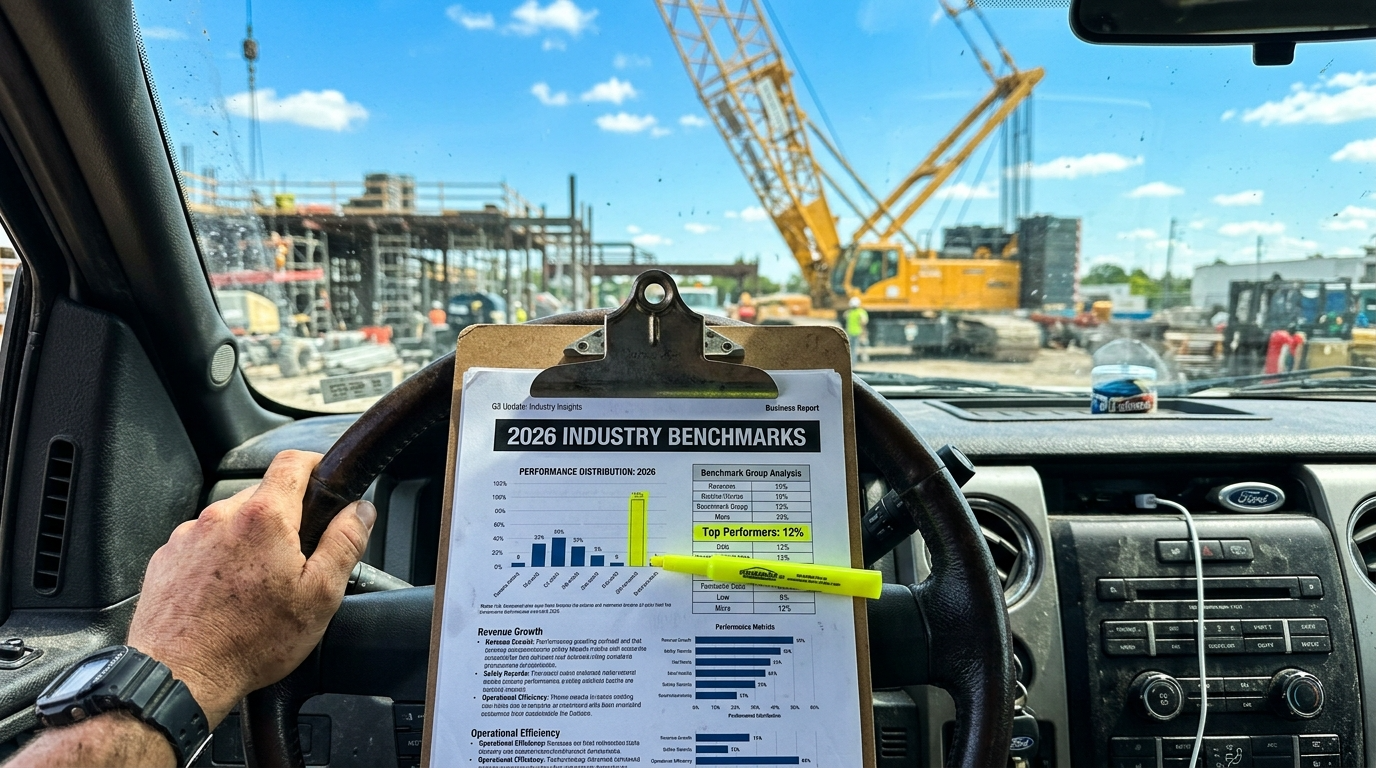
Understanding where your margins stand relative to the industry is the first step toward improving them.
Net Profit Margins
Contractor Type | Typical Net Margin |
|---|---|
General contractors (average) | |
Construction businesses (broad) | |
Specialty trade contractors | |
Commercial contractors | |
Top performers (“Best in Class”) |
The gap between average and best-in-class is striking. According to CFMA data, the typical construction net profit margin is around 6.3%, but top-performing companies achieve 11.9%. That’s nearly double, and it comes from discipline, not luck.
Gross Margins
Across global markets, average gross margins range from 19% to 22%, depending on project scale and specialization. Financial advisors working with small and mid-size contractors often recommend targeting 25% to 35% gross margins to leave room for overhead absorption and profit.
Overhead Benchmarks
Your overhead ratio (total indirect costs as a percentage of revenue) should fall between 8% and 15% depending on company size. Smaller firms tend to run higher ratios because they have less revenue to spread fixed costs across.
Markup Ranges
Average markups in 2026 range between 12% and 18%, varying by company size, project type, and region.
Specialty trade contractors consistently outperform general contractors on margin. This makes sense: they compete on value and expertise rather than price alone. Research from paving industry analysts shows that lower-middle-market contractors (under $25M) enjoy higher profit margins and better revenue growth than the major paving players. Specialization pays.
Why Contractor Margins Are Under Pressure Right Now
Understanding the forces compressing margins is essential context for any contractor margin improvement strategy. The squeeze is real, and it’s coming from multiple directions at once.
Labor Costs and Shortages
Labor costs are up 4% year-over-year, with field craft professionals averaging $36.54 per hour, an 18% premium over typical private-sector wages. The problem goes beyond cost. According to the AGC and NCCER 2025 Workforce Survey, 92% of construction firms report difficulty finding workers, and 45% say shortages are causing project delays. ABC estimates the industry needs 349,000 net new workers in 2026 alone.
When you can’t find people, you pay more for the ones you can get. And when projects slip because of staffing gaps, overhead costs pile up against the same revenue.
2026 Financial Risk: The Margin Impact of Non-Compliance
While operational efficiency is key, a single safety violation can erase the net profit of an entire project. Below are the finalized 2026 OSHA penalty ceilings that contractors must account for in their risk-adjusted margins.
Violation Type | 2026 Maximum Penalty | Impact on a $1M Project (5% Margin) |
Serious / Other-than-Serious | $16,550 | 33% of Net Profit |
Willful or Repeated | $165,514 | 331% of Net Profit (Net Loss) |
Failure to Abate | $16,550 per day | Variable (Rapid Erosion) |
Material Costs and Tariff Pressure
Tariffs on steel and aluminum have pushed the effective rate on construction goods to a 40-year high of 25% to 30%. Steel is up 13% and aluminum up 23%. Material costs overall have risen 5% to 7% on top of already elevated post-pandemic levels.
For asphalt contractors specifically, the sensitivity to oil market fluctuations adds another layer. Rising crude prices increase input costs, narrow profit margins, and create supply chain disruptions that are difficult to bid around.
Practitioners on AsphaltPro confirm what the numbers show: margins are thinner than outsiders assume, and talent shortages compound the financial pressure.
Competitive Bidding in a Shrinking Market
Total U.S. construction spending fell roughly 3% year-over-year by mid-2025. Fewer projects mean more contractors bidding on each one. Deloitte’s 2026 Engineering & Construction Outlook notes that many firms are “sacrificing profit margins to help keep prices stable,” a defensive strategy that works short-term but isn’t sustainable.
The combined effect: costs go up, prices stay flat or drop, and margins get crushed in the middle. Contractors who aren’t actively pursuing margin improvement are watching their profitability erode by default.
The Cash Flow Trap
Here’s a distinction that rarely gets discussed: you can have a positive margin and still run out of cash. Payment delays of 45 to 60 days are standard in commercial construction, but payroll hits every two weeks. A contractor can be profitable on paper while scrambling to make payroll in practice. Cash flow gaps force bad decisions, like taking low-margin work just to keep cash moving, which further compresses margins. Breaking this cycle requires both margin improvement and cash management discipline. They are related but not the same problem.
Seven Levers of Contractor Margin Improvement
These are the specific actions contractors can take to widen their margins. They’re ordered roughly by impact and ease of implementation.
1. Accurate Estimating and Real-Time Job Costing
This is the single highest-impact lever. Contractors who track actual costs against estimates in real time achieve 15% to 25% better margins than those who wait until project completion to assess profitability.
The most common estimating mistakes include failing to fully burden labor rates (benefits, insurance, and taxes add 30% to 40% on top of base wages), under-allocating equipment costs, and ignoring overhead absorption. A job that looks profitable on paper can turn out to be break-even when you account for the estimator’s time, the project manager’s salary allocation, and the office rent attributable to that project.
If you don’t know what a job actually cost until three months after it’s done, you can’t improve anything. You’re just guessing.
2. Strategic Project Selection
The temptation to chase volume is strong, especially when the market tightens. But the most profitable contractors carefully select projects that align with their capabilities and walk away from low-margin work.
This is where specialization matters. Specialty trade contractors achieve net margins of 6.9% to 8.5%, meaningfully above the 5% to 6% average for general contractors. They can charge more because they bring expertise that generalists don’t have.
If you’re winning bids too easily, your prices are probably too low. Check what other contractors in your trade are charging through local associations, peer networks, or mentors.
3. Workforce Productivity and Utilization Tracking
When crew utilization drops below target, overhead gets spread across fewer revenue dollars. A superintendent sitting idle for two weeks between projects doesn’t just cost their salary; they’re not helping absorb the overhead that keeps the business running.
As one practitioner put it in an AsphaltPro interview: “The best contractors have the best people. Skill equals profit in construction.” Contractors who track utilization systematically can identify gaps before they become expensive.
Investing in training, retention, and crew scheduling isn’t a soft cost. It’s a margin improvement strategy.
4. Purchasing Leverage and Group Buying
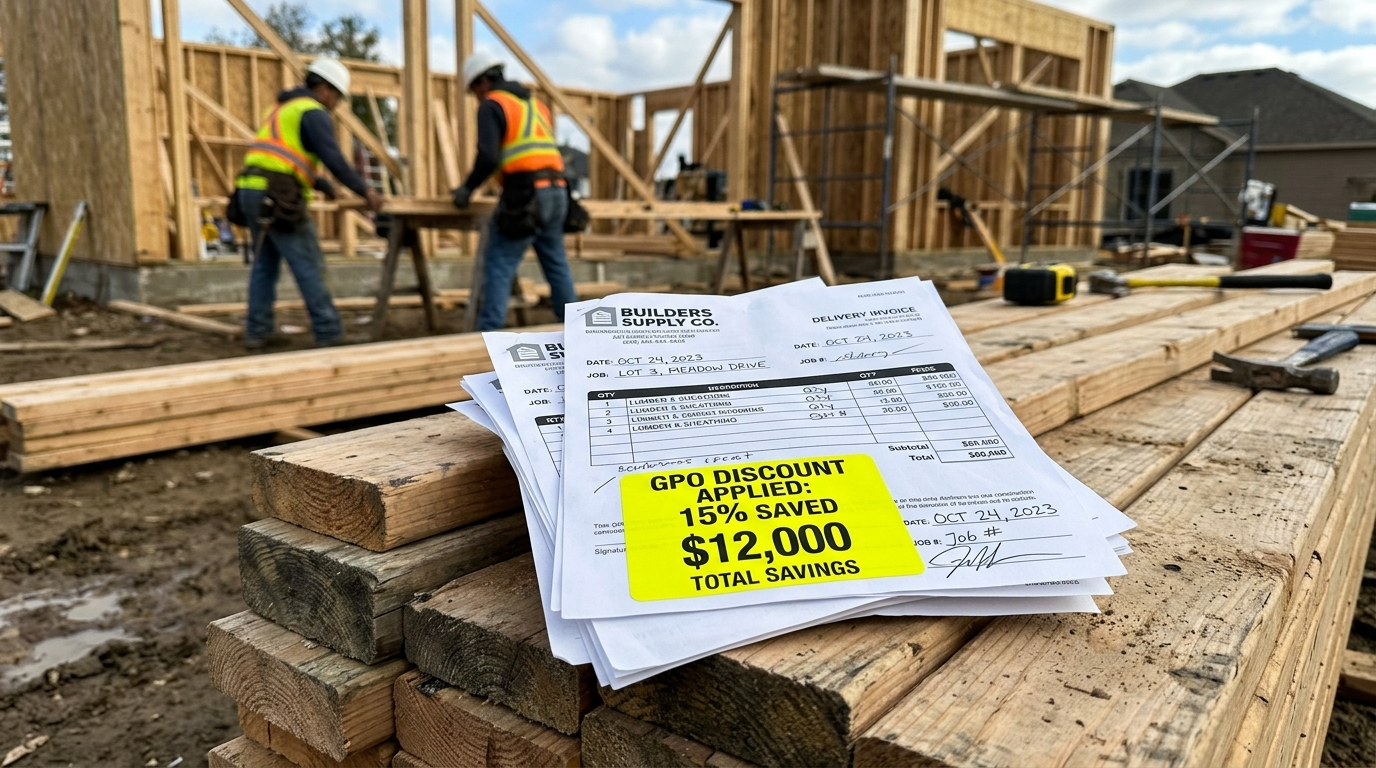
Materials represent a massive portion of project costs, and most contractors, especially small and mid-size firms, are paying more than they need to. Businesses using group purchasing organizations (GPOs) often achieve 5% to 7% in annual purchasing cost reductions. For a contractor with significant material spend, this translates into tens or hundreds of thousands of dollars saved each year.
The math is straightforward. A contractor running $5 million in annual material purchases who saves 6% through bulk buying programs keeps an extra $300,000. That’s pure bottom-line improvement, no pricing changes or operational overhauls required.
Real-world results back this up. Builders participating in committed purchase programs and national brand contracts have saved over 15% on materials in initial stages like lumber and drywall, averaging over $12,000 saved per build. These savings come from contractor purchasing leverage, the collective buying power that individual contractors can’t generate alone.
Categories where group purchasing makes an immediate difference include consumables, safety and PPE, tools, vehicle parts, and equipment. A well-structured construction sourcing strategy turns purchasing from a back-office function into a margin improvement tool.
5. Overhead Discipline
Many construction firms see profitability erode because they allow G&A spending to scale faster than revenue, especially after a period of rapid growth. Hiring an extra office admin, upgrading software, leasing a bigger shop: each decision seems reasonable in isolation, but together they can push your overhead ratio above 15% and eat your margins alive.
The fix is regular overhead audits. Compare your G&A as a percentage of revenue against the 8% to 15% benchmark. If you’re above 15%, look for the spending that crept in during your last growth phase.
6. Change Order Management and AR Policies
Before you can improve your profit margin, you need to protect the one you have. That means managing change orders quickly and clearly so extra work gets paid for, not absorbed. Every unbilled change order is margin you earned but gave away.
On the collections side, establish a formal accounts receivable policy. Slow collections create the cash flow gaps discussed earlier, which force bad margin decisions downstream. If your average collection period exceeds 45 days, that’s a problem worth fixing immediately.
7. Equipment Fleet Optimization
Equipment costs are a margin lever that many contractors overlook. The choice between a reactive “fix when it fails” model and a proactive fleet strategy has real financial consequences.
Don Swasing of Schlouch Inc. described the approach on AsphaltPro: “We run a high-performance fleet model which means I’m trading at the sweet spot prior to major component failure.” This avoids catastrophic repair bills, reduces downtime, and keeps crews productive.
The Role of Group Purchasing in Contractor Margin Improvement
Of the seven levers above, purchasing leverage is the one most underserved by current advice. Most articles about contractor margin improvement focus on estimating, software, and pricing strategies. Those matter, but they ignore a reality that practitioners deal with every day: material costs are rising faster than most contractors can raise prices.
This is where procurement alliances and buying groups fill a gap. By pooling purchasing volume across many contractors, these organizations create the kind of contractor purchasing leverage that drives profit — pricing power no individual small or mid-size contractor could access on their own.
The benefit isn’t limited to upfront pricing. Vendor rebate programs add another layer of savings that flows directly to the bottom line. Rebates on materials you’re already buying are the closest thing to free margin improvement that exists.
Studies show that companies with clear and specific profit margin goals make 33% more than those that don’t. Joining a contractor buying group is one of the clearest, most specific actions a contractor can take toward those goals. It requires no operational overhaul, no new software, and no change to how you run your crews. You just pay less for the same materials.
Diagnosing Your Margin Problem
Before chasing solutions, figure out what’s actually broken. Here’s a simple diagnostic framework:
Step 1: Calculate your gross margin. If it’s below 20%, you have a pricing or field efficiency problem. Your bids are too low, your crews are too slow, or your material costs are too high.
Step 2: Calculate your net margin. If your gross margin is healthy (20%+) but your net margin is below 6%, you have an overhead problem. Your office costs are too high relative to your revenue.
Step 3: Compare to benchmarks. If both margins are below industry averages, you likely have compounding problems, and you should start with the grosser issue (field costs) before tackling overhead.
Step 4: Set a target. The best-in-class benchmark is 10% to 12% net margin. You don’t have to get there overnight, but you need a number to aim at.
For contractors behind the curve on understanding the financial side of the business, one advisory source on AsphaltPro recommended focusing on improving field reporting integrity and finding a strong accounting partner. “A good accountant that specializes in construction is worth their weight in gold.”
Frequently Asked Questions
What is a good profit margin for a contractor?
Average net profit margins for general contractors run 5% to 6%. Specialty trade contractors do better at 6.9% to 8.5%. Top-performing contractors reach 10% to 12%. If your net margin is below 5%, it’s a sign that pricing, overhead, or both need attention.
What’s the difference between margin and markup?
Markup is the percentage you add to your costs to set a selling price. Margin is the percentage of your selling price that becomes profit. A 20% markup produces a 16.7% margin, not a 20% margin. Confusing these two is one of the most common causes of underpriced bids in construction.
How do I calculate my profit margin?
Subtract total project costs from revenue, divide the result by revenue, and multiply by 100. For example: a $500,000 project with $425,000 in total costs has a net margin of ($500,000 – $425,000) / $500,000 × 100 = 15%.
How often should I recalculate margins?
At minimum, review margins monthly at the company level and at completion for every project. Contractors who track costs against estimates in real time (weekly or even daily on large jobs) consistently outperform those who wait until the job is done.
How can purchasing leverage improve my margins?
Group purchasing organizations aggregate buying power across many contractors to negotiate better pricing with suppliers. Members typically save 5% to 7% on annual purchasing costs. For a contractor spending $2 million a year on materials, that’s $100,000 to $140,000 in savings flowing directly to the bottom line.
What’s the biggest mistake contractors make with margins?
Not diagnosing the right problem. A contractor with low gross margins needs to fix pricing or field efficiency. A contractor with healthy gross margins but low net margins needs to cut overhead. Applying the wrong fix wastes time and money.
Do smaller contractors have an advantage on margins?
In many cases, yes. Smaller, specialized contractors often outperform larger firms on margin because they have lower overhead ratios and can compete on expertise rather than volume. The key is maintaining that discipline as you grow rather than letting overhead scale faster than revenue.
How do tariffs and material costs affect contractor margins in 2026?
Tariffs on construction materials have reached a 40-year high of 25% to 30%, with steel up 13% and aluminum up 23%. These increases go straight into your cost base. Without active margin improvement strategies (better purchasing terms, tighter estimating, strategic price increases), these costs erode profits directly.
Recent Comments