
TL;DR
PPE compliance in construction is not just about wearing hard hats and safety glasses. It’s a documented system that includes hazard assessments, proper equipment selection, worker training, and recordkeeping, all governed by 29 CFR 1926 Subpart E. As of January 2025, OSHA requires that all construction PPE “properly fits” each individual worker. Violations can cost up to $165,514 per incident for willful offenses, and fines stack per worker, meaning a crew of ten without proper gear equals ten separate violations.
PPE compliance in construction means employers must identify workplace hazards, provide properly fitting personal protective equipment (PPE), train workers on its correct use, maintain documentation, and comply with OSHA’s construction PPE standards under 29 CFR 1926 Subpart E. Since January 13, 2025, OSHA also requires that PPE properly fit each affected employee. Failure to comply can result in citations, jobsite delays, and penalties of up to $165,514 per willful violation.
Key requirements include:
– Conduct a documented hazard assessment
– Select PPE appropriate for each hazard
– Ensure PPE properly fits every worker
– Train employees before work begins
– Maintain written records
– Inspect and replace damaged PPE
– Review PPE whenever jobsite hazards change
What Is PPE Compliance in Construction?
PPE compliance in construction means more than handing out safety vests and hoping for the best. OSHA treats it as a complete management system built on three pillars: hazard assessment, PPE selection, and worker training. Miss any one of these, and the entire program fails an inspection.
The governing standard is 29 CFR 1926 Subpart E, which covers all personal protective equipment requirements specific to the construction industry. In practical terms, a construction company cannot claim PPE compliance simply because workers own the right gear. The employer must assess workplace hazards, select equipment that matches those hazards, ensure every piece properly fits each worker (a rule that took effect in January 2025), train workers on correct use, and document all of it.
This matters beyond avoiding fines. Construction and extraction workers suffered 1,032 fatalities in 2024, accounting for roughly one in five U.S. workplace deaths. Proper PPE compliance directly reduces that number.
For contractors managing multiple trades and suppliers, PPE procurement is part of a broader construction cost management strategy. Buying the right equipment at the right price, from the right vendors, keeps both workers and budgets safe.
OSHA PPE Compliance Requirements at a Glance
Requirement | OSHA Requirement | Documentation Needed |
|---|---|---|
Hazard Assessment | Required | Written certification |
Proper PPE Selection | Required | Hazard assessment |
Proper Fit | Required (2025 Rule) | Fit documentation |
Employee Training | Required | Training records |
PPE Maintenance | Required | Inspection logs |
Respiratory Program | Required when respirators are used | Written program |
Periodic Review | Required when hazards change | Updated assessment |
Key PPE Categories in Construction
Every construction jobsite presents a different mix of hazards. Here are the primary PPE categories OSHA requires, along with the specific trade contexts where each applies.
Head Protection
Hard hats (Type I for top impact, Type II for top and lateral impact) are required wherever overhead hazards exist. That includes structural concrete pours where formwork is being stripped, demolition zones, and any area beneath crane operations. Workers on pile cap installations or elevated slab pours face falling debris from multiple directions, making Type II helmets the smarter choice even where not explicitly mandated.
Eye and Face Protection
This is one of the most frequently violated categories in construction. Eye and face protection under 29 CFR 1926.102 appeared on OSHA’s FY 2025 Top 10 most cited list. Concrete cutting, grinding, and demolition throw silica-laden dust and fragments at high velocity. Face shields over safety glasses provide dual protection during concrete saw operations. For asphalt work, chemical splash goggles may be necessary when handling tack coat or emulsion products.
Hearing Protection
Jackhammers, concrete saws, asphalt milling machines, and pneumatic tools all generate noise levels well above OSHA’s 90 dBA action level. Hearing protection gets overlooked on construction sites because the damage is cumulative and invisible. Workers on concrete demolition crews need it every shift, not just when the noise “seems loud.”
Hand Protection
The type of glove depends entirely on the task. Rebar workers need cut-resistant gloves rated ANSI A4 or higher. Asphalt crews need heat-resistant gloves to protect against burns from hot-mix material that can exceed 300°F. General concrete finishers need chemical-resistant gloves to guard against the alkalinity of wet cement, which causes contact dermatitis and chemical burns.
Foot Protection
Steel-toe boots are the baseline on virtually every construction site. Metatarsal guards add protection for workers handling heavy materials like concrete blocks or steel plates. For asphalt crews, slip-resistant soles are critical because fresh asphalt and tack coat create extremely slick surfaces. OSHA requires employers to pay for required PPE, though safety-toe footwear and prescription safety eyewear have specific exceptions under the payment rule.
Respiratory Protection
This category carries the highest stakes for concrete and asphalt contractors. OSHA’s permissible exposure limit for respirable crystalline silica is 50 micrograms per cubic meter over an 8-hour shift. Cutting, grinding, drilling, or crushing concrete, brick, mortar, and stone all generate silica dust that penetrates deep into lung tissue. NIOSH classifies asphalt fumes as a potential occupational carcinogen, recommending a maximum exposure of 5 mg/m³ for any 15-minute period. Respiratory protection for these trades ties to the separate respirator standard under 29 CFR 1910.134, which requires medical evaluations, fit testing, and a written respiratory protection program.
High-Visibility Clothing
ANSI Class 2 or Class 3 vests are required for workers near vehicle traffic. This covers parking lot paving projects, roadway overlay work, and any site with active truck courts. Class 3 garments (with sleeves and full torso coverage) provide the greatest visibility during dawn, dusk, and nighttime operations.
Fall Protection
Harnesses, lanyards, and anchor points are required for work at heights above 6 feet in construction. While fall protection under 1926.501 topped OSHA’s most cited list with 6,307 violations in FY 2025, it intersects with PPE compliance when the selected harness must now properly fit each worker under the updated rule.
Flame-Resistant and Arc-Rated Clothing
Required on industrial sites where flash fire or arc flash hazards exist. Concrete and industrial maintenance crews working inside manufacturing plants or near electrical infrastructure may need FR/AR clothing depending on the facility’s hazard analysis.
PPE Requirements by Construction Activity
Construction Task | Primary Hazards | Required PPE |
|---|---|---|
Concrete Cutting | Silica Dust, Flying Debris | Respirator, Eye Protection, Hearing Protection |
Asphalt Paving | Heat, Traffic | Heat Gloves, Hi-Vis Vest, Boots |
Roofing | Falls | Harness, Hard Hat |
Demolition | Falling Objects, Dust | Hard Hat, Respirator, Gloves |
Welding | UV Light, Sparks | Welding Helmet, FR Clothing |
Excavation | Cave-ins, Equipment | Hard Hat, Boots, Hi-Vis |
OSHA Standards That Affect PPE Compliance
Construction PPE compliance involves several OSHA standards working together.
OSHA Standard | Covers |
|---|---|
29 CFR 1926 Subpart E | General PPE Requirements |
29 CFR 1926.95 | PPE Selection |
29 CFR 1926.102 | Eye and Face Protection |
29 CFR 1926.100 | Head Protection |
29 CFR 1926.501 | Fall Protection |
29 CFR 1910.134 | Respiratory Protection |
29 CFR 1926.1153 | Respirable Crystalline Silica |
The 2025 OSHA PPE Fit Rule: What Changed
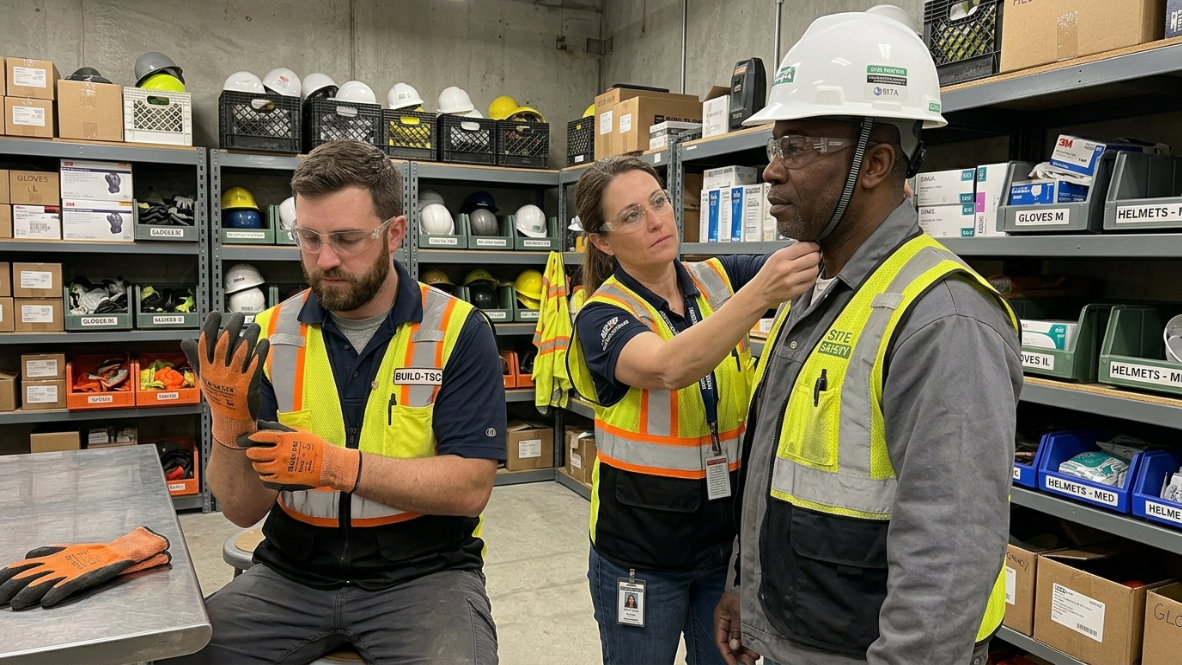
Effective January 13, 2025, OSHA revised 29 CFR 1926.95© to require that all PPE in construction “properly fits” each affected employee. Before this change, the construction standard only required PPE to be of “safe design and construction,” with no mention of fit. The general industry standard already had fit language, so this update simply closed the gap.
Why This Rule Exists
The driving force was clear. Findings from the She Builds Nation report showed that 67% of women surveyed expressed frustration over the lack of gender-friendly and maternity-friendly safety equipment. When a hard hat slides over a worker’s eyes or gloves are so oversized they reduce grip strength, the PPE becomes a hazard itself.
What “Properly Fits” Actually Means
Here’s where it gets complicated. A legal analysis by Eckert Seamans noted that OSHA rejected calls from experts and stakeholders to define “properly fits,” including a suggestion from NIOSH, OSHA’s own research arm. This means there is no standardized test or measurement employers can point to and say, “We passed.” Instead, compliance likely depends on demonstrating a good-faith process: offering multiple sizes, allowing workers to try on equipment, and documenting that selections were made with individual fit in mind.
Practical Steps for Employers
Audit your current PPE inventory for size ranges. If you stock only medium and large gloves, you are already behind.
Source PPE in a broader range of sizes, including options designed for smaller frames.
Document the fit selection process for each worker.
Retrain supervisors on what to look for when PPE doesn’t fit correctly.
For guidance on sourcing compliant equipment efficiently, our PPE procurement guide covers fit requirements alongside purchasing strategy.
Common PPE Fit Problems OSHA May Identify
Examples include:
Hard hats that slide over workers’ eyes
Oversized gloves reducing grip
Loose safety glasses allowing debris inside
Respirators that fail fit testing
Harnesses adjusted incorrectly
High-visibility vests several sizes too large
Boots that create trip hazards
Proper fit should allow workers to safely perform their tasks without introducing additional hazards.
Hazard Assessment: The Foundation of PPE Compliance
A PPE hazard assessment is not optional. It is a legal requirement under 29 CFR 1926.95, and it serves as the documented foundation for every PPE decision on a jobsite. Without it, even a fully equipped crew is technically non-compliant.
According to APTIM’s field experience, approximately half of small and medium-sized industrial businesses are not aware of this requirement and have not performed the hazard assessment. That’s a staggering gap, and it makes these companies easy targets during inspections.
The Hazard Assessment Process
Step 1: Walk the jobsite. Physically survey every work area to identify hazards. For a concrete demolition project, that means noting impact hazards (falling debris), airborne hazards (silica dust), eye hazards (fragments), and noise hazards (sawing, jackhammering).
Step 2: Match hazards to PPE. Each identified hazard must be paired with specific protective equipment. Asphalt paving, for instance, generates a distinct combination: heat exposure (heat-resistant gloves, long sleeves), fume inhalation (respiratory protection if thresholds are exceeded), traffic proximity (Class 2/3 hi-vis), and slip hazards (slip-resistant steel-toe boots).
Step 3: Certify in writing. The written certification must include the workplace or project area evaluated, the tasks reviewed, the hazards found, and the date and name of the person who completed the assessment.
Step 4: Review and update. Hazard assessments must be reviewed when new hazards are introduced and the formal document must be updated at least annually. A project that transitions from earthwork to structural concrete introduces entirely new PPE requirements.
The person conducting the assessment must be qualified or trained. This is not a task to hand off to the newest crew member. Understanding procurement risks in construction also applies here, as choosing the wrong PPE based on an incomplete assessment creates both safety and financial exposure.
Common Jobsite Hazards and Required PPE
Hazard | Examples | PPE Required |
|---|---|---|
Falling Objects | Crane operations | Hard Hat |
Flying Debris | Grinding, Saw Cutting | Safety Glasses |
Silica Dust | Concrete Cutting | Respirator |
Loud Noise | Jackhammers | Ear Protection |
Heat | Asphalt Paving | Heat Gloves |
Traffic | Road Work | High Visibility Vest |
Sharp Materials | Rebar | Cut Resistant Gloves |
Electrical Hazards | Industrial Sites | Arc Rated Clothing |
PPE Training Requirements
OSHA requires that employers train workers before they begin any task requiring PPE. Training must cover four areas: when PPE is necessary, how to properly put on and take off the equipment, the limitations of the equipment, and how to care for and maintain it.
Training isn’t a one-time event. Retraining is required when workplace conditions change, when new types of PPE are introduced, or when an employer has reason to believe a worker doesn’t understand the original training. A concrete finisher who transfers to a milling crew needs new training on respiratory protection and heat-resistant PPE, even if they’ve been with the company for years.
Documentation is the other half of the equation. OSHA’s 2025 updates bring stricter expectations around recordkeeping, with inspectors now expecting instant digital access to training records, incident logs, and enforcement documents during site visits. Paper binders buried in a jobsite trailer no longer meet practical expectations.
How Often Should PPE Training Be Conducted?
OSHA requires retraining whenever:
New equipment is introduced
Jobsite hazards change
Workers demonstrate improper PPE use
New employees are hired
Accident investigations identify training deficiencies
OSHA standards change
Many contractors also perform annual refresher training as a best practice.
Employer Responsibilities and Cost Rules
Employers must provide PPE at no cost to workers. The few exceptions are narrow: safety-toe footwear and prescription safety eyewear, if the employer allows them to be used off the job. Everything else, from hard hats to respirators to high-vis vests, is the employer’s financial responsibility.
This obligation extends to employee-owned PPE as well. If a worker brings their own safety glasses, the employer must still verify they meet the applicable ANSI standard and are in adequate condition.
Subcontractor PPE Compliance
Many subcontract agreements include a clause stating the subcontractor is responsible for compliance with OSHA regulations and other safety measures. This is standard practice, but it doesn’t fully insulate the general contractor. If a GC knows a sub’s workers lack proper PPE and does nothing, OSHA can cite both parties.
For general contractors evaluating new subcontractors, building PPE compliance into the contractor onboarding checklist is essential. Verify that the sub has a written hazard assessment, documented training records, and an adequate PPE inventory before they step on your site.
When drafting these agreements, vendor contracting best practices should include specific language around PPE compliance responsibilities, inspection cooperation, and remediation timelines for any violations discovered on site.
Employer vs Employee PPE Responsibilities
Employer | Employee |
|---|---|
Perform hazard assessments | Wear assigned PPE |
Provide required PPE | Report damaged PPE |
Ensure proper fit | Use PPE correctly |
Train workers | Follow training |
Replace damaged PPE | Report hazards |
Maintain records | Attend refresher training |
Penalties for PPE Non-Compliance
The financial consequences of failing PPE compliance in construction are severe and getting worse.
Current Fine Amounts (2025-2026)
Serious violations: Up to $16,550 per violation
Other-than-serious violations: Up to $16,550 per violation
Willful or repeated violations: Up to $165,514 per violation
Moderate-gravity violations: $9,457 to $14,187
How Fines Multiply
Under OSHA standard 1926.20, every worker who is not provided with PPE or required training is considered a separate violation. A crew of 15 workers without proper eye protection on a concrete cutting operation doesn’t generate one citation. It generates 15, each carrying up to $16,550. That’s nearly $250,000 from a single inspection finding.
Real Enforcement Cases from 2025
The highest proposed penalty of the year went to Sound Construction Inc., a concrete and earthwork contractor. OSHA proposed $1,224,798 in penalties after identifying seven willful and four serious violations. Virginia Transformer Corp. was cited for $986,888 after 53 serious and repeat violations were identified.
Jobsite Shutdowns
Practitioners on Procore’s safety forums report that if multiple OSHA violations pile up on a project, the inspector can shut down the jobsite entirely. As one safety professional put it, “If they come back three days later and nobody’s done anything to fix it, then you’re asking to get shut down.” Shutdowns cause schedule delays that can be far more expensive than the fines themselves, especially on projects with liquidated damages clauses.
PPE compliance is ultimately a construction cost management issue. The cost of proper gear, training, and documentation is a fraction of what a single serious citation can run.
Most Common OSHA PPE Violations
According to OSHA enforcement trends, common PPE violations include:
Missing fall protection
No eye protection
Missing hazard assessment
Improper respirator use
Lack of PPE training
Poor recordkeeping
Workers wearing damaged PPE
Improper PPE fit
Missing hearing protection
Failure to replace worn equipment
PPE Compliance for Concrete and Asphalt Work
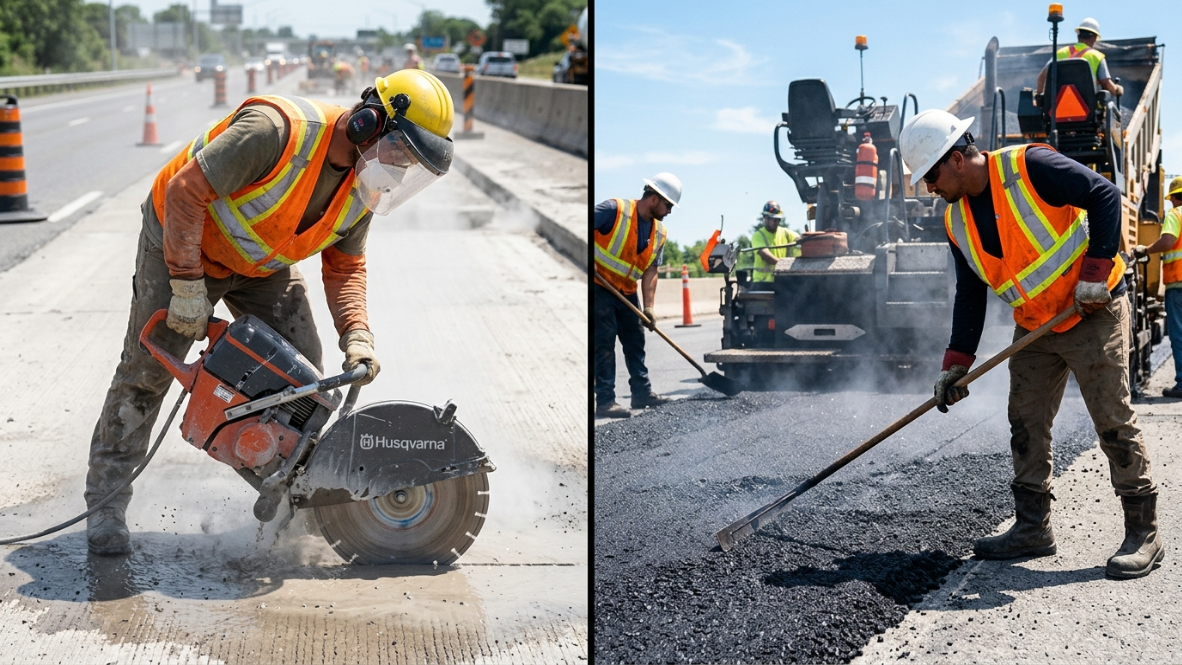
This is where generic PPE compliance guidance falls short. Concrete and asphalt operations create hazards that demand trade-specific PPE selections.
Concrete Work
Concrete cutting, grinding, drilling, and demolition are among the highest-risk activities for silica exposure. Many common construction materials contain crystalline silica, including cement, concrete, mortar, grout, and stone. When workers cut or crush these materials, microscopic dust particles travel deep into the lungs and cause silicosis, an incurable and sometimes fatal disease.
Required PPE for concrete operations:
Respirators (half-face or full-face with P100 filters, depending on exposure levels)
Safety glasses with side shields, or full-face shields during cutting
Cut-resistant gloves (ANSI A4+) for rebar handling
Chemical-resistant gloves for wet concrete contact
Steel-toe boots with metatarsal protection
Hard hat (Type II recommended during demolition)
Hearing protection during sawing, jackhammering, and demolition
Companies performing concrete work must maintain a written silica exposure control plan under OSHA’s Table 1 requirements. This goes beyond standard PPE compliance and requires engineering controls (wet cutting, vacuum systems) as the first line of defense, with respiratory PPE as supplemental protection.
Asphalt Work
Over 500,000 workers are exposed to asphalt fumes annually. Essential PPE for asphalt operations includes heat-resistant gloves, long-sleeved flame-resistant shirts, full-length pants, and steel-toed boots with slip-resistant soles.
Required PPE for asphalt paving operations:
Heat-resistant gloves rated for sustained contact above 200°F
Long sleeves and full-length pants (flame-resistant where hot-mix is handled)
Steel-toe boots with slip-resistant soles
ANSI Class 2 or 3 high-visibility vests (Class 3 for roadway work)
Safety glasses or goggles (splash protection for tack coat and emulsion)
Respiratory protection when fume exposure approaches NIOSH limits
Asphalt milling creates additional hazards because it generates silica dust from the existing pavement surface. Milling crews need the same respiratory considerations as concrete demolition crews. Sealcoating operations involve chemical exposure to coal tar or asphalt emulsion products, requiring chemical-resistant gloves and splash goggles.
For construction firms that manage both concrete and asphalt trades, sourcing trade-specific PPE through efficient channels matters. Our guide to procurement best practices covers how to standardize purchasing without sacrificing job-specific requirements.
State Plan Considerations for Southeastern Contractors
Contractors working across the Southeast face a regulatory wrinkle that most PPE compliance guides ignore: different states operate under different enforcement authorities.
Tennessee runs its own OSHA-approved State Plan through TOSHA (Tennessee Occupational Safety and Health Administration), covering most private sector workers and all state and local government workers. TOSHA maintains field offices in Nashville, Memphis, and Chattanooga and conducts its own inspections.
Alabama, by contrast, falls under federal OSHA jurisdiction. There is no state plan, which means federal OSHA conducts all enforcement directly.
Why does this matter for PPE compliance? State plans must be “at least as effective” as federal OSHA standards, but they can be more stringent. A contractor based in Memphis working a project in Nashville deals with TOSHA. That same contractor taking a job in Birmingham deals with federal OSHA. The PPE requirements are essentially identical, but the enforcement body, inspection procedures, and appeal processes differ.
The practical takeaway: build your PPE compliance program to meet or exceed federal standards, and it will satisfy any state plan. But know which agency has jurisdiction on each project so you can respond correctly if an inspector shows up.
PPE Compliance Checklist for Construction
Use this as a quick reference for any active jobsite:
✅ Written hazard assessment completed, dated, and signed by a qualified person
✅ PPE selected based on identified hazards (not just “what we had on the truck”)
✅ PPE properly fits each individual worker (2025 rule, document the process)
✅ Training completed before any worker begins PPE-required tasks
✅ Training records documented and digitally accessible
✅ Inspection and maintenance logs maintained for reusable PPE
✅ Respiratory protection program written and active if silica or fume exposure thresholds are met
✅ Subcontractor PPE compliance verified during onboarding
✅ Size inventory includes options for all body types (per fit rule)
✅ Hazard assessment reviewed whenever scope changes and at least annually
✅ Digital recordkeeping ready for immediate inspector access
This checklist works as a starting point, but every project has unique hazards that demand a site-specific assessment. For a more comprehensive approach to vetting the contractors and vendors who support your projects, the construction vendor selection criteria checklist builds safety compliance into the broader evaluation process.
PPE Compliance Best Practices
Successful contractors often implement the following:
Digital PPE inspections
QR-code equipment tracking
Annual hazard assessment reviews
Supervisor PPE audits
Daily toolbox talks
Automated training reminders
PPE inventory management software
Fit verification during onboarding
Frequently Asked Questions
What is the new OSHA PPE fit rule for construction in 2025?
Effective January 13, 2025, OSHA revised 29 CFR 1926.95© to require that all PPE in construction “properly fits” each affected employee. Previously, the standard only required PPE to be of “safe design and construction.” The revision aligns the construction industry standard with what was already required in general industry. OSHA did not define “properly fits,” which means employers need to demonstrate a good-faith process of offering multiple sizes and documenting individual fit selections.
Who is responsible for PPE compliance on a construction site with subcontractors?
Subcontract agreements typically assign OSHA compliance responsibility to the subcontractor, but general contractors are not fully off the hook. If a GC observes or should reasonably know about PPE violations by a subcontractor’s workers and takes no action, OSHA can cite both the GC and the sub. Best practice is to verify subcontractor PPE programs during onboarding and monitor compliance throughout the project.
How much can OSHA fine a construction company for PPE violations?
As of 2025, serious violations carry a maximum penalty of $16,550 per violation, while willful or repeated violations can reach $165,514 each. Critically, each unprotected worker counts as a separate violation. A concrete contractor cited for 10 workers without proper eye protection during a cutting operation faces up to $165,500 in fines from that single finding.
What PPE is required for concrete cutting and demolition?
Concrete cutting generates respirable crystalline silica dust, impact hazards, noise, and flying fragments. Required PPE typically includes a respirator with P100 filters (unless engineering controls keep exposure below the PEL of 50 µg/m³), safety glasses or a face shield, hearing protection, cut-resistant gloves, a hard hat, and steel-toe boots. A written silica exposure control plan is also required.
Does OSHA require a written PPE hazard assessment?
Yes. Under both 29 CFR 1910.132 (general industry) and 29 CFR 1926.95 (construction), employers must conduct a hazard assessment, select appropriate PPE, and certify the assessment in writing. The written document must include the workplace evaluated, hazards identified, PPE selected, the assessor’s name, and the date. Approximately half of small and mid-sized firms have not completed this requirement, according to industry consultants.
What is the difference between TOSHA and federal OSHA for construction contractors?
Tennessee operates TOSHA, an OSHA-approved State Plan that covers most private sector workers and all state and local government employees. Alabama falls under federal OSHA jurisdiction with no state plan. Both enforce standards that are at least as effective as federal requirements, but the enforcement bodies, inspection procedures, and appeals processes differ. Southeastern contractors working across state lines should verify which authority applies to each jobsite.
How often must PPE hazard assessments be updated?
Hazard assessments must be reviewed whenever new hazards are introduced to the workplace and the formal document must be updated at least annually. On construction projects, scope changes (such as transitioning from earthwork to structural concrete) introduce new hazards that require immediate reassessment, not just an annual review.
Can OSHA shut down a construction site for PPE violations?
Yes. If multiple violations pile up and a contractor fails to correct them after initial citation, OSHA inspectors can issue an imminent danger order that effectively shuts down the jobsite. Safety practitioners report that returning inspectors who find uncorrected conditions will escalate rapidly. The resulting schedule delays and contract penalties often cost far more than the OSHA fines themselves.
Recent Comments