
TLDR: A safety procurement checklist is a verification tool used before approving vendors, contractors, PPE, equipment, or safety-critical services. It covers insurance, safety performance records, OSHA documentation, training, hazard controls, and contract clauses. The best checklists scale with risk level and extend through field monitoring and post-job evaluation, not just document collection. Paper compliance is not the same as safe performance.
A safety procurement checklist is a structured process used before purchasing equipment or hiring contractors to verify that safety requirements have been met. Typical checklist items include:
– Risk classification
– Insurance verification
– Licenses and certifications
– OSHA compliance records
– Safety training documentation
– PPE and equipment standards
– Safety Data Sheets (SDS)
– Contract safety clauses
– Site-specific hazard controls
– Ongoing performance monitoring
Unlike a standard procurement checklist, a safety procurement checklist continues through contractor mobilization, field inspections, corrective actions, and post-project evaluation to reduce incidents and maintain regulatory compliance.
What Is a Safety Procurement Checklist?
A safety procurement checklist is a structured list of safety requirements verified before approving a purchase, vendor, subcontractor, or service. It is a risk-control tool, not a shopping list.
In construction and industrial settings, the checklist typically covers contractor prequalification, insurance verification, safety performance records, OSHA documentation, site-specific safety plans, training records, PPE specifications, safety data sheets, equipment certifications, contract language, and post-award monitoring. It sits within the broader contractor vendor procurement process and applies at multiple stages, from bid review through project closeout.
OSHA recommends that host employers include safety-related specifications and qualifications in contracts and bid documents and ensure selected contractors meet those requirements before work begins. ISO 45001:2018 (clause 8.1.4.1) similarly requires organizations to control procurement of products and services to ensure conformity with the occupational health and safety management system.
The checklist is broader than most people assume. It applies to hiring subcontractors, yes. But it also covers purchasing PPE, ordering chemicals that need safety data sheets, renting equipment, selecting temporary labor providers, and contracting emergency response services. Anything that introduces a safety hazard or compliance obligation deserves a procurement-stage review.
Explore construction vendor program benefits for your organization.
Why Safety Procurement Matters in Construction
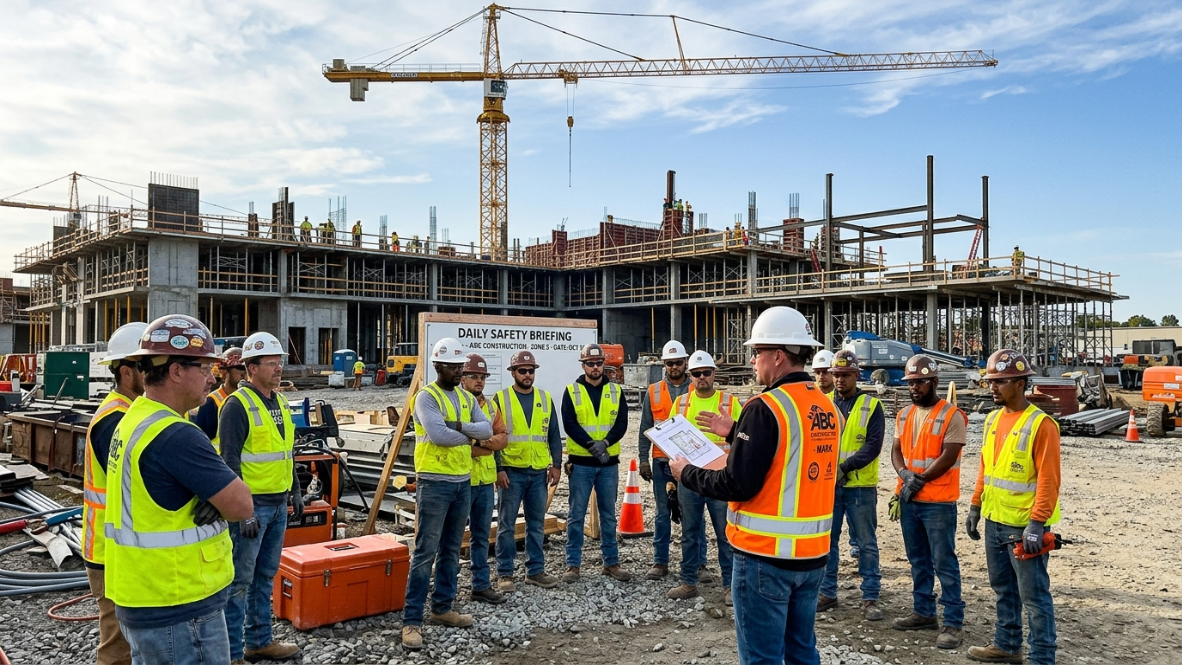
Construction recorded 1,034 private-industry workplace deaths in 2024, the highest of any private sector. Falls, slips, and trips accounted for 389 of those fatalities, representing nearly half of all fatal falls in private industry that year.
These numbers reflect procurement decisions. Who gets hired, what equipment reaches the jobsite, whether crews are trained for the specific scope, and how safety responsibilities are allocated in contracts all flow from the procurement stage.
The financial stakes are equally serious. OSHA penalties can reach $16,550 per serious violation and $165,514 per willful or repeated violation. Under the multi-employer citation policy, more than one employer can be cited for hazardous conditions on a shared worksite, meaning general contractors face penalties for subcontractor failures they should have caught or controlled.
Safety procurement is not administrative overhead. It is how organizations prevent unsafe mobilization, manage construction procurement risks, and avoid incident exposure, rework, and avoidable disputes.
Benefits of Using a Risk-Based Safety Procurement Checklist
Organizations that use structured safety procurement checklists consistently report improvements in contractor selection, project consistency, and regulatory compliance.
Benefits include:
Reduces contractor-related incidents before work begins
Identifies high-risk vendors early
Standardizes procurement decisions across projects
Improves OSHA readiness during inspections
Reduces insurance and litigation exposure
Prevents purchasing incompatible PPE or equipment
Creates documented due diligence
Improves communication between Procurement, Safety, and Operations
Builds long-term preferred vendor programs
Supports ISO 45001 continuous improvement
Rather than relying on experience alone, organizations can make procurement decisions using measurable safety criteria.
Safety Procurement Checklist vs Contractor Prequalification
Feature | Safety Procurement Checklist | Contractor Prequalification |
|---|---|---|
Covers Contractors | Yes | Yes |
Covers PPE Purchases | Yes | No |
Covers Equipment Rentals | Yes | No |
Covers Chemicals | Yes | No |
Includes Contract Clauses | Yes | Sometimes |
Includes Post-Award Monitoring | Yes | Rarely |
Includes Vendor Scorecards | Yes | Sometimes |
Used Throughout Project Lifecycle | Yes | Mostly Before Award |
Many organizations use contractor prequalification as only one step within a much broader safety procurement process.
When to Use a Safety Procurement Checklist
Safety procurement is not a one-time document collection step. NIOSH and the Campbell Institute describe contractor safety management as a lifecycle with five stages: prequalification, pre-job task and risk assessment, training and orientation, job monitoring, and post-job evaluation.
Common trigger points include:
Adding a new subcontractor to an approved vendor list
Issuing an RFQ or bid package for high-risk work
Evaluating tenders and awarding contracts
Purchasing PPE, fall protection, respiratory protection, tools, equipment, or chemicals
Mobilizing a contractor onsite
Renewing insurance, licenses, or safety documentation
Scoring vendors after project completion for reapproval
A 2021 academic study of 287 procurement professionals found that integrating health and safety objectives into procurement planning directly influences tendering, tender evaluation, contract conditions, and ultimately safety implementation on the project. Safety decisions made before award prevent field problems far more effectively than corrections attempted after work starts.
Safety Procurement Checklist: Core Items
The table below covers the main categories. Not every purchase needs every item. Scale the review to the risk level.
Category | What to Verify | Why It Matters |
|---|---|---|
Scope and risk classification | Work type, hazard profile, duration, height exposure, excavation, hot work, chemicals, heavy equipment | The checklist should match the risk. |
Licensing and qualifications | Licenses, certifications, competent-person designations, operator qualifications | Confirms the vendor can legally perform the work. |
Insurance and bonding | COI, general liability, workers’ comp, auto, umbrella, bonding, expiration dates | Protects against financial exposure from incidents. |
Safety performance records | EMR, TRIR, DART, OSHA 300/300A logs, incident history, corrective actions | Provides a baseline of past performance. |
Written safety program | Safety manual, site-specific plan, fall protection, LOTO, respiratory, excavation, silica, confined space | Confirms documented controls for relevant hazards. |
Training records | OSHA 10/30, task-specific training, equipment training, HazCom, first aid | Training must match the actual work and hazards. |
PPE requirements | PPE type, ANSI/NIOSH/ASTM standards, fit testing, replacement plan | OSHA requires PPE to be safe and properly fitting. |
Chemicals and SDSs | Safety data sheets, labels, storage, spill response, disposal | Required under OSHA’s hazard communication standard. |
Equipment and tools | Inspection records, maintenance logs, guards, operator qualification | Prevents unsafe equipment from entering the site. |
Contract safety clauses | Stop-work authority, incident reporting, audit rights, flow-down, corrective-action deadlines | Makes safety enforceable after award. |
Mobilization | Pre-job meeting, orientation, permits, JHA, emergency contacts | Bridges procurement approval to field execution. |
Monitoring | Inspections, corrective-action tracking, expiration alerts | Prevents the checklist from becoming one-time paperwork. |
Post-job evaluation | Safety score, incident review, rehire decision | Closes the loop for future procurement. |
For a detailed breakdown of evaluation criteria, see this vendor selection criteria checklist.
Risk-Based Safety Procurement: Low, Medium, and High-Risk Work
Not every vendor or purchase needs the same scrutiny. A concrete demolition subcontractor working inside an active warehouse requires far deeper review than a vendor delivering office furniture.
Low-risk procurement
Examples: office supplies, administrative services, delivered materials where the supplier does not enter active work areas.
Minimum checks: basic vendor file, insurance if required, delivery safety requirements.
Medium-risk procurement
Examples: material deliveries to active sites, routine maintenance, equipment rental, striping or small site services.
Minimum checks: COI, site access requirements, SDSs if chemicals are involved, PPE rules, incident reporting obligations.
High-risk procurement
Examples: concrete demolition, excavation and trenching, crane and rigging work, hot work, electrical work, confined-space entry, fall-exposed work, silica-generating tasks, work inside occupied industrial facilities.
Minimum checks: full prequalification (EMR, TRIR, DART, OSHA logs), citation review, site-specific safety plan, JHAs, competent-person verification, training records, equipment inspections, permit procedures, pre-mobilization meeting, ongoing inspections, and corrective-action tracking.
Organizations building an approved contractor list should consider embedding risk tiers into a preferred vendor program that formalizes the qualification and monitoring process.
Key Safety Metrics: EMR, TRIR, DART, and OSHA Logs
Safety metrics are a standard part of any contractor safety procurement checklist, but they need context.
EMR (Experience Modification Rate) compares a company’s workers’ comp claims to what is expected for similar businesses. Many teams use 1.0 as a benchmark: below 1.0 suggests better-than-average claims history. But EMR can be volatile for small companies and reveals nothing about current field controls.
TRIR (Total Recordable Incident Rate) estimates OSHA-recordable injuries per 100 full-time workers. The 2024 BLS benchmark for construction was 2.2 per 100 workers. Useful for comparison, but not the full picture.
DART (Days Away, Restricted, or Transferred) measures injury severity, capturing cases that involve lost time, restriction, or job transfer.
OSHA 300/300A/301 logs summarize recordable injuries and illnesses. Most prequalification processes request three years of logs.
Practitioners on Reddit report that COIs, EMR, and OSHA logs form the standard starting point for subcontractor safety prequalification. But experienced safety professionals caution against relying too heavily on lagging indicators. One LinkedIn practitioner noted that some organizations have moved away from EMR as a primary procurement metric, preferring recordable incident rate combined with a review of the contractor’s actual safety plan, supervisor qualifications, and recent corrective actions.
Use metrics as a screening input, then dig into scope fit, safety leadership, and hazard controls. Metrics tell you where a contractor has been. Plans, training, and supervision tell you where they are heading.
Safety Procurement Workflow
The safety procurement process generally follows six phases.
Phase | Primary Objective |
|---|---|
Planning | Define hazards and procurement requirements |
Vendor Screening | Verify qualifications and safety history |
Evaluation | Review documentation and safety capability |
Contract Award | Include enforceable safety requirements |
Mobilization | Verify readiness before work begins |
Monitoring & Closeout | Audit performance and update vendor ratings |
This lifecycle approach aligns procurement with contractor safety management rather than treating approval as a one-time paperwork exercise.
Product and PPE Safety Procurement Checklist
The safety procurement checklist is not limited to contractor selection. It also covers PPE, safety equipment, chemicals, and tools.
Key questions for product procurement:
Does the product match the specific hazard and task?
Does the PPE meet OSHA and applicable consensus standards (ANSI, NIOSH, ASTM)?
Does it fit the affected workers? OSHA requires construction PPE to be selected for proper fit.
Are multiple sizes available?
For respirators, is the purchase supported by medical evaluation, fit testing, and cartridge selection?
Are SDSs collected for hazardous chemicals? OSHA requires labels, SDSs, and worker training.
Are storage, shelf life, and temperature limits documented?
Are inspection and replacement intervals defined?
Is the lowest-cost option creating a compliance or lifecycle risk?
Many teams focus on price and availability but miss fit, task suitability, and replacement scheduling.
See the full construction PPE procurement guide.
Documents Commonly Requested During Safety Procurement
Different projects require different documentation. High-risk work usually requires significantly more verification than routine purchasing.
Document | Typical Purpose |
|---|---|
Certificate of Insurance | Verify coverage |
OSHA Logs | Review incident history |
EMR Letter | Insurance performance |
Safety Manual | Review management system |
Site-Specific Safety Plan | Hazard controls |
Job Hazard Analysis | Task planning |
Training Records | Verify qualifications |
Equipment Inspection Logs | Equipment safety |
SDS | Chemical hazards |
Respirator Fit Test | Respiratory protection |
Crane Certifications | Lifting operations |
Excavation Competent Person Documentation | Trenching work |
Safety Procurement Checklist Template
Use this phased template to build or strengthen your safety procurement process.
Before RFQ or bid
Define the scope and identify associated hazards
Classify the risk level (low, medium, high)
Identify OSHA, state, owner, and contract requirements
Add safety qualifications to bid documents
Define required documentation and submission deadlines
During vendor or contractor evaluation
Verify licenses and registrations
Collect COI and endorsements
Review EMR, TRIR, DART, and OSHA logs where relevant
Search OSHA citation history
Review the safety plan and scope-specific procedures
Confirm competent-person requirements and crew qualifications
Verify training records for assigned workers
Check equipment inspection and maintenance records
Check references for safety performance, not just price
Before contract award
Add safety responsibilities to the contract
Include stop-work authority, incident reporting, and audit rights
Include PPE and SDS obligations
Include corrective-action timelines and subcontractor flow-down clauses
Before mobilization
Hold a pre-job safety meeting
Confirm the site-specific safety plan and JHAs
Verify crew roster, qualifications, and competent persons
Verify permits (hot work, confined space, excavation, lift plans)
Confirm emergency contacts and nearest medical facility
Confirm PPE availability, fit, and condition
Confirm SDSs and labels for all chemicals
For the next steps in the approval workflow, review this vendor onboarding checklist.
During work
Conduct regular inspections
Track corrective actions to closure
Verify toolbox talks and daily hazard assessments
Monitor incident and near-miss trends
Update plans when scope, crew, equipment, or conditions change
After work
Complete a vendor safety scorecard
Record incidents, near misses, and deficiencies
Decide whether to approve, conditionally approve, or remove the vendor
Feed lessons learned into the next procurement cycle
Digital Safety Procurement Checklists vs Paper Checklists

Many organizations are replacing spreadsheet or paper-based procurement checklists with digital contractor management platforms.
Digital systems can automatically:
Notify users before insurance expires
Track training renewals
Store OSHA documentation
Assign corrective actions
Maintain approved vendor lists
Produce audit trails
Generate vendor scorecards
Monitor compliance across multiple projects
Digital workflows reduce administrative effort while improving documentation quality.
Common Mistakes With Safety Procurement Checklists
Using the same checklist for every vendor. A concrete demolition subcontractor and a parking lot striping vendor have completely different risk profiles. Use tiered checklists that match the scope.
Treating uploaded policies as proof of safe work. Practitioners on Reddit consistently flag this problem. One safety professional described contractors submitting polished policies to prequalification platforms that their workers have never read and that do not reflect the actual scope. A safety procurement checklist should verify that documents match the work, that supervisors understand them, and that compliance will be tested in the field.
Ignoring crew-level qualifications. A contractor may have a strong company-level safety packet but send unqualified workers. One LinkedIn safety professional emphasized verifying the qualifications of the specific people being sent, not just the company that employs them. Operator certifications, competent-person designations, and task-specific training should be confirmed at the crew level before mobilization.
Waiting until mobilization. Safety requirements belong in RFQs, bid documents, and contracts. Surfacing them for the first time at a pre-job meeting creates avoidable friction and risk.
Failing to monitor after award. A checklist that stops at prequalification misses the point. The contractor safety lifecycle includes job monitoring and post-job evaluation, and that is where paper compliance gets tested against reality.
Compliance note: This checklist is a planning tool, not legal advice. Requirements vary by state, contract, scope, and OSHA State Plan jurisdiction. Confirm requirements with qualified safety, legal, or risk professionals before relying on any checklist for a specific project.
Who Uses Safety Procurement Checklists?
Safety procurement checklists are commonly used by:
General Contractors
Commercial Builders
Industrial Facilities
Manufacturing Plants
Municipal Governments
Energy Companies
Utilities
Oil & Gas Contractors
Mining Operations
Transportation Agencies
Large Property Owners
Procurement Departments
Safety Managers
Risk Managers
Project Managers
Related Safety Procurement Terms
Term | Definition |
|---|---|
COI | Certificate of insurance showing current coverage. |
EMR | Experience Modification Rate; compares workers’ comp claims to expected claims for similar businesses. |
TRIR | Total Recordable Incident Rate; OSHA-recordable cases per 100 full-time workers. |
DART | Days Away, Restricted, or Transferred; severity-focused injury metric. |
OSHA 300 Log | Form for recording work-related injuries and illnesses. |
SDS | Safety Data Sheet; describes chemical hazards, handling, PPE, storage, and emergency measures. |
JHA / JSA | Job Hazard Analysis / Job Safety Analysis; task-level hazard and control review. |
PTP | Pre-task plan; short planning document completed before each work task. |
Competent person | Someone capable of identifying hazards and authorized to take corrective measures. |
Stop-work authority | Right to halt work when unsafe conditions are observed. |
Site-specific safety plan | Safety plan tailored to the actual site, scope, hazards, and crew. |
Risk Level Determines Checklist Depth
Not every purchase requires the same review.
Procurement Example | Risk Level | Typical Review |
|---|---|---|
Office Supplies | Low | Vendor information only |
Furniture Delivery | Low | Insurance if required |
Equipment Rental | Medium | COI, inspections |
Chemical Purchase | Medium | SDS, storage, PPE |
Roofing Contractor | High | Full prequalification |
Crane Contractor | High | Competent persons, lift plans |
Excavation Contractor | High | Trenching program, permits |
Confined Space Contractor | High | Rescue plans, training |
This tiered approach helps organizations allocate review effort where it provides the greatest risk reduction.
Frequently Asked Questions
Is a safety procurement checklist the same as a contractor prequalification checklist?
No. Contractor prequalification is one application. A safety procurement checklist also applies to PPE purchases, chemical orders, equipment rentals, service vendors, and temporary labor providers.
What should be on a safety procurement checklist?
At minimum: scope and risk classification, insurance, licenses, safety performance records (EMR, TRIR, DART), OSHA history, written safety programs, training records, PPE requirements, SDSs, equipment inspections, contract safety clauses, pre-job planning, field monitoring, and post-job evaluation.
Who owns the safety procurement checklist?
Procurement typically owns the workflow. Safety owns the technical review. Operations or project management owns field execution. Legal and risk management may review contract language and insurance.
Should EMR alone decide whether a contractor is approved?
No. EMR is a useful screening signal but not a final answer. Combine it with TRIR, DART, OSHA citation history, scope-specific safety plans, training proof, supervisor qualifications, and field performance history.
How often should safety procurement documents be updated?
Before each new high-risk project, when the scope changes, when insurance or licenses expire, after a serious incident, after OSHA enforcement activity, and during periodic vendor requalification (typically annually).
What is the biggest mistake in safety procurement?
Accepting paperwork without verifying whether it applies to the actual work and whether crews can execute it safely. Paper compliance is not the same as safe performance.
How does safety procurement connect to a vendor program?
A vendor program formalizes the approval, monitoring, and requalification process. The safety procurement checklist is one component of that structure. For organizations ready to formalize this, a contractor vendor program provides the framework to make safety procurement repeatable and consistent.
Recent Comments