
TL;DR
Construction cost optimization is the discipline of delivering required project function at the lowest total cost over the asset’s life, not just slashing line items during bidding. The biggest savings come from better decisions made early (during preconstruction), not from cutting corners later. Proven methods include Front-End Planning, Value Engineering, Lean production control, smarter procurement, and Life-Cycle Cost Analysis. Together, these approaches can reduce project costs by 10 to 25 percent while improving schedule performance.
At a Glance: How to Optimize Construction Costs in 2026
Construction cost optimization is the process of maximizing project value while minimizing total lifecycle expenses through five core pillars:
Front-End Planning (FEP): Investing 2–5% of budget early to save 10% in total costs.
Value Engineering (VE): Analyzing functions to find lower-cost, high-performance alternatives during design.
Lean Construction: Reducing field waste to save 10–25% on labor and activities.
Strategic Procurement: Using early buyouts and Group Purchasing Organizations (GPOs) to hedge against 2025-2026 material volatility.
Life-Cycle Cost Analysis (LCCA): Prioritizing long-term ROI over the lowest initial bid.
Construction cost optimization is a structured, data-driven approach to achieving the required function and performance of a project at the lowest total cost over its life. It integrates Front-End Planning (FEP), Value Engineering (VE), Lean production control, optimized procurement, and Life-Cycle Cost Analysis (LCCA). Done well, it reduces change orders and rework, improves schedule reliability, and lowers both first costs and operating costs. It is not late-stage budget cutting. That distinction matters more than most people realize.
The difference between optimization and cost cutting is simple. Cost cutting asks “where can we spend less?” Cost optimization asks “where can we get equal or better performance for less total money over time?” One shrinks scope. The other redesigns how you plan, buy, build, and maintain. IBM frames cost optimization as gaining visibility into spending, understanding tradeoffs, and taking a long-term view, and that framing applies directly to construction source.
Feature | Traditional Cost Cutting | Construction Cost Optimization |
Primary Goal | Minimize immediate cash outlay | Maximize total asset value & ROI |
Timing | Late-stage (Bid day or 60% Design) | Early-stage (Concept & Schematic) |
Method | Removing scope or downgrading specs | Process efficiency & functional analysis |
Impact | Higher maintenance & operating costs | 10–25% lower total lifecycle cost |
Risk | Increases likelihood of change orders | Reduces rework and schedule delays |
Where Projects Actually Win or Lose Cost
Most cost overruns don’t start in the field. They start in design and preconstruction, when decisions are made (or avoided) that lock in 80% or more of final project cost. Practitioners on LinkedIn consistently make this point: most overruns “start in design,” and fixing them requires dual estimating, early coordination, and pre-pour readiness checks source.
The Construction Industry Institute (CII) studied 609 projects worth $37 billion and found that owners with high front-end planning maturity delivered roughly 10% lower cost and 7% shorter schedules source. That’s the upstream leverage. Spending 2 to 5% of total installed cost on thorough planning pays back many times over.
Then there’s the information problem. A 2018 FMI/PlanGrid study found that the U.S. construction industry wastes an estimated $177 billion per year in labor costs, and 48% of rework stems from poor data and miscommunication source. That number should make every project executive uncomfortable. It means nearly half of all rework, one of the largest cost drains on any project, could be prevented by fixing how teams share and manage information.
This is why construction cost optimization is won in preconstruction, not in punch lists.
Navigating 2026 Market Volatility
As we move through 2026, the construction index continues to feel the ripple effects of 2025’s 11.9% jump in structural steel and fluctuating MEP equipment lead times. To optimize costs in this climate, firms are shifting from “Just-in-Time” to “Just-in-Case” procurement.
Top Procurement Tactics for 2026:
GPO Integration: Joining a National Buyer Alliance to access pre-negotiated tier-one pricing.
Warehouse Agreements: Paying for off-site storage to lock in current material prices for use 6–12 months later.
Escalation Clauses: Using “shared-risk” contracts that protect both owner and contractor from hyper-inflation on specific commodities.
The Cost Optimization Stack: Five Proven Layers
Think of cost optimization as a stack. Each layer builds on the one below it, and skipping a layer weakens everything above.
1. Front-End Planning and Scope Definition
Front-End Planning (FEP) is the process of defining project scope, aligning stakeholders, and assessing risks before committing significant capital. The primary tool is the Project Definition Rating Index (PDRI), developed by CII, which scores how well a project’s scope has been defined at key decision gates.
The math is straightforward. FEP typically costs 2 to 5% of total installed cost. Projects that invest in it see roughly 10% lower cost and 7% shorter schedules compared to those that rush past this phase source.
Practical FEP tactics include:
Running early constructability reviews with field superintendents and estimators in the room
Building risk registers that price schedule risk and market risk (not just safety)
Completing pre-bid utility and design clarifications to close scope gaps before they become change orders
Using AACE estimate classifications (Class 5 through Class 1) to match estimate accuracy with decision gates source
2. Value Engineering, Early and Lifecycle-First
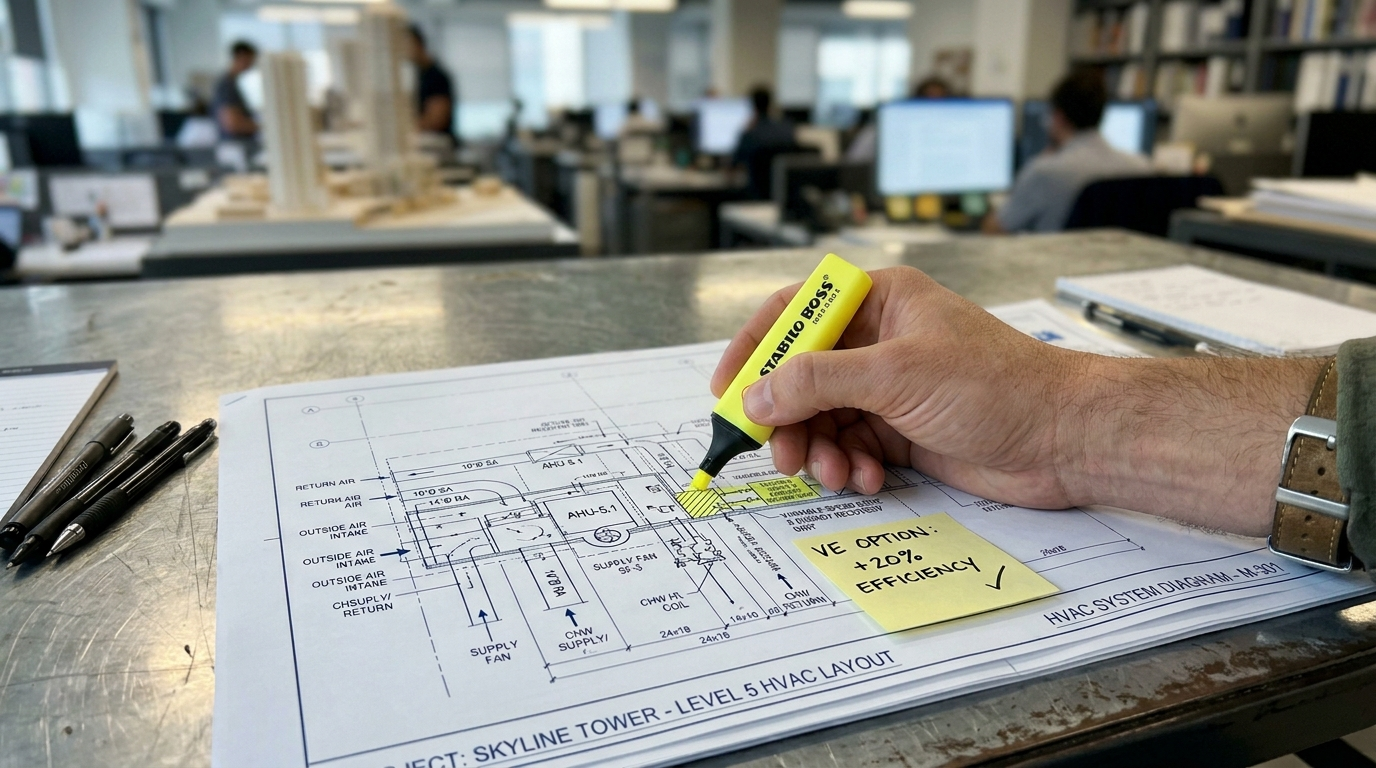
Value Engineering is a systematic, multidisciplinary review during concept or design that recommends functionally equivalent or better alternatives at the lowest lifecycle cost. That’s the FHWA’s definition, and the emphasis on “lifecycle” is the part most teams get wrong.
The standard VE job plan follows six phases: information gathering, function analysis (often using FAST diagrams), creative brainstorming, evaluation (weighing cost, constructability, and lifecycle impact), development, and presentation. On federal projects, Value Engineering Change Proposals (VECPs) allow contractors to propose cost-saving alternatives post-award, with savings shared under FAR Part 48 clauses.
Here’s where practitioners push back, and they’re right to do so. Engineers on r/MEPEngineering describe how VE often devolves into late-stage downgrades, stripping insulation ratings, cheaper fixtures, lower-performing systems, with no real analysis of lifecycle consequences source. That’s not value engineering. That’s scope reduction wearing a better name.
The fix is timing. VE works best during schematic design, when changes are cheap and the design team is still engaged. Project managers on r/Construction report that early, collaborative VE sessions with subcontractors produce far better results than handing subs a cut list after bid day source. Ask subs to propose labor-saving assemblies and alternate materials. They know their trades better than anyone in the design office.
3. Lean Production Control
Lean construction applies manufacturing-style waste reduction to field operations. The goal is removing variability, the unplanned waiting, rework, overproduction, and coordination failures that consume project budgets.
The numbers are real. BCG’s 2026 analysis reports that lean routines deliver approximately 10 to 15% cost savings on many construction activities source. McKinsey’s field experience shows 10 to 25% project cost savings and 10 to 30% faster completion when lean methods are implemented seriously source.
A case study from On Point Lean compared two identical industrial foundation scopes, one using traditional methods and one using Lean with the Last Planner System. The lean approach produced 17.4% lower cost ($5 million saved) and finished 19% faster source. That’s one project, not a universal promise, but it illustrates the magnitude.
Practical lean tools for cost-optimized construction:
Last Planner System: weekly work planning where crews commit to tasks they can actually complete, driving plan reliability up
Takt planning: sequencing trades through zones at a steady rhythm to prevent stacking and idle time
Weekly constraint removal: identifying and resolving blockers before they hit the field
Percent Plan Complete (PPC) tracking: measuring how often planned work actually gets done, then improving the causes of misses
Practitioners on r/ConstructionManagers emphasize that schedule discipline is the foundation of cost control. Auditors flag sites not working their current critical path as a strong predictor of cost overruns source. If the schedule is fiction, the budget will follow.
4. Procurement, Delivery Models, and Supply Chain Optimization
This is where many contractors have the most immediate control over construction cost optimization.
Delivery models matter. CMAA’s guidance highlights Design-Build and Construction Manager at Risk (CMAR) as structures that integrate preconstruction services, reduce late surprises, and (in CMAR) create GMP-based cost predictability. Share-savings clauses and VECP provisions further incentivize the team to optimize, not just comply source.
Early buyout protects against volatility. In 2025, ENR reported the Building Cost Index rose 4.2% year over year, the Construction Cost Index climbed 3.6%, and structural steel jumped roughly 11.9%, driven partly by tariffs source. In that environment, locking prices early for steel, rebar, major MEP equipment, and long-lead items is a direct cost optimization tactic.
Common data environments reduce expensive errors. If 48% of rework comes from poor data and miscommunication, the ROI of a properly managed CDE (BIM coordination, version-controlled drawing sets, RFI tracking) is enormous source.
Group purchasing and procurement alliances offer another layer. By consolidating volume across projects or across companies, contractors access national pricing, reduce per-unit material costs, and capture rebates that wouldn’t be available at individual project scale. This is especially valuable for contractors running multiple concurrent projects or managing multi-site programs.
If you’re spending significant money on materials and equipment, a construction purchasing strategy built around volume consolidation can produce measurable savings without touching project scope. For contractors exploring how group purchasing organizations work, a GPO savings guide breaks down the mechanics of national pricing programs and rebate structures.
Building strong vendor partnerships also plays a role. Suppliers who understand your volume, project pipeline, and material preferences can offer better pricing, priority scheduling, and fewer supply disruptions, all of which reduce total project cost.
5. Life-Cycle Cost Analysis
First cost is what you spend to build. Lifecycle cost is what you spend to build, operate, maintain, and eventually replace or decommission. Cost optimization that ignores lifecycle cost isn’t optimization at all.
FHWA’s RealCost tool is the standard for pavement LCCA, comparing alternatives like mill-and-overlay vs. full reconstruction by total present value over the analysis period source. For buildings, NIST’s Building Life-Cycle Cost (BLCC) program serves the same purpose. Both tools require setting a discount rate, analysis period, and maintenance cycle assumptions, but the output transforms how decisions get made.
Use LCCA for choices like:
Asphalt overlay vs. reconstruction (what’s cheaper over 30 years, not just this budget cycle?)
Roofing system selection (single-ply vs. built-up vs. metal)
MEP equipment (higher-efficiency units with lower operating cost vs. cheaper upfront options)
Lighting and controls packages
Quick Wins by Scope
Not every cost optimization effort requires a six-month lean transformation. Some wins are available on the next project.
Sitework and paving. Use LCCA to compare pavement alternatives, set maintenance cycles and discount rates in FHWA’s RealCost tool, and make the case for the option with the lowest total present value. Conduct subgrade verification and geotech checks before paving, because remediation after placement costs multiples of what prevention costs upfront.
Steel and rebar. With structural steel up nearly 12% in 2025, early buyout on steel packages is one of the simplest cost optimization moves available. Lock pricing as soon as design is sufficiently developed.
MEP prefabrication. McKinsey estimates modular approaches can be 20 to 50% faster and up to roughly 20% cheaper when executed at scale and in the right context source. Prefab MEP racks, headwalls, and bathroom pods work best when the scope is repetitive (multi-site retail, hospitality, healthcare). They don’t always save money on one-off custom projects.
Material rebates. Many contractors leave money on the table by not tracking or claiming available vendor rebates. Structured rebate programs through purchasing alliances can return significant dollars annually, with no impact on project specs.
What Practitioners Say Works (and What Doesn’t)
Field experience fills the gaps that frameworks leave open.
VE works when subs are at the table early. On r/Construction, project managers consistently report that asking subcontractors to propose labor-saving assemblies and alternate materials during preconstruction produces better VE outcomes than top-down budget cuts imposed after award source.
Weekly lessons-learned loops stop cost bleeding. Practitioners on r/ConstructionManagers describe incorporating brief lessons-learned reviews into weekly safety and production meetings. When mistakes or cost overruns are captured and shared the same week they happen, the same errors don’t repeat on the next pour, the next floor, or the next phase source.
Critical path focus predicts cost outcomes. Construction auditors flag sites that aren’t working their current critical path as high-risk for cost overruns. The schedule and the budget are connected, and when crews drift off the critical path without correction, costs drift too source.
Late VE is almost always a downgrade. The pattern is predictable: a project goes over budget at 60% design, someone orders a “VE session,” and the result is cheaper materials and reduced system performance. That’s not optimization. Real VE happens during concept and schematic design, when alternatives can be evaluated properly and the A/E team is still engaged.
Metrics and Governance for Cost Optimization
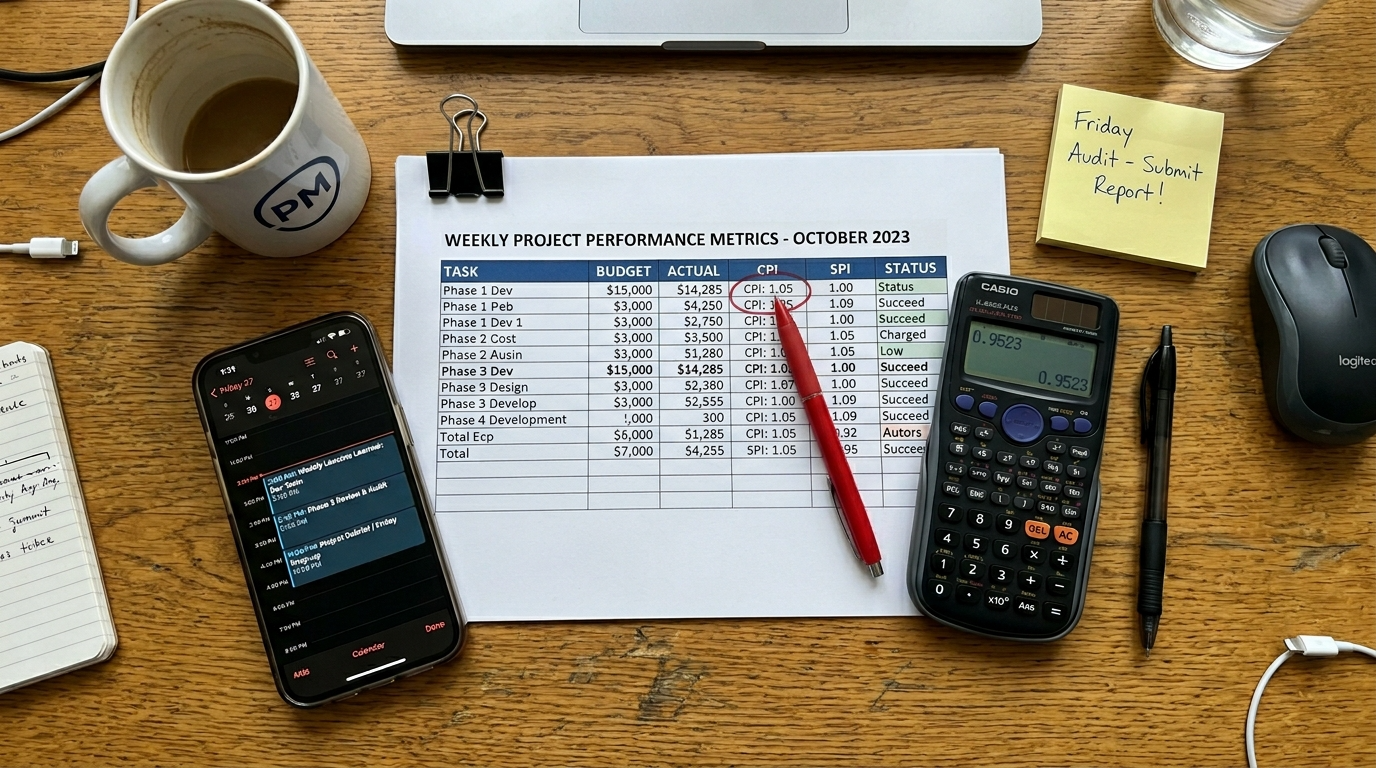
You can’t optimize what you don’t measure. These metrics form the governance backbone of a cost-optimized project:
Rework as a percentage of total cost. Track it, decompose it by cause (design errors, coordination failures, field execution), and address root causes. The FMI/PlanGrid benchmark of 48% rework from data and communication problems gives you a target area source.
Percent Plan Complete (PPC). The Last Planner System’s core metric. What percentage of planned weekly tasks actually got completed? High-performing lean projects sustain PPC above 80%.
Cost Performance Index (CPI) and Schedule Performance Index (SPI). Earned value basics. CPI below 1.0 means you’re spending faster than planned; SPI below 1.0 means you’re behind schedule. Track both weekly.
Estimate accuracy at each gate. Match your estimate class (AACE 56R-08) to your project phase. A Class 5 estimate at concept should have a different expected accuracy range than a Class 2 estimate at detailed design.
Change order rate and value. Both the number and dollar value of change orders indicate how well front-end planning and coordination performed.
Procurement performance metrics. Cycle time, supplier on-time delivery, PO accuracy, and cost-per-PO. Tracking purchasing efficiency KPIs closes the loop between procurement decisions and field cost outcomes.
Tools That Support Construction Cost Optimization
A few tools deserve mention because they directly enable the practices described above.
Common Data Environments (CDEs) and BIM reduce version errors, improve coordination, and cut the rework that comes from teams working on outdated drawings. The connection between CDE adoption and reduced information waste is direct and well-documented source.
FHWA RealCost handles pavement LCCA, calculating present value comparisons between maintenance strategies and reconstruction alternatives. NIST BLCC does the same for building systems source.
Procurement platforms and purchasing alliances give contractors visibility into national pricing, consolidated SKU management, and rebate tracking. For contractors managing purchasing leverage across multiple projects, these tools turn fragmented buying into systematic savings.
Putting It All Together
Construction cost optimization is not one technique. It’s a stack of five disciplines applied at the right time:
Front-End Planning defines the project correctly and prices risk honestly.
Value Engineering finds equal-or-better performance at lower lifecycle cost.
Lean production control removes waste and variability from field execution.
Procurement optimization locks pricing, consolidates volume, and aligns delivery models with project goals.
Life-Cycle Cost Analysis ensures today’s savings don’t become tomorrow’s maintenance burden.
The teams that get this right spend more time and money in preconstruction, and they consistently deliver projects at lower total cost. That’s the paradox of optimization: spending more on planning saves more on building.
For contractors looking to improve their cost position through smarter procurement, joining a contractor buying group is one of the fastest paths to measurable savings on materials and equipment. The Contractors National Buyer Alliance connects contractors with national pricing programs, volume-based rebates, and a sourcing strategy designed to reduce costs without reducing scope.
Frequently Asked Questions
Is construction cost optimization just another name for cost cutting?
No. Cost cutting reduces spending broadly, often by removing scope or downgrading materials. Cost optimization maintains or improves project function while reducing total lifecycle cost. The distinction is critical: cutting first cost on a roofing system that then fails five years early is not optimization. It’s deferred expense.
When should Value Engineering happen?
During concept or schematic design, when changes are cheapest and alternatives can be properly analyzed. VE sessions held at 60% or 90% design completion almost always devolve into scope reductions rather than genuine functional improvements. Post-award, VECPs provide a narrower path to shared savings, particularly on federal projects under FAR Part 48.
How much should a project budget for Front-End Planning?
CII data suggests 2 to 5% of total installed cost is the typical range. Projects that invest at this level see roughly 10% lower cost and 7% shorter schedules compared to projects that underinvest in planning source. It’s one of the highest-return investments a project owner can make.
Does modular or prefab construction always save money?
Not always. McKinsey’s research shows modular methods are consistently faster (20 to 50%) and can deliver up to about 20% cost savings, but only when the scope is repetitive and the supply chain supports it source. Custom, one-off projects rarely see cost savings from prefabrication. Multi-site programs with repeatable scopes (hotel rooms, healthcare headwalls, MEP racks) are the sweet spot.
What’s the single highest-impact cost optimization lever?
Front-End Planning. The CII data is unambiguous: thorough scope definition and risk assessment before committing capital produces the largest, most reliable cost and schedule improvements. Everything else in the optimization stack works better when the project is properly defined from the start.
How do procurement alliances fit into cost optimization?
Procurement alliances and group purchasing organizations aggregate buying volume across multiple contractors or projects to negotiate national pricing, consolidated terms, and rebates. For materials and equipment, this approach can lower unit costs significantly without changing specifications. It slots into the procurement layer of the optimization stack alongside early buyout and delivery model selection.Measuring whether those programs actually deliver requires looking at real ROI from contractor purchasing programs, separating gross savings claims from cash impact on project margins.
What metrics should teams track to know if optimization is working?
Start with rework percentage (by cost), Percent Plan Complete (PPC) for lean execution, CPI and SPI for earned value, and change order rate and value. If rework is dropping, PPC is above 80%, CPI is at or above 1.0, and change orders are declining, the optimization program is working.
How does 2026 technology impact cost optimization?
In 2026, cost optimization is increasingly driven by Automated Constraint Mapping and BIM-integrated procurement. By linking the 3D model directly to supply chain databases, contractors can identify price spikes in real-time and swap materials during the design phase before costs are locked in.

Recent Comments