
TL;DR
A contractor vendor agreement is a legally binding contract that defines the terms, obligations, and payment conditions between a contractor and a vendor or supplier. In construction, these agreements carry unique risks around payment timing, insurance requirements, and liability classification that generic templates don’t address. Understanding construction-specific clauses like pay-when-paid, COI requirements, and bonding provisions can protect your business from costly disputes and cash flow problems.
Contractor vendor agreements are one of those documents that every construction business relies on but few take the time to fully understand. The result, according to practitioners and legal professionals alike, is predictable: payment disputes, liability gaps, and relationships that fall apart when something goes wrong on the job.
This guide breaks down what contractor vendor agreements actually are, what they should contain, and the construction-specific clauses that separate a good agreement from a dangerous one.
Looking to strengthen your vendor relationships from the start? Learn how contractor-vendor partnerships set the foundation for better agreements and long-term savings.
Quick Answer: What Should a Contractor Vendor Agreement Include?
A contractor vendor agreement should clearly define:
– scope of work
– pricing and payment terms
– insurance and COI requirements
– indemnification clauses
– change order procedures
– dispute resolution terms
– termination conditions
– lien waiver requirements
– retainage terms
– force majeure provisions
In construction, vendor agreements should also address construction-specific risks like pay-if-paid clauses, additional insured endorsements, and workers’ compensation verification. A well-written agreement reduces payment disputes, protects cash flow, and limits liability exposure across the project lifecycle.
What Is a Contractor Vendor Agreement?
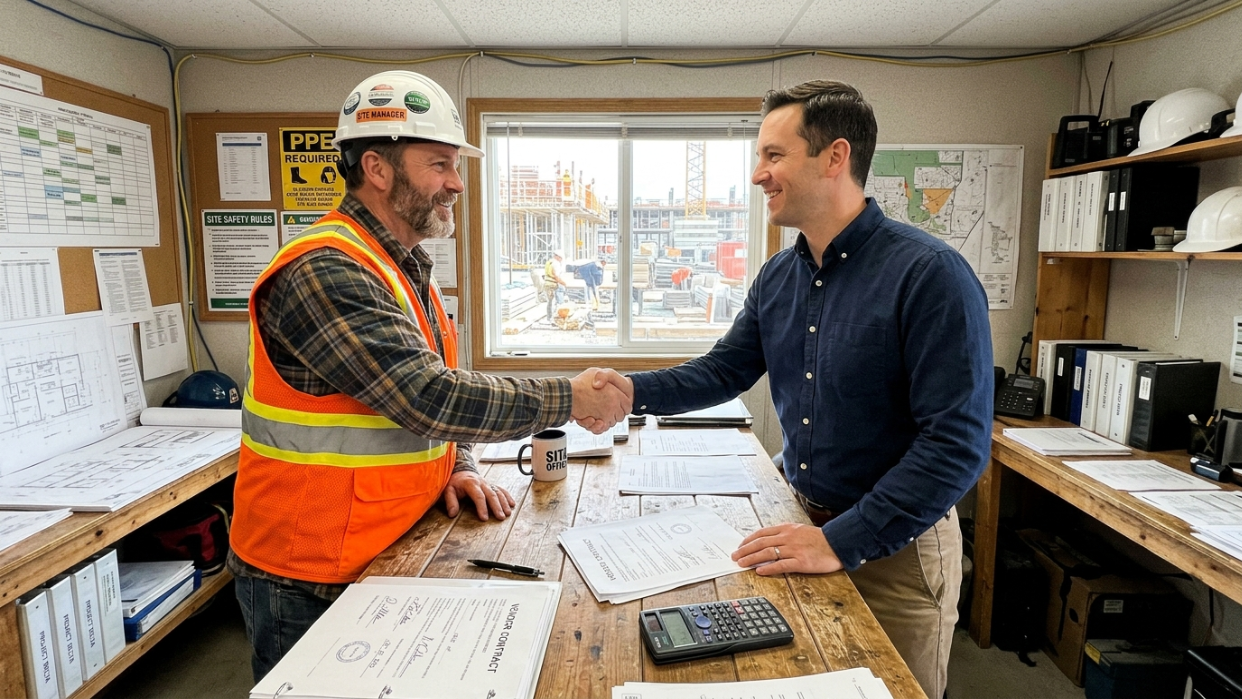
A contractor vendor agreement is a legally binding contract between a business (typically a general contractor or construction firm) and a vendor that outlines the terms governing their commercial relationship. It specifies obligations, deliverables, payment terms, insurance requirements, and other provisions designed to protect both parties.
You’ll also hear these called vendor contracts, vendor agreements, purchase agreements, or supply agreements. In federal procurement contexts, the Office of Management and Budget actually replaced the term “vendor” with “contractor,” making the two terms functionally interchangeable in government guidance.
In construction, these agreements go beyond standard business contracts. They govern the relationships with suppliers, material vendors, equipment providers, and service companies who play critical roles in project execution. A poorly written agreement (or worse, no agreement at all) creates exposure that can cascade across an entire project.
As one legal firm, Davis Business Law, put it plainly: “Many of the problems we see involve deals with no contracts, or lousy agreements downloaded from the internet.” That warning applies doubly in construction, where the stakes involve jobsite safety, lien rights, and six-figure payment obligations.
Contractor vs. Vendor vs. Subcontractor: What’s the Difference?
This is the single biggest source of confusion in construction contracting, and getting it wrong has real financial consequences.
Vendor | Contractor/Subcontractor | Supplier | |
|---|---|---|---|
Primary role | Sells goods or products | Sells time and services | Provides raw materials or components |
Relationship duration | Often ongoing | Project-specific, time-limited | Can be ongoing or project-based |
On-site work | Typically none | Performs work on-site | Delivers materials, usually no on-site labor |
Insurance required | Product liability, commercial general liability | General liability, workers’ compensation, auto | Product liability, commercial general liability |
Payment structure | Per order or supply schedule | Milestone-based or time and materials | Per order or on account |
The distinction matters because misclassifying vendors and subcontractors can expose contractors to significant insurance and liability risks. A subcontractor must carry and provide proof of both liability and workers’ compensation insurance. Vendors generally provide proof of product liability or commercial general liability, but aren’t covered under workers’ compensation for on-site labor since they don’t perform work on the site.
If you treat a subcontractor as a vendor and skip the workers’ comp verification, a single jobsite injury can land squarely on your balance sheet. The average cost of a single fatal workplace injury is $1,460,000.
For a deeper look at evaluating and selecting the right partners, see this guide to construction sourcing strategy.
Contractor Vendor Agreement Checklist
Before signing any vendor agreement, contractors should confirm the following items are included and reviewed.
Agreement Element | Why It Matters |
|---|---|
Full legal names of parties | Prevents enforceability issues |
Detailed scope of work | Reduces change order disputes |
Payment schedule | Protects cash flow |
Insurance requirements | Limits liability exposure |
COI verification procedures | Confirms active coverage |
Indemnification language | Defines risk allocation |
Change order process | Controls scope creep |
Retainage terms | Clarifies withheld payments |
Lien waiver requirements | Protects against mechanic’s liens |
Dispute resolution method | Avoids costly litigation confusion |
Termination procedures | Prevents contract ambiguity |
Governing law/state jurisdiction | Important for enforceability |
Key Components of a Contractor Vendor Agreement
Every contractor vendor agreement should address these core elements. Missing even one can create ambiguity that turns into a dispute.
Parties Involved
This section identifies who is entering the agreement and defines the nature of the relationship. It should explicitly state that the vendor is an independent contractor, not an employee or partner of the buyer. This language matters for tax purposes, liability allocation, and insurance coverage.
Scope of Work (SOW)
The scope of work clause is foundational. It details the specific services or products a vendor is expected to deliver, along with quality standards, quantities, and timelines. In construction, vague scope language is the number one cause of change order disputes. Be specific about materials, grades, delivery schedules, and acceptance criteria.
Payment Terms
This section specifies pricing, payment schedule, late fees, and accepted payment methods. Construction contracts commonly use terms like Net 30, Net 45, or Net 60. Early payment discounts such as “2/10 Net 30” (a 2% discount for paying within 10 days) can yield roughly 36% annualized returns for the paying party, making them worth negotiating into your agreements.
Contractual interest rates of 8 to 15 percent annually on overdue balances are generally considered reasonable in commercial agreements. Rates above 20 percent risk being reduced by a court.
Don’t overlook vendor rebate programs as a payment term feature. Many contractors leave money on the table by not negotiating volume-based rebates into their vendor agreements.
Insurance and COI Requirements
Almost every construction contract now requires vendors to have insurance with specific coverage amounts and endorsements. Collecting Certificates of Insurance (COIs) isn’t optional anymore.
Construction work typically requires $1 to $2 million in general liability. Most commercial construction contracts demand additional insured status for both ongoing and completed operations, a waiver of subrogation, and primary and non-contributory language.
Failing to verify COIs before work begins is one of the most common and most costly mistakes contractors make.
Indemnification
Indemnification clauses obligate one party to shield another from legal consequences arising from certain conduct. In construction, these clauses determine who pays when something goes wrong on the job. Read them carefully, because they can shift enormous risk from the general contractor to the vendor (or vice versa) depending on the language.
Confidentiality
Confidentiality clauses protect sensitive information exchanged during the vendor relationship, including proprietary pricing, business strategies, and project details. These are standard in most contractor vendor agreements but often overlooked during negotiations.
Termination Conditions
Termination clauses define how and when the business relationship can end. They should cover the end date, reasons for early termination, notice requirements, and wind-down procedures. One common trap practitioners flag is auto-renewal language. As LegalClarity notes, auto-renewal clauses are convenient but can lock you into a relationship you want out of if you miss the cancellation window.
Dispute Resolution
This section defines how conflicts get resolved: mediation, arbitration, or litigation. Arbitration is common in construction because it’s faster and less expensive than court proceedings, but it also limits your ability to appeal. Know which mechanism your agreement specifies before you sign.
Force Majeure
Force majeure clauses protect both parties if unforeseen events (natural disasters, pandemics, government actions) prevent contract fulfillment. After the supply chain disruptions of recent years, these clauses have moved from boilerplate to critical.
Change Management
In construction, changes are inevitable. Your agreement needs a clear process for how contract modifications get proposed, documented, and approved. Without this, every change becomes a potential dispute about scope creep, pricing, and timelines.
Types of Vendor Contracts Used in Construction
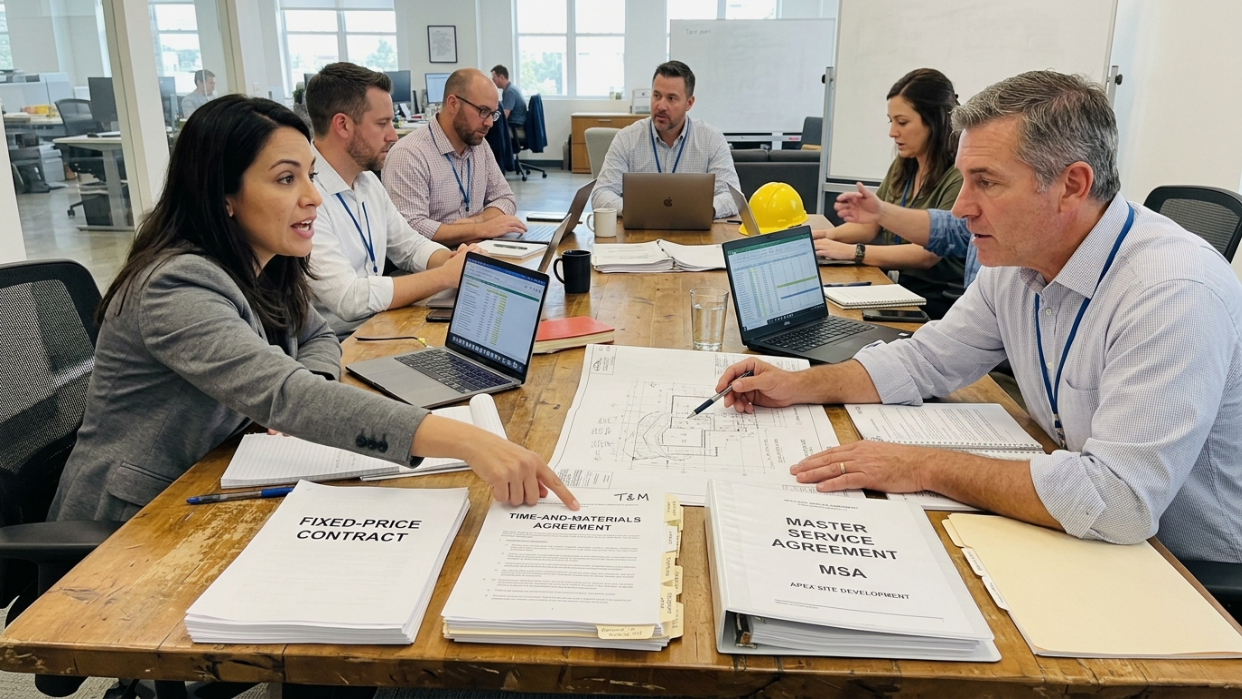
Not all contractor vendor agreements use the same pricing structure. Choosing the right contract type depends on how well you can define the scope upfront.
Fixed-Price Contracts
A predetermined price for goods or services, set before work begins. These work best for projects with clearly defined scopes where the risk of cost overruns is low. The vendor absorbs the risk of going over budget. For material purchases with known quantities, fixed-price is usually the right choice.
Time and Materials Contracts
The vendor bills based on actual time spent and materials used. These offer flexibility for projects where the scope is uncertain or likely to evolve. The buyer absorbs more risk but gains adaptability. Common for maintenance work or emergency repairs where it’s impossible to define the full scope in advance.
Unit Price Contracts
A fixed price per unit of work or product (per cubic yard, per square foot, per linear foot). These are extremely common in construction, especially for concrete, asphalt, and earthwork. They allow the total contract value to flex based on actual quantities while keeping the per-unit cost predictable.
Cost-Reimbursable Contracts
The vendor gets compensated for all project costs plus a negotiated profit margin. Used when costs are genuinely hard to estimate upfront. These require trust and transparency, along with clear documentation of allowable expenses.
Letter Subcontracts
Used for time and materials work when a job is so large it must start before all contract details are finalized. A letter subcontract defines a percentage of the work that may be completed during this preliminary phase, typically not more than 40%. This prevents schedule delays while the full agreement is still being negotiated.
Master Service Agreements (MSAs)
Framework contracts that govern long-term relationships across multiple projects. Individual work orders or statements of work are issued under the MSA’s umbrella terms. For contractors who work with the same vendors repeatedly, MSAs reduce the administrative burden of negotiating a new agreement for every project.
To understand how these contract types fit into a broader construction purchasing strategy, consider how your vendor mix and project pipeline should influence which structures you use most.
Comparison of Construction Vendor Contract Types
Contract Type | Best For | Risk Level | Pricing Flexibility |
|---|---|---|---|
Fixed-Price | Clearly defined scopes | Low for buyer | Low |
Time and Materials | Uncertain scopes | Higher for buyer | High |
Unit Price | Variable quantities | Moderate | Moderate |
Cost-Reimbursable | Complex projects | Higher for buyer | High |
Master Service Agreement | Long-term relationships | Moderate | Moderate |
Construction-Specific Clauses to Watch
This is where contractor vendor agreements in construction diverge sharply from agreements in other industries. These clauses can make or break your cash flow, your liability exposure, and your vendor relationships.
Pay-When-Paid vs. Pay-If-Paid
This is the most financially consequential clause distinction in construction contracting, and most people signing these agreements don’t fully understand the difference.
Pay-when-paid addresses the timing of payment. The general contractor’s obligation to pay the vendor or subcontractor is delayed until the GC receives payment from the owner, but the obligation to pay still exists.
Pay-if-paid shifts the entire risk of the owner’s nonpayment from the general contractor to the subcontractor or vendor. If the owner never pays, the vendor never gets paid. Period.
The real-world impact is severe. Consider this scenario: a framing subcontractor completes a $180,000 scope in March. The GC doesn’t receive payment until June due to an RFI dispute. Under pay-when-paid terms, the sub gets paid in late June, nearly 90 days after completing work, while carrying over $140,000 in unreimbursed labor and material costs the entire time.
In 2019, contractors waited on average 50 to 75 days for payment. Late payments to material suppliers can damage relationships and trigger stricter credit terms on future orders.
Practitioners on construction accounting forums underscore this point. One noted: “The contractors who get hurt the most are those who lack real-time visibility into their cash position. When you don’t know your actual job-level cash flow, a 60-day delay doesn’t feel critical until it’s too late to stop the bleeding.”
Some states restrict or prohibit pay-if-paid clauses entirely. Know your state’s laws before accepting this language.
Lien Waiver Requirements
Lien waivers are documents in which a vendor or subcontractor relinquishes their right to file a mechanic’s lien against the property. They’re typically exchanged at each payment milestone. Your contractor vendor agreements should specify when waivers are required, whether they’re conditional or unconditional, and what form they must take.
Bonding Provisions
You may want to consider bonds when dealing with certain types of vendors. Performance bonds guarantee the vendor will complete the work as specified. Payment bonds guarantee the vendor will pay its own suppliers and laborers. Although bonds aren’t required on all vendor agreements, they can save your business if a vendor fails to deliver on a large order or scope of work.
Retainage Terms
Retainage is the percentage of each payment withheld until the project is complete or a milestone is reached, typically 5% to 10%. Your agreement should clearly state the retainage percentage, the conditions for release, and the timeline. Disputes over retainage are common and expensive when the agreement is ambiguous.
For more on managing the financial dimensions of your vendor relationships, explore strategies for construction cost management.
How to Negotiate Better Vendor Agreements
According to the 2025 Contracting Benchmark Report from Ironclad, vendor agreements are negotiated 70% of the time. You should feel empowered to challenge standard terms rather than accepting them as fixed.
That said, sub-tier parties in construction often face a power imbalance. As ForConstructionPros has reported, sub-tier parties generally don’t have the ability to demand modification of the contract language because the party above has more power, knowing there are always others willing to do the work with the contract as-is.
Here’s how to negotiate from a stronger position.
Research Market Rates
Get multiple quotes before committing. You can’t negotiate effectively without knowing what the market actually charges. Construction cost benchmarking gives you the data to push back on inflated pricing.
Have a BATNA
Another common pitfall is not having a clear “Plan B” or best alternative to a negotiated agreement. If you don’t have other options, you lose all your leverage. Always identify at least two viable alternatives before sitting down to negotiate.
Bundle Purchases
An underutilized strategy in vendor contract negotiations is bundling requests. Instead of negotiating individual items or services separately, group related items together. This can lead to better overall deals because it increases the vendor’s total revenue from the relationship while giving you volume-based discounts.
Focus on Total Value, Not Just Price
The biggest mistake is focusing only on price. A cheap deal with terrible terms can cost you more in the long run through poor quality, delivery delays, or unfavorable payment structures. Evaluate the complete package: warranty terms, delivery reliability, payment flexibility, and support.
Use Collective Purchasing Power
Group purchasing organizations (GPOs) negotiate contracts with suppliers covering pricing, payment terms, service levels, and conditions that individual buyers rarely have the volume to secure on their own. GPOs have been shown to cut supply costs by around 13% for their members compared to individual buyers, with some delivering 15% to 35% reductions across indirect spend categories.
For contractors who want pre-negotiated vendor terms without the overhead of negotiating every agreement individually, contractor buying groups offer a practical solution.
Typical Construction Vendor Agreement Workflow
Most construction companies follow a structured workflow when onboarding vendors and executing agreements.
Step 1: Vendor Prequalification
Review:
insurance certificates
licensing
references
safety history
financial stability
Step 2: Scope Definition
Define:
materials or services
quantities
specifications
delivery expectations
project timelines
Step 3: Contract Review
Review:
payment terms
indemnification
retainage
insurance endorsements
dispute resolution clauses
Step 4: COI Verification
Confirm:
active coverage dates
policy limits
additional insured status
waiver of subrogation language
Step 5: Execution and Tracking
Store signed agreements centrally and track:
renewal dates
insurance expirations
rebate eligibility
vendor performance metrics
Common Mistakes Contractors Make with Vendor Agreements
Poor contract management can cause companies to lose up to 9% of their annual revenue. Here are the mistakes that cost contractors the most.
Using Internet Templates Without Legal Review
Generic templates downloaded from free websites are written for generic businesses. They won’t include construction-specific protections like COI requirements, retainage terms, lien waiver procedures, or pay-when-paid provisions. Getting a template reviewed by a construction attorney costs a fraction of what a single dispute will cost you.
Missing Auto-Renewal Deadlines
Many vendor agreements include auto-renewal clauses with narrow cancellation windows, sometimes as short as 30 days before the renewal date. If you miss the window, you’re locked in for another term. Calendar every renewal date and set reminders 60 to 90 days in advance.
Signing Pay-If-Paid Clauses Without Understanding Them
Too many subcontractors and vendors sign agreements containing pay-if-paid language without realizing they’ve just assumed 100% of the owner’s nonpayment risk. Read every payment clause carefully and understand the difference between pay-when-paid and pay-if-paid before you sign.
Not Requiring COIs Before Work Begins
Allowing a vendor or subcontractor to start work without a current Certificate of Insurance is a gamble with potentially catastrophic consequences. Make COI collection a non-negotiable step in your onboarding process.
Failing to Define Change Order Procedures
Construction projects change. Materials get substituted, quantities increase, timelines shift. Without a documented change order process in your vendor agreement, every modification becomes a negotiation from scratch, and often a dispute.
Ignoring Vendor Classification
Treating a subcontractor as a vendor (or vice versa) to avoid insurance requirements or simplify paperwork creates liability exposure that can surface months or years later in the form of audits, claims, or lawsuits.
For a comprehensive approach to avoiding these pitfalls, review construction purchasing best practices.
Best Practices for Managing Contractor Vendor Agreements
Standardize Agreement Templates
Using standardized templates reduces administrative errors and improves consistency across projects.
Centralize Contract Storage
Store agreements, COIs, and amendments in a centralized system to simplify audits and renewals.
Review Agreements Annually
Construction laws, insurance requirements, and pricing conditions change frequently. Annual reviews help maintain compliance.
Track Insurance Expirations
Expired insurance certificates create major liability exposure if vendors continue working on active projects.
Document All Change Orders
Verbal approvals create disputes. Every scope or pricing change should be documented in writing.
Use Legal Review for Large Contracts
High-value agreements should always be reviewed by a construction attorney familiar with state-specific construction law.
Frequently Asked Questions
What is a contractor vendor agreement?
A contractor vendor agreement is a legally binding contract between a contractor (or construction business) and a vendor that outlines the terms of their commercial relationship. It covers deliverables, payment terms, insurance requirements, termination conditions, and other provisions that protect both parties.
What is the difference between a vendor and a subcontractor in construction?
A vendor sells goods or products to a business. A subcontractor sells services and performs work on a project site. The distinction matters for insurance, since subcontractors must carry workers’ compensation coverage, and for liability allocation. Misclassifying one as the other creates significant financial and legal risk.
What should payment terms look like in a construction vendor agreement?
Payment terms should specify the pricing structure, payment schedule (Net 30, Net 45, etc.), late payment penalties, early payment discounts, and the payment method. In construction, it’s also critical to address retainage percentages, lien waiver exchange requirements, and whether the agreement uses pay-when-paid or pay-if-paid language.
Are vendor agreements negotiable?
Yes. According to the 2025 Contracting Benchmark Report, vendor agreements are negotiated 70% of the time. Contractors should treat initial terms as a starting point rather than a final offer, especially on pricing, payment timelines, and liability provisions.
What insurance should I require from a construction vendor?
At minimum, require general liability insurance (typically $1 to $2 million for construction work), commercial auto coverage if vehicles are involved, and workers’ compensation if the vendor’s employees perform any on-site labor. Most commercial construction contracts also require additional insured endorsements, waiver of subrogation, and primary and non-contributory language.
What is the difference between pay-when-paid and pay-if-paid?
Pay-when-paid delays the timing of payment to a vendor or subcontractor until the general contractor receives payment from the owner, but the payment obligation still exists. Pay-if-paid makes payment entirely contingent on receiving payment from the owner. If the owner never pays, the vendor or sub doesn’t get paid. Some states restrict or prohibit pay-if-paid clauses.
How can small contractors get better vendor agreement terms?
Small contractors can improve their negotiating position by getting multiple competitive quotes, bundling related purchases for volume discounts, maintaining a clear alternative (BATNA), and joining group purchasing organizations that negotiate pre-set terms on behalf of their members. GPOs can deliver significant savings that individual buyers can’t access alone.
Do I need a lawyer to review a contractor vendor agreement?
For any agreement involving significant dollar amounts, ongoing commitments, or jobsite work, yes. A construction attorney can identify risks in indemnification language, payment clauses, insurance provisions, and termination terms that non-lawyers routinely miss. The cost of legal review is minimal compared to the cost of a single contract dispute.

Recent Comments