
TL;DR
A contractor vendor comparison refers to both understanding the difference between contractors and vendors in construction and the process of systematically evaluating them for project selection. Contractors perform project-specific work on site, while vendors supply materials or standard products. Misclassifying the two creates real insurance and liability exposure. A structured comparison process using prequalification, scope leveling, and balanced scorecards produces better outcomes than chasing the lowest bid.
The terms “contractor” and “vendor” get tossed around interchangeably on construction projects, and that creates problems. Not just confusion in meetings, but genuine financial and legal risk. A contractor vendor comparison matters because the distinction between these roles determines insurance requirements, contractual obligations, payment structures, and liability exposure.
This guide covers both sides of the term: what separates contractors from vendors in construction, and how to compare multiple contractors or vendors when you’re selecting one for a project.
If you’re evaluating vendor relationships for upcoming projects, contractor vendor programs can help streamline the process through pre-vetted options.
What is a Contractor Vendor Comparison?
A contractor vendor comparison is the process of evaluating and distinguishing contractors (who perform on-site construction work) from vendors (who supply materials or products), and systematically comparing qualified options based on scope, cost, insurance coverage, risk, and performance—not just price.
It is used to reduce procurement risk, prevent misclassification issues, and ensure fair, apples-to-apples bid evaluation before awarding construction contracts.
Why Contractor Vendor Comparison Matters in 2026
Contractor and vendor selection has become more complex due to rising material costs, tighter insurance requirements, and increased supply chain volatility. In 2026, procurement decisions directly affect:
Project profitability
Insurance exposure
Schedule reliability
Legal compliance
Total lifecycle cost
Poor classification or weak comparison methods can lead to budget overruns, audit penalties, and project delays.
Contractor vs. Vendor: Core Definitions
What Is a Contractor?
A contractor is an individual or company hired to perform specific services or tasks on a project. The work is project-based, time-limited, and governed by a contractual agreement that defines scope, deliverables, timelines, and compensation. Contractors manage their own resources, crews, and methods. They’re paid based on milestones or project completion.
In commercial construction, examples include a concrete finishing crew, an asphalt paving company, or a structural steel erector. These entities show up on site, perform physical work, and carry direct responsibility for execution.
What Is a Vendor?
A vendor sells or delivers products, materials, or standardized services to a project. Sometimes called a dealer, distributor, or merchant, a vendor operates through purchase orders or supply contracts at a fixed price. They have limited involvement in how their products get installed or integrated.
Construction vendor examples include a ready-mix concrete supplier, a rebar fabricator, an asphalt emulsion distributor, or an equipment rental company. They support the project indirectly by providing what contractors need to do the work.
As Danny Markus noted in a LinkedIn discussion on this topic, contractors operate independently and manage their own resources toward project goals, while vendors engage in more of a partnership focused on maintaining a steady and reliable supply chain. That framing (independence vs. partnership) is a useful mental shortcut.
What About Subcontractors?
A subcontractor is hired by a general contractor or construction manager to perform a specific, substantive portion of a construction project. Subcontractors execute physical work and carry their own regulatory compliance obligations. The term often gets confused with “vendor,” but the distinction is significant for insurance, contracts, and risk allocation.
For a deeper look at how these agreements differ, see this guide on contractor vendor agreements.
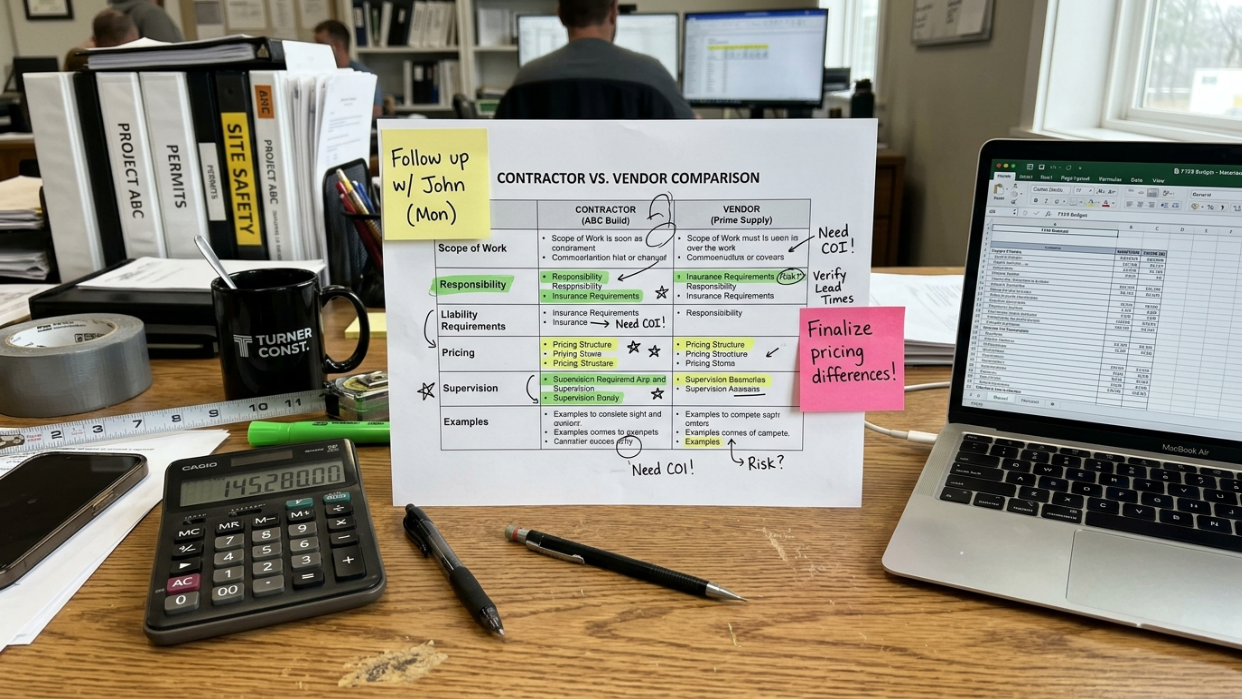
Key Differences: Contractor vs. Vendor Comparison Table
Dimension | Contractor / Subcontractor | Vendor / Supplier |
|---|---|---|
Relationship | Project-specific, time-limited | Ongoing, supply-chain oriented |
Payment model | Milestone-based or project completion | Per-purchase or per-delivery |
Project involvement | Direct execution of physical work | Indirect, materials/equipment delivery |
Insurance required | General liability + workers’ compensation | Product/general liability only (typically) |
Contractual instrument | Subcontract agreement with scope and schedule | Purchase order or supply contract |
Control over methods | Self-managed, independent execution | Specifications set by contractor or architect |
Example | Concrete finishing crew, paving contractor | Ready-mix supplier, rebar fabricator |
This contractor vendor comparison table covers the structural differences, but the real-world implications run deeper than categories suggest.
Why Correct Classification Matters
This is where contractor vendor comparison moves from an academic exercise to a financial one. Misclassifying a vendor as a subcontractor (or vice versa) creates measurable exposure.
Insurance and Liability Risk
In construction, general contractors are typically required to obtain certificates of insurance from all subcontractors. If a vendor gets classified as a subcontractor but doesn’t carry workers’ compensation insurance, the general contractor may be required to pay workers’ comp premiums for that uninsured entity. According to risk managers quoted in Carrier Chronicles (a Safety National publication), misclassifying vendors and subcontractors exposes contractors to costly insurance and liability risks.
This isn’t theoretical. Workers’ compensation audits look at payments made to uninsured subcontractors and add those amounts to the contractor’s payroll for premium calculation. A $200,000 purchase order to a material supplier, if misclassified as a subcontract, could generate thousands in unexpected premium charges.
Top Risks of Misclassifying Contractors and Vendors
Misclassification is one of the most expensive procurement mistakes in construction.
Common consequences include:
Unexpected workers’ compensation premium audits
Lien exposure from unpaid subcontractors
Insurance coverage gaps during site incidents
Contract disputes over scope responsibility
Tax reporting inconsistencies (1099 vs vendor payments)
Real-world impact:
A single misclassified supplier can trigger thousands in audit adjustments if labor exposure is incorrectly assigned.
Compliance Documentation
Proper classification drives what documentation you need to collect:
From subcontractors: Certificate of insurance (general liability + workers’ comp), W-9, trade licenses, safety records, bonding capacity
From vendors: Certificate of insurance (product/general liability), W-9, credit references, delivery terms
Understanding these distinctions is part of broader procurement risk management that protects your bottom line.
The Financial Scale
Procurement accounts for 40% to 70% of a construction company’s total spending. When that much money flows through vendor and subcontractor relationships, getting the classification right on every entity matters. Project delays alone can increase costs by 10-15% through extended labor, equipment rental, and overhead. Many of those delays trace back to procurement failures, including poorly managed vendor relationships.
Contractor vs Vendor vs Subcontractor: Quick Comparison
Category | Contractor | Vendor | Subcontractor |
|---|---|---|---|
Work type | On-site execution | Material/product supply | Specialized on-site work |
Contract type | Subcontract agreement | Purchase order | Subcontract agreement |
Project role | Direct labor execution | Indirect support | Direct labor execution |
Insurance risk | High | Low–medium | High |
Payment method | Milestones / progress billing | Per delivery | Milestones / progress billing |
Example | Concrete crew | Ready-mix supplier | Electrical subcontractor |
How to Compare Contractors and Vendors: A Practical Framework
Whether you’re evaluating three concrete subcontractors for a foundation project or comparing four ready-mix suppliers for a large pour, the contractor vendor comparison process follows a similar structure.
Step 1: Prequalification
Before comparing bids, filter out entities that can’t meet baseline requirements. During prequalification, contractors and vendors should provide:
Valid licenses and certifications
Proof of insurance (appropriate to their classification)
Financial references or statements
Safety records (EMR, OSHA citations)
Employee profiles and relevant experience
Historical project portfolio with references
Full-featured prequalification platforms like ISNetworld charge subcontractors $875+ per year just to register, which gives you a sense of how seriously the industry takes this step.
For a complete approach to finding and filtering potential partners, the vendor sourcing guide walks through the process in detail.
Step 2: Bid Comparison and Scope Leveling
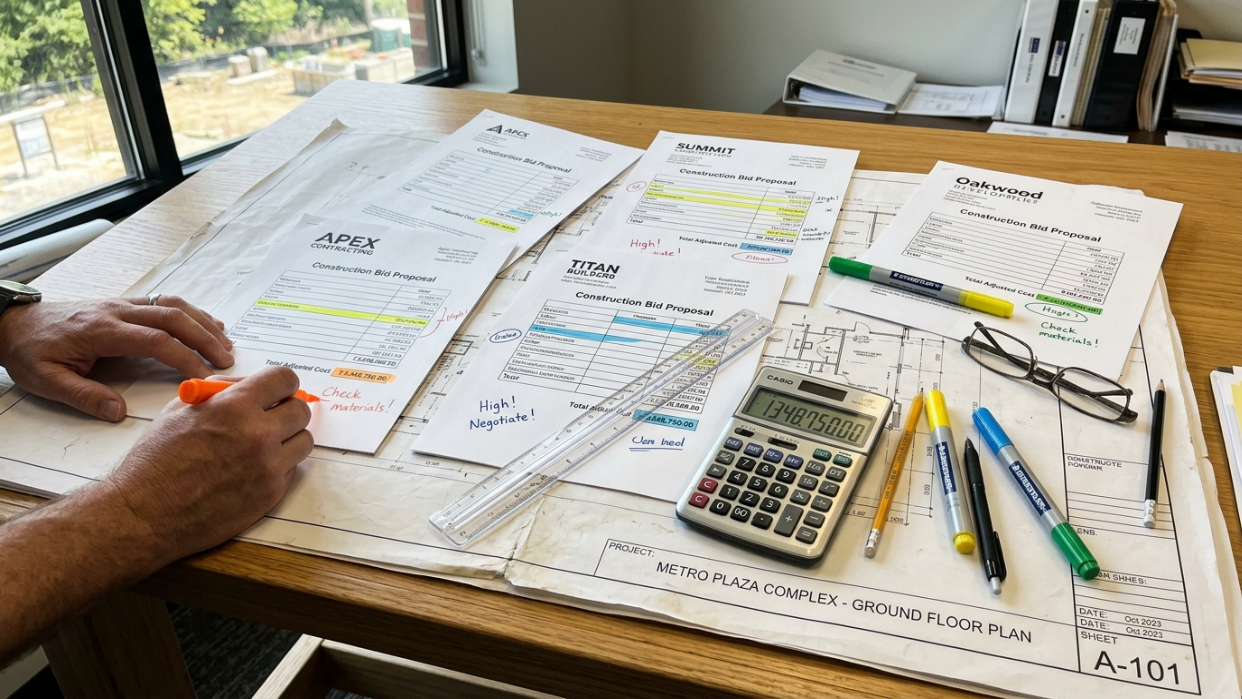
Once qualified entities submit bids, the comparison begins. Itemize costs across consistent categories: labor, materials, equipment, permits, and overhead. The critical step most people skip is scope leveling, which means ensuring every bid covers the same tasks and deliverables before comparing prices.
A paving bid that excludes milling and a paving bid that includes it aren’t comparable at face value. Neither is a concrete bid that includes rebar supply versus one that assumes owner-furnished reinforcement. Direct costs (materials and labor) typically represent 60-70% of the total project budget, so even small scope discrepancies create large price differences.
Step 3: The Balanced Scorecard Approach
Price comparison alone is insufficient. A balanced scorecard evaluates vendor and contractor performance across four dimensions:
Relationship quality: Communication, responsiveness, willingness to problem-solve
Cost management: Not just initial price but change order history, billing accuracy, and total cost of engagement
Quality: Workmanship standards, defect rates, rework frequency
Delivery: Schedule adherence, material lead times, crew availability
This methodology gauges how a vendor’s or contractor’s performance aligns with your project goals, not just their price point. For contractors comparing vendor pricing across multiple projects, construction cost benchmarking provides useful reference points.
Contractor Vendor Comparison Scorecard Template
Category | Weight (%) | Contractor A | Contractor B | Vendor C |
|---|---|---|---|---|
Price | 25% | |||
Quality | 25% | |||
Delivery reliability | 20% | |||
Safety record | 15% | |||
Financial stability | 15% |
How to use:
Multiply each score by its weight, then sum results to identify the strongest overall performer—not just the cheapest bid.
Step 4: Check the Risk Behind the Price
One practitioner in a Reddit construction discussion framed it well: construction cost is heavily driven by risk and scope uncertainty, so meaningful negotiation means identifying the parts of the price tied to risk, then reducing those risks to reduce cost. If a vendor is pricing in a 15% contingency for material volatility, and you can offer a longer commitment or more predictable order schedule, that contingency shrinks.
AGC reported that the producer price index for nonresidential construction materials and services rose 3.6% over 12 months in their November 2025 analysis, while contractors’ bid prices rose only 2.7% over the same period. That gap means contractors are absorbing material cost increases. Smarter vendor comparison and negotiation tactics can help close it.
Common Mistakes in Contractor Vendor Comparison
Comparing bids without normalizing scope. This is the most frequent error. Two bids that look $50,000 apart may actually be $5,000 apart once you account for scope differences. Always create an apples-to-apples comparison before evaluating price.
Ignoring insurance gaps. A subcontractor without adequate workers’ comp coverage shifts that liability to you. A vendor without product liability insurance leaves you exposed if defective materials cause damage. Check every certificate, every time.
Choosing based on relationship alone. Practitioners on ProcurePro note that most contractors still rely on spreadsheets for vendor tracking, if they track performance at all. “Rows of names, random notes, and half-remembered phone calls about late arrivals” is the reality on the ground. Relationships matter, but performance data should back up your gut feeling.
Always chasing the lowest price. Vendor management isn’t just about picking the best price. It’s about managing risk, ensuring compliance, and getting the job done without surprises. The lowest bidder who misses delivery deadlines or delivers inconsistent material quality costs more in the end.
Not checking financial health. A vendor or subcontractor in financial distress is a project risk. Request financial references or check bonding capacity. Entities that can’t pay their own suppliers create lien exposure on your project.
For a broader framework on avoiding these pitfalls, the procurement planning checklist covers each phase of the selection process.
Building Long-Term Vendor Relationships
A single contractor vendor comparison is useful. A systematic approach to vendor management is transformational. Construction tech adoption has climbed 20% year over year according to Deloitte’s 2023 analysis, with the average general contractor now running 6.2 digital tools. But technology alone doesn’t fix vendor management. The underlying strategy matters more.
Effective procurement strategies can result in 10-15% cost reductions through optimized supplier agreements and bulk purchases. That’s where organized approaches, like buying groups and construction vendor partnerships, create advantages that individual negotiation can’t match.
When contractors pool purchasing volume, they gain pricing leverage that makes every future vendor comparison start from a stronger position. Explore how contractor supplier discounts work in practice and how they can shift your cost structure.
Frequently Asked Questions
What is the difference between a vendor and a subcontractor in construction?
A vendor supplies materials, equipment, or standardized products to a project through purchase orders. A subcontractor performs physical construction work under a subcontract agreement. The key differences are in insurance requirements (subcontractors need workers’ comp, vendors typically don’t), project involvement (subcontractors work on site, vendors deliver to it), and contractual structure.
Do vendors need the same insurance as contractors?
No. Vendors generally need product liability and general liability insurance. Contractors and subcontractors need general liability plus workers’ compensation insurance. The distinction matters because misclassifying a vendor as a subcontractor can trigger workers’ comp premium charges for the general contractor.
How do buying groups help contractors compare vendors?
Buying groups aggregate purchasing volume across multiple contractors, which gives individual members access to pre-negotiated pricing and vetted vendor relationships. This simplifies the contractor vendor comparison process because pricing, terms, and quality standards are already established. Learn more in this construction buying group guide.
What documents should a vendor provide during prequalification?
At minimum: certificate of insurance, W-9, business licenses, credit references, and product certifications. For larger supply contracts, also request financial statements, delivery performance records, a client reference list, and documentation of quality control processes.
Is the lowest bid always the best choice for a contractor or vendor?
No. The lowest bid frequently excludes scope items, underestimates quantities, or reflects an entity in financial distress trying to win work at any cost. A balanced evaluation that weighs cost alongside quality, delivery reliability, safety record, and financial stability produces better project outcomes.
How often should contractor vendor comparisons be repeated?
At least annually for ongoing supply relationships, and for every new project when selecting subcontractors. Market conditions shift, vendor performance changes, and insurance coverages lapse. Regular comparison keeps your vendor roster current and your pricing competitive.
What is scope leveling in bid comparison?
Scope leveling is the process of adjusting competing bids so they cover identical work items before comparing prices. This means adding the cost of excluded items to lower bids and removing the cost of extras from higher bids, creating a true apples-to-apples comparison.
How does contractor vendor comparison improve project profitability?
It improves profitability by reducing procurement waste, preventing scope overlap, improving bid accuracy, and selecting partners that minimize delays and rework. Even small improvements in vendor selection can reduce total project costs by 10–15% in large construction projects.

Recent Comments