
TL;DR
A contractor vendor strategy is the deliberate system a construction company uses to select, segment, manage, and optimize its vendors across projects. It replaces ad-hoc supplier choices with documented processes for prequalification, performance tracking, sourcing decisions, and negotiation. Procurement accounts for 40% to 70% of a contractor’s total spending, so even small improvements in vendor strategy translate to outsized margin gains. Most contractors have vendor habits, not vendor strategies, and that distinction costs them 5 to 15% in potential savings.
What is a contractor vendor strategy?
A contractor vendor strategy is a structured system construction companies use to select, segment, and manage suppliers and subcontractors to improve cost control, reduce project risk, and increase procurement efficiency. It replaces informal vendor selection with data-driven processes such as prequalification, performance scorecards, and strategic sourcing models (single, dual, or multi-sourcing). Companies with strong vendor strategies typically reduce procurement costs by 5–15% and improve project delivery reliability.
What Is a Contractor Vendor Strategy?
A contractor vendor strategy is the structured plan a construction company uses to select, segment, manage, and optimize its network of material suppliers, subcontractors, equipment providers, and service vendors across projects. It answers three questions: who do you buy from, how do you manage those relationships, and how do you improve them over time?
This is different from calling the same concrete supplier you used on your last three jobs because they pick up the phone. That’s a vendor habit. A strategy means intentional decisions backed by data on spend, risk, performance, and market conditions.
Think of it this way. Vendor management is what happens on a single project: tracking deliveries, checking compliance, resolving disputes. Vendor strategy sits above all of that. It’s the overarching plan that dictates which vendors get which level of attention, which categories get competed aggressively, and which relationships get nurtured over years.
If you’re evaluating how your current vendor relationships stack up, a good starting point is understanding how contractor vendor programs can formalize what might currently be informal.
Why Contractors Need a Formal Vendor Strategy
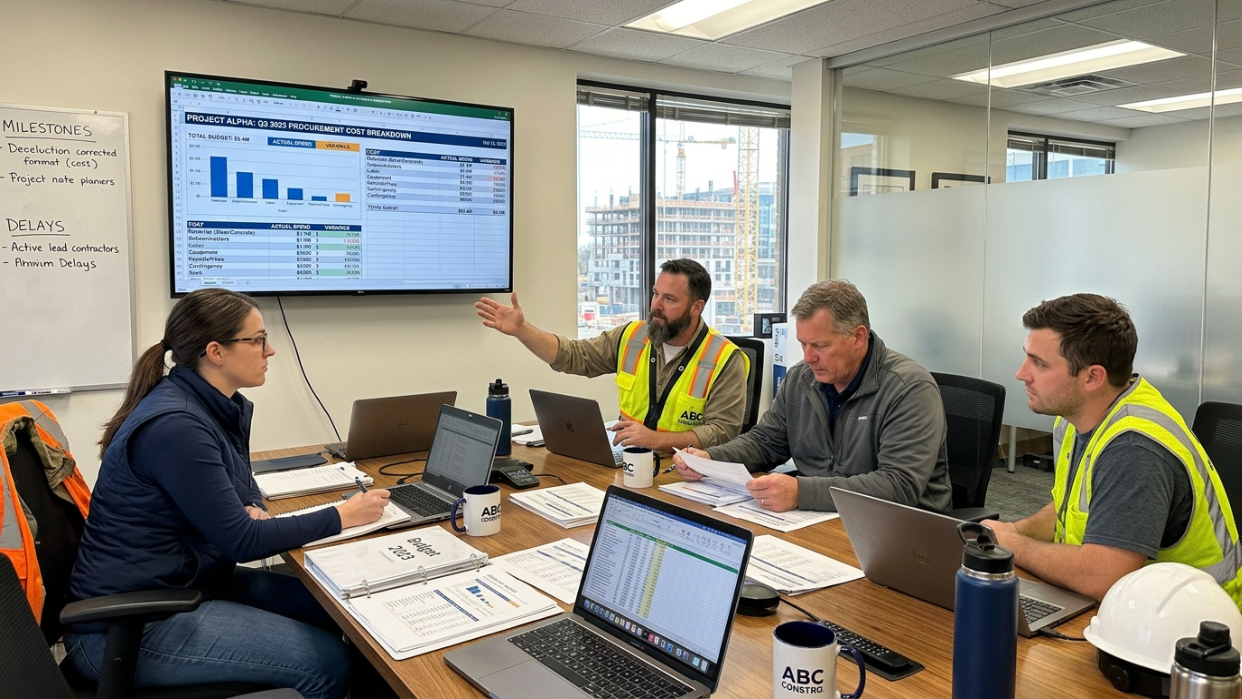
Construction is not a forgiving industry when it comes to procurement mistakes. Only half of construction companies report finishing projects on time, and 87% say their work faces increasing scrutiny, according to a KPMG survey. When projects go sideways, the root cause is rarely the design or the scope. It’s usually a subcontractor or supplier issue. The warning signs were probably there, but without the right system, nobody could see them.
The financial case is even more direct. McKinsey reports that procurement typically accounts for 40% to 70% of a construction company’s total spending, and that best-in-class procurement practices can produce margins five to ten percentage points higher than laggards. For a mid-size contractor doing $50 million in annual revenue, that’s not a rounding error. That’s the difference between growing and going under.
40% of engineering and construction firms experienced schedule delays or cost impacts exceeding 20% in 2023, per KPMG’s Global Construction Survey. Many of those overruns trace back to supply chain disruptions that a more intentional vendor strategy could have mitigated, whether through dual-sourcing critical materials, prequalifying backup subcontractors, or negotiating price holds in volatile categories.
Practitioners on construction forums frequently point to a pattern: when vendor oversight changes from project to project, so do the outcomes. If subcontractor issues keep repeating, it’s not bad luck. It’s the process. A formal contractor vendor strategy replaces that inconsistency with a repeatable system.
For a deeper look at where procurement savings actually come from, see our guide on construction procurement savings.
Vendor Strategy Impact Summary
Area | Without Strategy | With Vendor Strategy |
|---|---|---|
Procurement Costs | Uncontrolled | 5–15% savings potential |
Vendor Performance | Inconsistent | Scorecard-driven accountability |
Risk Exposure | High (reactive) | Reduced via segmentation |
Pricing Power | Weak | Strong via consolidation |
Project Delays | Frequent | Reduced via dual-sourcing |
Key Benefits of a Contractor Vendor Strategy
A structured vendor strategy delivers measurable operational and financial improvements across construction projects:
Cost Optimization
Centralizing procurement decisions allows contractors to negotiate better pricing, reduce duplication, and leverage volume discounts across projects.
Reduced Project Risk
Vendor segmentation and prequalification reduce the likelihood of subcontractor failure, supply disruptions, or compliance issues.
Improved Schedule Reliability
Dual-sourcing and performance tracking reduce delays caused by vendor dependency or underperformance.
Better Vendor Accountability
Scorecards ensure vendors are evaluated objectively rather than based on relationships or convenience.
Stronger Negotiation Position
Historical performance data and spend visibility improve leverage during contract negotiations.
Common Use Cases of Contractor Vendor Strategy
Contractor vendor strategies are typically implemented to solve the following challenges:
Unpredictable subcontractor performance across projects
Rising material costs and inconsistent supplier pricing
Lack of visibility into total vendor spend
Frequent project delays caused by procurement issues
Difficulty managing multiple vendors across job sites
Weak negotiation leverage with suppliers
Core Components of a Contractor Vendor Strategy
A complete vendor strategy has six pillars. Most contractors do one or two of these well and ignore the rest. The contractors who protect their margins do all six.
Vendor Segmentation: Not Every Vendor Deserves Equal Attention
This is where most contractor vendor strategies should start, and where almost none do. The instinct is to treat every vendor the same: send an RFP, pick the lowest bidder, manage the relationship identically. That’s a mistake. Your concrete supplier and your safety equipment vendor require completely different levels of strategic attention.
The Kraljic Matrix, originally developed for manufacturing procurement, adapts well to construction. It segments what you buy into four categories based on two factors: how much you spend (profit impact) and how hard it is to find alternatives (supply risk).
Construction Vendor Segmentation Grid
Low Supply Risk | High Supply Risk | |
|---|---|---|
High Spend Impact | Leverage (concrete, rebar, lumber): Compete aggressively, multi-source | Strategic (specialty subs, critical equipment): Build partnerships, co-plan schedules |
Low Spend Impact | Non-Critical (office supplies, safety consumables): Automate, simplify | Bottleneck (niche materials, sole-source items): Secure supply, find alternatives |
This grid changes how you allocate time. You don’t need quarterly business reviews with your office supply vendor. But your specialty subcontractor who handles post-tension slab work? That relationship deserves real investment, because losing them mid-project could cost weeks.
No ranking page on this topic currently presents this framework in a construction-specific way. Yet it’s the single most useful tool for deciding where to focus.
Sourcing Strategy: Single, Dual, or Multi-Source

Once you’ve segmented your vendors, you need a sourcing model for each category. The three options are straightforward, but the trade-offs are not.
Single-sourcing means buying a category from one vendor. You get volume pricing, simpler management, and a deeper relationship. The downside is obvious: if that vendor fails, you have no backup. According to Deloitte, 63% of public companies have increased dual and multi-sourcing specifically to reduce this risk.
Dual-sourcing splits a category between two vendors. Construction companies often use this for high-spend materials like steel or concrete, where demand fluctuates and market conditions shift fast. You maintain competitive tension while still giving each vendor enough volume to care about the relationship.
Multi-sourcing spreads purchases across three or more vendors. This works for commodity materials (standard lumber, gravel, basic hardware) where price is the main differentiator and switching costs are low. But splitting every category across multiple vendors destroys the volume that drives better pricing.
The right answer depends on the category. Strategic items get single or dual-sourced with deep partnerships. Leverage items get competed across two to three vendors. Non-critical items get simplified, maybe through a preferred vendor program that handles the selection automatically.
For a complete breakdown of sourcing approaches, see our contractor vendor sourcing guide.
Prequalification: Vet Before You Hire
Prequalification is the checkpoint that prevents bad vendors from entering your pipeline. Once a vendor responds to a request for prequalification, they present documents that verify compliance and financial health. Common documents include references, employee certifications, financial history, insurance certificates, safety records (EMR rates), and a portfolio of past projects.
The goal is not to create a bureaucratic gauntlet. It’s to catch the obvious problems before they become your problems. A subcontractor with lapsed insurance or a history of OSHA violations isn’t someone you want discovering during a project audit.
Good prequalification also builds your vendor network over time. Every qualified vendor goes into a database, categorized by trade, capacity, location, and past performance. When a new project starts, you’re not scrambling for bids. You’re pulling from a curated list.
Performance Scorecards: Measure What Matters
You can’t improve what you don’t track. Performance scorecards are the mechanism that turns subjective opinions (“they were okay”) into objective data you can act on.
Define five to eight key performance indicators: timeliness, quality of work, safety compliance, cost control, responsiveness to RFIs, and change order management are common choices. Assign weights to each metric based on what matters most to your operation. Design a scoring system, and make sure all project managers use a standardized template.
Organizations that implement structured vendor scorecards report a 15 to 25% reduction in supply chain risks. Gartner found that formal supplier scorecards generate twice the number of applied supplier ideas, meaning vendors actually start suggesting improvements when they know they’re being measured.
Best practice is to review scorecards after each project milestone or at least quarterly. Five to ten focused KPIs are more actionable than thirty diluted ones. For guidance on which metrics matter most, our overview of procurement KPIs and metrics goes deeper.
As one quantity surveyor put it on a construction forum, “You don’t know if they’re good, you just know they weren’t a disaster last time.” Scorecards replace that guesswork.
Contract and Negotiation Framework
Negotiation is where vendor strategy converts directly to dollars saved. But effective negotiation requires data, not just pressure.
Successful strategies involve trading volume commitments, faster payment terms (such as 2/10 Net 30), or cleaner scopes for specific concessions: unit price reductions, freight caps, extended price holds, or priority scheduling during peak season. The key is understanding what your vendor values and structuring deals where both sides win.
Contractors who negotiate category by category, armed with scorecard data and market benchmarks, consistently outperform those who approach every negotiation the same way. For specific techniques, see our piece on vendor price negotiation tactics.
Volume Leverage and Buying Groups
A centralized procurement model, where a single team handles purchasing across all projects, concentrates your company’s total buying power. Instead of each project manager negotiating separately (and often paying different prices for the same material), one team builds consistent relationships with key vendors and negotiates enterprise-level terms.
Businesses can save 5 to 15% through centralized purchasing approaches. For contractors who lack the individual volume to command top-tier pricing, buying groups and purchasing alliances aggregate demand across multiple companies to achieve the same effect.
This pillar of vendor strategy is especially relevant for mid-size contractors who are too big to ignore procurement efficiency but too small to get the pricing that national firms command. A construction buying group can bridge that gap.
Vendor Management vs. Vendor Strategy vs. Supplier Relationship Management
These three terms get used interchangeably, which causes confusion. They’re related but distinct.
Vendor Management | Vendor Strategy | Supplier Relationship Management | |
|---|---|---|---|
Scope | Single project or purchase order | Entire vendor portfolio across all projects | Long-term partnerships with top-tier vendors |
Focus | Delivery, compliance, payment | Segmentation, sourcing models, portfolio optimization | Collaboration, joint planning, innovation |
Timeframe | Project duration | Annual or multi-year | Ongoing, often multi-year |
Who owns it | Project manager or superintendent | Procurement lead or company leadership | Strategic procurement or executive team |
Example | Tracking whether rebar arrives on Tuesday | Deciding to dual-source rebar across two regions | Co-developing a just-in-time delivery system with your primary steel supplier |
Vendor management is a tactical subset of supplier relationship management, which takes a strategic approach to developing long-term, collaborative partnerships. Vendor strategy sits above both. It’s the plan that tells you which tactics to apply to which vendors, and which relationships deserve the investment of true partnership.
A useful distinction: procurement is the full process of identifying needs, researching markets, selecting vendors, negotiating contracts, purchasing materials, scheduling deliveries, and assessing performance. Purchasing is one specific step within that process, focused on the actual transaction. Vendor management is another step. A contractor vendor strategy is what connects all of these steps into a coherent system. For more on how these pieces fit together, our guide on construction purchasing strategy breaks down the distinctions.
Common Mistakes in Contractor Vendor Strategy
Treating all vendors the same. Without segmentation, your project manager spends as much time managing a $5,000 safety supply order as a $500,000 concrete package. That’s not just inefficient. It means your strategic vendors don’t get the attention they need.
Relying on gut feel instead of data. A contracts admin picks a subcontractor they worked with years ago, but there’s no record of past performance, no scorecard, no documentation. The choice feels safe but it’s actually uninformed.
Focusing only on cost. Too often there’s a singular focus on cost reduction, with risk management, communication quality, and schedule reliability falling by the wayside. The cheapest bid from a vendor with a history of delays isn’t actually cheap.
Skipping the post-project vendor review. If you don’t evaluate vendor performance after project completion, your next project starts from the same uncertain baseline. Scorecard data only compounds in value if you actually collect it.
Fragmenting your vendor base without reason. Coordinating five to ten manufacturing partners means duplicating supplier qualifications, quality audits, delivery schedules, and invoice reconciliation. Teams managing fragmented vendors can spend 30 to 40% of their working hours on administrative coordination instead of strategic sourcing. Fragmentation has a hidden cost that rarely shows up in procurement budgets.
How to Build a Contractor Vendor Strategy: Seven Steps
Step 1: Audit your current vendor base. List every vendor, subcontractor, and supplier you’ve used in the last 12 to 24 months. Include total spend, number of projects, and any performance notes (even informal ones).
Step 2: Segment vendors by risk and spend impact. Use the construction vendor segmentation grid above. Plot each vendor category into one of four quadrants. This immediately clarifies where to focus.
Step 3: Choose a sourcing model per category. Leverage categories get competed. Strategic categories get partnership investment. Bottleneck categories get supply security measures. Non-critical categories get simplified or automated.
Step 4: Set prequalification standards. Define the minimum documentation, certifications, insurance levels, and safety records required for a vendor to enter your approved list. Apply these consistently.
Step 5: Build a scorecard with five to eight KPIs. Timeliness, quality, safety, cost control, and responsiveness are the core five. Add category-specific metrics as needed. Standardize the template across all project managers.
Step 6: Negotiate with data, not threats. Use scorecard results, spend data, and market benchmarks to inform every negotiation. Trade volume commitments and payment terms for the concessions that matter most to your bottom line.
Step 7: Review and iterate quarterly. A contractor vendor strategy is not a document you create once and file away. Review vendor performance quarterly. Reassess segmentation annually. Adjust sourcing models when market conditions shift.
On a mid-size commercial development project, a project manager may be coordinating with 30 to 80 active vendors at any given time. AI tools are now being used for invoice reconciliation, compliance tracking, and vendor risk flagging. But when a contractor disputes a rejected pay application or challenges a back charge, the resolution requires relationship judgment, legal awareness, and negotiating discretion. No automated system should be making those calls. Technology supports vendor strategy. It doesn’t replace it.
Contractor Vendor Strategy Implementation Timeline
Phase | Timeline | Key Actions |
|---|---|---|
Phase 1: Audit | Weeks 1–2 | Vendor inventory + spend analysis |
Phase 2: Segmentation | Weeks 2–3 | Kraljic matrix classification |
Phase 3: Framework Design | Weeks 3–5 | Sourcing models + KPIs |
Phase 4: Prequalification Setup | Weeks 4–6 | Vendor onboarding system |
Phase 5: Scorecard Rollout | Weeks 5–8 | KPI tracking implementation |
Phase 6: Optimization | Ongoing | Quarterly reviews + renegotiation |
The Bottom Line
Most contractors leave money on the table because they manage vendors reactively instead of strategically. A contractor vendor strategy, built on segmentation, data-driven scorecards, and intentional sourcing decisions, is how you stop that leak. With procurement representing 40 to 70% of total construction spending, even a 5% improvement in how you manage that spend changes your financial trajectory.
The contractors who build real vendor strategies don’t just save money. They get better subcontractor performance, fewer supply disruptions, and stronger negotiating positions that compound over time.
Ready to see what structured vendor strategy looks like in practice? Explore our guide on construction vendor partnerships for the next step.
Tools Used in Contractor Vendor Strategy
Modern contractor vendor strategies increasingly rely on digital tools to improve accuracy and efficiency:
Procurement management systems for vendor tracking and approvals
Vendor scorecard dashboards for performance evaluation
ERP systems for spend visibility and contract management
AI tools for invoice matching and anomaly detection
Project management software for procurement coordination
Frequently Asked Questions
What is the difference between vendor management and vendor strategy?
Vendor management is the tactical, project-level work of tracking deliveries, verifying compliance, and managing payments. A vendor strategy is the overarching plan that determines which vendors to work with, how to segment them by importance, what sourcing model to use for each category, and how to optimize the entire portfolio over time. Strategy informs management, not the other way around.
How do contractors segment their vendors?
The most effective approach adapts the Kraljic Matrix to construction. Vendors are categorized based on two dimensions: spend impact (how much money flows through that category) and supply risk (how difficult it would be to switch vendors). This produces four quadrants: leverage, strategic, non-critical, and bottleneck. Each quadrant gets a different management approach.
What KPIs should a contractor track on a vendor scorecard?
Start with five to eight focused metrics. The most common are timeliness of delivery or completion, quality of work, safety compliance (EMR rates, incident history), cost control (change order frequency), and responsiveness to communication and RFIs. Weighted scoring lets you emphasize what matters most to your operation.
Is single-sourcing or multi-sourcing better for construction materials?
Neither is universally better. Single-sourcing gives you volume pricing and deeper relationships but creates supply risk. Multi-sourcing reduces risk but dilutes your purchasing power. The right choice depends on the category. High-spend, low-risk materials often benefit from dual-sourcing, while strategic or specialty categories may warrant single-source partnerships with contingency plans.
How often should a contractor review their vendor strategy?
Vendor performance scorecards should be reviewed after major project milestones or at least quarterly. The broader strategy, including segmentation, sourcing models, and the approved vendor list, should be reassessed annually or whenever significant market conditions change (material price spikes, supply chain disruptions, or major shifts in project volume).
Can small contractors benefit from a vendor strategy?
Yes, arguably more than large ones. Small contractors often lack the purchasing volume to command top-tier pricing on their own, which makes strategic decisions about sourcing, segmentation, and buying group membership even more impactful. Businesses that centralize purchasing, even at a small scale, can save 5 to 15% compared to ad-hoc approaches.
What documents should contractors require during vendor prequalification?
At a minimum: proof of insurance (general liability, workers’ compensation), relevant trade licenses and certifications, financial references or statements, safety records including EMR rates, a portfolio of comparable past projects, and at least three client references. Some contractors also require proof of bonding capacity for subcontractors on larger projects.
How does a vendor strategy connect to overall project profitability?
Procurement typically represents 40 to 70% of a construction company’s total spending. McKinsey data shows that best-in-class procurement practices produce margins five to ten percentage points higher than companies with poor procurement discipline. A vendor strategy is the mechanism that turns procurement from a cost center into a competitive advantage.
How does vendor segmentation improve construction procurement?
Vendor segmentation improves procurement by categorizing suppliers based on spend impact and supply risk, allowing contractors to allocate resources more efficiently and reduce exposure to high-risk vendors.
What is the biggest mistake in contractor vendor management?
The biggest mistake is treating all vendors equally instead of prioritizing strategic vendors. This leads to wasted management effort and weaker performance from critical suppliers.
What industries use vendor strategy besides construction?
Vendor strategy is widely used in manufacturing, oil and gas, infrastructure development, and large-scale engineering projects where procurement represents a significant portion of total costs.

Recent Comments