
TL;DR
Contractor PPE discount programs are organized arrangements that give construction firms access to safety equipment below standard pricing. They include trade association memberships, group purchasing organizations (GPOs), supplier tiered pricing, vendor rebates, bulk purchasing deals, and early payment discounts. With tariffs threatening to raise PPE costs, OSHA’s 2025 fit rule expanding required SKUs, and material inflation squeezing margins, these programs have become a financial necessity rather than a nice-to-have. GPO members pay roughly 13% less on average than firms negotiating alone.
Contractor PPE Discount Programs at a Glance
Contractor PPE discount programs help construction companies reduce safety equipment costs through negotiated pricing, purchasing groups, supplier incentives, and payment discounts. The right program depends on annual PPE spend, workforce size, purchasing volume, and the number of active suppliers.
For most contractors:
– Under $25,000 annual PPE spend: Supplier discounts and early-payment terms usually provide the best value.
– $25,000–$100,000 annual PPE spend: Supplier tiered pricing and trade association programs become worthwhile.
– Over $100,000 annual PPE spend: Group Purchasing Organizations (GPOs) generally provide the greatest long-term savings because they combine negotiated pricing, rebates, and purchasing leverage.
Rather than relying on a single discount source, many contractors stack multiple programs together to maximize savings while maintaining OSHA compliance.
Why Contractor PPE Costs Deserve Your Attention Right Now
Personal protective equipment is not a line item most contractors get excited about. Hard hats, safety glasses, gloves, high-visibility vests, hearing protection, respirators. It’s the stuff you need on every job, for every worker, every single day. And the bills add up fast.
PPE budgets on a single construction project can range from $50,000 to $150,000 or more, depending on project hazards and equipment quality. Multiply that across several active projects and the annual spend becomes significant. The U.S. PPE market alone is valued at $26.06 billion by 2026, and the global market is projected to reach $129.18 billion by 2034.
Three forces are converging to push those costs higher:
OSHA’s January 2025 fit rule. The revised language in 29 CFR 1926.95© now requires PPE to be selected so that it “properly fits each affected employee.” That means contractors can no longer stockpile one-size-fits-all gear and call it compliant. More sizes, more SKUs, more cost per crew.
Tariff pressure on imported safety equipment. The International Safety Equipment Association (ISEA) warns that tariffs enacted on and after April 2, 2025, could make it harder for American businesses to afford critical protective gear. Their report projects that even a 1% increase in workplace injuries linked to reduced PPE use could result in 40,000 additional injuries and cost the economy $1.8 billion annually.
Broad material cost inflation. JLL reports that material prices in 2025 averaged roughly 4.2% above 2024 levels, with tariff impacts expected to range from 5% to 25% depending on the material type. Aggregate construction costs are projected to rise approximately 8% under current trade policy conditions.
For contractors already dealing with rising supply costs, PPE is no longer something you can afford to buy without a strategy.
What Are Contractor PPE Discount Programs?
A contractor PPE discount program is any organized arrangement, through trade associations, group purchasing organizations, supplier partnerships, or bulk purchasing agreements, that gives construction firms access to safety equipment at prices below standard retail or list pricing.
The goal is straightforward: lower per-unit PPE costs while maintaining compliance with OSHA standards and quality expectations.
These programs exist because individual contractors, even large ones, rarely have enough purchasing volume in any single PPE category to negotiate meaningful price breaks on their own. By pooling demand or formalizing purchasing relationships, contractors gain access to pricing tiers that would otherwise be reserved for much larger buyers.
This concept applies broadly across construction procurement. If you’re new to organized discount structures, our contractor supplier discounts guide covers the fundamentals in detail.
What PPE Categories Do These Programs Cover?
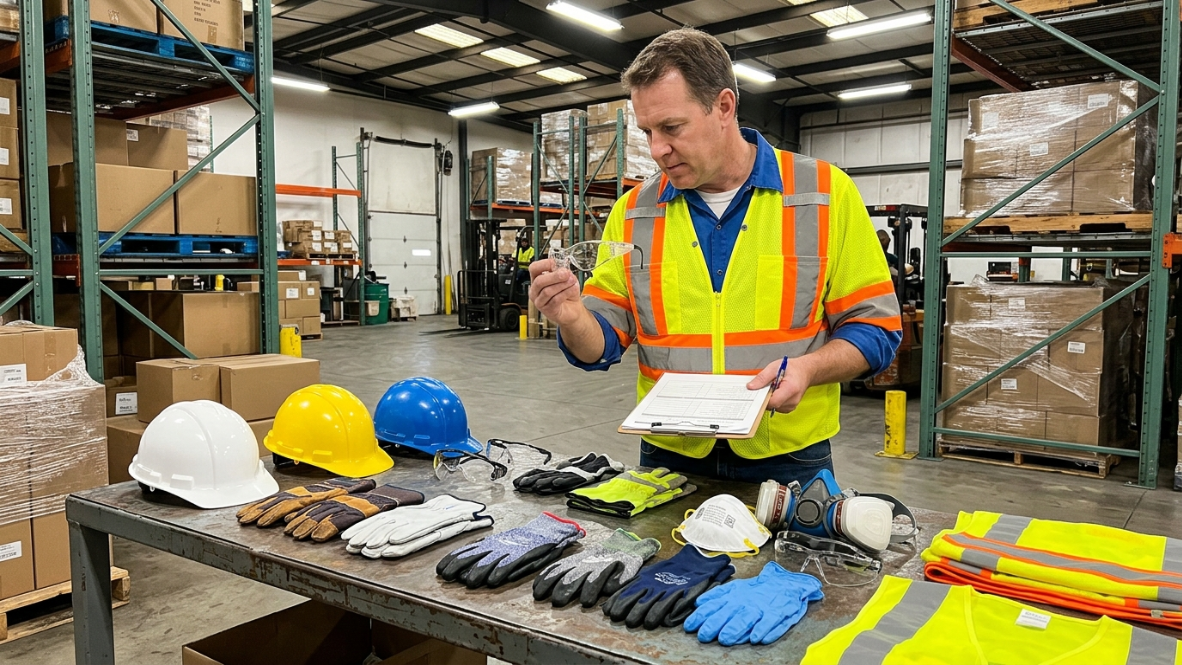
Before evaluating programs, it helps to understand what falls under the PPE umbrella in construction. The most common categories in bulk orders include:
Head protection: Hard hats, safety helmets
Eye and face protection: Safety glasses, goggles, face shields
Hand protection: General-purpose gloves, chemical-resistant gloves, cut-resistant gloves
Foot protection: Safety-toe boots, metatarsal guards
High-visibility clothing: Vests, jackets, shirts meeting ANSI/ISEA 107 standards
Hearing protection: Earplugs, earmuffs
Respiratory protection: Disposable respirators, half-face and full-face respirators
Fall protection: Harnesses, lanyards, self-retracting lifelines
Specialty items: Welding PPE, electrical PPE, arc-flash gear, coveralls, rainwear
Under 29 CFR 1926.95(d), employers generally must provide required PPE at no cost to employees, with limited exceptions for non-specialty safety-toe footwear and non-specialty prescription safety eyewear when off-site use is allowed. That employer cost burden is exactly why discount programs matter. Safety is non-negotiable, and for now, providing PPE is a cost of doing business.
The Six Types of Contractor PPE Discount Programs

1. Trade Association Member Programs
This is the most visible model. Organizations like the Associated General Contractors of America (AGC) negotiate group discounts with major suppliers and pass those savings to members. AGC members saved over $14 million in a single year using their member discount programs.
For PPE specifically, AGC chapters partner with suppliers like Airgas, offering members exclusive pricing on safety equipment, fall gear, workwear, and more. Other associations bundle safety training discounts alongside equipment pricing, such as AGC’s partnership with ClickSafety for a 10% discount on training courses.
The catch: association programs typically cover a broad range of vendor categories (office supplies, rental equipment, insurance), and PPE may be just one small piece. The discounts are real but often modest compared to what a dedicated purchasing program can deliver.
2. Group Purchasing Organizations (GPOs)
A GPO pools the purchasing volume of many member companies to negotiate pricing, rebates, and terms that no individual contractor could access alone. You gain the buying power of a large enterprise without being one.
The numbers support this approach. On average, organizations using a GPO pay about 13% less for supplies than those negotiating on their own. Non-healthcare GPOs saved their members $4.2 billion in 2022 alone.
For contractors spending significant dollars on materials and equipment (including PPE and indirect supplies), a GPO is often the single highest-impact discount program available.
Many GPOs are funded by administrative fees paid by suppliers, meaning membership is free or very low cost for the contractor. Others charge dues. Understanding the fee model matters before you join.
The key question to ask any GPO: does it cover your biggest spend categories? The best construction GPOs handle concrete, steel, lumber, equipment, PPE, fuel, and other indirect materials under one umbrella. Our construction supplier programs guide breaks down how to evaluate GPO options.
3. Supplier Tiered Pricing Programs
Many PPE dealers and distributors offer tiered pricing based on annual spend volume. The structure is simple: the more you buy, the less you pay per unit.
A typical arrangement works like this: a “C-rank” contractor account doing more than $25,000 per year in purchases might earn 5% to 10% off list pricing. An “A-rank” customer doing more than $100,000 annually earns 10% to 15%. Prompt payment is usually required to maintain tier status.
This model rewards loyalty and predictability. If your PPE spend is concentrated with one or two suppliers, tiered pricing can be meaningful. The risk is that you’re locked into a single vendor relationship, which limits your ability to comparison shop.
Practitioners on industry forums frequently note that tiered pricing only works if you actually track your spend and proactively renegotiate your tier as volume grows. Many contractors qualify for better tiers than they’re currently receiving but never ask. For tactical approaches, see our vendor price negotiation tactics guide.
4. Vendor Rebate Programs
Unlike upfront discounts that lower your invoice price immediately, a rebate is earned retroactively. You purchase at full or near-full price, then receive a rebate check (or credit) after hitting volume thresholds over a defined period.
Vendor rebate programs in PPE typically fall into three categories: volume-based (buy X units, earn Y%), growth-based (increase purchases by Z% over last year), and product-specific (tied to particular brands or product lines). The average profit boost from well-managed rebate programs runs 3% to 5% annually.
The challenge with rebates is tracking. If you don’t have systems to monitor purchase volumes against rebate thresholds, you’ll leave money on the table. This is one area where GPOs add value, because they often manage rebate tracking on behalf of members.
5. Bulk Purchasing Agreements
The most straightforward model. You commit to buying PPE in large quantities, either for a specific project or across your annual operations, and the supplier offers reduced unit costs in return.
Bulk orders often come with faster shipping and dedicated account support. Some suppliers partner directly with manufacturers to cut out middlemen and pass the savings along.
But bulk buying carries real risks in PPE procurement that don’t apply to, say, lumber or concrete. Practitioners on Reddit and construction forums regularly warn about the “fit problem” in bulk PPE orders. When you order gear for one worker and get the size wrong, it’s an inconvenience. When you order for 200 workers across several trades and get sizes wrong, it becomes a site-wide safety gap, a budget problem, and a replacement headache that repeats for the life of the project.
OSHA’s 2025 fit rule makes this worse. Bulk procurement often pushes buyers toward fewer SKUs because it simplifies the purchase order. But fit-sensitive PPE has to work for every affected employee. Bulk orders now require real size planning.
6. Early Payment Discounts
Often overlooked, early payment terms can meaningfully reduce PPE costs. The most common structure is “2/10 net 30,” meaning you get a 2% discount if you pay the invoice within 10 days instead of the standard 30-day terms.
Two percent might sound small, but annualized across all your PPE purchases, it adds up. And unlike other discount programs, early payment discounts require no membership, no minimum volume, and no long-term commitment. You just need the cash flow to pay early.
For contractors focused on overhead reduction, stacking early payment discounts on top of GPO pricing or tiered discounts creates compound savings that really move the needle.
How Much Can Contractors Actually Save?
Actual savings depend on purchasing volume, workforce size, and how many discount programs are combined.
Example Annual Savings
Annual PPE Spend | Typical Savings Strategy | Estimated Savings |
|---|---|---|
$20,000 | Early payment + supplier pricing | $1,000–$2,500 |
$50,000 | Tier pricing + rebates | $3,000–$6,500 |
$100,000 | GPO + rebates + early payment | $10,000–$18,000 |
$250,000 | Full procurement strategy | $25,000–$45,000 |
While every contractor’s purchasing profile differs, organizations that negotiate pricing systematically typically outperform companies buying PPE on a project-by-project basis.
PPE Discount Program Comparison
Program Type | Typical Savings | Best For | Main Drawback |
|---|---|---|---|
Trade Association | 5–10% | Small contractors | Limited supplier choices |
GPO | Around 13% average | Medium to large contractors | Requires evaluating participating suppliers |
Supplier Tier Pricing | 5–15% | Loyal repeat buyers | Often tied to one supplier |
Vendor Rebates | 3–5% additional | High-volume purchasers | Savings arrive later |
Bulk Purchasing | 5–20% | Large projects | Inventory and sizing risk |
Early Payment | 2% per invoice | Contractors with strong cash flow | Requires faster payment |
How to Evaluate a Contractor PPE Discount Program
Not all programs deliver equal value. Before committing to any arrangement, assess it across five dimensions:
Category coverage. Does the program include your primary PPE spend categories? A program that offers great pricing on safety glasses but doesn’t cover respirators, fall protection, or specialty gloves may not be worth the administrative effort.
Quality assurance. Discounted PPE is worthless if it doesn’t meet ANSI/ISEA standards or fails on the job site. Verify that program suppliers carry proper certifications and that the products meet current OSHA requirements, including the 2025 fit standard.
Pricing transparency. Can you see actual pricing before committing? Some programs layer in middlemen or administrative fees that eat into the advertised discount. Ask for a side-by-side comparison against your current invoices.
Vendor flexibility. Are you locked into a single approved vendor, or can you source from multiple suppliers? Programs that restrict your options can create problems when your preferred vendor is out of stock on a critical item.
Total cost of ownership. This is the most important and most frequently ignored factor. A smart PPE procurement strategy focuses on total cost of ownership, recognizing that higher-quality gear is often more cost-effective due to better durability and lower injury rates. Low-quality PPE comes with hidden costs, including frequent replacement cycles and increased employee turnover from workers frustrated with substandard gear.
For a comprehensive framework on evaluating vendor programs, our vendor comparison checklist walks through the full process.
Questions to Ask Before Joining Any PPE Discount Program
Before signing an agreement, ask the supplier or purchasing organization:
Pricing
Are discounts based on list price or actual invoice price?
Are shipping charges included?
Are there annual membership fees?
Product Selection
Are multiple PPE brands available?
Does the catalog include properly fitting PPE in multiple sizes?
Are specialty items covered?
Inventory
What happens during product shortages?
Are substitute products automatically approved?
Are backorders common?
Rebates
How are rebates tracked?
When are they paid?
Is there a minimum purchase requirement?
Contract Terms
Is there a long-term commitment?
Can contractors buy from other suppliers?
Are pricing reviews performed annually?
Signs a Contractor Has Outgrown Retail PPE Purchasing
Many contractors continue buying PPE the same way they did when they had only a few employees. Common signs it’s time to adopt a formal purchasing program include:
PPE purchases exceeding $25,000 annually
Multiple active job sites
Frequent emergency PPE orders
Inconsistent pricing between suppliers
High replacement rates
Limited visibility into annual PPE spending
Multiple project managers ordering independently
As purchasing volume grows, centralized procurement typically produces lower costs and more consistent inventory management.
Common Mistakes When Buying PPE at Scale
Chasing the lowest unit price. The cheapest hard hat that cracks after three weeks costs more than the mid-priced one that lasts six months. Unit price is one input, not the decision.
Ignoring the OSHA fit requirement. OSHA investigated 826 worker deaths in construction in 2024. Penalties for serious violations now exceed $16,550 per violation, and willful or repeated violations can reach $165,514 each. The fit requirement isn’t optional, and buying bulk without a size plan puts you at risk.
Overstocking perishable PPE. Some PPE degrades over time. Respirator filters, certain glove materials, and adhesive-backed components all have shelf lives. Buying a three-year supply at a bulk discount isn’t a deal if half of it expires before use.
Treating PPE as overhead instead of strategic spend. A recent industry survey found that 54% of construction professionals said workers don’t wear required PPE consistently. Part of that problem is poor-fitting or uncomfortable gear purchased on price alone. When procurement treats PPE as a strategic category, the company buys better gear, workers actually wear it, and injury rates drop.
Not stacking discount programs. These programs aren’t mutually exclusive. You can belong to a GPO for base pricing, earn vendor rebates on volume, and take early payment discounts on every invoice. The combination is where the real savings live. For broader cost strategies, our construction procurement savings guide covers how to build a layered approach.
PPE Procurement Best Practices for 2026
Leading contractors increasingly manage PPE like any other strategic procurement category.
Recommended practices include:
Forecast PPE demand by project phase.
Standardize approved products where practical.
Maintain multiple PPE sizes to satisfy OSHA fit requirements.
Track cost per employee rather than only total spending.
Review supplier pricing annually.
Monitor rebate eligibility throughout the year.
Audit inventory quarterly to reduce waste.
Combine purchasing data across projects whenever possible.
How PPE Savings Connect to Broader Procurement Strategy
PPE is one line in a much larger procurement picture. The same principles that drive savings on safety equipment, pooled purchasing power, transparent pricing, total cost thinking, apply to every category a contractor buys: concrete, steel, lumber, fuel, equipment rentals, office supplies.
The contractors who save the most don’t optimize PPE in isolation. They treat it as one component of a unified vendor program strategy that covers all major spend categories under negotiated terms.
Research from UMass confirms that “discounts” top the list of most valued services builders expect from suppliers. Price sensitivity in construction isn’t a myth. It’s the primary driver of supplier selection. The question is whether you’re capturing those discounts systematically or leaving them scattered across individual relationships with no coordination.
On-site injuries cause project delays, first because of the accident itself, and second from the investigation that follows. Injuries also increase workers’ compensation claims, which drive premium costs higher. Taking all of that into account, the cost of providing properly fitting PPE through a well-structured discount program is a small upfront price to pay compared to the alternative.
Ready to see how organized purchasing programs can reduce your PPE costs alongside your other major spend categories? Explore our construction supplier programs guide for a complete breakdown of GPO options available to contractors.
Key Contractor PPE Statistics
Metric | Value |
|---|---|
OSHA PPE Fit Rule Effective | January 13, 2025 |
Average GPO Savings | About 13% |
Vendor Rebate Improvement | 3–5% |
Material Inflation (2025) | Around 4.2% |
Possible Tariff Impact | 5–25% |
Serious OSHA Violation Penalty | More than $16,550 |
Willful OSHA Violation Penalty | More than $165,000 |
Frequently Asked Questions
What is a contractor PPE discount program?
A contractor PPE discount program is any organized arrangement that gives construction companies access to personal protective equipment at below-retail pricing. These programs include trade association memberships, group purchasing organizations, supplier tiered pricing, vendor rebates, bulk purchasing deals, and early payment discount terms. The goal is to reduce per-unit safety equipment costs while maintaining OSHA compliance and product quality.
How much can contractors save through PPE discount programs?
Savings vary by program type. GPO members save roughly 13% on average compared to firms negotiating independently. Supplier tiered pricing offers 5% to 15% depending on annual volume. Vendor rebate programs add another 3% to 5% in annual profit improvement. Stacking multiple programs together creates the highest total savings.
Who is required to pay for construction PPE?
Under OSHA regulations (29 CFR 1926.95(d)), employers must generally provide required PPE at no cost to employees. Limited exceptions exist for non-specialty safety-toe footwear and non-specialty prescription safety eyewear when off-site use is permitted. The employer cost burden is the primary reason contractor PPE discount programs exist.
What changed with OSHA’s 2025 PPE rule?
OSHA’s updated construction PPE rule, effective January 13, 2025, revised the language in 29 CFR 1926.95© to require that PPE be selected so it “properly fits each affected employee.” This means contractors need to stock more sizes and SKUs rather than relying on one-size-fits-all inventory, which increases purchasing costs and makes discount programs more valuable.
Are GPO memberships free for contractors?
Many construction GPOs are funded by administrative fees paid by suppliers, making membership free or very low cost for contractor members. Some GPOs charge annual dues instead. Before joining, verify the fee model and compare it against projected savings to confirm the program delivers net value.
Can you combine multiple PPE discount programs?
Yes. Many contractors stack GPO base pricing with supplier tiered discounts, vendor rebate programs, and early payment terms simultaneously. The programs operate at different points in the purchasing and payment cycle, so they’re not mutually exclusive. Combined savings often exceed what any single program delivers alone.
How do tariffs affect PPE pricing for contractors?
The ISEA reports that tariffs enacted in 2025 could raise PPE costs significantly, making critical safety gear harder for businesses to afford. Since much PPE is manufactured overseas, tariff impacts flow directly to contractor budgets. This cost pressure makes organized discount programs, especially GPOs with pre-negotiated pricing, more important for maintaining affordable PPE procurement.
What is the biggest mistake contractors make when buying PPE in bulk?
Ordering too few SKUs to simplify the purchase order. Bulk buying naturally pushes toward standardization, but with OSHA’s 2025 fit requirement, PPE must work for every individual worker. Ordering 200 units in three sizes when your crew needs seven sizes creates a safety gap, a compliance risk, and a replacement cost that erases whatever bulk discount you earned.
Recent Comments