
Construction projects are massive, complex undertakings. From the foundation to the finishes, every single material, piece of equipment, and service needs to be acquired and delivered to the right place at the right time. The team at the heart of this complex supply chain is one of the most critical for a project’s success: the construction purchasing departments. These departments do far more than just buy things; they are the strategic engine that drives cost control, scheduling, and risk management, directly impacting a project’s bottom line.
Effective procurement is no small task. In fact, purchasing activities can account for 40 to 70 percent of a company’s total spending. This guide explores the comprehensive world of construction procurement, breaking down the processes, challenges, and strategies that define high functioning construction purchasing departments.
2026 Construction Purchasing Strategy: The Bottom Line
To succeed in 2026, construction purchasing departments must shift from transactional buying to strategic value chain management. The core strategy focuses on:
Early Involvement: Engaging procurement during the design phase to lock in long-lead items.
Digital Integration: Using e-procurement and real-time tracking to mitigate supply chain volatility.
Collective Leverage: Joining buyers’ alliances to gain the pricing power of Tier-1 contractors.
Risk Mitigation: Diversifying vendor bases to avoid single-point-of-failure disruptions.
The Foundations of Construction Procurement
Before diving into the day to day tasks, it’s important to understand the strategic framework that guides a purchasing department. This involves knowing the difference between procurement and purchasing, understanding key roles, and recognizing how project structure and rules shape the entire process.
Procurement vs. Purchasing: What’s the Difference?
People often use the terms procurement and purchasing interchangeably, but they have distinct meanings.
Procurement is the broad, strategic process of acquiring everything needed for a project. It covers the entire lifecycle from planning and sourcing to negotiating contracts and managing supplier relationships. It’s about the “what, when, and from whom” to buy.
Purchasing is a transactional subset of procurement. It’s the tactical act of buying, involving tasks like creating purchase orders, placing orders, and processing payments. It’s focused on the “how” to buy.
Essentially, procurement is the strategy that maximizes value through cost savings and risk management, while purchasing is the efficient execution of that strategy. A strategic procurement move might involve joining a buyers’ group to leverage volume pricing, a process that goes far beyond simple purchasing.
The Role and Responsibilities of a Procurement Team
Professionals in construction purchasing departments are supply chain and logistics experts. Their primary responsibility is to get the right materials to the right place on time and within budget. This is a tall order in an industry where prices can fluctuate wildly.
Key responsibilities include:
Forecasting Costs: Accurately predicting material costs to prevent budget overruns.
Negotiating Terms: Securing better pricing, delivery schedules, and payment terms from vendors.
Managing Suppliers: Vetting and maintaining relationships with reliable vendors and having backup options ready.
Controlling Quality: Ensuring all purchased materials meet the project’s specifications and quality standards.
A skilled procurement manager can shield a project from sudden price spikes by locking in prices or making bulk deals early. Their performance has a direct impact on project profitability, making them indispensable.
How Project Delivery Methods Impact Procurement
The way a project is structured contractually (its delivery method) significantly changes how procurement works.
Design Bid Build: In this traditional method, procurement is sequential. The design is finished, a contractor is selected through bidding, and only then does purchasing begin. It’s straightforward but can be slow.
Design Build: Here, design and construction overlap. The contractor is involved early and can start procuring long lead time items (like structural steel or major equipment) before the design is 100% complete, speeding up the project.
Construction Manager at Risk (CMAR): Similar to Design Build, the CMAR provides input during the design phase, allowing for earlier procurement and better schedule coordination.
Alternative methods like Design Build and CMAR allow for a more integrated and flexible procurement process, often resulting in faster project delivery. See our construction sourcing strategy guide for how to operationalize this.
Public vs. Private Procurement Compliance
The rules for buying are very different depending on who owns the project.
Public procurement, for government or taxpayer funded projects, is bound by strict laws promoting fairness and transparency. This usually means public bid advertisements and awarding the contract to the “lowest responsive and responsible bidder”. These projects also come with heavy compliance requirements, like bid bonds and prevailing wage rates.
Private procurement offers much more flexibility. A private owner can negotiate with a single contractor, choose a bid that isn’t the lowest based on reputation or relationships, and move much faster, often by leveraging purchasing cooperatives for standardized pricing and speed.
Public vs. Private Procurement: At a Glance
Feature | Public Procurement | Private Procurement |
Primary Goal | Fairness & Transparency | Speed & Cost-Efficiency |
Vendor Selection | Lowest responsive/responsible bidder | Best value or existing relationship |
Flexibility | Rigid; strict legal compliance | High; negotiable terms |
Speed | Slower (Mandatory bid periods) | Faster (Direct negotiation) |
Bonding | Strict (Performance/Payment bonds) | Variable based on owner risk |
Ethics and Anti Bid Shopping
Ethical conduct is the cornerstone of trust in the construction industry. One of the most damaging unethical practices is bid shopping. This happens when a general contractor uses a subcontractor’s or supplier’s bid as leverage to get a lower price from a competitor.
While not always illegal, bid shopping is widely condemned because it undermines fair competition and devalues the time and effort bidders put into their proposals. It strains relationships and can even lead to quality issues if the winning bidder cuts corners to make up for their reduced price. Ethical construction purchasing departments maintain the confidentiality of bids and award contracts in good faith, building a reputation that attracts the best and most reliable partners.
The Procurement Lifecycle: From Planning to Purchase
The procurement process follows a logical sequence of steps designed to ensure the right partners and materials are selected in a fair, organized, and effective manner.
Step 1: Contractor Prequalification
Prequalification is a screening process to create a pool of qualified bidders before the actual bidding begins. Owners or general contractors vet potential bidders based on criteria like financial stability, experience, safety records, and past performance. This crucial step reduces project risk by filtering out any firms that may not be capable of successfully completing the work. It saves everyone time by ensuring that only qualified companies invest resources in bidding.
Step 2: Bid Solicitation and Evaluation
Bid solicitation is the formal invitation for contractors or suppliers to submit proposals. This is done through documents like a Request for Proposal (RFP) that detail the project scope, specifications, and contract terms.
Once bids are received, the evaluation begins. This process isn’t always about picking the lowest price. A sound evaluation aims to reduce risk and maximize quality. Many owners use a best value selection method, weighing price against other factors like technical approach, experience, and schedule. This ensures the chosen partner offers the best overall value, not just the cheapest cost.
Step 3: Supplier and Subcontractor Selection
Choosing the right suppliers and subcontractors is vital. The decision balances cost with confidence, as project success depends heavily on their performance. Relying only on the lowest price often cannot guarantee the required quality.
Selection criteria frequently include:
Price and technical qualifications
Past experience and reputation
Capacity to deliver on time
Financial stability and safety record
A contractor building a hospital, for instance, will likely prioritize a mechanical subcontractor’s healthcare experience over a small price difference. Strong relationships also matter; cooperative and communicative partners are invaluable.
Step 4: Purchase Order Issuance
A Purchase Order (PO) is a formal contract from a buyer to a supplier. It details exactly what is being purchased, including quantity, specifications, price, and delivery terms. Issuing a PO converts a purchasing decision into a legally-binding, trackable document.
POs are critical for preventing miscommunication and for tracking budgets. Modern electronic PO systems, used by many construction purchasing departments, streamline this process, reducing paperwork and speeding up approvals.
Step 5: Submittal Review Coordination
After a contract is awarded but before work is installed, contractors must submit documents, drawings, or samples to the design team for approval. This is the submittal process. Submittal review coordination ensures that what is being purchased and installed perfectly matches the project’s design specifications.
This quality control step prevents costly mistakes, like ordering the wrong model of equipment. It connects the dots between what was designed and what will actually be built, acting as a final quality check before materials are ordered in bulk.
From Order to On Site: Logistics and Management

Once a purchase is made, the work of the procurement team shifts to ensuring materials get to the site correctly and are cared for until they are needed.
Delivery Logistics and Receiving
Delivery logistics involves the complex planning of how and when materials arrive on site. This is especially challenging on tight urban sites where there’s no room for storage. A material delivery schedule is created to align with the construction timeline, ensuring items arrive just in time.
The receiving process takes over upon arrival. The site team inspects deliveries for accuracy and damage, verifies them against the PO, and documents everything. Smooth logistics are critical, as supply chain issues are a leading cause of project delays.
Material Tracking and Expediting
The job isn’t done once an order is placed. Construction purchasing departments actively track the status of orders to spot potential delays early. If a critical delivery is at risk of being late, expediting begins. This could involve pushing a supplier to prioritize an order, paying for faster shipping, or finding an alternative source. Proactive tracking and expediting are essential to staying on schedule.
Preventing Damage to Stored Materials
Materials stored on site are vulnerable to weather, theft, and mishandling. Protecting this investment is a key part of procurement. Best practices include:
Proper Storage: Keeping materials dry, secure, and off the ground.
Organized Stacking: Following guidelines to prevent crushing or warping.
Security: Using locked containers, fencing, and cameras to prevent theft.
Just in Time Delivery: Minimizing storage time on site to reduce exposure to risk.
A well run job site is often identified by its neat and protected material storage areas.
Emerging Trends for 2026 Construction Purchasing
To stay competitive this year, purchasing departments are adopting three specific strategies:
Predictive Analytics: Using historical data to buy materials before seasonal price hikes.
Circular Procurement: Prioritizing vendors who offer material take-back programs or recycled content to meet new “Green Building” mandates.
Real-Time Logistics: Utilizing IoT sensors for high-value equipment tracking from factory to site.
Mastering the Financials in Procurement
The financial health of a project is directly tied to the performance of its purchasing department. Smart financial management during procurement can be the difference between a profitable job and a losing one.
Budget and Cost Control
Since procurement represents such a large portion of project costs, effective cost control relies heavily on smart purchasing. Strategic procurement techniques, such as bulk purchasing, locking in prices early, and building purchasing leverage, have the potential to capture cost improvements of 5% to 15%.
Procurement teams work with estimators to set budgets, then use competitive bidding and negotiation to meet or beat those numbers. They continuously track commitments against the budget, and if costs on one item go up, they look for savings elsewhere, perhaps through value engineering.
How to Measure Purchasing Success (KPIs)
PO Cycle Time: Average time from requisition to purchase order issuance.
Cost Avoidance: Savings achieved through negotiation vs. the initial quote.
Supplier Lead Time Variability: The gap between promised and actual delivery dates.
Invoice Accuracy: Percentage of vendor invoices that match the PO without errors.
Cash Flow Management for Materials Purchasing
Cash flow is king in construction. A negative cash flow, where a contractor has to pay suppliers before getting paid by the owner, is a leading cause of business failure. Construction purchasing departments play a huge role in managing this cash gap.
Tactics include negotiating longer payment terms with suppliers (e.g., 60 days instead of 30), scheduling deliveries in phases to spread out payments, and aligning major purchases with the project’s billing cycle. Well-structured vendor rebates can also improve realized margins and cash flow. For many contractors, improving purchasing power and payment terms is a top priority. Organizations like the Contractors National Buyer Alliance (CNBA) help by leveraging the collective buying power of their members to secure better pricing and more favorable terms, which directly improves cash flow. Find out more about how a buyer’s alliance can strengthen your business.
Navigating Risk and Change
Construction is unpredictable. A proactive approach to managing change and risk is what separates the best procurement teams from the rest.
Procurement Risk Management
This involves identifying potential risks in the supply chain and having a plan to deal with them. Common risks include price volatility, supplier default, and delivery delays. To mitigate these, procurement teams prequalify vendors, maintain backup suppliers, and lock in prices for critical materials. Great procurement managers are always anticipating what could go wrong and developing contingency plans.
Supply Chain Disruption Mitigation
In recent years, global events have shown just how fragile supply chains can be. Strategies to mitigate disruptions include:
Diversifying Suppliers: Sourcing from multiple vendors in different regions.
Maintaining Buffer Stock: Keeping a safety inventory of critical items.
Flexible Design: Allowing for approved equals if a specified product becomes unavailable.
Building Partnerships: Creating strong, collaborative relationships with key suppliers.
Joining a larger network can provide a significant advantage. The established relationships and buying power of an alliance like CNBA can help members secure materials even when supply is tight. Explore how purchasing networks (GPOs) can stabilize your supply chain.
Schedule and Design Change Management
Schedules and designs often change mid project. When they do, the procurement plan must adapt instantly.
Schedule Changes: If a project is delayed, material deliveries must be rescheduled to avoid premature arrival and storage issues. If it’s accelerated, orders must be expedited.
Design Changes: When a design is modified, existing orders may need to be canceled or altered, and new materials sourced quickly. The procurement team must evaluate the cost impact and communicate with suppliers to manage the transition smoothly.
Agility and clear communication are key to handling these changes with minimal disruption.
The Language of Materials: Specifications and CSI Divisions
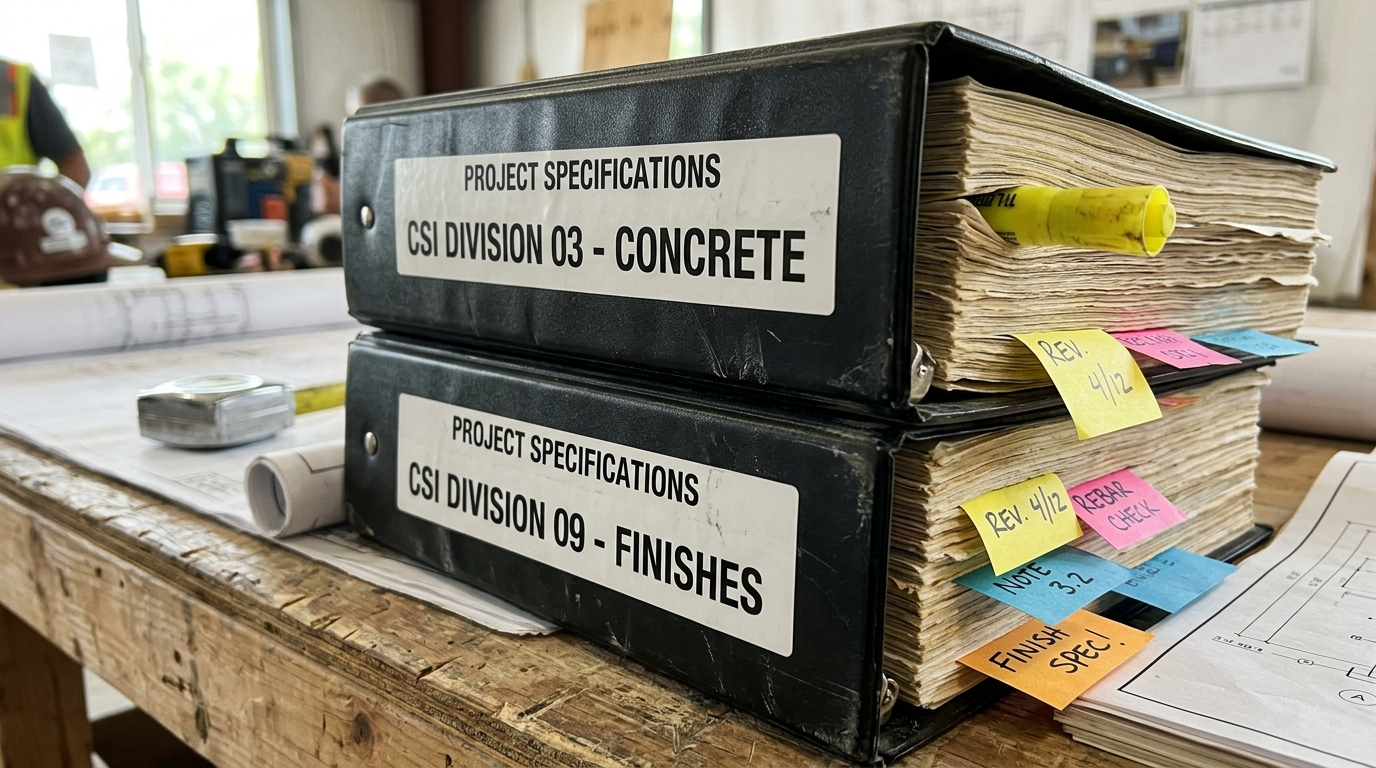
To ensure everyone is on the same page, the construction industry uses a standardized system for classifying materials called the CSI MasterFormat. This system organizes work into 50 divisions (e.g., Division 03 is Concrete, Division 09 is Finishes).
Project specifications provide detailed written requirements for every material, referencing these CSI divisions and sections. For a procurement professional, the specs are the rulebook. They dictate the required quality, performance standards, and acceptable manufacturers for everything that needs to be purchased. Referencing a CSI section number on a purchase order is shorthand for a long list of technical requirements, ensuring there is no ambiguity about what to buy.
Frequently Asked Questions
1. What is the main goal of a construction purchasing department?
The main goal is to strategically acquire all necessary materials, equipment, and services on time, within budget, and to the specified quality standards, thereby maximizing value and minimizing risk for the project.
2. How do construction purchasing departments save money?
They save money through strategic sourcing, negotiating bulk discounts, locking in prices to avoid market volatility, managing supplier relationships to get better terms, and implementing cost control measures throughout the project lifecycle.
3. Why is supplier relationship management important for construction purchasing departments?
Strong supplier relationships lead to better pricing, more reliable deliveries, and greater flexibility when changes or problems arise. A trusted supplier is more likely to prioritize orders or help find solutions during a supply chain disruption.
4. How can technology help a construction purchasing department?
Technology like e procurement software automates purchase order creation, streamlines approvals, improves budget tracking, and provides data analytics to help teams make smarter purchasing decisions and identify potential supply chain risks earlier.
5. How can a smaller contractor improve its purchasing power?
Smaller contractors can significantly increase their purchasing power and gain access to better pricing and terms by joining a group purchasing organization or a buyer’s alliance like the Contractors National Buyer Alliance (CNBA).
Recent Comments