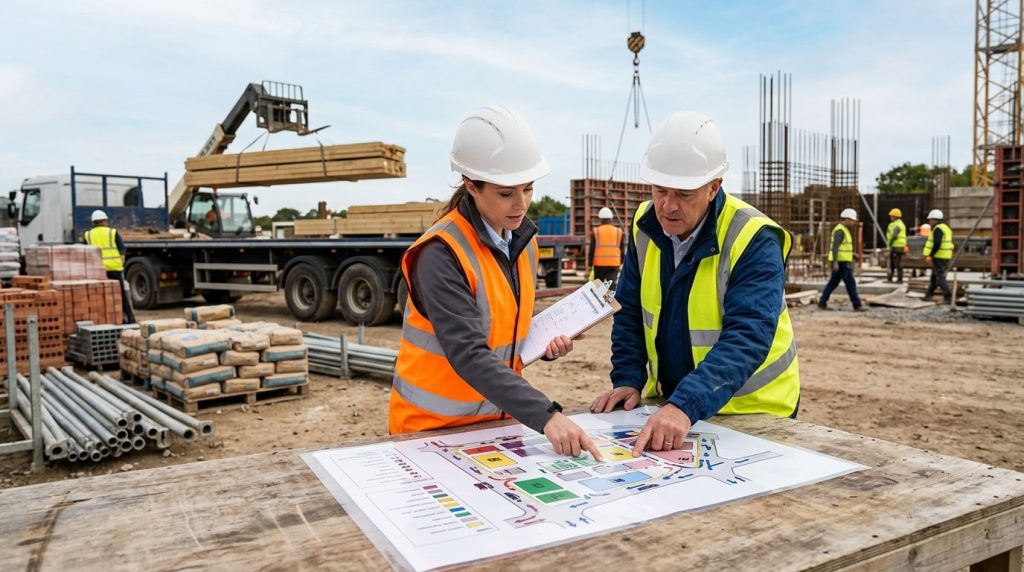
Construction projects are massive undertakings with countless moving parts. From the initial groundbreaking to the final coat of paint, success hinges on having the right materials, equipment, and people in the right place at the right time. This complex logistical dance is managed through construction procurement planning, the strategic process of sourcing and managing everything a project needs to succeed.
Key Takeaway: What is Construction Procurement Planning? Construction procurement planning is the strategic process of identifying, sourcing, and managing the external resources (materials, labor, and equipment) required to complete a build. Unlike simple purchasing, it involves a multi-stage checklist:
Project Definition: Aligning needs with budget and timeline.
Market Analysis: Evaluating supplier capacity and price volatility.
Route Selection: Choosing a delivery method (e.g., Design-Build vs. CMAR).
Contracting: Risk allocation and vendor selection.
Logistics & Tracking: Managing lead times to prevent site delays.
Think of it as the project’s central nervous system for resources. It’s not just about buying things; it’s a comprehensive strategy that can make or break your budget, timeline, and final quality. In fact, a good procurement system is so crucial that organizations like the ISO provide detailed guidelines for it. Get it right, and your project runs like a well oiled machine. Get it wrong, and you’re looking at delays, cost overruns, and constant headaches.
Critical 2026 Construction Procurement Trends
To stay competitive this year, procurement strategies must account for:
AI-Driven Predictive Sourcing: Using algorithms to forecast material shortages 6 months out.
Circular Economy Mandates: Prioritizing “Buy-Back” contracts for unused materials to reduce waste.
Digital Twins in Logistics: Syncing procurement lead times with live digital twin models to automate “Just-in-Time” delivery.
The Strategic Foundation of Construction Procurement Planning
Before you can even think about ordering a single bag of cement, you need a rock solid strategy. Effective construction procurement planning starts with a high level view, aligning every future purchase with the project’s ultimate goals.
Construction Procurement vs. Purchasing: The Strategic Difference
First, let’s clear up a common mix up. While people often use “procurement” and “purchasing” interchangeably, they are quite different.
Purchasing is transactional. It’s the act of buying, including placing orders, receiving goods, and processing payments. It’s a reactive task focused on fulfilling an immediate need.
Procurement is strategic. It’s the entire end to end process, from identifying a need and sourcing suppliers to negotiating contracts and managing long term relationships. It’s proactive, looking at the big picture to deliver long term value.
In short, purchasing is one step within the much broader, more strategic world of procurement.
Developing Your Procurement Strategy
A “procurement strategy” is your master plan. It outlines which procurement routes you’ll use, how you’ll package contracts, how you’ll manage risk, and the timing of it all. This strategy should be developed early and documented within the Project Execution Plan (PEP), the master blueprint for the entire job. This integration ensures that your procurement activities are perfectly synchronized with design, engineering, and construction, preventing disconnects down the road.
Identifying Objectives and Allocating Risk
Every project has unique priorities. Is speed the most important factor? Is the budget ironclad? Or is achieving the absolute highest quality the main goal? You must identify these objectives and parameters upfront. These decisions, often a trade off between time, cost, and quality, will guide every procurement choice you make.
A huge part of this is risk assessment and allocation. You need to identify potential risks (like material price spikes, delivery delays, or contractor defaults) and decide who will bear that risk. One way to share and mitigate risk is by forming “contractor alliances” with key vendors and peers. This is typically handled through the contract. For instance, a fixed price contract shifts cost overrun risk to the contractor, while a cost plus contract keeps it with the owner. The key is to allocate risk to the party best able to manage it, creating a fair balance that prevents inflated bids and future disputes.
Market Analysis and Client Decisions
Smart procurement doesn’t happen in a vacuum. It requires a deep understanding of the market. Market analysis involves researching supplier availability, pricing trends, and potential disruptions (like shortages or tariffs). For example, knowing that steel prices are projected to rise could prompt an earlier purchase to lock in a lower rate.
Ultimately, the client is in the driver’s seat for major decisions, like choosing the overall procurement route and approving major contract awards. A clear governance structure is needed to ensure client decision making is timely and informed, preventing bottlenecks that could derail the procurement schedule.
Choosing Your Path: Construction Procurement Routes
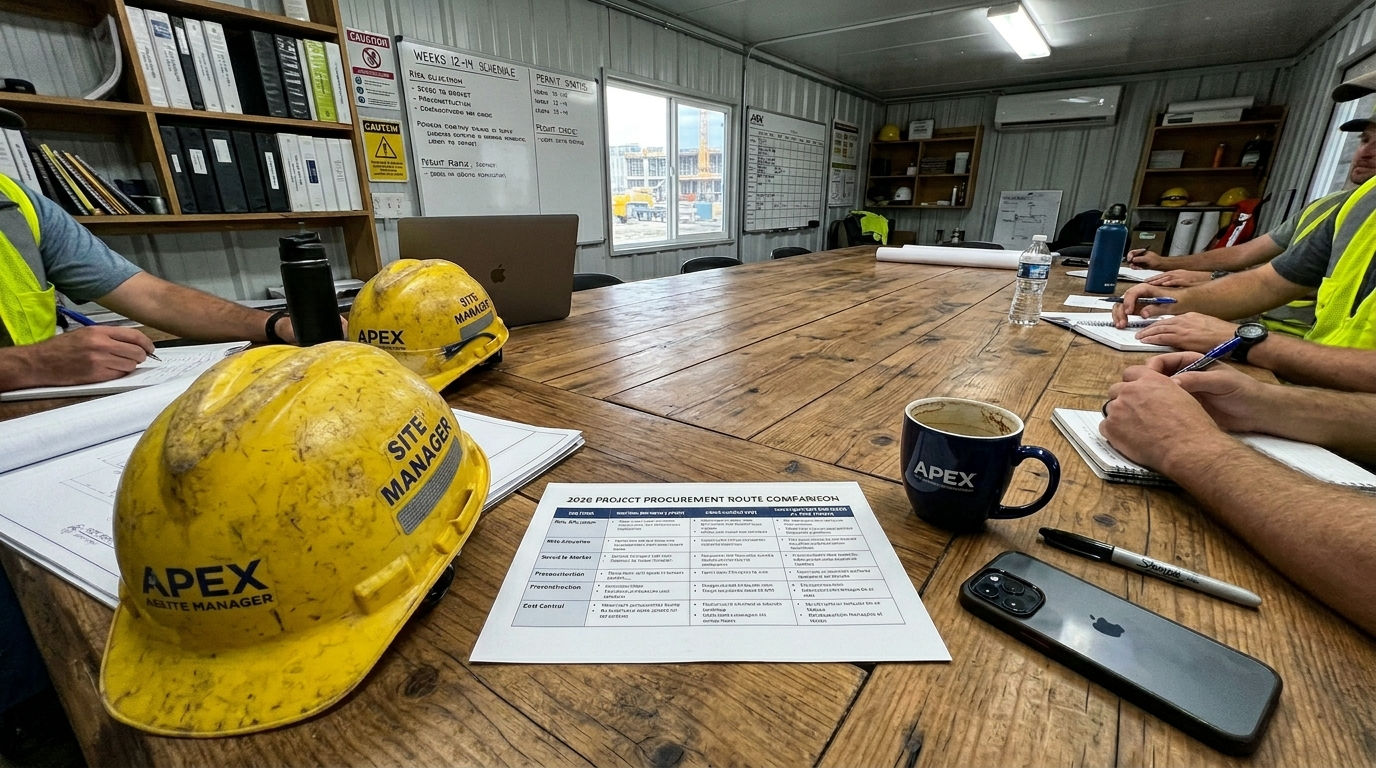
A procurement route, or project delivery method, defines the entire structure of relationships and contracts between the owner, designer, and builder. Choosing the right one is one of the most critical decisions in construction procurement planning.
How to Select the Right Method
The best procurement method depends entirely on the project’s characteristics and the owner’s priorities. Key factors include the project’s complexity, budget, schedule sensitivity, and desired risk allocation. An owner wanting a single point of responsibility and a fast schedule might lean toward Design Build, while one focused on a competitive bid for a fully completed design might prefer the traditional route.
Traditional Design Bid Build (DBB)
This is the classic approach. The owner hires a designer to create a complete set of plans, then puts those plans out for competitive bid from contractors. The contract is usually awarded to the lowest responsive and responsible bidder.
Pros: Clear separation of roles, transparent and competitive bidding.
Cons: It’s often the slowest method because design and construction happen sequentially. One industry study found DBB projects took about 102% longer from design to completion compared to Design Build. They can also be prone to more change orders and cost growth if design issues are discovered during construction.
Design Build (DB)
Here, the owner signs a single contract with one entity to handle both design and construction. This integrated approach allows design and construction phases to overlap, which can significantly speed up the project.
Pros: Faster delivery, a single point of responsibility, and often better cost performance. Research has shown Design Build projects average 3.8% less cost growth and are delivered roughly twice as fast as DBB projects.
Cons: The owner has less direct control over the design details once the process starts.
Due to its efficiency, Design Build is projected to account for up to 47% of construction spending in the assessed segments and geographies in 2025.
Construction Management at Risk (CMAR)
A hybrid approach where the owner hires a Construction Manager (CM) during the design phase to act as a consultant. The CM provides input on cost, schedule, and constructability. Later, that same CM acts as the general contractor and commits to delivering the project within a Guaranteed Maximum Price (GMP).
Pros: Early contractor collaboration, cost certainty with a GMP, and the ability to fast track.
Cons: The owner holds separate contracts with the designer and the CM, so it isn’t a single point of responsibility like Design Build.
Public Private Partnership (PPP)
A long term contract between a public entity and a private company to finance, build, and often operate a major infrastructure project, like a highway or hospital. The private partner takes on significant financial and operational risk in exchange for payments over the life of the contract.
Pros: Leverages private sector funding and efficiency, minimizes upfront public spending, and encourages a focus on life cycle costs.
Cons: Highly complex agreements that require extensive legal and financial expertise to structure correctly.
Procurement Route | Risk Owner | Best For… | Speed Rating |
Design-Bid-Build (DBB) | Owner | Low-complexity, budget-fixed projects | Slow |
Design-Build (DB) | Contractor | Fast-track projects requiring innovation | Very Fast |
CM at Risk (CMAR) | CM / Owner | Large, complex builds with evolving scope | Moderate |
PPP | Private Partner | Large-scale public infrastructure | Varies |
The Procurement Process: A Step by Step Breakdown
Once the strategy is set and the route is chosen, the tactical work of construction procurement planning begins. This is the process of turning project needs into delivered goods and services.
The Planning Phase: Defining What You Need
Needs Assessment: This is the first step where you identify and define precisely what the project requires, from raw materials like concrete and steel to subcontractor services.
Specification Development: Here, you translate those needs into detailed technical specifications. A clear specification for concrete, for example, would include its required strength (e.g., 4000 psi), mix design, and relevant standards. Clear specs ensure all vendors are bidding on the exact same thing.
“Sourcing Strategy”: Will you source materials globally or domestically? A domestic strategy might offer faster delivery and support the local economy, while a global strategy could provide cost savings, but with added logistical complexity and risk. A diversified supply base with multiple qualified suppliers for key materials is a crucial risk management tactic.
Lead Time and Long Lead Item Planning: You must identify items with long manufacturing or delivery times, such as custom elevators or specialized electrical gear. Long lead item planning involves ordering these items very early, sometimes even before the main contractor is selected, to ensure they don’t delay the entire project schedule. Joining a “contractor collective purchasing program” can also improve allocations and lead times on scarce materials.
2026 Material Lead Time & Risk Matrix

Effective planning requires understanding the “Volatility vs. Delay” impact of key resources.
Category | Typical 2026 Lead Time | Risk Mitigation Strategy |
Structural Steel | 16–24 Weeks | Early mill slots; Contractor Alliances |
Electrical Switchgear | 40–60 Weeks | Pre-purchase by Owner (Long Lead Item) |
Specialized HVAC | 20–30 Weeks | Standardize specs across projects |
Cement/Aggregates | 2–4 Weeks | Local sourcing; volume-based GPO pricing |
The Sourcing and Selection Phase: Finding Your Partners
Vendor Prequalification: Before inviting bids, you can screen potential contractors to ensure they are financially stable, experienced, and have a good safety record. This creates an approved manufacturers list or bidders list of reliable partners, reducing the risk of contractor failure. Participating in “purchasing networks” can also expand your qualified supplier pool while capturing GPO-level savings.
Solicitation: Now you go to the market. This is typically done with one of two documents:
Request for Quotation (RFQ): Used when you know exactly what you want and the decision will be based almost entirely on price. You send detailed specs and ask for a price quote.
Request for Proposal (RFP): Used for more complex services where the “how” is just as important as the “how much.” You ask for a detailed proposal, including the vendor’s technical approach, team qualifications, and schedule, in addition to cost.
Bid Evaluation and Selection: This is where you analyze the offers. For an RFQ, you might simply select the lowest price from a compliant bidder. For an RFP, you’ll use a scoring system to evaluate proposals based on a range of “best value” criteria, such as technical merit and experience.
Budget Verification: Before making a final decision, a crucial step is to verify that the selected bid fits within the approved project budget. No contract should be awarded without confirming the funds are available. Also account for “vendor rebates” that can improve total ROI.
The Contracting and Execution Phase: Making It Happen
Contract Award and Negotiation: Once a winner is selected, you finalize the terms. This may involve negotiating details like payment schedules, delivery dates, and warranty periods before both parties sign the legally binding contract. A responsibility matrix, like a RACI chart, is often used to clarify who is responsible, accountable, consulted, and informed for every task.
Order Management and Logistics Planning: After the contract is signed, you manage the execution. This involves issuing purchase orders and then tracking them through manufacturing and shipping. Logistic planning ensures smooth delivery to the site, which may require pre shipment inspections to verify quality before items are sent.
Managing and Optimizing Your Procurement Efforts
Effective construction procurement planning doesn’t stop once the orders are placed. It requires continuous management, monitoring, and improvement throughout the project lifecycle.
Performance and Relationships
Performance Monitoring and Evaluation: You must constantly track supplier performance against agreed upon metrics like on time delivery, quality, and safety. This allows you to catch issues early and provide feedback. After the job, a formal supplier performance evaluation creates a record that helps inform future sourcing decisions.
Supplier Relationship Management (SRM): Instead of one off transactions, SRM focuses on “building long term, collaborative partnerships” with key suppliers. This can lead to better service, stable pricing, and shared innovation. Alliances like the Contractors National Buyer Alliance (CNBA) are built on this principle, leveraging the collective buying power of members to foster strong, mutually beneficial partnerships with top vendors. If you’re evaluating options, see this guide to “contractor group purchasing organizations (GPOs)”.
Process and Control
Procurement Schedule Alignment: This is the critical practice of integrating procurement timelines directly into the overall project schedule. You must work backward from when an item is needed on site to determine the deadline for ordering it, accounting for all lead times.
Change Control and Change Orders: Projects rarely go exactly as planned. You need a robust change control ability to manage modifications in a structured way. This involves a formal process for requesting, evaluating, and approving any changes to the scope, price, or schedule. This applies to both owner initiated changes and necessary adjustments like top up requisitions for materials.
Inventory and Material Management: A system for tracking materials from delivery to installation is vital. This prevents loss, avoids shortages, and minimizes the amount of cash tied up in excess materials sitting on site.
Advanced Strategies and Tools
KPI and Data Analytics: Modern procurement is data driven. Tracking key performance metrics (KPIs) like cost savings and cycle times allows you to measure efficiency. Data analytics for procurement can uncover trends in spending and supplier performance, enabling smarter, evidence based decisions.
Technology and System Integration: Procurement technology adoption, from e-bidding platforms to contract management systems, automates manual tasks and improves transparency. Even better is system integration with project tools, which links procurement software with scheduling and cost control systems to create a single source of truth for all project data.
Standardization and Collaboration: Using standardized procurement templates for things like RFQs and contracts saves time and reduces risk. Above all, strong communication and collaboration among the owner, designer, contractor, and suppliers is essential for success.
A particularly powerful methodology that combines many of these principles is Advanced Work Packaging (AWP). AWP breaks the project down into small, manageable work packages and requires that all engineering, procurement, and construction activities are tightly integrated from the very beginning. This ensures that construction crews in the field have everything they need to be productive, dramatically improving project predictability and performance. In fact, research by the Construction Industry Institute (CII) has shown that projects using AWP can achieve up to a 25% improvement in productivity.
A Focus on Value: Beyond the Bottom Line
Truly advanced construction procurement planning looks beyond the initial price tag to consider broader definitions of value.
Lifecycle Consideration: This means evaluating the total cost of ownership, not just the upfront purchase price. A more expensive but highly energy efficient HVAC system might save a building owner millions in operating costs over its lifetime, making it the better long term value.
Sustainability in Procurement: This involves integrating environmental and social factors into your decisions. This can mean choosing materials with recycled content, prioritizing suppliers with fair labor practices, or sourcing locally to reduce transportation emissions and support the community.
Putting It All Together: Practical Procurement Checklists
To ensure nothing falls through the cracks, many teams use a procurement checklist organized by key project constraints.
Time Checklist
Have all long lead items been identified and ordered?
Are delivery dates clearly stated in all contracts?
Is the procurement schedule fully integrated with the master project schedule?
Design Checklist
Are all specifications and drawings clear, complete, and unambiguous?
Has the design been reviewed to ensure it allows for competitive sourcing?
Is there a formal process for handling bidder questions and design clarifications?
Cost Checklist
Has the budget been verified before awarding any contracts?
Are payment terms structured to optimize project cash flow?
Has a contingency been allocated for potential procurement risks like price increases?
By methodically working through a well designed construction procurement planning process, you transform procurement from a simple administrative function into a powerful strategic advantage that drives project success. Organizations that master this discipline are better equipped to deliver complex projects on time and on budget. For contractors looking to enhance their capabilities, joining a group like the Contractors National Buyer Alliance (CNBA) can provide the leverage and market intelligence needed to take their procurement strategy to the next level.
Frequently Asked Questions about Construction Procurement Planning
What is the primary goal of construction procurement planning?
The primary goal is to ensure all necessary goods, services, and contracts are secured in a way that meets the project’s objectives for cost, schedule, and quality, all while managing risk effectively.
What is the most common procurement method in construction?
Historically, Traditional Design Bid Build (DBB) has been the most common, especially in the public sector. However, alternative methods like Design Build (DB) and Construction Management at Risk (CMAR) have grown significantly in popularity due to their potential for faster delivery and better collaboration.
How does technology help in construction procurement?
Technology helps by automating repetitive tasks, improving transparency and collaboration, and providing powerful data analytics. E-bidding platforms, contract management systems, and integrated project management software can save hundreds of hours of administrative work and lead to better decision making.
Why is supplier relationship management important?
Strong supplier relationships can lead to better service, preferential treatment, more reliable supply chains, and opportunities for innovation. Treating suppliers as partners rather than just transactional vendors builds a foundation of trust that pays dividends, especially when challenges arise.
How can I improve my company’s construction procurement planning?
Start by developing a formal procurement strategy that aligns with your business goals. Adopt standardized templates and processes, invest in technology to improve efficiency, and focus on building strong relationships with key suppliers. For added strength, consider the advantages of a buyer’s group. Explore how the Contractors National Buyer Alliance (CNBA) can amplify your purchasing power and strategic partnerships.
Recent Comments