
TL;DR
Material prices rose 6.2% in 2025, and tariffs are adding another 5 to 9% on top. Since materials account for 50 to 70% of total project costs, even small procurement improvements translate to thousands saved per job. The highest-impact strategies to reduce material costs in construction include joining a group purchasing organization (10 to 25% savings), buying seasonally (10 to 20%), and using recycled materials like reclaimed asphalt pavement (20 to 50% on specific line items).
How can contractors reduce material costs in 2026?
To reduce construction material costs, contractors should prioritize joining a Group Purchasing Organization (GPO) for 10–25% instant savings, utilizing Reclaimed Asphalt Pavement (RAP) to cut aggregate costs by 20–50%, and implementing Price Escalation Clauses to mitigate the 9% average tariff inflation. Strategic timing, such as buying lumber and steel in Q4, further reduces expenses by 10–20% by avoiding peak-season premiums.
At-a-Glance: 10 Strategies Compared
Strategy | Expected Savings | Effort Level | Best For | Time to Implement |
|---|---|---|---|---|
Join a GPO or buying alliance | 10–25% | Low | All contractors | Immediate |
Lock in pricing / buy seasonally | 10–20% | Low to Medium | Planned projects | 1–3 months |
Negotiate supplier relationships | 5–15% | Medium | Repeat buyers | Ongoing |
Price escalation clauses | Risk mitigation (prevents 5–25% overruns) | Medium | Long-term projects | Next contract |
Reduce on-site waste | 5–15% | Medium | High-volume sites | 1–2 months |
Use recycled/reclaimed materials | 20–50% | Medium | Paving and concrete | Project-specific |
Just-in-time delivery | 3–8% | Medium | Urban or theft-prone sites | Immediate |
Estimating technology | 5–10% | High (upfront) | Growing firms | 3–6 months |
Value engineering | 5–20% | High | Design-build projects | Pre-construction |
Multi-trade consolidation | 5–15% | Low | Project owners and GCs | Next project |
Strategy | Expected Savings | Material Focus | Implementation Complexity |
GPO Membership | 10–25% | All (Tools, Steel, Safety) | Low (Instant) |
Recycled/RAP | 20–50% | Asphalt, Concrete, Base | Medium (Spec-dependent) |
Seasonal Buying | 10–20% | Lumber, Roofing, Asphalt | Low (Planning-based) |
Escalation Clauses | Risk Hedge | Steel, Aluminum, Copper | Medium (Contractual) |
BIM/Digital Takeoff | 5–10% | Concrete, Drywall, Electrical | High (Software-driven) |
Why Construction Material Costs Demand Attention Right Now
Construction material prices rose 6.2% across 2025, the largest single-year increase since the pandemic-era spikes of 2021, according to the Bureau of Labor Statistics Producer Price Index. Source. That alone would be painful. But bid prices haven’t kept pace, which means contractors are absorbing the difference directly from their margins.
Then there are tariffs. Cushman & Wakefield estimates that current tariff rates will increase construction materials costs by roughly 9% relative to 2024 averages. Structural steel, rebar, metal deck, and aluminum framing have taken the biggest hits, with tariffs on Chinese-sourced residential materials ranging from 10 to 55%.
When materials represent 50 to 70% of total project costs, and labor inflation is running at 4 to 5% annually, total project escalation of 6 to 10% is realistic for 2025 and 2026. These aren’t abstract numbers. They determine whether your next bid is profitable or underwater.
You can’t control tariffs. You can’t set commodity prices. But you can control how you buy, when you buy, and how much you waste. The strategies below are ranked roughly from highest impact to most specialized, each with real savings data so you can prioritize. For a broader look at the pressures shaping today’s market, see this overview of challenges and opportunities in the construction industry.
Pro Tip: Managing material costs is only half the battle. Check out our [2026 Guide to Reducing Labor Overhead] and [Top Construction Accounting Software for Small Firms] to protect your total margin.
1. Join a Group Purchasing Organization (GPO) or Buying Alliance
Best for: Small and mid-size contractors who lack the volume to negotiate enterprise-level pricing on their own.
Expected savings: 10–25%
This is the single most underleveraged strategy for reducing material costs in construction. A GPO pools the purchasing volume of hundreds or thousands of member companies, then negotiates pre-set pricing with suppliers. You get the buying power of a large general contractor without being one.
The numbers back this up. Among Fortune 1000 companies participating in buying consortiums, 85% report savings of 10% or more. Organizations purchasing through GPOs reduce supply-chain buying costs by an average of 13.1%, according to the Healthcare Supply Chain Association. Across indirect spend categories, documented savings range from 15 to 35% with success rates above 96% over the past decade.
Key tactics:
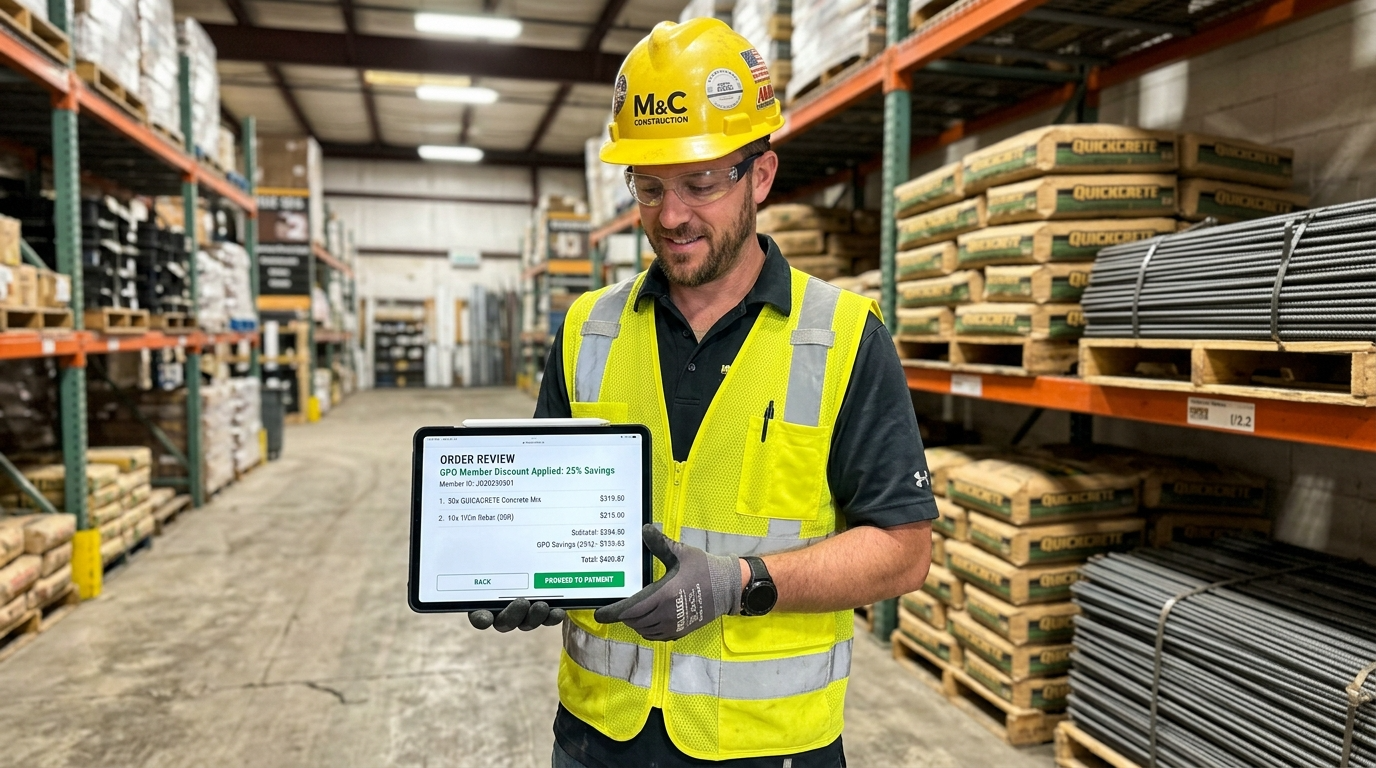
GPO membership is typically free for contractors. Suppliers fund the organization through a 1 to 3% administrative fee on sales, not member dues. This removes the biggest objection.
Members often access annual cash rebates on top of discounted pricing, plus reduced procurement admin time (up to 60% in some programs).
The model works for everything from concrete supplies and asphalt materials to tools, safety equipment, and fleet parts.
Tradeoffs to consider:
You may have less flexibility in supplier choice, since GPO contracts are pre-negotiated with specific vendors.
Not all GPOs cover the same product categories. Evaluate whether the organization’s supplier network matches your actual spend.
Savings on commodity materials (aggregates, ready-mix) may be smaller than savings on specialty items or equipment.
Practitioners on forum discussions at Boom & Bucket consistently emphasize that committing to volume and being a repeat customer are the keys to better pricing. A GPO formalizes that exact dynamic at scale.
If you want to understand how these organizations work in detail, read this contractor group purchasing organization guide. To compare options, here’s a breakdown of the best buying groups for contractors.
2. Lock in Material Pricing Early and Buy Seasonally
Best for: Contractors with predictable project pipelines who can plan purchases 1 to 3 months ahead.
Expected savings: 10–20%
Timing is one of the simplest ways to reduce construction material costs, yet most contractors buy reactively. Material prices follow predictable seasonal patterns. Lumber prices are typically lowest in winter (January through February) and highest in summer when construction activity peaks. Asphalt and aggregate suppliers often discount during slow months when their plants are underutilized.
Key tactics:
Use winter months (November through January) to lock in bulk purchases for spring and summer projects. One construction materials blog noted that this window consistently offers the best pricing.
For asphalt and concrete contractors, the off-season for paving is the on-season for buying. Forward-purchase aggregates, rebar, and sealcoating materials in Q4 or Q1.
Buying early and in bulk locks in current prices before further surges, which is especially critical during periods of tariff uncertainty.
Tradeoffs to consider:
Early purchasing ties up cash. You need the financial capacity (or financing) to hold inventory.
Storage costs and the risk of material damage or theft increase when you stockpile.
Seasonal patterns don’t apply equally to all materials. Concrete, for instance, is less seasonal than lumber or asphalt.
Building a sound construction sourcing strategy helps you systematize this approach rather than relying on gut timing.
3. Negotiate Supplier Relationships, Not Just Prices
Best for: Contractors with recurring material needs and established supplier contacts.
Expected savings: 5–15%
Most contractors think negotiation means haggling over unit prices. The real savings come from structuring the relationship itself. Material suppliers are often the last in line to get paid on any construction project. Anything that reduces their risk becomes a bargaining chip: guaranteed volume, prompt payment, multi-project commitments.
Key tactics:
Offer prompt payment (net-15 instead of net-60) in exchange for a 2 to 5% discount. On a $500,000 material order, paying faster saves $10,000 to $25,000 with zero negotiation required.
Consolidate suppliers. Giving one vendor more volume gives you more pull. Spreading orders across five suppliers means none of them have a reason to give you priority pricing.
Ask for “first price, best price” quotes to eliminate rounds of back-and-forth.
Request free delivery on large orders. This saves crew time and eliminates truck costs that quietly eat your margin.
Tradeoffs to consider:
Consolidating suppliers increases your dependency on a single source. If they have supply chain disruptions, you’re exposed.
Prompt payment discounts only work if your cash flow supports early payment. This can be tight on projects with slow pay applications.
Relationship-based pricing is informal and can evaporate when your contact at the supplier moves on.
Forum users on Boom & Bucket emphasize that demonstrating repeat business and timing orders during off-peak periods are the most reliable negotiation strategies, more effective than aggressive price shopping. For a deeper look at this approach, here’s a guide on how to build strong contractor-vendor partnerships.
4. Use Price Escalation Clauses in Contracts
Best for: Contractors bidding long-duration projects (6+ months) during volatile pricing periods.
Expected savings: Risk mitigation (prevents 5–25% cost overruns)
This strategy doesn’t reduce material costs directly. It prevents them from destroying your profit when prices spike after you’ve already submitted a bid. A material price escalation clause adjusts the contract price based on an objective index, typically a Bureau of Labor Statistics Producer Price Index for the relevant material category.
Key tactics:
Tie escalation clauses to BLS Producer Price Index data for concrete products, asphalt, or steel reinforcement. This gives both parties an objective benchmark, not a subjective argument.
During the bidding phase, identify which materials are most likely to be affected by tariffs or trade wars and limit the clause to those items.
Escalation clauses contribute to overall financial stability by shifting risk away from the contractor and toward the party better positioned to absorb it (typically the project owner).
Tradeoffs to consider:
Many project owners resist escalation clauses because they create budget uncertainty on their end.
These clauses add complexity to contract administration and require tracking index data throughout the project.
If material prices drop, a two-way escalation clause means you may owe the owner a credit, which can complicate cash flow.
With tariffs on structural steel and aluminum creating unpredictable cost swings, escalation clauses have gone from a nice-to-have to a necessity on commercial and industrial projects.
5. Reduce Material Waste On-Site
Best for: High-volume jobsites, especially concrete and structural work where over-ordering is common.
Expected savings: 5–15% of material budget
Up to 30% of all building materials on a typical construction site end up as waste. More than 75% of that waste, including wood, drywall, plastics, and asphalt shingles, goes straight to landfills. This is money in a dumpster, literally.
Key tactics:
Improve quantity takeoffs. Even a 5% over-estimation on a 1,000-yard concrete pour wastes 50 yards at $150+ per yard. That’s $7,500 lost on a single pour.
BIM-based planning helps prevent over-ordering through more precise materials planning.
Prefabrication can reduce debris by 30% or more through off-site production and tighter quality control.
Projects using lean construction methods see 15 to 30% reductions in time and cost through better coordination and fewer delays.
Tradeoffs to consider:
Lean processes require upfront training and cultural buy-in from crews. This isn’t a switch you flip overnight.
BIM software has licensing costs and a learning curve.
Tighter ordering means less margin for error if unexpected conditions arise on-site.
Waste reduction is one of the most overlooked ways to reduce material costs in construction because it doesn’t show up as a line item on a purchase order. The savings are invisible until you track them.
6. Use Recycled and Reclaimed Materials
Best for: Paving and concrete contractors with access to milling operations or recycled aggregate suppliers.
Expected savings: 20–50% on specific materials
This is a blind spot across virtually every article currently ranking for this topic. Reclaimed Asphalt Pavement (RAP) costs 20 to 50% less than virgin asphalt while delivering comparable performance. Based on Federal Highway Administration evaluation, pavements containing up to 30% RAP perform similarly to those built entirely from virgin materials.
Key tactics:
For paving contractors, milling existing asphalt and recycling it into new overlays is one of the most cost-effective strategies available. Using recycled asphalt can save approximately 20 to 30% compared to new hot mix.
Replacing virgin aggregates with RAP aggregate in base and sub-base layers can achieve material cost savings of approximately 30%.
Concrete and asphalt concrete make up 85% of construction and demolition waste in the United States, creating a large and growing supply of recyclable material.
Steel recycling rates in construction already sit at 93%, so structural steel is another area where reclaimed material is both available and proven.
Tradeoffs to consider:
Not all specifications allow recycled materials. Check project specs and local codes before committing.
Quality varies by source. RAP from a controlled milling operation is different from random demolition debris.
Some owners and engineers remain skeptical of recycled content, requiring additional documentation or testing.
For contractors focused on asphalt and concrete work, this strategy alone can fundamentally change project economics.
7. Implement Just-in-Time Delivery
Best for: Urban jobsites, theft-prone locations, or projects with limited staging area.
Expected savings: 3–8%
Just-in-time (JIT) delivery means coordinating material arrivals to match the actual construction schedule rather than stockpiling weeks in advance. The savings aren’t dramatic on paper, but they compound. Less material on hand means lower risk of theft, damage, weather exposure, and worker injuries from cluttered staging areas.
Key tactics:
Coordinate deliveries to match pour schedules. Don’t stockpile rebar or forms for weeks. Order 48 to 72 hours ahead of need.
JIT cuts storage costs, theft and damage risks, and last-minute emergency order expenses. It also keeps cash from sitting in unused inventory.
Material theft is not a trivial problem. The Department of Energy estimates that $1 billion worth of copper alone is stolen from construction sites annually.
Tradeoffs to consider:
JIT delivery is only as reliable as your suppliers and their delivery fleet. One late truck can shut down a pour.
It requires precise scheduling and communication between the field team and procurement.
Bad weather or traffic disruptions can derail tightly timed deliveries in ways that stockpiling avoids.
JIT works best when paired with strong supplier relationships (Strategy 3) and accurate scheduling tools. It’s a supporting strategy, not a standalone solution, for reducing material costs in construction.
8. Invest in Accurate Estimating and Takeoff Technology
Best for: Growing firms bidding multiple projects, especially those with recurring quantity estimation errors.

Expected savings: 5–10% of material costs
Inaccurate estimates create cost overruns in two directions. Over-estimate and you waste material. Under-estimate and you pay premium pricing for emergency loads. BIM-based takeoffs reduce unplanned changes by up to 40% and deliver cost estimation accuracy within 3%, while cutting the time to develop a cost estimate by up to 80%.
Key tactics:
For concrete and asphalt work, accuracy in quantity takeoffs directly determines whether you over-order or scramble for expensive emergency deliveries.
Contractors using historical data in preconstruction reduce change order costs by up to 25%, according to McKinsey research.
Digital takeoff tools eliminate the manual measurement errors that plague paper-based estimating.
Tradeoffs to consider:
Software licensing, training, and implementation have real upfront costs.
The technology only helps if estimators actually use it consistently. Partial adoption creates more confusion than benefit.
BIM is most effective on larger, more complex projects. For simple flatwork or overlay jobs, the ROI may not justify the investment.
Technology is a force multiplier for every other strategy on this list. Better estimates mean tighter purchasing, less waste, and more accurate bids, all of which help reduce material costs across every construction project.
9. Apply Value Engineering Without Sacrificing Quality
Best for: Design-build projects or situations where the contractor has input during the design phase.
Expected savings: 5–20%
Value engineering means finding ways to achieve the same functional result at lower cost. It’s not about cutting corners. It’s about questioning assumptions. One common example: substituting conventional concrete with High-Performance Concrete (HPC) or Self-Consolidating Concrete (SCC) can reduce labor and formwork costs even if the material itself costs more per yard.
Key tactics:
In structural concrete, switching from traditional rebar cages to fiber-reinforced concrete for certain applications can cut labor and material costs simultaneously.
In asphalt, optimizing mix designs (higher RAP content, polymer-modified binders for longer pavement life) is value engineering in action.
Using high-performance, lightweight concrete instead of traditional mixes can reduce material volume and accelerate placement.
Tradeoffs to consider:
Value engineering requires early contractor involvement in the design process, which not all project delivery methods allow.
Alternative materials or methods may require additional testing, submittals, or owner approval.
The upfront engineering analysis costs time and money, though it typically pays for itself many times over on larger projects.
The best time to reduce material costs in construction is before you break ground. Value engineering is how that happens.
10. Consolidate Trades with a Multi-Trade Contractor
Best for: Project owners and general contractors managing complex commercial or industrial sites.
Expected savings: 5–15%
When a single contractor handles concrete, asphalt, site work, and related scopes, you eliminate the layered markups and scheduling conflicts that come from managing multiple subcontractors. Multi-trade delivery reduces duplication, improves efficiency, and provides consolidated pricing without third-party subcontractor markups.
Key tactics:
Fewer handoffs between trades means fewer delays. Delays cost money through extended general conditions, idle equipment, and rescheduling fees.
A multi-trade contractor can sequence work more efficiently because they control the schedule across disciplines. Concrete, curb and gutter, asphalt, and striping can flow without the coordination gaps that plague multi-sub projects.
Consolidated purchasing across trades means one contractor buying rebar, concrete, asphalt, aggregates, and site materials, which creates natural volume leverage.
Tradeoffs to consider:
True multi-trade contractors are less common than specialists. You need to verify they have genuine self-perform capability across all claimed disciplines.
Consolidation means putting more project risk with a single firm. Vet their financial capacity and project history carefully.
For highly specialized work (post-tension, tilt-up), a dedicated specialty sub may still be the right call.
Multi-trade consolidation is one of the easiest ways to reduce construction material costs for project owners because the savings show up automatically through fewer markups and tighter coordination.
Bringing It All Together
No single strategy will solve the material cost problem. The contractors who protect their margins combine several of these approaches. Join a buying alliance to get better base pricing. Buy seasonally to capture off-peak discounts. Negotiate relationship-level terms with your key suppliers. Use escalation clauses to protect bids on long-duration work. Cut waste on-site. Explore recycled materials where specs allow.
The common thread is intentionality. Most construction companies spend reactively, buying what they need when they need it from whoever answers the phone. That approach worked when material inflation was 1 to 2% a year. It doesn’t work when tariffs, supply chain disruptions, and commodity volatility are pushing costs up 6 to 10% annually.
For a structured approach to construction purchasing best practices, including how to combine GPO membership with supplier negotiations and seasonal buying, explore the resources available through CNBA’s contractor purchasing network. Membership is free, and the savings start immediately.
Frequently Asked Questions
What percentage of construction project costs go to materials?
Materials typically account for 50 to 70% of total construction project costs, according to industry data from CivilPracticalKnowledge. The exact percentage depends on the project type, with material-intensive work like paving and concrete flatwork sitting at the higher end of that range.
How much can a group purchasing organization save contractors on materials?
GPO members typically see savings of 10 to 25% on materials and equipment. Among large companies using buying consortiums, 85% report savings of 10% or more, and documented success rates for savings programs exceed 96% over the past decade. Membership is generally free because suppliers fund the GPO through administrative fees.
Are recycled construction materials as good as new materials?
For many applications, yes. The Federal Highway Administration found that pavements containing up to 30% Reclaimed Asphalt Pavement (RAP) perform similarly to those constructed entirely from virgin materials. Recycled concrete aggregate is also widely used in base and sub-base applications with proven results.
How do tariffs affect construction material prices in 2025 and 2026?
Cushman & Wakefield estimates tariffs will increase construction materials costs by approximately 9% relative to 2024 averages. Steel, rebar, metal deck, and aluminum framing have been hit hardest, with tariffs on Chinese-sourced materials ranging from 10 to 55%.
What is a price escalation clause in a construction contract?
A price escalation clause adjusts the contract price if material costs rise significantly during the project. It’s typically tied to an objective index like the BLS Producer Price Index, giving both the contractor and project owner a fair, data-driven mechanism for handling price volatility.
How much material waste occurs on a typical construction site?
Up to 30% of building materials delivered to a typical construction site can end up as waste. Implementing lean construction methods, prefabrication, and BIM-based material planning can reduce this waste by 15 to 30%.
What is the fastest way to start reducing material costs?
Joining a GPO or buying alliance offers the fastest path because there’s no upfront cost, no implementation delay, and savings apply to your very next purchase order. Seasonal buying and prompt payment discounts are also quick wins that require no technology investment.
Does just-in-time delivery actually work in construction?
It works well when paired with reliable suppliers and accurate scheduling. JIT reduces theft, damage, storage costs, and cash tied up in unused inventory. The tradeoff is that it requires tighter coordination, and one late delivery can disrupt the entire schedule.
Recent Comments