
TLDR
Construction safety vendor partnerships are structured relationships where safety is built into every stage of the vendor lifecycle, from selection and contracting through field coordination and performance review. They go beyond paperwork: the goal is shared accountability for safer jobsites across general contractors, subcontractors, suppliers, and service providers. With construction accounting for over 20% of U.S. workplace fatalities in 2024, how you choose and manage vendors is itself a safety decision.
Construction safety vendor partnerships are formal systems for selecting, onboarding, managing, and reviewing subcontractors and vendors using safety criteria throughout the project lifecycle. Effective partnerships reduce OSHA risk, improve compliance, lower insurance costs, reduce incidents, improve coordination between multiple employers, and create safer construction sites through shared accountability.
Key Takeaways
Safety starts before a vendor is hired.
Contracts should clearly define safety responsibilities.
OSHA’s multi-employer policy means multiple companies may share liability.
EMR should never be the only prequalification metric.
Continuous field monitoring is more important than paperwork alone.
Vendor performance reviews should determine future work opportunities.
What Are Construction Safety Vendor Partnerships?
A construction safety vendor partnership is a formal working relationship between a construction company and its vendors, subcontractors, suppliers, or service providers where safety expectations are defined before work starts and managed throughout the project.
This is not just buying materials from a supplier who happens to have a safety manual on file. It is a structured process that connects procurement decisions to jobsite outcomes. The partnership covers the full vendor lifecycle: selection, contract, onboarding, field coordination, monitoring, corrective action, and review.
The concept applies broadly. Subcontractors, equipment rental companies, PPE suppliers, traffic control vendors, safety consultants, temporary labor providers, and compliance software platforms can all be part of a safety-focused vendor relationship.
OSHA’s recommended practices for construction safety programs reinforce this idea. OSHA says general contractors should establish specifications and qualifications for contractors and staffing agencies, communicate hazards, and coordinate work planning before work begins.
Think of it as vendor management with a safety operating system. Every outside company working on or supporting a project should understand the hazards, follow the same expectations, and be held accountable for safety performance. For a broader look at how vendor programs create value, see our construction vendor program guide.
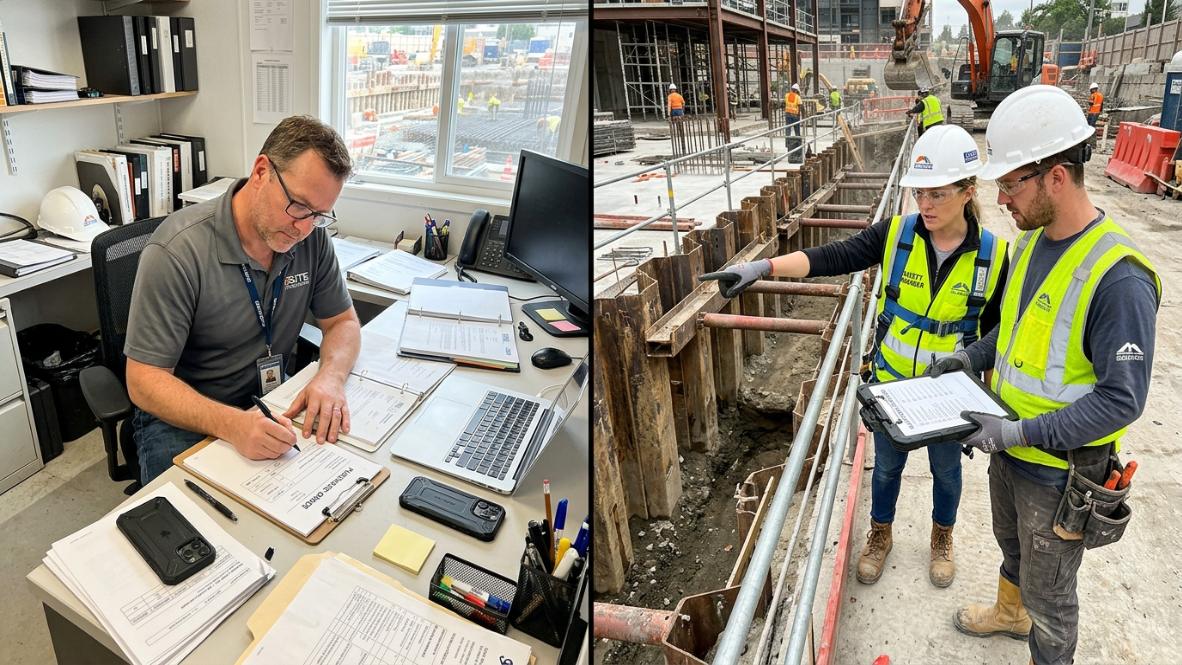
Traditional Vendor Management vs Construction Safety Vendor Partnerships
Traditional Vendor Management | Construction Safety Vendor Partnership |
|---|---|
Focuses on cost | Focuses on safety and performance |
Procurement driven | Operations + Safety driven |
Vendor selected once | Continuous evaluation |
Minimal field involvement | Ongoing field coordination |
Basic contract requirements | Detailed safety obligations |
Performance based on delivery | Performance based on safety metrics and execution |
Limited communication | Daily collaboration |
Why Construction Safety Vendor Partnerships Matter
Construction remains one of the most dangerous industries in the United States by raw numbers. In 2024, the industry recorded 1,034 fatal occupational injuries, the most of any private-industry sector that year. That number represents roughly 20.4% of all U.S. workplace fatalities.
The hazard profile is specific. BLS categorized those 2024 construction fatalities as 389 falls, slips, and trips; 244 transportation incidents; 187 exposures to harmful substances or environments; and 161 contact incidents. NIOSH has reported that construction workers account for 49% of all fatal occupational falls, with about 300 fatal and 20,000 nonfatal fall injuries per year since 2013.
Here is the part that makes vendor partnerships essential: most construction projects involve multiple employers on the same site. A GC might bring in a concrete sub, an excavation crew, a crane rental company, a traffic control vendor, and a PPE supplier, all working around each other. OSHA recognizes this reality and expects coordination across employers on multi-employer worksites.
Specialty trades sit at the center of this issue. CPWR’s 2025 Construction Chart Book reported that specialty trade contractors accounted for 62.4% of fatal construction injuries in 2023 among cases with a reported major subsector. They also accounted for 71.3% of nonfatal injuries involving days away from work in 2021 and 2022. These are the vendors and subcontractors that construction safety partnerships are designed to manage.
Safety vendor partnerships are not only about compliance. They protect workers, reduce downtime from incidents, lower insurance claims exposure, and improve project predictability. When a vendor’s safety failure shuts down a site or triggers an OSHA investigation, the cost goes far beyond the fine. Understanding procurement risks in construction means treating vendor safety as a financial issue, not just a regulatory one.
Benefits of Construction Safety Vendor Partnerships
Organizations that integrate safety into vendor management typically experience:
Better Regulatory Compliance
Clearly defined responsibilities help companies meet OSHA expectations while reducing regulatory risk.
Lower Incident Rates
Prequalified vendors with proven safety performance are less likely to contribute to workplace injuries.
Reduced Insurance Costs
Fewer incidents can lower workers’ compensation claims and positively influence insurance experience.
Improved Project Scheduling
Fewer accidents mean fewer work stoppages and less disruption to project timelines.
Better Communication
Shared expectations improve coordination among subcontractors, suppliers, and project managers.
Stronger Vendor Relationships
Consistent standards build long-term partnerships with reliable vendors.
Construction Safety Vendor Partnership Lifecycle
Vendor Prequalification
Safety Evaluation
Contract Requirements
Site-Specific Planning
Vendor Onboarding
Daily Coordination
Inspections & Audits
Corrective Actions
Performance Review
Preferred Vendor Status
How Construction Safety Vendor Partnerships Work
The best way to understand a construction safety vendor partnership is through a lifecycle framework. Safety cannot show up only at orientation. It has to be part of every stage.
Screen Vendors Before Award
Before awarding work, review each vendor’s safety record and capability. Ask for:
Written safety program
Certificates of insurance
EMR (experience modification rate)
TRIR (total recordable incident rate) and DART rate
OSHA 300 logs and citation history
Training records and competent person qualifications
Incident corrective action history
References from recent projects
A LinkedIn practitioner summarized the approach well: smart GCs review financials and WIP reports alongside safety metrics like EMR, TRIR, OSHA citation trends, and foreman-level performance. Safety and financial risk are connected.
CRE Insight Journal recommends asking vendors for three-year TRIR and EMR trends, probing improvements or spikes, and asking specifically how they handle training, safety meetings, and incident follow-up. One-time snapshots miss the trajectory.
For a detailed walkthrough, our vendor selection criteria checklist breaks down each evaluation step.
Align Expectations in the Contract
If safety requirements are not in the contract, enforcing them later is difficult. Safety professionals on Reddit emphasize this point repeatedly. One practitioner advised checking exactly what the contract requires before escalating with a stubborn subcontractor, adding that if a requirement is missing, it should become a lessons-learned item for the next contract.
Contract topics should include:
Required safety documents and submission deadlines
Site-specific safety plan requirements
Orientation and training requirements
PPE and equipment standards
Incident, near-miss, and unsafe condition reporting timelines
Audit and inspection rights
Corrective action deadlines
Subcontractor flow-down requirements
Stop-work authority for serious safety issues
Performance review criteria
OSHA recommends including safety-related specifications and prequalifications in contracts and bid documents. This is not optional best practice. It is how responsibilities get defined on a multi-employer worksite. For more on structuring these agreements, see our guide on vendor contracting best practices.
Onboard Before Mobilization
Every vendor should complete site orientation before starting work. This includes project-specific hazards, emergency procedures, communication chains, daily huddle expectations, work zone rules, and documentation requirements.
OSHA recommends communicating this information before on-site work starts and updating it whenever conditions change. A safety vendor partnership treats onboarding as a gate, not a formality. Our vendor onboarding guide covers the full process.
Coordinate Work in the Field
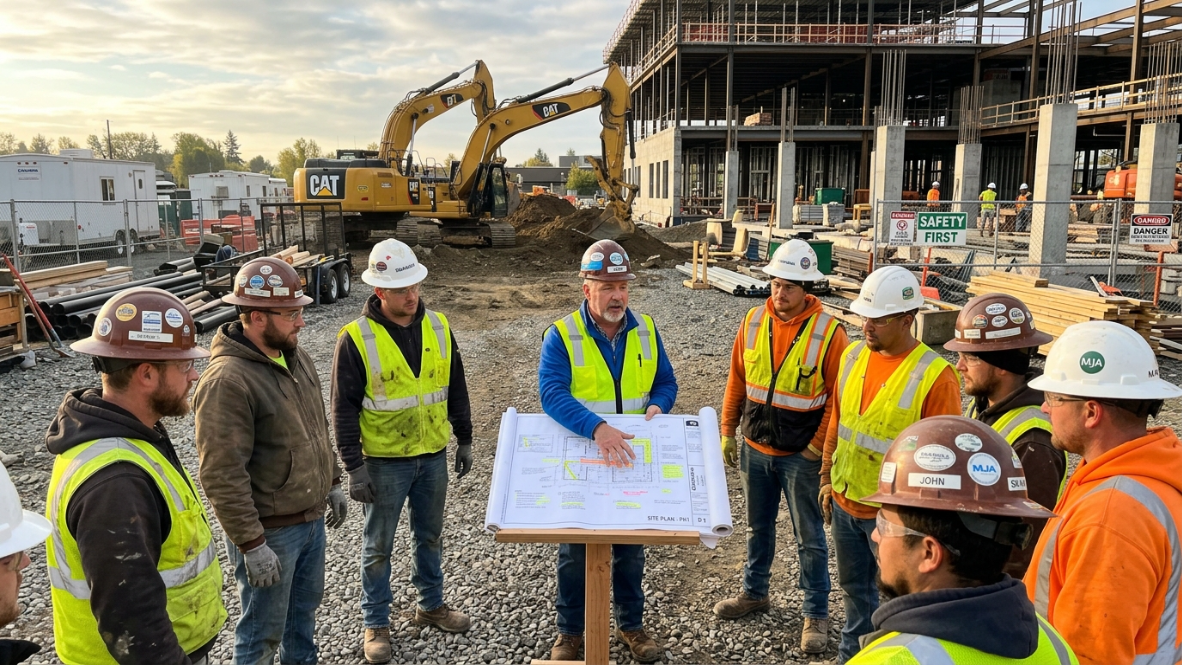
This is where most safety programs succeed or fail. Field coordination includes:
Pre-task planning before each work phase
Daily safety huddles
Toolbox talks on current hazards
Work sequencing reviews to prevent trade conflicts
Equipment movement coordination
Traffic control and pedestrian interface planning
Simultaneous operations review
OSHA recommends coordinating work planning and scheduling specifically to identify and resolve conflicts that could affect safety. A site-specific safety plan sitting in a project trailer does nothing if field supervisors do not follow it.
Monitor Performance
Use both lagging indicators and field evidence:
Site inspections and audit findings
Open corrective actions and closure timelines
Near-miss reporting volume and quality
Incident trend reviews
Supervisor participation in safety meetings
Training expiration tracking
Toolbox talk attendance
Review Before Renewal
After a project ends, evaluate each vendor’s safety performance. Did they follow the site-specific plan? Were incidents reported promptly? Were corrective actions closed? Did their field leadership actively support safety?
The answers determine whether the vendor stays approved, needs improvement, or gets removed from future work. This review step is what separates a true construction safety vendor partnership from a one-and-done transaction.
Key Safety Metrics in Vendor Partnerships
Construction safety vendor partnerships rely on measurable data, but no single metric tells the full story.
EMR (Experience Modification Rate): This workers’ compensation insurance metric reflects past injury frequency and severity. It is widely used in construction prequalification. But NCCI directly warns that it is not appropriate to use e-mods alone to compare the relative safety of employers. E-mods can be affected by payroll size, state rules, deductibles, and classification issues.
TRIR (Total Recordable Incident Rate): Calculated as (number of recordable cases / total hours worked) x 200,000. BLS defines recordable cases as work-related injuries and illnesses resulting in death, lost consciousness, days away from work, restricted activity, job transfer, or medical treatment beyond first aid.
DART Rate: Focuses on more severe cases involving days away, restricted work, or job transfer. OSHA defines it using the same 200,000-hour formula.
OSHA 300/300A Logs: Show the actual recorded incidents for a given year. Review three-year trends rather than a single snapshot.
Leading indicators: Near-miss reports, safety observations, audit closure rates, toolbox talk participation, and training completion rates. These show whether a vendor is actively managing safety, not just reacting after injuries happen.
Good vendor evaluation uses lagging metrics and field evidence together. EMR, TRIR, and DART tell part of the past. Site-specific plans, hazard controls, audits, near-miss reporting, and supervisor behavior show whether the vendor can work safely on this job. For more on connecting these data points to procurement KPIs and metrics, see our full guide.
OSHA Multi-Employer Worksite Rules in Plain English
Any discussion of construction safety vendor partnerships has to address OSHA’s multi-employer citation policy. This is the regulatory framework that makes vendor safety everyone’s problem.
On a multi-employer worksite, OSHA may cite more than one employer for a hazardous condition. The agency evaluates each employer’s role using four categories:
Creating employer: The company that caused the hazard.
Exposing employer: The company whose workers are exposed to the hazard.
Correcting employer: The company responsible for fixing the hazard.
Controlling employer: The company with general supervisory authority over the worksite, including the power to correct violations or require others to correct them.
Control can come from contract language or from control exercised in practice. A GC cannot simply assume that “the subcontractor is responsible for its own safety” and walk away from all liability. The actual role, contract rights, practical control, and corrective authority matter.
This is exactly why safety expectations belong in contracts and why safety vendor partnerships need clear documentation of who is responsible for what before anyone mobilizes.
Construction Safety Vendor Partnership vs. Related Terms
These terms overlap, and the distinctions matter.
Vendor management is the broad process of selecting, onboarding, monitoring, and reviewing vendors. Safety may be one component, or it may be barely addressed.
Construction safety vendor partnerships specifically build safety into procurement, contracts, onboarding, field coordination, and performance review. Safety is not a side feature. It is a core requirement.
Preferred vendor programs give approved vendors repeat access to work based on criteria like price, reliability, and service. Some include safety standards. Many do not. Our preferred vendor programs guide explains how to structure these with safety built in.
Contractor safety management focuses on contractors and subcontractors performing work on site. A safety vendor partnership may also include suppliers, consultants, PPE vendors, equipment rental firms, and technology providers.
OSHA Strategic Partnership is a formal OSHA program. These are agreements between OSHA and employers, workers, trade associations, or labor organizations designed to eliminate serious hazards. They are not the same as an internal vendor relationship.
Trade partner safety program is a construction-native term used by many GCs for subcontractor safety expectations, handbooks, orientations, and enforcement. It overlaps significantly with safety vendor partnerships but typically focuses more narrowly on trade subcontractors.
Characteristics of Successful Construction Safety Vendor Partnerships
High-performing partnerships usually include:
Executive leadership support
Standardized prequalification
Site-specific planning
Clear contract language
Frequent field inspections
Shared safety goals
Open communication
Data-driven performance reviews
Continuous improvement
Vendor recognition programs
Best Practices for Construction Safety Vendor Partnerships
Prequalify every vendor.
Standardize evaluation criteria.
Use written safety expectations in contracts.
Conduct project-specific onboarding.
Hold regular coordination meetings.
Monitor leading and lagging indicators.
Perform routine field audits.
Recognize high-performing vendors.
Review lessons learned after each project.
Continuously improve vendor requirements.
Common Mistakes
Treating Vendor Safety as Paperwork
A vendor with uploaded documents can still fail in the field. Practitioners on Reddit report that contractor management software is something “everyone needs” but many users dislike the available options. One commenter drew a clear line between documentation tools and actual safety performance management. The portal is not the partnership. The partnership is the process: requirements, ownership, field execution, and feedback.
Accepting Generic Safety Manuals as Site-Specific Plans
Practitioners on Reddit note that subcontractors frequently submit an entire company safety manual when the GC is asking for a site-specific safety plan. A better approach: provide a clear template and example, but require the subcontractor to own the hazards and controls for its specific scope. An experienced construction safety manager warned against writing contractors’ plans for them, explaining that pre-written plans can blur responsibility and produce documents the contractor does not truly understand.
Waiting Until After Award to Discuss Safety
If safety requirements are not in bid documents and contracts, enforcement relies on persuasion. That works sometimes. It fails often.
Using EMR as the Only Safety Screen
NCCI’s warning is clear: e-mods alone are not an appropriate measure of relative safety. Pair EMR with TRIR, DART, OSHA history, three-year trends, incident narratives, field audits, and leading indicators.
Assuming Subcontractors Manage All Risk Independently
OSHA’s multi-employer citation policy means the controlling employer, often the GC, has obligations too. Contract authority and actual site control both matter.
Buying Software Before Defining the Process
Practitioners consistently say contractor management software is widely needed but rarely loved. A platform that tracks document uploads does not solve safety performance management if the underlying process, from prequalification to field audits to post-project review, is unclear. For a deeper look at safety program structures that connect to vendor management, see our safety programs and vendors guide.
90-Day Implementation Plan
Days 1–30
Standardize prequalification
Update vendor policies
Define safety metrics
Days 31–60
Revise contracts
Build onboarding process
Train project managers
Days 61–90
Launch audits
Track KPIs
Review vendor performance
Identify preferred vendors
Construction Safety Vendor Partnership Checklist
Before work starts, confirm:
Vendor scope of work is clear
Safety requirements are in bid documents or the contract
Vendor has submitted insurance and required safety documents
EMR, TRIR, DART, OSHA logs, and incident history have been reviewed as trends
Site-specific safety plan is submitted and reviewed
Job hazard analysis is complete for high-risk work
Field supervisors know the plan
Site orientation is complete before mobilization
Emergency contacts and reporting procedures are clear
PPE, equipment, and training requirements are confirmed
Subcontractor flow-down requirements are defined
Audit and stop-work process is clear
Near-miss and incident reporting process is active
Vendor performance will be reviewed after the project
FAQ
Is a construction safety vendor partnership the same as vendor management?
No. Vendor management is broader and covers selection, onboarding, monitoring, and review across all performance areas. A construction safety vendor partnership is the safety-specific dimension of the relationship, focused on how vendors are selected, contracted, coordinated, and reviewed for safer work.
Is this the same as an OSHA Strategic Partnership?
No. OSHA Strategic Partnerships are formal agreements between OSHA and employers, workers, trade associations, or labor organizations to improve safety practices. A construction safety vendor partnership is usually an internal business relationship between a contractor, owner, and its vendors or subcontractors.
What types of vendors should be included?
Any vendor whose work, equipment, material, delivery, or service can affect jobsite safety. That includes subcontractors, material suppliers, equipment rental firms, PPE suppliers, traffic control vendors, testing and inspection firms, safety consultants, temporary labor providers, and compliance software vendors.
What safety documents should vendors provide?
Common documents include certificates of insurance, a written safety program, OSHA logs (where applicable), EMR documentation, training records, a site-specific safety plan, job hazard analyses, equipment inspection records, SDS documents where relevant, and incident and corrective action history.
Should EMR decide whether a vendor is safe?
No. EMR is useful as a screening input, but NCCI warns it is not appropriate to use e-mods alone to compare employer safety. Use EMR alongside TRIR, DART, OSHA logs, three-year trends, incident narratives, field audits, training records, and leading indicators.
Who is responsible for safety when a subcontractor is on site?
The subcontractor is responsible for its employees, but OSHA may evaluate multiple employers on a multi-employer worksite. OSHA considers whether each company created the hazard, exposed its workers, had responsibility to correct it, or had supervisory control over the worksite.
What is the most common failure in safety vendor partnerships?
Treating safety as document collection. A real partnership requires site-specific planning, field verification, supervisor involvement, regular communication, and timely corrective action. A safety manual sitting in a portal is not a partnership.
Do smaller contractors need different treatment?
Not different standards, but possibly different support. CPWR research shows small contractors have increased their use of online safety training and heat exposure mitigation, but gaps remain in preconstruction planning and technology adoption. Clearer templates, earlier expectations, and more structured onboarding help smaller vendors meet project safety requirements without lowering the bar.
Ready to build stronger vendor relationships with safety built in from the start? Our vendor partnership strategies guide walks through the full implementation process.
Recent Comments