
TL;DR
Building a construction safety program requires vendors across multiple categories: OSHA training providers, safety management software, consulting firms, and PPE supply vendors. For every $1 invested in safety, contractors save $4 to $6. This guide compares the top vendors in each category, breaks down real pricing, and explains how group purchasing organizations can cut 10% to 20% off safety supply costs. Small contractors should start with free-tier SafetyCulture, per-course OSHA training, and a GPO for supplies. Large GCs need enterprise platforms and dedicated safety staff.
If you’re choosing construction safety program vendors in 2026, start by matching vendors to your biggest need instead of looking for one platform that does everything. OSHA training providers handle compliance, safety software manages inspections and incidents, consultants build programs and conduct audits, PPE suppliers equip crews, and Group Purchasing Organizations (GPOs) reduce costs across every category. Most small contractors need only one vendor from each category, while larger contractors typically combine enterprise software, dedicated safety staff, and national purchasing agreements.
Construction Safety Vendor Decision Matrix
If You Need… | Best Vendor Category | Typical Budget |
|---|---|---|
OSHA compliance | OSHA Training Provider | $50-$500 per employee/year |
Daily inspections | Safety Management Software | Free-$30/user/month |
Audit preparation | Safety Consultant | $1,500-$2,000/day |
PPE purchasing | Safety Supply Vendor | $500-$2,000/employee/year |
Lower purchasing costs | Group Purchasing Organization | Membership based |
Why Construction Safety Programs Are a Non-Negotiable Investment
Preventable workplace injuries cost U.S. employers $181.4 billion annually. In construction specifically, 1,034 workers died on the job in 2024, with falls from elevation accounting for 389 of those deaths, according to OSHA. Fall protection has been OSHA’s most-cited violation for 14 consecutive years, with 5,914 citations issued in fiscal year 2025.
These aren’t just statistics. They represent project shutdowns, lawsuits, skyrocketing insurance premiums, and devastated families.
The financial case for safety is clear. Employers save between $4 and $6 for every $1 invested in construction safety programs, according to the American Society of Safety Professionals and the U.S. Department of Energy. Companies with comprehensive safety programs report 21% higher profit margins and 17% greater productivity compared to those without structured safety initiatives. Research from the Construction Industry Institute goes further: projects with zero recordable injuries complete 10% faster and 5% under budget on average.
Safety isn’t compliance overhead. It’s profit protection. The question isn’t whether to invest in a safety program, but which construction safety programs vendors deserve your money.
→ Explore contractor vendor discounts that apply to safety supplies and beyond.
How We Evaluated Construction Safety Program Vendors
Every vendor in this guide was evaluated using the same criteria.
Evaluation Criteria
Factor | Weight |
|---|---|
OSHA Compliance | 20% |
Ease of Use | 15% |
Pricing | 20% |
Customer Reviews | 15% |
Features | 15% |
Scalability | 10% |
Customer Support | 5% |
Vendors were compared using publicly available pricing, OSHA authorization status, software capabilities, industry reviews, contractor feedback, and suitability for different company sizes.
The 5 Types of Construction Safety Program Vendors
Most comparison articles cover one slice of the safety vendor ecosystem. That’s a problem, because a real safety program requires vendors across multiple categories working together. Here’s the full taxonomy:
Category | What It Covers | Starting Cost Range | Best For |
|---|---|---|---|
OSHA Training Providers | Compliance courses, DOL cards, toolbox talks | $49 to $500/employee/year | Meeting regulatory minimums |
Safety Management Software | Inspections, incident tracking, observations | $0 to $80,000/year | Digitizing safety workflows |
Safety Consulting Firms | Audits, program development, staff augmentation | $1,500 to $2,000+/day | Expert guidance, ISO certification |
PPE & Safety Supply Vendors | Hard hats, harnesses, hi-vis, fall protection | $500 to $2,000/employee/year | Equipping crews |
Group Purchasing Organizations | Pre-negotiated pricing across all supply categories | Membership-based | Reducing cost across all vendor relationships |
The vendors below are organized by category, with honest pricing, real user feedback, and clear guidance on who each option fits best. Use this alongside a vendor comparison checklist to evaluate your options systematically.
Best OSHA Training Providers for Construction
One fact cuts through all the marketing noise: the DOL completion card is identical regardless of which authorized provider issues it. OSHA’s official list of authorized online outreach training providers includes 360Training, CareerSafe, ClickSafety, HSI, PureEHS, Redvector (Vector Solutions), and the University of South Florida, among others. What actually differs is price, course experience, language options, and customer support.
1. ClickSafety
Best for: Mid-size to large contractors buying OSHA cards in bulk.
Pricing: OSHA 10 Construction starts around $59; OSHA 30 Construction around $159.
Key features: 500+ course catalog, volume discounts for employer accounts, mobile-friendly interface.
Limitations: Content-only platform with no built-in LMS for tracking employee records. If you need compliance record management, you’ll need separate software. Customer support is adequate but not exceptional.
Language support: English and Spanish available on core courses.
2. 360Training (OSHAcampus)
Best for: Budget-conscious contractors who need bilingual training.
Pricing: OSHA 10 Construction starts around $49, making it the cheapest authorized option for most buyers.
Key features: Full English and Spanish course libraries, OSHA-authorized, widely recognized brand.
Limitations: The interface feels dated compared to competitors. Practitioners on forums consistently report slow customer support response times, particularly when dealing with certificate delivery issues.
Good to know: Despite the UX complaints, the training content meets the same OSHA standards as every other authorized provider.
3. CareerSafe
Best for: First-time workers and younger employees entering the trades.
Pricing: OSHA 10 Construction around $59.
Key features: Youth-focused curriculum design, strong onboarding orientation for workers new to construction.
Limitations: Course pacing is deliberately slow, which frustrates experienced workers. Not ideal for seasoned crews who just need a refresher or card renewal.
4. HSI (Summit Training Source)
Best for: Enterprise teams needing LMS integration and custom training programs.
Pricing: Starts at $4,000 per year minimum.
Key features: Full learning management system, custom course creation tools, integration with enterprise HR platforms, extensive safety video library.
Limitations: The $4,000 floor prices out small contractors entirely. One practitioner on a safety industry forum noted that the per-seat costs make sense at 50+ employees but become “painful overhead” below that threshold.
5. National Safety Council (NSC)
Best for: Corporate EHS environments where brand prestige and certification reputation matter.
Pricing: Premium, typically higher than other authorized providers for comparable content.
Key features: Strong brand recognition, comprehensive catalog beyond OSHA courses, first aid and CPR certification programs.
Limitations: For most field-level construction safety programs vendors, the NSC premium isn’t justified. The DOL card is the same. You’re paying for the name.
Cost benchmarks to know: Compliance training in 2026 runs roughly $5 to $17 per employee per month for online programs, or $50 to $100 per employee per year for basic course access. Specialized or in-person training pushes that to $200 to $500 per employee. Plan accordingly when building your annual safety budget.
OSHA Training Provider Comparison Table
Vendor | OSHA Authorized | Spanish Courses | LMS | Starting Price | Best For |
|---|---|---|---|---|---|
ClickSafety | Yes | Yes | No | $59 | Mid-size contractors |
360Training | Yes | Yes | No | $49 | Lowest cost |
CareerSafe | Yes | Limited | No | $59 | New workers |
HSI | Yes | Yes | Yes | $4,000/year | Enterprise |
NSC | Yes | Yes | Partial | Premium | Corporate EHS |
What Construction Safety Software Should Include
Instead of comparing products first, buyers should know which features matter.
Minimum recommended capabilities include:
Mobile inspections
Incident reporting
Near miss reporting
Toolbox talks
Corrective action tracking
Employee training records
OSHA log management
Photo documentation
Offline functionality
Dashboard reporting
QR code inspections
Subcontractor management
Digital signatures
Best Construction Safety Management Software
Software is where safety programs either stay on paper or actually change behavior in the field. The right platform handles inspections, incident reports, safety observations, and compliance documentation. The wrong one becomes shelfware.
1. SafetyCulture (iAuditor)
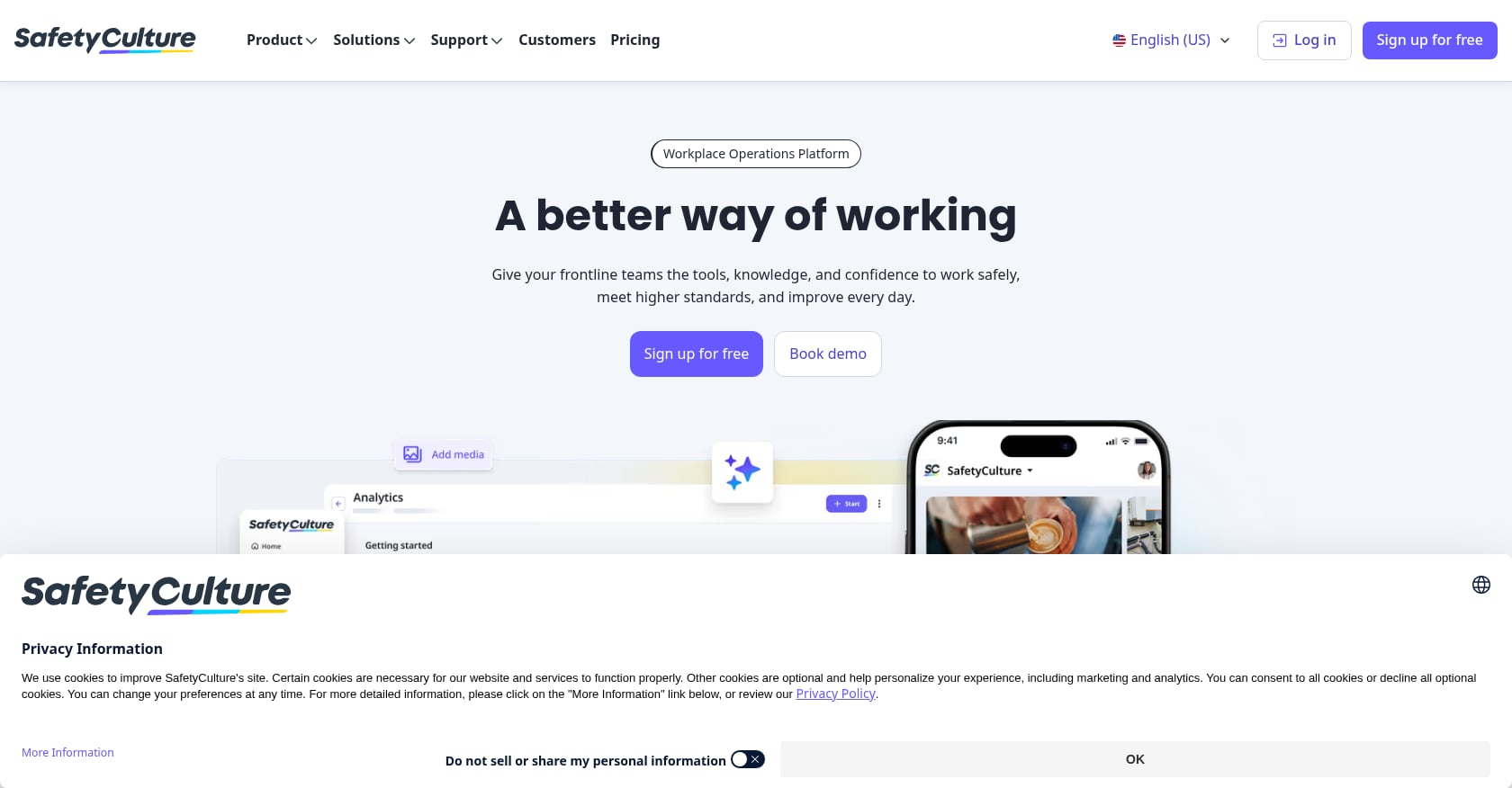
Best for: Small to mid-size contractors who want mobile-first inspections without a big upfront investment.
Pricing: Free for up to 10 users (basic inspections, 3 years of data history). Premium runs $24 to $29 per user per month billed annually.
Key features: 1,500+ inspection templates, full offline capability, AI report summaries on Premium, photo and annotation tools for field documentation.
Limitations: Per-user pricing scales fast. For a team of 20 on Premium, you’re looking at roughly $5,800 per year. Users on Capterra report that exported reports need manual cleanup and that device caps catch people off guard. Reporting depth on the free tier is restrictive.
Market adoption: AGC’s 2025 survey found that 43% of small-to-mid-size GCs using digital safety tools chose iAuditor, making it the dominant option in that segment.
A 20-year EHS practitioner writing on Safetyology noted a common complaint from small business operators: “The per-user pricing model punishes small teams.” Something worth weighing if you’re running lean crews.
2. Procore Safety
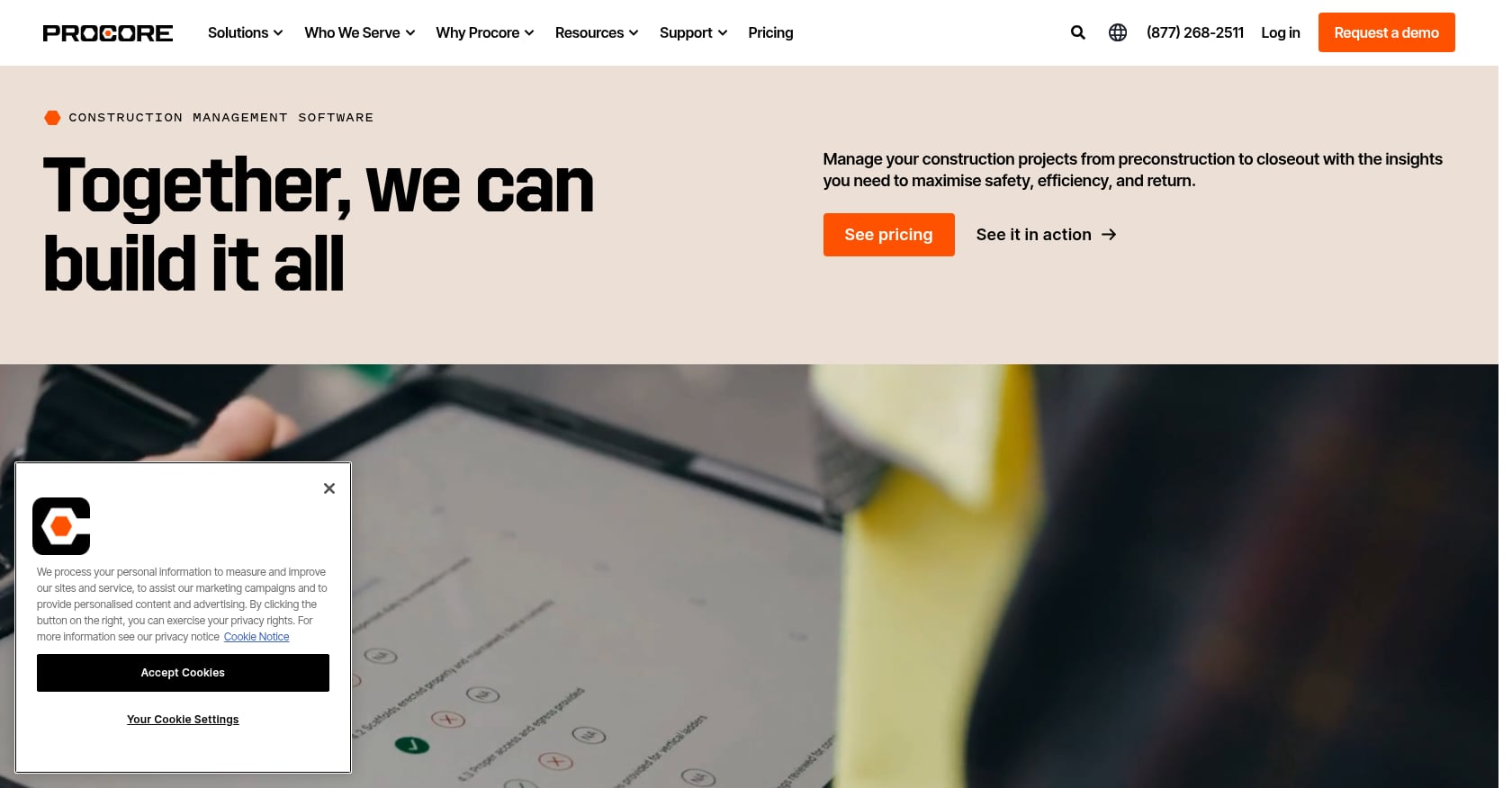
Best for: General contractors already using Procore for project management.
Pricing: Included with a Procore subscription, but Procore itself starts around $375/month for small contractors. Most small contractors report $10,000 to $25,000 per year as a realistic starting point for the platform.
Key features: Integrated with Procore’s project management, drawing, and quality modules. Handles safety observations, incident tracking, and inspections within the broader project workflow.
Limitations: The safety module was added later and it shows. It handles the basics (observations, incidents, inspections) but lacks the depth of dedicated safety platforms. If you’re not already on Procore, subscribing just for safety is expensive. Practitioners on MakeSafetyEasy describe it bluntly: “great if you’re already there, expensive as a standalone.”
3. BIS Safety Software
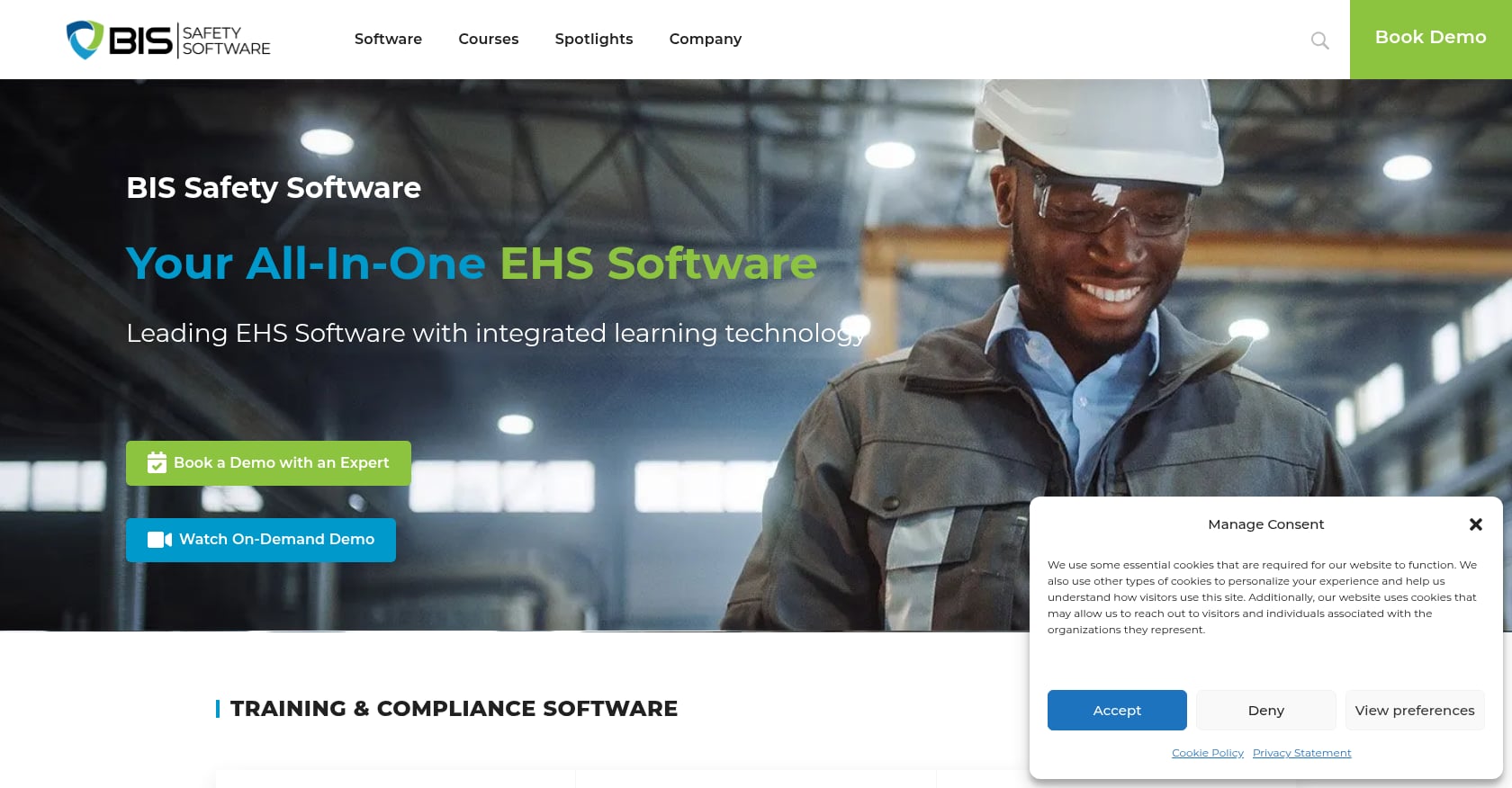
Best for: Multi-location firms that need a broad, all-in-one EHS platform.
Pricing: Custom pricing (request a quote).
Key features: Covers the widest range of EHS functions including training management, permit-to-work systems, contractor management, and incident investigation. Strong for organizations managing safety across dozens of sites.
Limitations: Configuration complexity is the consistent complaint. Expect a longer implementation timeline and potentially the need for dedicated admin support. Not a “set it up in an afternoon” product.
4. eSafety
Best for: Contractors who need multi-location compliance tracking and subcontractor safety management.
Pricing: Custom pricing.
Key features: Contractor qualification tracking, compliance dashboards, safety document management across multiple jobsites.
Limitations: Lower brand recognition means fewer third-party integrations and a smaller user community for troubleshooting. Worth evaluating if contractor management is your primary pain point.
Software pricing reality: Enterprise platforms like Autodesk BIM 360 and ComplianceQuest run $40,000 to $80,000 annually, which puts them out of reach for most mid-size GCs. For the majority of construction safety programs vendors in the software category, the real choice is between SafetyCulture’s free/Premium tiers and whatever your existing project management platform offers.
Common Mistakes When Buying Safety Software
Many contractors buy software that never gets adopted because they focus only on features instead of implementation.
Avoid these common mistakes:
Buying enterprise software for a 10-person crew
Ignoring mobile usability
Choosing software without offline capability
Purchasing software that duplicates existing project management tools
Forgetting employee training
No implementation plan
No executive ownership
Not measuring adoption
Should You Buy Software or Hire a Consultant?
Situation | Software | Consultant |
|---|---|---|
Daily inspections | ✅ | |
Incident reporting | ✅ | |
OSHA documentation | ✅ | |
Site safety plans | ✅ | |
Mock OSHA audits | ✅ | |
Root cause investigations | ✅ | |
Temporary safety staffing | ✅ | |
Employee onboarding | ✅ |
Construction Safety Consulting Firms Worth Knowing
Sometimes you need a human, not a platform. Safety consultants fill gaps that courses and software can’t: developing site-specific safety plans, preparing for audits, and staffing temporary safety officers for large projects.
But the model is changing. Atlantic Training put it well: “You can’t afford to pay a consultant $2,000 a day every time you hire a new subcontractor.” The trend is toward hybrid approaches that combine digital training platforms with targeted expert consulting for high-stakes situations.
1. Marsh
Best for: Mega-projects and enterprise-level Total Cost of Risk analysis.
Pricing: Enterprise consulting rates (expect significant five-figure engagements minimum).
Key features: Deep risk modeling capabilities, insurance advisory integration, global reach.
Limitations: Priced and scoped for the largest contractors. Mid-size GCs will find Marsh’s services overbuilt for their needs.
2. BSI
Best for: Contractors pursuing ISO 45001 certification or bidding on government contracts that require it.
Pricing: Varies by audit scope (typically $10,000+ for initial certification).
Key features: ISO certification and auditing, globally recognized accreditation, structured management system development.
Limitations: Paperwork-heavy and process-intensive. For the average subcontractor, ISO certification is overkill unless contract requirements demand it.
3. Core Safety Group
Best for: Temporary on-site safety manager staffing for specific projects.
Pricing: Staff augmentation rates (daily or project-based).
Key features: Experienced safety professionals available for short-term deployment, useful for peak project periods or gap coverage.
Limitations: This is a staffing solution, not a training or program development solution. You still need separate training and documentation systems.
4. Medcor
Best for: On-site injury clinics that reduce workers’ comp claims and lost-time incidents.
Pricing: Custom (depends on site size and duration).
Key features: On-site medical clinics, immediate injury triage, workers’ compensation cost reduction programs.
Limitations: Medcor handles the medical response side only. It doesn’t train your crews or build your safety program. Think of it as a downstream safety investment, not an upstream one.
When to hire a consultant vs. use a platform: If you need a site-specific safety plan for a complex project, an audit to prepare for a prequalification review, or temporary safety officer coverage, a consultant makes sense. For ongoing compliance training and daily safety management, platforms are more cost-effective. When negotiating consulting contracts, review vendor contracting best practices to protect your interests.
Construction Safety Supply Vendors
PPE and safety equipment represent the most tangible, recurring cost in any construction safety program. Hard hats, fall harnesses, hi-vis clothing, safety glasses, hearing protection, and respirators are purchased continuously.
The major construction safety supply vendors include Grainger, Fastenal, White Cap, McMaster-Carr, MSC Industrial, Uline, and Zoro. Each has distinct strengths. Forum users consistently recommend McMaster-Carr for speed (next-day delivery on roughly 99% of orders with published pricing and no account setup required) and Grainger for volume pricing through negotiated accounts with same-day pickup at 318+ branch locations.
For a detailed comparison of these vendors with pricing models and procurement strategies, see our construction safety supply vendors comparison.
Two regulatory and market developments are reshaping safety supply purchasing in 2026:
OSHA’s PPE fit rule (December 2024): OSHA finalized revisions to 29 CFR 1926.95, requiring that PPE must properly fit each construction employee. This aligns construction standards with existing general industry requirements and means contractors can no longer buy one-size-fits-most safety gear. Purchasing decisions now need to account for sizing variety, which affects inventory costs and vendor selection. Our PPE compliance guide covers the full implications.
Tariff impact on PPE costs: According to ISEA, 77% of members report significant cost increases in safety supplies due to tariffs on steel, aluminum, and specialty plastics. These materials directly affect hard hats, fall arrest systems, and safety footwear. Contractors who haven’t adjusted their supply cost reduction strategies are absorbing margin hits they don’t need to.
Smart PPE is worth watching. The smart PPE segment now holds a 38.6% share of the construction safety technology market. Think hard hats with impact sensors, wearable heat-stress monitors, and connected fall detection devices. Adoption is still early, but larger GCs are beginning to specify smart PPE on high-risk projects.
How GPOs Cut Safety Program Costs Across Every Category
One procurement strategy that almost no vendor comparison article mentions is group purchasing. A Group Purchasing Organization aggregates the buying power of many contractors to negotiate pre-set pricing with major vendors, similar to how hospital systems have used GPOs for decades.
The numbers are straightforward. On average, organizations using a GPO pay about 13% less for supplies than those negotiating independently. For safety and PPE specifically, standardizing sourcing through a GPO contract can cut costs 10% to 20% while also improving compliance with safety specifications. Among Fortune 1000 companies participating in buying consortiums, 85% report savings of 10% or more.
A GPO doesn’t replace your safety vendors. It makes every vendor relationship more cost-effective. Here’s how that works across safety program categories:
PPE and supplies: Pre-negotiated pricing on hard hats, harnesses, gloves, and hi-vis gear from major distributors. This is where the savings are most immediate and measurable.
Training: Volume pricing agreements on OSHA courses and LMS platforms that individual contractors can’t negotiate alone.
Software: Enterprise-level pricing tiers made accessible to mid-size firms through collective purchasing power.
Tariff protection: GPO contracts often include price-hold provisions that buffer members from sudden tariff-driven cost increases, an increasingly important benefit in 2026.
→ Learn how construction supplier programs work and what savings they can unlock for your safety budget.
What a Complete Safety Program Actually Costs
No article in the search results stacks up the total cost of a construction safety program. Here’s a realistic breakdown by company size:
Small Contractor (Under 25 Employees)
Category | Vendor Approach | Annual Cost Estimate |
|---|---|---|
Training | ClickSafety or 360Training per-course | $1,250 to $5,000 |
Software | SafetyCulture free tier | $0 |
PPE/Supplies | Regional distributor + GPO | $12,500 to $50,000 |
Consulting | As-needed only | $3,000 to $6,000 |
Total | $16,750 to $61,000 |
Mid-Size GC (25 to 200 Employees)
Category | Vendor Approach | Annual Cost Estimate |
|---|---|---|
Training | HSI or ClickSafety bulk + bilingual courses | $5,000 to $40,000 |
Software | SafetyCulture Premium | $5,800 to $70,000 |
PPE/Supplies | Grainger/Fastenal + GPO pricing | $50,000 to $400,000 |
Consulting | Quarterly audits + project-specific plans | $10,000 to $40,000 |
Total | $70,800 to $550,000 |
Large GC (200+ Employees)
Category | Vendor Approach | Annual Cost Estimate |
|---|---|---|
Training | Enterprise LMS (HSI or Vector Solutions) | $20,000 to $100,000 |
Software | Procore Safety or BIS Safety | $25,000 to $80,000 |
PPE/Supplies | National distributor + GPO | $200,000 to $1,000,000+ |
Consulting | Dedicated safety staff + specialist consultants | $50,000 to $200,000 |
Total | $295,000 to $1,380,000+ |
These numbers make one thing clear: PPE and supplies dominate the total cost of a safety program, regardless of company size. That’s exactly where GPO membership delivers the highest dollar-value return. Even a 10% reduction on a $400,000 annual PPE spend saves $40,000, which is enough to fund a full digital safety platform. For a broader view of where to find savings, explore this procurement savings guide.
How to Choose the Right Safety Vendor Stack for Your Size
Not every contractor needs every category of vendor. Here’s a practical starting framework:
Under 25 employees: Start with SafetyCulture’s free tier for inspections and incident tracking. Buy OSHA 10/30 cards individually through ClickSafety or 360Training. Join a GPO to get volume pricing on PPE without needing volume. Hire a consultant only for specific high-risk projects or prequalification preparation.
25 to 200 employees: Move to SafetyCulture Premium or evaluate Procore Safety if you’re already on that platform. Negotiate bulk training rates through HSI or ClickSafety’s employer program. Use a GPO for PPE procurement and look into preferred vendor programs to consolidate purchasing. Schedule quarterly safety audits with a consulting firm.
200+ employees: You likely need dedicated safety staff supplemented by enterprise software (BIS Safety or Procore), an enterprise LMS for training, and comprehensive GPO membership for supplies. At this scale, safety consulting shifts from external firms to internal capability with occasional specialist support.
Regardless of size, the first step after selecting your construction safety programs vendors is onboarding them properly. A structured vendor onboarding checklist prevents the common problem of paying for tools and services that never get fully implemented.
Key Metrics to Track After Implementing a Safety Program
Measure success using leading and lagging indicators.
Leading Indicators
Safety observations completed
Toolbox talks conducted
Near misses reported
Corrective actions closed
Inspection completion rate
Employee training completion
Lagging Indicators
TRIR
DART rate
Lost-time incidents
Workers’ compensation costs
OSHA citations
EMR score
Construction Safety Vendor Checklist
Before choosing any vendor, verify:
OSHA authorized (if applicable)
Transparent pricing
Mobile capability
Offline support
References
Customer reviews
Data export
Integrations
Contract flexibility
Ongoing support
FAQ
Do all OSHA training providers give the same DOL card?
Yes. Every OSHA-authorized outreach training provider issues the identical Department of Labor completion card. The card looks the same, carries the same weight, and satisfies the same requirements whether you paid $49 or $200 for the course. What differs between providers is the learning experience, interface quality, language options, and customer support.
What’s the minimum a small contractor should spend on a safety program?
At minimum, every employee needs OSHA 10 training ($49 to $59 each), basic PPE ($500 to $800 per worker annually), and some form of inspection and incident documentation. For a 10-person crew, that’s roughly $6,000 to $9,000 per year. Using SafetyCulture’s free tier for documentation and a GPO for supply discounts keeps this number manageable. Skipping the investment entirely is far more expensive when you factor in that workplaces with safety management systems reduce injury costs by 20% to 40%.
How do tariffs affect safety supply costs in 2026?
Tariffs on steel, aluminum, and specialty plastics directly increase the cost of hard hats, fall arrest hardware, safety-toe footwear, and metal-framed safety equipment. ISEA reports that 77% of its members have experienced significant cost increases due to these tariffs. Contractors who buy individually absorb the full increase. Those purchasing through GPOs or negotiated contracts often benefit from price-hold provisions that buffer against sudden spikes.
What does OSHA’s new PPE fit rule mean for my purchasing?
OSHA’s December 2024 revision to 29 CFR 1926.95 requires that PPE must properly fit each construction employee, not just be “available.” This means contractors need to stock a wider range of sizes, particularly for harnesses, hard hats, and gloves. It also means women and smaller-framed workers must receive properly sized equipment rather than being handed standard sizes. Vendors who offer broad size ranges and fit consultation services become more valuable under this rule.
Is Procore Safety worth it if I’m not already using Procore?
Probably not. Procore Safety’s value comes from its integration with Procore’s project management, drawings, and quality modules. As a standalone safety platform, it’s expensive relative to dedicated safety tools like SafetyCulture. If you’re already paying for Procore and want safety features in the same interface, it’s a reasonable addition. If not, dedicated construction safety programs vendors offer more functionality for less money.
Should I hire a safety consultant or use software?
For daily safety management (inspections, incident documentation, training tracking), software is more cost-effective and consistent. For periodic needs like developing a site-specific safety plan, preparing for an audit, conducting a root cause investigation after a serious incident, or staffing a temporary safety officer, consultants are worth the investment. Most mid-size contractors benefit from a hybrid approach: software for daily operations, consultants for strategic or high-stakes situations.
How much can a GPO actually save on safety supplies?
Published data shows 10% to 20% savings on safety and PPE purchases through GPO contracts, with an overall average of 13% across all supply categories. For a contractor spending $100,000 per year on safety supplies, that’s $10,000 to $20,000 back in your pocket annually, before factoring in time savings from simplified procurement and reduced vendor management overhead.
→ Ready to reduce what you spend across all your safety program vendors? See how contractor buying groups deliver savings without changing the vendors you already trust.
Recent Comments