
TL;DR
Construction vendor price negotiation works best when contractors stop asking “Is this your best price?” and start making specific trades: faster payment, committed volume, cleaner scopes, or shared risk in exchange for documented savings. Procurement accounts for 40% to 70% of a construction company’s total spending, so even small improvements compound into real margin gains. This guide covers 15 field-tested negotiation tactics, from bid leveling and quote validity windows to escalation clauses and buying-group leverage, with copy-and-paste scripts for each.
How do you negotiate construction vendor prices?
To effectively negotiate construction vendor pricing in 2026, contractors should move beyond simple price-cutting requests and utilize bid leveling to compare “apples-to-apples” quotes. Successful strategies involve trading volume commitments, faster payment terms (e.g., 2/10 Net 30), or cleaner scopes for specific concessions like unit price reductions, freight caps, and extended price holds. With procurement representing 40% to 70% of total project costs, utilizing escalation/de-escalation clauses and contractor buying groups is essential to protecting margins against market volatility.
Why Vendor Negotiation Is a Profit Lever, Not an Admin Task
If your supplier negotiation strategy starts and ends with “Can you do better on this?”, you are leaving money on the table. Construction suppliers can move on price when you change the economics around the deal: cleaner scope, faster payment, larger volume, fewer rush orders, better forecasting, or shared escalation risk.
The numbers make this obvious. McKinsey reports that procurement typically accounts for 40% to 70% of a construction company’s total spending, and that best-in-class procurement practices can produce margins five to ten percentage points higher than procurement laggards. Many construction CPOs believe consistent procurement discipline could generate savings of up to 12%.
Meanwhile, the squeeze is real. AGC reported that the producer price index for nonresidential construction materials and services rose 3.6% over 12 months in their November 2025 analysis, while contractors’ bid prices rose only 2.7% over the same period. That gap comes straight out of contractor margins. And 53% of contractors listed material costs as a top concern heading into 2026.
This is the core problem construction vendor price negotiation solves. Not by squeezing vendors until they cut corners, but by structuring deals where both sides benefit from predictability, reliability, and reduced risk.
The best way to negotiate construction vendor pricing is to compare leveled quotes, benchmark price increases against market data, and trade something vendors value (volume, faster payment, longer commitments, cleaner scopes, or delivery flexibility) for a specific concession such as lower unit pricing, rebates, freight caps, price holds, or escalation limits.
Before getting into the 15 tactics, it helps to understand what contractor purchasing leverage actually consists of, and why it matters more than negotiation technique alone.
What Construction Vendor Price Negotiation Really Means
Vendor price negotiation in construction is not just haggling over a line item on a quote. It includes:
Base unit price for materials, equipment, or services
Payment terms and early-pay discounts
Quote validity periods and price-lock mechanics
Freight, fuel surcharges, and delivery fees
Volume tiers and annual rebates
Escalation and de-escalation clauses for volatile materials
Lead times and availability guarantees
Rental adders (damage waivers, environmental fees, standby charges)
Return, restocking, and cancellation terms
Service-level expectations (on-time delivery, order accuracy, emergency response)
A practitioner in a Reddit construction discussion framed it well: construction cost is heavily driven by risk and scope uncertainty, so meaningful negotiation means identifying the parts of the price tied to risk, then reducing those risks to reduce cost. That is the operating principle behind every tactic below.
Quick Reference: Negotiation Leverage Matrix
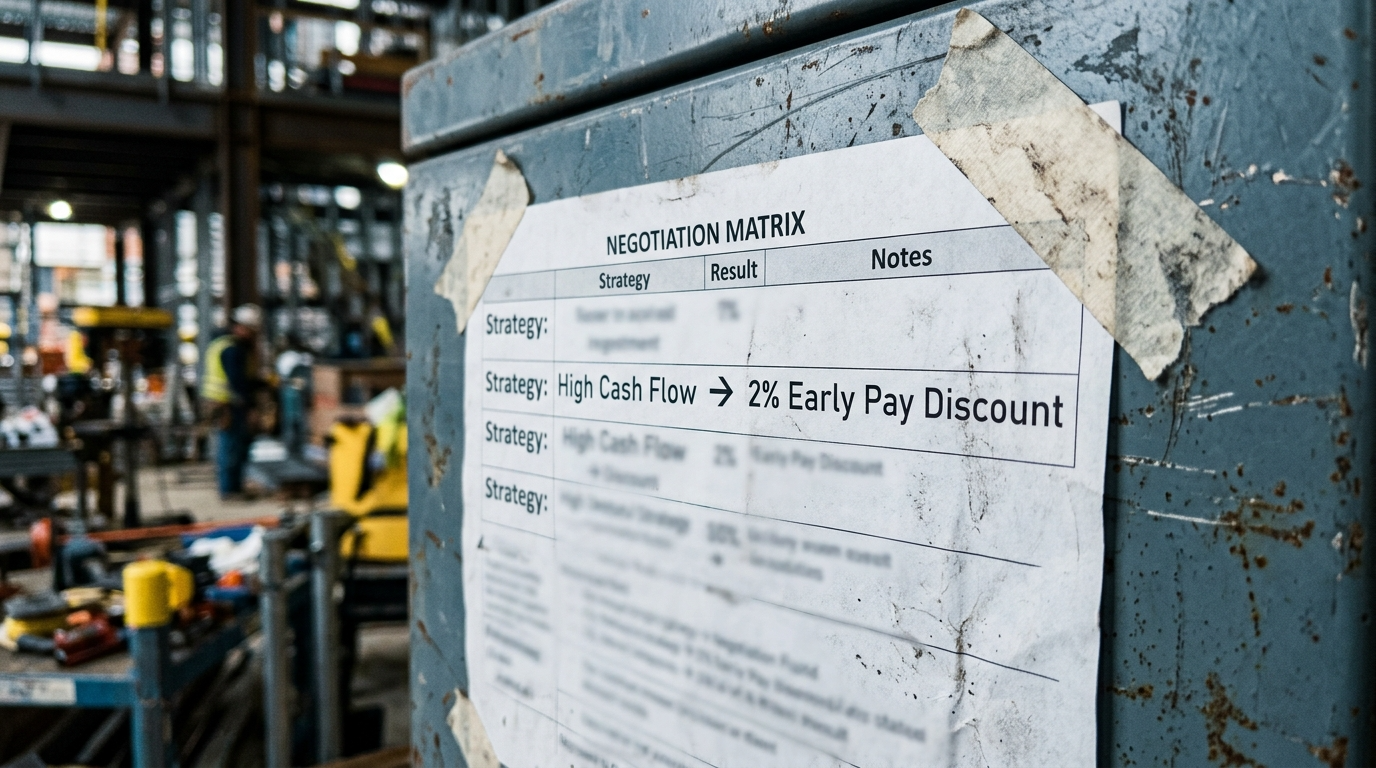
If you have… | Ask the Vendor for… | SEO Keywords to Use |
High Cash Flow | 2% Early Payment Discount | Early pay discount, Net 10 terms |
Consistent Annual Volume | Tiered Pricing & Rebates | Volume rebates, annual spend |
Flexible Schedule | Free Freight/Consolidated Shipping | Landed cost, freight caps |
Project Uncertainty | Escalation/De-escalation Clause | Material price index, PPI |
Limited Buying Power | Buying Group/GPO Access | Contractor purchasing alliance |
At-a-Glance: 15 Construction Vendor Price Negotiation Tactics
# | Tactic | Best For | What You Give | What You Ask For | Main Tradeoff |
|---|---|---|---|---|---|
1 | Build a should-cost baseline | All vendor talks | Data-driven discussion | Price justification by category | Requires quote history |
2 | Bid-level every quote | Sub buyout, material packages | Clean RFQ format | Apples-to-apples pricing | Slower upfront process |
3 | Keep real alternatives | Major suppliers | Competitive opportunity | Better pricing or terms | Too many vendors dilutes volume |
4 | Consolidate volume | Repeat categories | Forecasted spend, preferred status | Tiered pricing, rebates, price holds | Supplier concentration risk |
5 | Use buying-group leverage | Limited individual volume | Program compliance | Pre-negotiated pricing, rebate access | Must use program vendors |
6 | Trade faster payment for discount | Cash-stable contractors | Net 10/15 or reliable ACH | 1%–2% discount | Must actually pay on time |
7 | Negotiate quote validity | Volatile materials | Deposit, PO, or release schedule | 30/60/90-day price lock | Working capital commitment |
8 | Use escalation/de-escalation clauses | Long jobs, volatile categories | Shared risk | Index-based price adjustment with cap | Legal and admin complexity |
9 | Lock early buys with stored materials | Long-lead materials | Early order, storage plan | Current pricing and allocation | Storage, insurance, cash flow |
10 | Negotiate landed cost | Freight-heavy purchases | Consolidated delivery schedule | Freight cap, no delivery minimum | Less delivery flexibility |
11 | Audit equipment rental adders | Rentals over 30 days | Longer term, preferred vendor | Waive or cap add-on fees | Damage exposure if waiving protection |
12 | Use unit prices and allowances carefully | Unknown quantities | Clear assumptions and caps | Pre-priced changes | Can be gamed with bad quantities |
13 | Dual-source high-risk categories | Long-lead or volatile items | Split volume | Supply backup, pricing discipline | Less volume concentration |
14 | Scorecard vendors on performance | Recurring suppliers | Transparent performance tracking | Price tied to service outcomes | Requires consistent measurement |
15 | Document every give/get | All negotiations | Clear commitments | Enforceable savings and terms | Administrative discipline |
15 Construction Vendor Price Negotiation Tactics
1. Build a Should-Cost Baseline Before Asking for a Discount
Best for: Every construction vendor negotiation, regardless of category or size.
Asking for a discount without knowing where the price comes from is guessing. A should-cost baseline separates material cost from freight, tax, fuel surcharge, overhead, risk, and margin so you know which components are negotiable.
Compare the current quote against past invoices for the same category.
Break the price into base material, freight, delivery, fuel surcharge, tax, minimums, and fees.
Benchmark volatile categories using BLS Producer Price Index data, AGC construction cost tables, manufacturer price sheets, or state DOT index mechanisms.
Ask the vendor to explain each increase by category, not as a single percentage.
AGC’s 2026 data shows real input cost pressure, with nonresidential input costs up 3.6% year over year. That does not mean every increase you receive is justified. Some suppliers apply blanket increases that exceed their actual cost movement. Data lets you separate legitimate increases from padding.
Script: “We see the increase, but we need to separate material, freight, fuel, and margin. Can you send the manufacturer notice or index movement behind this change?”
Tradeoffs: Requires maintaining quote history and spending time on analysis. Worth it for any purchase above $10,000.
2. Bid-Level Every Vendor Quote
Best for: Subcontractor buyout, material packages, commodity categories, and any purchase with multiple bidders.
“Get three quotes” is advice you will find everywhere. It is also incomplete. Three mismatched quotes create false leverage. One may exclude freight, another may exclude accessories, and the third may assume a different lead time.
Before comparing prices, normalize every quote against the same checklist:
Scope included and excluded
Quantity basis
Freight and delivery charges
Taxes
Fuel surcharges
Minimum order fees
Lead time
Quote validity period
Warranty
Substitution assumptions
Payment terms
Return and restocking terms
This is bid leveling, and it is one of the most overlooked steps in contractor supplier negotiation. Without it, you might choose the “lowest” quote only to find it is the most expensive once delivery charges, short validity, and exclusions are factored in.
Script: “We are leveling all quotes on the same basis. Please revise using the attached scope matrix so we can compare freight, lead time, exclusions, and quote validity consistently.”
Tradeoffs: Slows the upfront process. But it reduces change orders and surprise costs downstream. For guidance on structuring your sourcing approach before quotes go out, see this construction sourcing strategy guide.
3. Keep Real Alternatives, Not Fake Leverage
Best for: Large material buys, subcontractor buyout, equipment rental, recurring MRO purchases.
Vendors know when you are bluffing. Calling a supplier and saying “I have other options” without actually having priced and qualified alternatives is transparent and ineffective.
A credible alternative means:
A real second source, quoted and qualified
An alternate specification that meets project requirements
A buying-group price you can reference
A different delivery or scheduling option that changes the cost equation
The goal is not to threaten. It is to give the vendor a reason to sharpen the pencil. Framing matters: “You are our preferred supplier” combined with “we are benchmarking this package” is more effective than an ultimatum.
Script: “You are our preferred supplier, but we are benchmarking this package. If you can meet the target on price hold and freight, we can keep the full package with you.”
Tradeoffs: Maintaining too many vendor relationships dilutes volume leverage and adds administrative burden. Use alternatives strategically, not chaotically.
4. Consolidate Volume in Exchange for Tiered Pricing
Best for: Recurring categories like PPE, tools, sealants, small equipment, consumables, concrete accessories, and MRO supplies.
Vendors discount predictable revenue. If your company buys the same category from five different sources because each project manager has a favorite supplier, you are paying fragmented-volume pricing across the board.
Consolidating spend into fewer vendors can unlock:
Tiered pricing based on annual volume
Year-end rebates
Free or reduced freight thresholds
Longer quote validity
Dedicated account rep
For a deeper look at how rebate programs work and how to track them, see this contractor vendor rebates guide.
Script: “If we commit this category to you for the next 12 months, what tiered pricing, freight terms, and year-end rebate can you put in writing?”
Tradeoffs: Supplier concentration creates risk if the vendor misses deliveries or raises prices after you are locked in. Pair volume commitments with performance expectations and an escape clause.
5. Use Buying-Group Leverage When Individual Spend Is Not Enough
Best for: Small and mid-sized contractors whose individual spend does not command national-account pricing.
This is one of the most practical but underused approaches to construction vendor price negotiation. If your annual spend in a category is $200,000 and the pricing tier you need requires $2 million, no amount of negotiation technique will close that gap. The problem is not your skill. It is leverage.
Contractor buying groups and purchasing alliances exist to aggregate demand across multiple contractors, giving each member access to pricing programs that would be difficult or impossible to negotiate alone. The logic is straightforward: suppliers offer better pricing to larger addressable volumes.
A contractor buying group works best when:
Your individual volume is thin relative to the pricing tier you want
Categories are fragmented across many small purchases
Vendor rebate and pricing programs require volume thresholds you cannot meet alone
You want access to pre-negotiated programs without running your own RFP process
Script: “We are reviewing whether our current pricing reflects our individual spend or a larger aggregated purchasing program. Can you match program-level pricing if we direct more volume through your line?”
Tradeoffs: Buying groups work only if members actually use program vendors and track compliance. The savings are real, but they require discipline to capture.
6. Trade Faster Payment for a Real Discount
Best for: Trusted suppliers where the contractor has sufficient cash control and AP discipline to pay quickly.
Payment timing is one of the most powerful bargaining chips in construction, and most contractors underestimate it. The industry is notoriously slow-pay. Levelset’s National Construction Payment Report found that only 50% of construction businesses received payment within 30 days of invoicing, and 80% spent significant portions of the workweek chasing payments. A later Levelset report confirmed fewer than half of construction companies were paid within 30 days on average.
In that environment, a contractor who reliably pays on day 10 or day 15 is genuinely valuable to a supplier. A classic 2/10 Net 30 term gives a 2% discount for paying 20 days early. The annualized return on that discount is roughly 36% to 37%, which makes it a no-brainer if your cost of capital is lower.
But here is the critical warning: practitioners on Reddit report that suppliers notice when customers take the 2/10 discount but still pay in 45 days. Some suppliers price around expected late-payment behavior. If you negotiate early-pay terms, your accounting team must actually process invoices on schedule.
Script: “If we pay by ACH within 10 days, can you offer 2%? If day 10 is too aggressive, price a dynamic option: 1.5% by day 15 or 1% by day 20.”
Tradeoffs: Only profitable when borrowing costs are below the implied return and AP can execute consistently.
7. Negotiate Quote Validity and Price Holds
Best for: Lumber, steel, copper, asphalt, concrete accessories, fixtures, imported materials, and any long-lead item.
A vendor quote is useless if nobody knows how long it is valid or what action locks the price. In volatile markets, this becomes a major source of mid-project cost overruns.
Contractors in a 2026 Reddit thread reported quote validity periods ranging from 10 days to 30 days, and several recommended getting written expiration dates, paying deposits to lock pricing, and purchasing materials immediately after contract signing when possible.
Key questions to ask every vendor:
Is the quote valid for 7, 14, 30, 60, or 90 days?
Does the price lock at quote acceptance, signed PO, deposit, release to production, shipment, or delivery?
What happens if the project is delayed beyond the validity window?
Is there a de-escalation credit if the price drops before delivery?
What documentation proves the increase if the quote expires?
Script: “Please confirm the price-hold period and the event that locks the price. We need the quote to state whether pricing is fixed at PO, deposit, release, shipment, or delivery.”
Tradeoffs: Longer holds often require deposits, volume commitments, or early ordering, all of which tie up working capital.
8. Use Objective Escalation and De-Escalation Clauses
Best for: Long-duration projects and volatile categories like steel, asphalt, fuel-linked products, copper, aluminum, and imported specialty materials.
If a supplier is padding the base price by 8% to protect against future volatility, a bilateral escalation/de-escalation clause may lower the starting price by sharing the risk instead of forcing one side to absorb all uncertainty.
ConsensusDocs describes its 200.1 document as a standard material price escalation clause that identifies affected materials and adjusts the contract price using a metric, typically an agreed objective market index.
The key concepts in a well-structured clause:
Covered materials: which specific items trigger the mechanism
Baseline date and baseline price: the reference point
Trigger threshold: movement above a defined percentage (commonly 3% to 5%)
Objective index: BLS PPI, ENR, or another documented source
Symmetry: if prices go up, the clause adjusts up; if prices go down, the contractor gets a credit
Cap and collar: maximum and minimum adjustment limits
Notice deadline: how quickly one party must notify the other
Proof requirements: manufacturer notice, invoice comparison, or published index
Practitioners on ContractorTalk forums describe tracking supplier price sheets weekly during volatile periods and using threshold-based clauses that trigger when material costs increase beyond 5% between estimate and procurement. The smart ones also include de-escalation language so savings flow both directions.
Script: “Rather than carrying a large contingency in the base price, can we use a bilateral escalation/de-escalation mechanism tied to an objective index with a defined threshold and documentation requirement?”
Tradeoffs: Requires legal review. The wrong index or unclear trigger language creates disputes instead of preventing them.
9. Lock Early Buys With Stored Materials or Call-Off Agreements
Best for: Materials with known quantities, long lead times, or announced manufacturer price increases.
Sometimes the best negotiation is not a discount. It is securing today’s pricing and allocation before the market moves.
A LinkedIn practitioner post recommended early ordering where storage is available, or asking distributors to store materials under managed call-off agreements when manufacturer price increases are expected. This is particularly relevant in 2026, with AGC reporting that 32% of contractors accelerated purchases in response to actual or proposed tariffs.
Implementation checklist for stored materials:
Owner approval and billing rules for stored materials
Bill of sale and title transfer documentation
Insurance coverage confirmation
Materials labeled, segregated, and photographed
Release schedule agreed in writing
Damage and theft responsibility assigned
Script: “If we issue the PO this week, can you hold current pricing and store the material under a call-off schedule? Please price storage separately and confirm title, insurance, and release terms.”
Tradeoffs: Ties up cash, creates storage and insurance obligations, and adds theft/damage risk. But for categories where prices are rising predictably, locking in early can save more than any discount negotiation.
10. Negotiate Landed Cost, Not Just Unit Price
Best for: Bulk materials, multi-site contractors, remote jobsites, heavy freight, and recurring deliveries.
The cheapest unit price can become the most expensive purchase once freight, minimum delivery fees, fuel surcharges, wait time, and short-load charges are added.
Practitioners on Reddit report that many contractors maintain two or three regular suppliers for routine materials because the relationship streamlines ordering and the supplier’s flexibility on same-day deliveries, without premium fees, prevents crew downtime that costs far more than a small price difference.
Line items to negotiate beyond unit price:
Prepaid freight threshold (e.g., free freight over $2,500)
Fuel surcharge cap or fixed rate
Minimum delivery charge waiver
Consolidated delivery schedule discount
Same-day delivery terms
Restocking fee reduction or elimination
Return window extension
Jobsite wait-time billing policy
Script: “Your unit price is close, but the landed cost is high after freight and minimums. If we consolidate deliveries every Tuesday and Thursday, can you waive minimum delivery charges and cap fuel surcharge at 4%?”
Tradeoffs: Fewer delivery windows mean less flexibility. Worth it when the savings on freight and minimums are substantial. For more on building a strong contractor-vendor partnership that supports these types of arrangements, that takes ongoing relationship investment.
11. Audit Equipment Rental Adders
Best for: Aerial lifts, loaders, compactors, pumps, generators, excavators, and any rental lasting more than 30 days.
Rental companies negotiate far more than the base rate. The real cost often hides in add-on charges that most contractors accept without question.
Common rental adders to review:
Damage waiver / rental protection plan: Compare against your own insurance coverage
Environmental fees: Often a flat percentage, sometimes negotiable on long-term rentals
Delivery and pickup charges: Ask for free delivery on rentals above a duration threshold
Fuel/refuel charges: Return-full policies vs. refueling fees
Standby charges: What you pay when equipment sits idle
Overtime billing: How rates change outside standard hours
Cleaning fees: At pickup or return
Off-rent process: How quickly the meter stops after you call off-rent
Script: “Please send the all-in rental quote with every charge beyond base rate. We want to review damage waiver, environmental fees, delivery, pickup, refuel, and off-rent terms separately.”
Tradeoffs: Waiving protection plans can save money but exposes the contractor to damage liability if your general liability or equipment floater does not cover rental equipment.
12. Use Unit Prices, Allowances, and Alternates as Safety Valves
Best for: Underground work, demolition, contaminated soil, rock excavation, owner-driven scope options, and finish selections where quantities are uncertain.
Unit prices and allowances can prevent adversarial change-order pricing by pre-agreeing rates before the unknown conditions materialize. CMU’s construction pricing resource explains that unit price bidding is useful when material or labor quantities are uncertain, with final payment based on actual quantities multiplied by quoted unit prices.
But unit prices are not automatically safer. An owner-side project manager on Reddit described how contractors can assign artificially high or low unit prices to unknown-quantity items, causing dramatic cost swings when actual quantities differ from estimates. The fix: attach unit rates to reasonable quantity ranges and cap total extension amounts.
Script: “Let’s pre-price the uncertain quantities now, but tie the unit rates to a reasonable quantity range and cap the extension so neither side is gambling on bad assumptions.”
Tradeoffs: Poor quantity assumptions can create worse disputes than a lump sum. Get field input on realistic ranges before setting quantities.
13. Dual-Source High-Risk Categories
Best for: Category management and annual supplier planning across a portfolio of projects.
Not every category should be sourced the same way. A contractor should match the sourcing strategy to the risk profile.
Category Type | Recommended Approach | Why |
|---|---|---|
Low-risk, high-volume commodities | Single-source or preferred-source | Builds volume leverage |
High-risk, long-lead materials | Dual-source | Protects schedule |
Specialty products with few substitutes | Prequalify backup early | Avoids supplier lock-in |
Routine consumables | Buying group or catalog program | Reduces admin, improves pricing |
Emergency jobsite needs | Relationship supplier | Availability beats low price |
Single-sourcing everything creates dangerous dependence. But splitting every category across three vendors destroys the volume leverage that drives better pricing. The right answer depends on the category. For a broader framework on how to build this out, see this construction purchasing strategy best practices guide.
Script: “For this category, we are willing to single-source if pricing and service levels justify it. For long-lead items, we need an approved backup source.”
Tradeoffs: Dual sourcing adds administrative work and reduces concentration discounts. Worth it for categories where a supply disruption would idle crews.
14. Scorecard Vendors on Price and Performance Together
Best for: Recurring suppliers, preferred vendors, rental companies, distributors, and MRO providers.
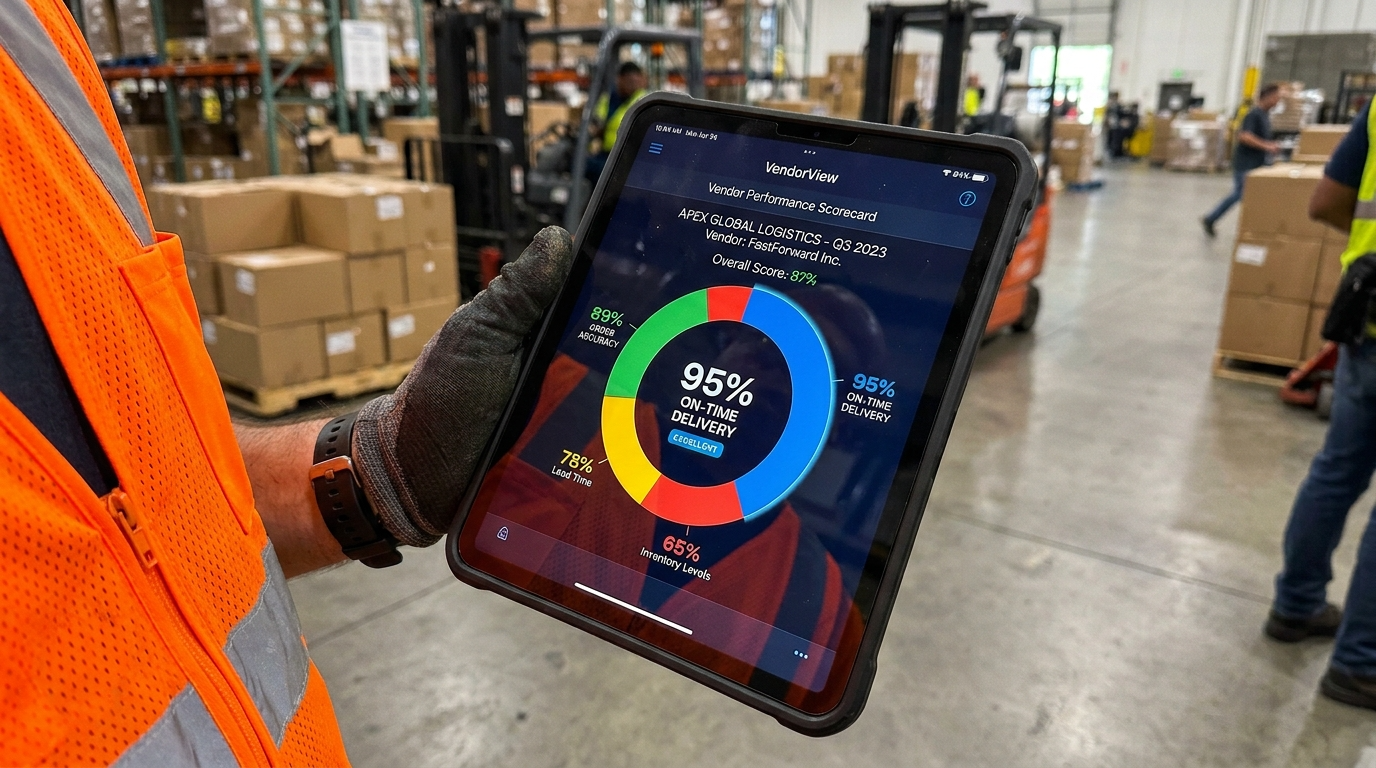
A vendor who is 3% cheaper but late 20% of the time is not cheaper. Construction vendor price negotiation should include performance data, not just pricing data.
Metrics worth tracking:
On-time delivery rate
On-time and in-full rate
Backorder frequency
Defect and damage rate
Emergency response time
Quote and invoice accuracy
Change-order support responsiveness
Warranty claim resolution
When you have six months of data showing a supplier misses delivery windows 15% of the time, that becomes a negotiation tool: either improve service, or give price relief to offset the downtime your crews absorb.
Script: “We want to review price and service together. If on-time-in-full stays above 95% and invoice accuracy stays above 98%, we keep preferred status. If not, we need price relief or a second source.”
Tradeoffs: Requires consistent tracking. Do not threaten performance penalties if you cannot measure performance.
15. Document Every Give/Get in the PO, MSA, or Vendor File
Best for: Every construction vendor negotiation, no exceptions.
A negotiated discount that does not show up on invoices is not savings. A price hold that lives only in a text message is weak. A rebate without a tracking process is money you will never collect.
What to document in every negotiated vendor agreement:
Base price and discount tier
Rebate formula and payment schedule
Payment terms (Net 10, 2/10 Net 30, etc.)
Freight terms and caps
Quote validity period and lock event
Escalation/de-escalation mechanism
Service-level expectations
Delivery terms and penalties
Approved substitutions
Contract renewal date and notice requirements
Who owns tracking and enforcement
Script: “Before we issue the PO, please confirm the negotiated price, payment terms, freight terms, quote validity, and escalation language in writing so our AP and project teams can enforce the deal.”
Tradeoffs: Administrative discipline is the only cost. Without documentation, savings leakage is almost guaranteed.
The Give/Get Checklist: What to Bring to Every Vendor Conversation
Every negotiation is a trade. Vendors are not charities, and contractors are not beggars. Before any supplier meeting, map what you can give against what you need.
What contractors can give:
Faster payment (Net 10 or Net 15 instead of Net 30)
Cleaner volume forecast
Larger committed volume
Longer contract term
Preferred vendor status
Consolidated delivery schedule
Fewer emergency and rush orders
Better scope clarity on RFQs
Approved alternate specifications
Earlier release schedule
What contractors can ask for:
Base price reduction
Tiered pricing thresholds
Annual or quarterly rebates
Extended price hold
Freight cap or free freight threshold
Fuel surcharge cap
No minimum delivery charge
Better return and restocking terms
Escalation/de-escalation cap
Dedicated account rep
Service-level commitment with consequences
The most effective construction vendor price negotiations happen when both columns are populated before the conversation starts.
2026 Construction Market Volatility Checklist
Before signing a vendor agreement this year, ensure you have addressed these three 2026-specific factors:
Tariff Contingencies: Does the contract specify who absorbs sudden port-of-entry tax increases?
Fuel Surcharge Pegs: Is the fuel surcharge fixed, or is it floating based on a monthly national average?
Storage “Call-Off” Terms: If you buy early to beat a price hike, is the vendor providing insured, climate-controlled storage?
What Not to Do When Negotiating Construction Vendor Prices
Avoiding common mistakes matters as much as applying the right tactics.
1. Do not ask for a discount without offering anything. Vendors hear “Can you do better?” constantly. Without a specific trade, they have no reason to move.
2. Do not compare unleveled quotes. Three quotes that exclude different things are not comparable. Level them first.
3. Do not chase the cheapest supplier if it risks crew downtime. A supplier who causes a crew to wait two hours on a jobsite costs more than the price difference. Practitioners on Reddit consistently emphasize that supplier reliability can outweigh a few percentage points of savings.
4. Do not promise fast payment if AP cannot execute. Taking the 2% discount and paying on day 45 will damage the relationship and may increase future prices.
5. Do not accept tariff or material increase claims without proof. Contractors in 2026 Reddit discussions reported challenging suppliers to show manufacturer proof of tariff-related increases and paying less when proof was not produced. Ask for the source document. AGC reported that 40% of firms raised bid prices and 35% passed most or all tariff costs to owners, but that does not mean every supplier-side claim is accurate.
6. Do not negotiate after the vendor is mobilized. Leverage is strongest before award, before mobilization, and before materials are urgently needed. Once a supplier has crews deployed or materials staged, your leverage evaporates.
7. Do not ignore freight, fuel, rental, and delivery fees. These line items can add 5% to 15% to the base price, and they are often the most negotiable part of the quote.
When a Contractor Buying Group or Purchasing Alliance Makes Sense
Some pricing problems cannot be solved with better scripts. If your company’s individual purchasing volume does not command the pricing tier you want, the problem is structural leverage, not negotiation skill.
Contractor buying groups and purchasing alliances exist to solve this. They aggregate demand across multiple contractors, creating collective volume that individual companies could not generate alone. Suppliers benefit from larger, more predictable revenue. Contractors benefit from pricing and rebate programs they would not qualify for individually.
A buying group or contractor purchasing network makes the most sense when:
Individual category spend is below vendor pricing thresholds
Purchases are fragmented across too many suppliers
Rebate programs require volume you cannot hit alone
You want pre-negotiated pricing without running a full RFP every time
Categories like MRO, PPE, tools, fuel, and consumables are purchased routinely but never strategically
The economics are simple. If a vendor offers 8% better pricing at $5 million in annual volume and your company spends $400,000 in that category, you need aggregation to reach the tier. That is what buying groups provide.
If your individual purchasing leverage is thin and you want to explore how aggregated demand could improve your vendor pricing, learn more about how CNBA helps contractors build purchasing leverage.
Practical Examples
Example: Price Increase Proof Request
A vendor says prices are up 12% because of tariffs. Here is a response that separates legitimate increases from blanket markups:
“Please break the 12% into base material, tariff, freight, fuel, and margin. Send the manufacturer notice, revised supplier quote, tariff documentation if applicable, and effective date. We can discuss a justified category-specific adjustment, but we cannot accept a blanket increase without backup.”
This works because, as legal practitioners on LinkedIn have emphasized, contractors should communicate immediately in writing when expecting or receiving a price escalation and be prepared to prove or disprove the increase with supporting documents.
Example: Bid Leveling in Practice
Bad comparison:
Supplier A: $92,000, excludes freight, 10-day validity, 8-week lead time
Supplier B: $98,000, includes freight, 30-day validity, 4-week lead time
Supplier C: $95,000, excludes accessories, no quote hold
Correct approach: Normalize freight, accessories, validity, and lead time into a single comparison matrix before naming a low bidder. Supplier A’s apparent $6,000 advantage may disappear once you add $4,500 in freight, a tighter validity window that increases risk, and a longer lead time that delays the schedule.
Example: Early-Pay Discount Math
A supplier offers 2/10 Net 30 on $100,000 in monthly purchases.
Discount: 2% = $2,000 per month
Payment acceleration: 20 days earlier
Annualized return: roughly 36% to 37%
If your borrowing cost is far below that implied return and you can reliably process payment by day 10, take the discount every time. If you need to borrow at expensive rates or cannot consistently hit the payment window, do not promise it.
FAQ About Construction Vendor Price Negotiation
How do you negotiate better prices with construction vendors?
Compare leveled quotes, know your total spend by category, benchmark price increases against published indexes (BLS PPI, AGC tables, manufacturer notices), and offer specific trades, such as faster payment, committed volume, cleaner scope, or longer contract terms, in exchange for documented concessions. Generic requests for a “better price” rarely work.
What is a reasonable supplier discount to ask for?
There is no universal percentage. A 2% early-pay discount is standard on 2/10 Net 30 terms. Volume-based discounts vary by category and can range from 3% to 15% depending on spend level, market conditions, and the vendor’s margin structure. Larger savings usually require structural changes like volume consolidation, buying-group membership, or risk reduction, not just asking.
Should contractors always get three vendor quotes?
For major packages, yes. But getting three quotes only adds value if the quotes are leveled, meaning the same scope, inclusions, freight, lead time, and validity period. For routine purchases, a preferred supplier with periodic benchmarking may be more efficient than running competitive quotes on every order.
How should you respond to a vendor price increase?
Ask for proof. Request the manufacturer notice, revised supplier quote, freight or fuel surcharge schedule, tariff documentation if applicable, and the effective date. Benchmark the claimed increase against market data. Negotiate a phased increase, a cap, or a de-escalation clause that credits you if costs drop.
Are payment terms negotiable with construction suppliers?
Yes, and they are often one of the most powerful negotiation tools in construction. Because the industry is slow-pay heavy, a contractor who reliably pays within 10 to 15 days is valuable to suppliers. But payment commitments must match your cash flow and AP capability. Promising fast payment and failing to deliver undermines trust and future pricing.
What is a material escalation clause?
A contract clause that adjusts price when specified material costs move beyond a defined threshold. The best versions are bilateral (covering both escalation and de-escalation), tied to an objective index, and require documentation before triggering. ConsensusDocs 200.1 is a widely referenced standard form for this.
When should a contractor consider joining a buying group?
When individual purchasing volume is too small to reach preferred pricing tiers, when categories are fragmented across many small purchases, or when vendor rebate programs require volume thresholds you cannot meet alone. A contractor buying group aggregates demand to create collective leverage.
What is the difference between unit price and landed cost?
Unit price is the cost per unit of material or service. Landed cost includes everything required to get that material to the jobsite: freight, fuel surcharge, minimum delivery fees, environmental fees, taxes, and any other charges. Negotiating unit price alone misses the 5% to 15% that often hides in these add-ons.

Recent Comments