TL;DR
Hand injuries cost construction firms an average of $22,384 per claim, and over 70% of them are preventable with the right gloves. This guide profiles seven construction hand protection vendors, comparing their product lines, bulk pricing structures, ANSI ratings, and real-world performance. For procurement teams outfitting entire crews, vendor selection matters as much as glove selection. The right supplier relationship can cut your per-pair cost dramatically while keeping compliance airtight.
Looking to reduce your PPE spend through pre-negotiated vendor pricing? Check out contractor supplier discount programs available through buying alliances.
Quick Answer: Best Construction Hand Protection Vendors for 2026
If you’re choosing a construction hand protection vendor in 2026, the best option depends on your crew size and work type rather than a single “best” brand.
Need | Recommended Vendor |
|---|---|
Best Overall | MCR Safety |
Best for Enterprise Contractors | Honeywell / PIP |
Best for Precision Work | Mechanix Wear |
Best Value Procurement | Magid |
Best Impact Protection | Safety TUFF |
Best Multi-Brand Supplier | PalmFlex |
Best for Light Assembly | Ansell |
For most contractors, MCR Safety and Magid provide the strongest balance of product range, ANSI compliance, distributor availability, and procurement flexibility. Companies managing multiple jobsites often benefit from Honeywell’s enterprise purchasing programs, while demolition crews should prioritize vendors offering ANSI 138 impact-rated gloves.
Why Vendor Selection Matters More Than Glove Selection
Most articles about construction hand protection focus on which glove to pick. That’s only half the equation. If you’re a safety manager or purchasing agent buying for 20, 50, or 200 workers, the vendor behind the glove determines your total cost, your fulfillment speed, and whether you can get NET 30 terms that don’t strangle your cash flow.
The numbers make the case for getting this right. Hand injuries remain the most common preventable workplace injury, accounting for 23% of all work-related injuries. More than one million construction workers visit the emergency room annually for hand injuries, with costs ranging from $2,000 for stitches to $70,000 for a severed tendon. The average total incurred cost per hand, finger, and wrist injury claim is $22,384.
OSHA estimates that more than 70% of these injuries could be prevented simply by wearing appropriate safety gloves. The remaining 30%? Often a mismatch between the glove and the task, which is a vendor education problem as much as anything else.
Upper extremities (arms, hands, fingers) accounted for 40% of all employer-reported severe injury reports from 2015 to 2021. In 2020 alone, the BLS documented approximately 121,860 cases of nonfatal hand injuries involving days away from work. These aren’t abstract statistics. They’re workers’ comp claims, project delays, and OSHA citations that hit your bottom line directly.
For a broader look at safety supply procurement across all PPE categories, see our construction safety supply vendors comparison.
What Makes a Good Construction Hand Protection Vendor?
Many contractors confuse glove manufacturers with glove vendors.
A quality construction hand protection vendor should provide far more than gloves. The best suppliers help contractors:
Maintain OSHA PPE compliance
Recommend task-specific glove programs
Keep high-demand gloves in stock
Offer consistent ANSI-certified products
Provide volume discounts
Support NET 30 purchasing
Reduce procurement costs across multiple jobsites
For contractors purchasing hundreds or thousands of gloves annually, supplier reliability often becomes more important than individual glove features.
How to Evaluate Construction Hand Protection Vendors
Before comparing specific companies, establish your evaluation criteria. Most procurement teams default to price-per-pair, but that metric alone leads to bad decisions. Here’s a better framework:
Product range. Can this vendor cover all your glove needs (cut-resistant, impact, chemical, disposable) or will you need multiple suppliers?
ANSI compliance verification. Does the vendor clearly label ANSI/ISEA 105 cut ratings and ANSI/ISEA 138 impact ratings on every product? Vendors who obscure or omit ratings should raise red flags.
Bulk pricing structure. What are the minimums? Is pricing by the dozen, by the case, or negotiable at volume? Does price drop meaningfully at scale?
Fulfillment and shipping. Can they ship 500 pairs on a 2-day turnaround? Construction timelines don’t wait for backorders.
Payment terms. NET 30 availability matters for contractors managing cash flow across multiple projects.
Construction-specific expertise. A vendor who primarily serves manufacturing or food service may stock gloves that look similar but perform poorly on a construction site.
For a structured approach to scoring vendors against these criteria, our vendor selection criteria checklist provides a downloadable framework.
Understanding ANSI Glove Ratings: A Quick Reference
Before evaluating construction hand protection vendors, you need to speak the language of glove ratings. Two standards matter most:
ANSI/ISEA 105 (Cut, Puncture, Abrasion): This standard rates gloves on a scale from A1 (lowest cut resistance) to A9 (highest). The updated 2024 version uses a pentagon-shaped label showing performance classifications on each side. For construction, most tasks require at minimum A2 to A4 cut resistance.
ANSI/ISEA 138 (Impact Protection): This standard establishes performance requirements for dorsal impact protection, critical for concrete crews, heavy equipment operators, and demolition workers. It’s undercovered in most glove guides but absolutely essential for construction procurement.
Task-specific minimums for construction:
Task | Minimum Cut Rating | Impact Rating Needed? |
|---|---|---|
General material handling / lumber | A2 to A4 | No |
Concrete work / rebar tying | A4+ with Abrasion Level 3+ | Recommended |
Demolition / pile driving | A4+ | ANSI 138 required |
Finish carpentry / equipment operation | A1 to A3 | No |
Grinding / cutting | A6+ | Recommended |
For more on OSHA-compliant PPE requirements, see our PPE compliance guide.
Construction Glove Types Explained
Many procurement mistakes happen because buyers choose gloves based only on cut resistance. Different construction hazards require different glove designs.
Glove Type | Best Uses |
|---|---|
Nitrile-coated | General labor, framing, material handling |
Leather | Masonry, demolition, heavy lifting |
Impact gloves | Heavy equipment, concrete, oil & gas |
Chemical-resistant | Paints, solvents, adhesives |
Disposable nitrile | Cleanup, inspections |
Welding gloves | Hot work, torch cutting |
At-a-Glance Vendor Comparison Table
Vendor | Founded | Best For | Key Lines | Bulk Minimums | ANSI Range | Price Range (per pair) |
|---|---|---|---|---|---|---|
MCR Safety | 1974 | Full crew outfitting | Predator, CutPro, NitriShield | Dozen/case via distributors | A1 to A9 | $3 to $35 |
Mechanix Wear | 1991 | Dexterity tasks | Original, M-Pact, Durahide | Direct + retail | Varies by model | $15 to $50 |
Magid Glove | 1946 | Procurement teams | T-REX, RoadMaster, ROC | Direct + distributors | A1 to A9 | $5 to $30 |
Honeywell/PIP | 100+ years | Enterprise standardization | CoreShield, G-Tek, WorkEasy | Enterprise sales | A1 to A9 | $5 to $40 |
Ansell | 1893 | Precision handling | HyFlex series | Direct + distributors | Varies (often unrated) | $15 to $25 |
Safety TUFF | Newer | Impact protection | Impact, Cut-Resistant Impact | 72+ pairs wholesale | ANSI 138 Level 1 + A5 | Contact for pricing |
PalmFlex | 30+ years | Multi-brand reseller | Atlas, Majestic, Ironclad | Dozen/case minimums | Depends on brand | $2 to $30 |
Use our vendor comparison checklist to score these vendors against your specific project requirements.
Which Vendor Is Best for Different Contractor Sizes?
Contractor Size | Best Vendor |
|---|---|
1–20 workers | PalmFlex |
20–75 workers | Magid |
75–250 workers | MCR Safety |
250+ workers | Honeywell |
Heavy Civil | Safety TUFF |
Finish Contractors | Mechanix Wear |
1. MCR Safety
Best for: Large crew outfitting with a broad product range across all construction glove types.
MCR Safety brings 49 years of PPE manufacturing experience to the table. Their product catalog covers virtually every hand protection need a construction crew encounters, from disposable nitrile gloves for quick tasks to heavy-duty impact-resistant models for demolition work.
Key product lines:
Predator series: Combined impact and cut protection, designed for heavy construction
CutPro series: ANSI-rated cut resistance from A1 through A9, with options for every risk level
NitriShield: Disposable gloves for paint, solvents, and cleanup tasks
Ninja series: Coated gloves with nitrile, latex, or polyurethane for improved grip and durability
Pricing and procurement:
Sold through a vast network of industrial distributors rather than direct to end users
Case and dozen pricing available through distributor partners
Price range spans $3 to $35 per pair depending on protection level
Real user feedback: Workers on product review sites report that MCR Predator gloves are “easy on, easy off,” though several note they get compromised between the thumb and index finger faster than expected. One construction worker clarified that while the gloves “will eventually tear between the thumb and forefinger,” that typically happens after weeks of daily use, which is reasonable for heavy-duty work.
Limitations:
Distributor-only model can make pricing less transparent. You may get different quotes from different distributors for the same glove.
Some durability complaints on specific models, particularly at stress points
No direct relationship with end users, which limits the ability to negotiate custom terms
MCR Safety works best for construction companies that already have a relationship with an industrial distributor and want a single brand that covers the full spectrum of hand protection needs.
2. Mechanix Wear
Best for: Dexterity-intensive tasks like finish carpentry, equipment operation, and precision tool handling.
Founded in 1991 for NASCAR pit crews, Mechanix Wear built its reputation on gloves that let skilled hands do precise work without sacrificing protection. They now offer 36 construction-specific SKUs spanning heat resistance, impact resistance, water resistance, cut resistance, and welding.
Key product lines:
The Original: The flagship general-purpose work glove, rated 4.8 out of 5 stars, priced at roughly $23.99
M-Pact: Features D3O palm padding to dissipate high-impact energy and reduce hand fatigue
Durahide: Leather and synthetic blend for abrasion resistance
Specialty Grip: Designed for wet or oily conditions
Pricing and procurement:
Available direct from Mechanix Wear and through retail/industrial channels
$15 to $50 per pair depending on model
Less emphasis on bulk/case pricing compared to industrial-focused vendors
Real user feedback: Practitioners on the Fine Homebuilding forum are split on Mechanix. One user said, “I really like my original Mechanix but they tend to wear out way too fast for the price you pay. I don’t get six months out of a pair before the seams split.” Another carpenter reported wearing through the fingertips in about two weeks. The dexterity is consistently praised, but longevity is the recurring complaint.
Limitations:
Premium price relative to lifespan is the number one issue raised by construction workers
Not designed for heavy-duty abuse like demolition or rebar handling
Bulk pricing structure isn’t as aggressive as vendors built around the industrial distributor model
The brand recognition that helps in retail can inflate prices at the procurement level
Mechanix Wear makes sense when your crew needs to feel small fasteners, operate controls, or do finish work. For rough tasks, the cost-per-day math doesn’t favor them.
3. Magid Glove & Safety
Best for: Procurement teams wanting a single supplier with a deep catalog, direct safety consulting, and sustainability options.
Magid is a fourth-generation, family-owned company that has been producing work gloves since 1946. With over 3,000 loyal customers and annual output of 84 million products, they operate at a scale that supports serious construction procurement. Expert Consumers named Magid the top provider of safety work gloves based on safety compliance, product range, and material innovation.
Key product lines:
T-REX: Impact protection series for heavy construction
RoadMaster: Mechanics-style gloves for equipment operators
ROC GP102: A sustainable option made from 90% recycled polyester blend with foam nitrile palm coating, delivering ANSI Level 4 abrasion resistance
Pricing and procurement:
Available through direct sales and distributor networks
$5 to $30 per pair
Over 38,000 orders processed through their website, suggesting a functional direct-ordering system
Bulk construction orders may require direct contact for optimal pricing
Real user feedback: Based on analysis of over 1,011 customer reviews on Amazon, Magid maintains a 4.3 rating. Their cut-resistant gloves received an editorial verdict of 4.4 out of 5, described as offering dependable ANSI A6 cut protection at a value price point.
Limitations:
Less brand recognition among field workers compared to Mechanix or Ironclad
Primarily a distributor model for large orders, which may require more legwork to set up
The sheer size of their catalog can make initial product selection overwhelming without guidance
The sustainability angle is worth noting. Both Magid’s ROC line and Ansell’s HyFlex updates now use recycled yarn and reduced packaging, an emerging procurement factor that no other construction hand protection vendors guide addresses.
4. Honeywell (PIP / Hand Protection Division)
Best for: Enterprise-level standardization across multi-site construction operations, plus electrical safety applications.
Honeywell’s hand protection division gained significant depth after acquiring PIP’s glove line, creating one of the broadest portfolios in the industry. As a licensee of both Dyneema and DuPont advanced fibers, their gloves use proprietary engineered yarn blends and coatings that smaller vendors can’t match.
Key product lines:
CoreShield: Enhanced cut resistance with comfort and dexterity across 22 styles with thumb reinforcement
G-Tek: General purpose and cut-resistant options through the PIP acquisition
WorkEasy: Budget-friendly options for lower-risk tasks
All cut resistance levels covered, from A1 to A9
Pricing and procurement:
Enterprise sales model with dedicated account management
$5 to $40 per pair depending on specification
Special abrasion technology provides 2x durability coating, and washable construction extends product life and lowers cost of ownership
Key differentiator: The washable glove technology is genuinely valuable for cost-conscious procurement. If a $12 glove lasts through three washes while maintaining protection, you’ve effectively reduced your per-shift cost by 60% or more.
Limitations:
Complex product catalog can overwhelm buyers without a dedicated safety manager
Enterprise sales model means smaller contractors (under 50 employees) may not get ideal pricing or attention
Lead times can be longer than smaller, more agile vendors
Navigating the post-PIP-acquisition product line requires patience, as some overlap exists between legacy brands
Honeywell is the right choice for construction companies running multiple jobsites who need to standardize glove programs across hundreds of workers with consistent ANSI compliance.
5. Ansell (HyFlex Line)
Best for: Precision handling, light construction assembly, and multi-hazard tasks requiring maximum tactile sensitivity.
With 125 years of protective equipment history, Ansell has built the HyFlex line into an industry standard for material handling. The HyFlex 11-840 is their best-seller, featuring an ergonomic nylon-spandex shell with breathable foam nitrile palm.
Key product lines:
HyFlex 11-840: General material handling benchmark at roughly $18.48 per pair
HyFlex Intercept (cut-rated models): For tasks requiring actual cut protection
AEROFIT Coating: Up to 30% thinner than standard coatings for exceptional tactile control
Six high-volume styles updated with recycled yarn and plastic-free packaging
Pricing and procurement:
$15 to $25 per pair
Available through direct sales and distributor networks
Washable HyFlex gloves maintain protection after up to three washes
Real user feedback: One longtime user noted on a business purchasing platform, “I used these gloves at work for years before I retired and I just love them.” The comfort and dexterity receive consistently high marks.
Critical buyer warning: The HyFlex 11-840 is not a cut-resistant glove. Buyers routinely assume all HyFlex models are cut-rated, which is dangerous. If your crew handles sharp materials, you must specifically select the Intercept or other cut-rated HyFlex variants.
Limitations:
Better suited for manufacturing and assembly than heavy demolition or concrete work
Can feel too thin for rough tasks like handling concrete forms or rebar
The cut-resistance confusion has real safety implications if procurement isn’t careful
Premium pricing for what amounts to a light-duty glove in construction contexts
Ansell fills a niche in construction hand protection for tasks where feel matters more than brute durability, like electrical work, instrumentation, or light finishing.
6. Safety TUFF
Best for: Impact protection specialists handling concrete forms, heavy equipment, and demolition.
Safety TUFF has carved out a focused position among construction hand protection vendors by concentrating on what heavy construction crews actually need: impact and cut protection in one package.
Key product lines:
Impact gloves: ANSI 138 Level 1 certified for impact resistance
Cut-resistant impact gloves: Combined ANSI 138 Level 1 impact with ANSI A5 cut resistance
Pricing and procurement:
Wholesale pricing available for orders of 72 pairs or more, regardless of style mix
NET 30 terms available on a case-by-case basis
Direct purchasing model, not dependent on distributor markup
The NET 30 terms and 72-pair wholesale threshold are notably contractor-friendly. Many competing vendors either require much larger minimums or don’t offer trade credit at all.
Real user feedback: One construction worker shared that “Safety TUFF gloves really have grown on me.” Another acknowledged they are “bulky and pretty warm, so hands get hot in summer,” but concluded “they work great and will protect your hands better than almost any other glove.”
Limitations:
Limited product line focused primarily on impact protection
Bulkier than competitors, which reduces dexterity for fine tasks
Not suitable for warm-weather comfort or situations requiring tactile sensitivity
Smaller company with less infrastructure than Honeywell or Ansell
Safety TUFF is the right call for concrete crews, demolition teams, and heavy equipment operators who prioritize maximum hand protection over finesse.
7. PalmFlex
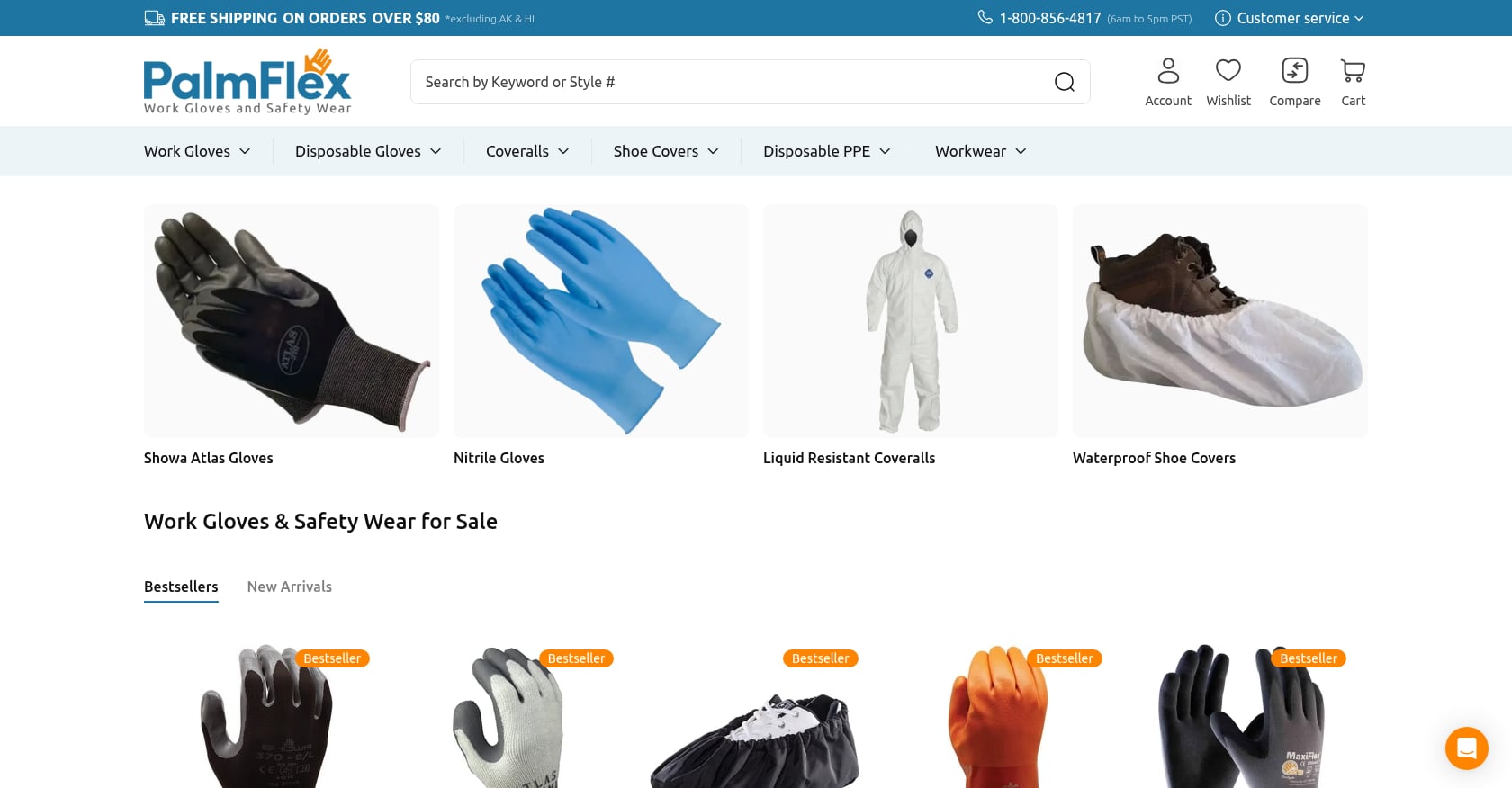
Best for: Mid-size contractors wanting a one-stop multi-brand distributor with straightforward bulk pricing.
PalmFlex has operated as a work glove distributor for over 30 years, stocking brands like Showa Atlas, Majestic, PIP, Ironclad, and Chilly Grip. Rather than manufacturing their own gloves, they aggregate multiple brands and pass along volume pricing.
Key offerings:
Construction gloves utilizing leather, Kevlar, and synthetic materials
Sizes from XXS to 4XL (important for crews with diverse hand sizes)
Free shipping on all orders over $80 in the continental U.S.
Wholesale orders by the dozen or by the case, with cases offering better per-unit pricing
Pricing and procurement:
$2 to $30 per pair depending on brand and protection level
Case pricing provides meaningful discounts over dozen pricing
Multi-brand selection lets you compare options in one order
Limitations:
Reseller, not manufacturer, so you’re paying a markup over direct relationships
Pricing depends entirely on which brands they stock at any given time
Website experience is dated compared to more modern e-commerce platforms
No proprietary products or exclusive technology
PalmFlex works well for contractors who want to try gloves from multiple brands without setting up accounts with each manufacturer. Think of them as a consolidator rather than a specialist.
Honorable Mentions
Ironclad: Their General Utility Work Gloves earned 4.8 out of 5 stars and are frequently called the most versatile option. However, a contractor on the Fine Homebuilding forum reported that Ironclads “feel great” but “don’t wear well, lasted almost through 1 job.” Great for occasional use, questionable for daily crew outfitting.
Majestic Glove: The Majestic 3382 wrinkled latex palm glove is a workhorse used in millions of pairs across construction and industrial applications. Available through most major distributors at competitive case pricing.
Eros Wholesale: One of the largest bulk work gloves distributors, in the wholesale business for over 60 years. Their basic string knit gloves start at $0.40 per pair in 900-pair cases, making them the go-to for high-volume, low-risk applications like general material handling.
Matching Gloves to Construction Tasks
This is where most construction hand protection vendors guides fall short. They list products without connecting them to actual jobsite scenarios. Here’s how to think about it:
Demolition and heavy material handling: You need ANSI 138 impact rating plus A4 or higher cut resistance. Safety TUFF’s impact line or MCR Safety’s Predator series are purpose-built for this. As This Old House expert Mark Fitzpatrick recommends, cowhide and canvas gloves suit demolition, while heat-resistant welder’s gloves are necessary for torch work.
Rebar tying and concrete work: A4+ cut resistance with abrasion Level 3 or higher. The repetitive motion of tying rebar destroys thin gloves. MCR’s CutPro or Magid’s T-REX series hold up better than general-purpose models.
Finish carpentry and equipment operation: Dexterity is king. Mechanix Wear’s Original or Ansell’s HyFlex 11-840 give operators the tactile feedback they need. Just don’t expect them to survive demolition day.
General material handling and lumber: This is where the cost-per-day calculation gets interesting. A seasoned reviewer on Pro Tool Reviews concluded that after trying every kind of work glove, “fancy, padded work gloves wear out just as quickly as cheap gloves” and “often increase bulk while removing the dexterity found in simple fabric nitrile-dipped gloves.” For everyday jobsite work, lightweight coated fabric gloves bought in bulk consistently deliver the best value.
For a deeper breakdown of PPE procurement and compliance, including how to build a task-matched glove program, we cover the full process in a separate guide.
How to Reduce Hand Protection Costs Without Cutting Safety
Construction companies burn through gloves. A 50-person crew going through two pairs per week at $8 per pair spends over $41,000 annually on hand protection alone. Here’s how to lower that number without increasing injury risk.
Do the cost-per-day math, not cost-per-pair. A $25 pair of Mechanix gloves that lasts two weeks costs $1.79 per day. A $3 pair of nitrile-dipped gloves that lasts three days costs $1.00 per day. Multiple contractors on the Fine Homebuilding forum confirm this logic. One carpenter noted, “I buy cheap Wells-Lamont gloves for six or eight bucks and get a few years out of a pair.” Another approach: buy $0.67 bulk nitrile-dipped gloves for general tasks and reserve premium gloves for high-risk work only.
Use washable gloves where possible. Both Honeywell’s CoreShield and Ansell’s HyFlex maintain protection through multiple washes. If a $12 glove survives three wash cycles, your effective cost drops to $4 per use cycle.
Rotate specialty and bulk gloves. Don’t issue $30 impact gloves for tasks that only need $3 string knits. Match the glove to the hazard.
Buy through procurement alliances. Individual contractors lack the volume to negotiate aggressive case pricing. Joining a construction vendor discount program pools your purchasing power with other contractors to access pricing tiers that would normally require enterprise-scale orders.
For a complete breakdown of tactics beyond gloves, our guide on construction supply cost reduction strategies covers every major spend category.
Price tiers to expect. According to This Old House testing, construction work gloves fall into three categories: under $20 for fabric or synthetic materials, around $50 for tactical gloves with reinforcements, and approximately $100 for Kevlar or flame-resistant materials with leather protection layers.
The Vendor vs. Brand Distinction
This is a point most articles miss entirely. A “brand” like MCR Safety makes gloves. A “vendor” is the entity you actually buy from, which might be a distributor, a reseller, or the manufacturer directly.
When you’re buying for a crew, the vendor experience matters as much as the product:
Can they fulfill reorders within 48 hours?
Do they offer NET 30 payment terms?
Will they send samples before you commit to 500 pairs?
Do they have a dedicated account rep who understands construction?
Some brands (Mechanix Wear, Safety TUFF) sell direct. Others (MCR Safety, Magid) primarily work through distributor networks. And resellers like PalmFlex stock multiple brands under one roof. Each model has tradeoffs for the buyer.
If you’re building a formal vendor relationship, our vendor onboarding guide walks through the steps from initial contact to first purchase order.
How Often Should Construction Gloves Be Replaced?
Replacement depends on glove type and jobsite conditions.
Glove Type | Typical Replacement |
|---|---|
Disposable nitrile | Daily |
Nitrile-coated | Every 3–7 days |
Leather | 2–8 weeks |
Impact gloves | Monthly or when damaged |
Welding gloves | When heat damage appears |
Frequently Asked Questions
What ANSI cut level do construction workers need?
It depends on the task. General material handling and lumber work typically requires A2 to A4 cut resistance. Concrete work and rebar tying calls for A4 or higher with abrasion Level 3+. Demolition and heavy impact tasks should add ANSI 138 impact certification on top of cut ratings. Most construction hand protection vendors carry options across the full A1 to A9 spectrum.
Are expensive construction gloves worth the price?
Often not for everyday tasks. Multiple contractors and reviewers have concluded that lightweight nitrile-dipped gloves at $1 to $3 per pair deliver the best cost-per-day value for general jobsite work. Reserve premium $25 to $50 gloves for specific high-risk tasks like impact work, welding, or precision equipment operation.
What’s the difference between a glove brand and a glove vendor?
A brand manufactures gloves. A vendor is the company you purchase from, which could be the manufacturer directly, a distributor, or a multi-brand reseller. The vendor relationship determines your pricing, payment terms, fulfillment speed, and support. When outfitting construction crews, the vendor experience matters as much as the glove quality.
Can I get NET 30 terms from construction glove vendors?
Some vendors offer NET 30, but availability varies. Safety TUFF offers NET 30 on a case-by-case basis with a 72-pair minimum. Larger vendors like Honeywell typically offer trade credit for enterprise accounts. Smaller contractors may need to work through procurement alliances to access favorable payment terms.
How many pairs of gloves does a construction worker use per year?
It varies dramatically by trade. A general laborer handling lumber and materials might go through 50 to 100 pairs of lightweight gloves per year. A concrete finisher working with rebar could destroy a pair every two to three days. Demolition crews can burn through premium impact gloves weekly. Build your annual budget around task-specific consumption rates, not a single average.
What’s the minimum order for bulk construction gloves?
Most construction hand protection vendors sell by the dozen or by the case. Safety TUFF starts wholesale pricing at 72 pairs. PalmFlex requires dozen or case minimums. MCR Safety and Magid work through distributors who typically have their own minimums. For better pricing, case orders almost always beat dozen orders on a per-pair basis.
Are recycled or sustainable construction gloves as protective as standard ones?
Yes, when properly rated. Magid’s ROC GP102, made from 90% recycled polyester, carries ANSI Level 4 abrasion resistance. Ansell’s updated HyFlex models use recycled yarn while maintaining their protection ratings. Always verify ANSI ratings regardless of material sourcing. Sustainability and safety are not mutually exclusive.
How do I standardize glove programs across multiple jobsites?
This is where enterprise-level construction hand protection vendors like Honeywell excel. Their CoreShield line offers 22 styles covering all cut resistance levels, with consistent labeling and washable construction. The key is selecting two to four glove models that cover all your task categories, then building a reorder system with your vendor. Our PPE standardization guide covers the full process.
Take the Next Step on Hand Protection Procurement
Choosing the right construction hand protection vendor isn’t just about finding the cheapest glove. It’s about building a vendor relationship that delivers consistent product, fair pricing, reliable fulfillment, and terms that work for how contractors actually manage cash flow.
CNBA helps contractors access pre-negotiated pricing across safety supply categories, including hand protection, by pooling purchasing power through a buyer alliance model. If you’re spending more than you should on PPE, explore how contractor purchasing alliances can reduce your per-pair cost while maintaining the protection your crews need.
Recent Comments