
TL;DR
Contractor fall protection equipment includes harnesses, lanyards, self-retracting lifelines, anchor systems, guardrails, and safety nets, all regulated under OSHA’s construction standards. Falls caused nearly 40% of construction fatalities in 2023, and fall protection remains OSHA’s most-cited violation for 15 consecutive years. This glossary defines every key term contractors need to know, explains current OSHA requirements including the 2025 PPE fit rule, and covers critical safety concepts like suspension trauma and equipment retirement that most references skip.
Contractor fall protection equipment includes full-body harnesses, shock-absorbing lanyards, self-retracting lifelines (SRLs), anchor points, guardrails, safety nets, warning lines, and positioning systems. OSHA generally requires fall protection for construction workers exposed to falls of 6 feet or more. Every system must be properly fitted, inspected before each use, connected to an approved anchor, and removed from service after arresting a fall.
Quick Equipment Selection Guide
If You’re Working On | Recommended Protection |
|---|---|
Residential roofing | Harness + SRL or shock-absorbing lanyard |
Steel erection | Harness + SRL + engineered anchor |
Concrete formwork | PFAS + positioning device |
Elevated slabs | Guardrails where possible, PFAS where required |
Bridge construction | Safety nets + PFAS |
Ladder climbing | Vertical lifeline + rope grab |
Boom lift | Harness + manufacturer-approved lanyard |
Scaffolding | Guardrails first, PFAS when required |
Why Contractor Fall Protection Equipment Vocabulary Matters
Falls killed 421 of the 1,075 construction workers who died on the job in 2023, making them the single deadliest hazard in the industry. For the 15th straight year, fall protection tops OSHA’s list of most-cited violations. In fiscal year 2025 alone, OSHA issued 5,914 fall protection citations under 29 CFR 1926.501.
The financial exposure is real. A serious fall protection violation now carries a maximum penalty of $16,550. Willful or repeated violations can reach $165,514 per violation, per worker. A single site visit with multiple exposed workers can produce six-figure fines. Worse, a pattern of citations can trigger stop-work orders and disqualify contractors from bidding on future projects, both public and private.
Knowing the vocabulary isn’t academic. When a safety manager says “competent person,” that’s a legal designation with specific OSHA requirements, not an informal compliment. When a superintendent hears “fall clearance,” they need to calculate whether a worker will hit the ground even with a harness on. Getting the terminology right is the difference between passing an audit and shutting down a jobsite.
This glossary translates contractor fall protection equipment terms into plain language, connects each one to its OSHA context, and flags the details that actually matter on a construction site. For contractors looking to streamline how they source safety gear, contractor supplier discount programs can reduce equipment costs without cutting corners on compliance.
OSHA Contractor Fall Protection Equipment Checklist
Use checkboxes.
□ Properly fitted full-body harness
□ Compatible lanyard or SRL
□ Approved anchor point
□ Self-locking snap hooks
□ Rescue plan documented
□ Daily equipment inspection completed
□ Competent person designated
□ Workers trained
□ Labels readable
□ Equipment not previously involved in a fall
Fall Protection Equipment Inspection Checklist
Component | Check For |
|---|---|
Harness | Cuts, burns, UV damage |
Stitching | Broken threads |
D-rings | Cracks |
Buckles | Proper operation |
Labels | Legible |
Lanyards | Fraying |
Shock absorber | Deployment |
SRL | Smooth locking |
Contractor Fall Protection Equipment Replacement Schedule
Equipment | Replace Immediately When |
|---|---|
Harness | Any fall arrest |
SRL | After deployment |
Lanyard | Shock absorber deployed |
Snap hook | Bent or cracked |
Anchor connector | Deformed |
Lifeline | Damaged or contaminated |
Contractor Fall Protection Equipment by Job Type
Contractor Type | Typical Equipment |
|---|---|
Roofing | Harness, SRL |
Concrete | PFAS, positioning system |
Structural steel | SRL, horizontal lifeline |
Electrical | Harness, anchor straps |
HVAC | SRL |
Solar | Roof anchor + SRL |
Bridge | Nets + PFAS |
Industrial maintenance | Harness + rope grab |
OSHA Fall Protection Equipment Requirements at a Glance
Requirement | OSHA Rule |
|---|---|
Construction trigger | 6 ft |
General industry | 4 ft |
Max arrest force | 1,800 lbs |
Max free fall | 6 ft |
Max deceleration | 3.5 ft |
Anchor strength | 5,000 lbs |
Body belts | Prohibited |
PPE fit | Must fit worker |
Equipment Terms: Harness and Body Gear
Full-Body Harness
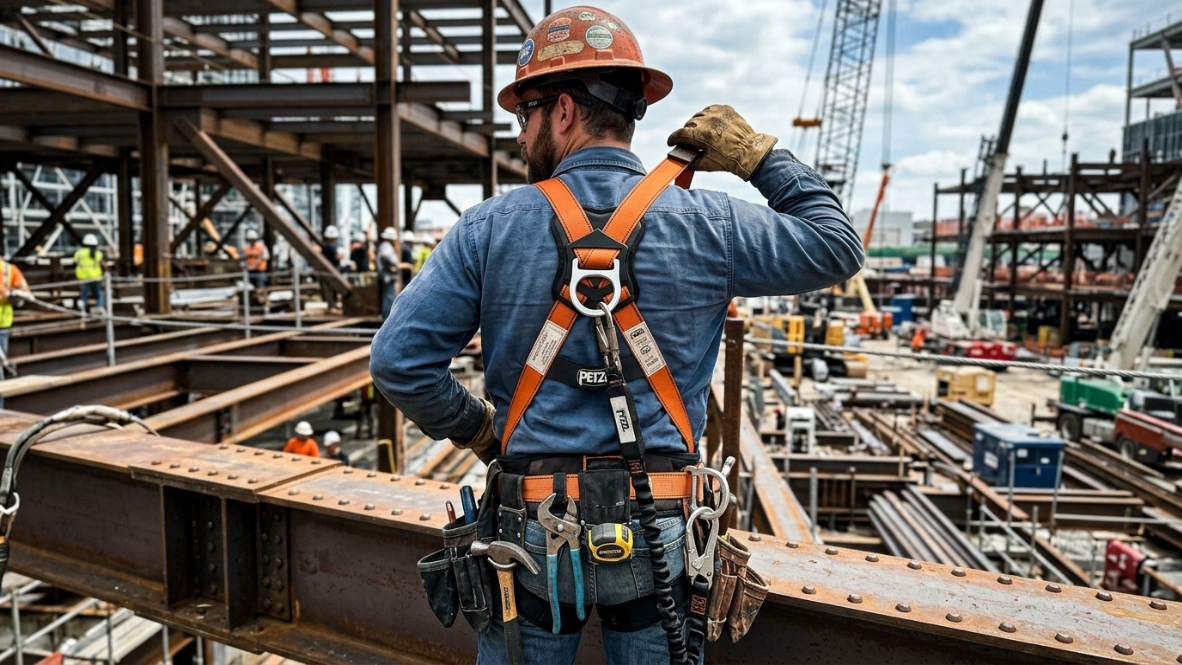
A full-body harness is a system of connected straps that distributes fall arrest forces across the thighs, pelvis, chest, and shoulders. It is the only acceptable body support device in a personal fall arrest system. OSHA banned body belts for fall arrest in 1998 under 29 CFR 1926.502(d) because they concentrated forces on the abdomen, causing internal injuries during falls.
Practitioners on construction forums frequently point out that harness selection matters beyond just meeting OSHA minimums. Workers who wear full tool belts report that certain harness designs “fight” their carpenter bags, creating productivity problems and tempting workers to loosen or remove the harness. For contractors managing concrete crews, structural steel erectors, or anyone working at height, choosing a harness that accommodates the tools workers actually carry is a compliance strategy, not just a comfort preference.
The December 2024 Final Rule (effective January 13, 2025) amends 29 CFR 1926.95 to require that all construction PPE, including harnesses, must properly fit each affected employee. One-size-fits-all harness programs are now citable.
D-Ring
A D-ring is a D-shaped metal attachment point on a harness where connectors (lanyards, self-retracting lifelines) clip in. The dorsal D-ring, located between the shoulder blades, is the primary attachment point for fall arrest. Some harnesses include additional D-rings at the chest (for ladder climbing), hips (for positioning), and shoulders (for confined space retrieval).
The D-ring must be rated to withstand the forces generated during fall arrest. If a D-ring shows signs of distortion, cracks, or corrosion during inspection, the harness must be removed from service immediately.
Body Belt
A body belt is a single strap worn around the waist. OSHA prohibited its use as part of a personal fall arrest system effective January 1, 1998. Body belts are still permitted for positioning and fall restraint, but never for fall arrest. Any contractor still using body belts to arrest falls is in direct violation of 29 CFR 1926.502(d).
Connector and Lifeline Terms
Lanyard
A lanyard is a flexible line, typically made of synthetic webbing or wire rope, that connects a worker’s harness to an anchorage point or deceleration device. Standard lanyards are typically six feet long, which limits free fall distance to the OSHA maximum of six feet. Lanyards come in two main varieties: shock-absorbing and non-shock-absorbing. For fall arrest applications, a shock-absorbing lanyard is required.
Shock-Absorbing Lanyard
A shock-absorbing lanyard contains a built-in energy absorber (usually a woven pack that tears open in a controlled way during a fall) that reduces the arresting force on the worker’s body. OSHA requires that the maximum arresting force on a worker must not exceed 1,800 pounds (29 CFR 1926.502(d)(16)). Without a shock absorber, a sudden stop from a six-foot fall would generate forces well above that limit.
The catch: a shock absorber extends up to 3.5 feet as it deploys. This additional distance must be factored into fall clearance calculations. Many contractors underestimate total fall distance because they forget the shock absorber’s extension.
Self-Retracting Lifeline (SRL)
A self-retracting lifeline is a device that allows a cable or webbing to pay out and retract automatically as a worker moves, similar to a seatbelt. When it senses a sudden acceleration (a fall), it locks and arrests the fall within inches. SRLs limit free fall distance to roughly two feet, which dramatically reduces arresting forces compared to a standard six-foot lanyard.
Practitioners on forums note that “most of the bucket work guys have gone to retractables.” The shorter free fall distance makes SRLs increasingly preferred over traditional lanyards, especially for work on structural concrete, leading edges, and elevated slabs where fall clearance is tight.
Snap Hook
A snap hook is a connector with a spring-loaded gate used to join components of a fall arrest system. OSHA requires all snap hooks used in fall arrest to be self-locking (29 CFR 1926.502(d)(5)), meaning the gate cannot open accidentally under load. Non-locking snap hooks have been prohibited in fall arrest systems since 1998 because they can roll out (disconnect) under certain loading conditions.
Rope Grab
A rope grab is a device that attaches to a vertical lifeline and travels freely up and down as the worker moves. When a fall occurs, the rope grab locks onto the lifeline and arrests the fall. Rope grabs are common on ladder climbing systems and vertical concrete formwork operations.
Horizontal Lifeline
A horizontal lifeline is a cable or synthetic line stretched between two anchor points, allowing a worker to move laterally while remaining connected. OSHA requires that horizontal lifelines be designed by a qualified person, because the forces generated at anchor points during a fall arrest on a horizontal line are significantly higher than the forces on a single vertical anchor.
Vertical Lifeline
A vertical lifeline is a line suspended from an anchor point above the worker, used with a rope grab or similar device. Each worker must have their own vertical lifeline. Sharing a vertical lifeline between two workers is prohibited because a fall by one worker could dislodge or compromise the other’s connection.
For contractors managing PPE procurement and compliance, understanding the differences between these connector types is essential for ordering the right equipment for specific job conditions.
Anchor System Terms
Anchorage / Anchor Point
An anchorage is a secure point of attachment for a fall arrest system. Under OSHA 29 CFR 1926.502(d)(15), anchorages for personal fall arrest systems must be capable of supporting at least 5,000 pounds per attached worker, or must be designed, installed, and used under the supervision of a qualified person as part of a complete system that maintains a safety factor of at least two.
Anchorage failure is one of the most common causes of fatal falls in the field. Contractors sometimes attach lanyards to conduit, rebar stubs, or light-gauge framing that cannot support the required load. On concrete structures, cast-in-place anchor bolts or engineered anchor plates are the standard. Every anchor point should be evaluated by a competent or qualified person before use.
Anchor Connector
An anchor connector is hardware (cross-arm straps, beam clamps, concrete anchor bolts) that creates a connection point where none exists. For example, a beam clamp wraps around a steel I-beam and provides a D-ring that a worker can clip into. The connector must be rated to the same 5,000-pound standard as the anchorage itself.
Passive Protection Systems
Guardrail System
A guardrail system is a barrier erected along exposed edges to prevent workers from falling. Under OSHA 29 CFR 1926.502(b), the top rail must be 42 inches high (plus or minus 3 inches), the midrail at 21 inches, and the system must withstand a 200-pound force applied in any direction at the top rail. Guardrails are the most common form of passive fall protection on construction sites, particularly around floor openings, leading edges, and elevated slab perimeters.
Guardrails are considered passive fall protection because they require no action from the worker. They simply prevent access to the fall hazard.
Safety Net System
A safety net system is a mesh net installed below a work area to catch falling workers. OSHA 29 CFR 1926.502© requires safety nets to be installed as close as practicable under the walking/working surface, but never more than 30 feet below. Nets must extend outward from the edge to catch workers who fall at an angle. Safety nets are common in bridge construction and high-rise structural work where guardrails and harnesses are impractical.
Toe Board
A toe board is a low barrier (at least 3.5 inches tall) installed at floor level along an exposed edge. Its purpose is not to prevent workers from falling, but to stop tools, materials, and debris from sliding off elevated surfaces onto workers below. OSHA requires toe boards as part of guardrail systems when there is a risk of objects falling from above.
Warning Line System
A warning line system is a barrier made of rope, wire, or chain, supported by stanchions, erected around a roof or elevated work area to warn workers they are approaching an unprotected edge. OSHA requires warning lines to be set up at least 6 feet from the edge on low-slope roofs (29 CFR 1926.502(f)). Warning lines alone are not sufficient fall protection. They are used in combination with other methods, such as a safety monitor or personal fall arrest system.
System and Method Terms
Personal Fall Arrest System (PFAS)
A PFAS is the complete system designed to arrest a worker in a fall. It consists of three components: an anchorage, a connector (lanyard or SRL), and a full-body harness. All three must work together. A harness without a proper anchor is not a fall arrest system, and a lanyard clipped to an inadequate anchor point is worse than useless because it creates a false sense of security.
OSHA requires a PFAS when a worker is exposed to a fall of 6 feet or more in construction (29 CFR 1926.501(b)(1)) and no other form of fall protection (guardrails, nets) is feasible.
Fall Restraint System
A fall restraint system prevents a worker from reaching a fall hazard in the first place. It uses a harness and a short lanyard or restraint line anchored so the worker physically cannot get to the edge. Unlike a fall arrest system, a fall restraint system is never designed to stop a fall in progress. It simply makes a fall impossible by limiting how far the worker can travel.
Fall restraint is often preferred where feasible because it eliminates the need for fall clearance calculations and post-fall rescue planning.
Active Fall Protection
Active fall protection requires the worker to do something: put on a harness, clip into an anchor, adjust a lanyard. Personal fall arrest systems and fall restraint systems are both active protection. The risk with active systems is that they depend on worker compliance. Patent filings and industry discussions reveal a persistent tension in construction: workers paid by piecework sometimes view tethers as obstacles to productivity and skip them. The contractor remains legally responsible regardless.
Passive Fall Protection
Passive fall protection requires no action from the worker. Guardrails, safety nets, and hole covers are all passive systems. OSHA’s hierarchy of controls favors passive protection because it does not depend on individual behavior. When planning fall protection for a concrete pour or structural erection, contractors should always evaluate whether passive systems can be installed before defaulting to harnesses.
Positioning Device System
A positioning device system supports a worker on a vertical or steep surface, allowing hands-free work. Think of a concrete finisher leaning back in a harness while working on a wall form, or an ironworker straddling a beam. OSHA 29 CFR 1926.502(e) requires that positioning devices limit free fall to 2 feet and that the system be rigged so a worker cannot free fall more than 2 feet. Positioning devices are not fall arrest systems, they are supplemental.
Controlled Access Zone (CAZ)
A controlled access zone is a designated work area near a leading edge where only authorized workers are permitted. OSHA allows CAZs for certain leading edge and precast concrete work when conventional fall protection is infeasible. A CAZ must be defined by a control line set between 6 and 25 feet from the leading edge, and only workers engaged in the specific task are allowed inside.
CAZs are not a blanket exception. Their use is limited and must be documented in a fall protection plan.
Fall Protection Plan
A fall protection plan is a written, site-specific document required when conventional fall protection (guardrails, nets, PFAS) is demonstrably infeasible. OSHA limits fall protection plans to three scenarios: residential construction, precast concrete erection, and leading edge work (29 CFR 1926.502(k)). A qualified person must develop the plan, and it must explain why standard methods cannot be used and what alternative measures will protect workers.
This is a frequently misunderstood area. Some contractors treat the fall protection plan as a general permission slip to skip harnesses. It is the opposite: it’s a documented justification with specific alternative controls, and OSHA scrutinizes these plans closely.
Fall Protection Hierarchy of Controls
The hierarchy ranks protection methods from most to least preferred:
Elimination (redesign the work to remove the fall hazard entirely)
Passive protection (guardrails, covers, nets)
Fall restraint (prevent workers from reaching the edge)
Fall arrest (stop a fall in progress)
Administrative controls (warning lines, safety monitors, controlled access zones)
Contractors who understand this hierarchy make better decisions about which fall protection equipment to specify for each phase of a project. Starting with elimination and working down reduces both risk and compliance exposure.
Measurement Terms Every Contractor Should Know
Free Fall Distance
Free fall distance is the vertical distance a worker falls before the fall arrest system begins to engage. OSHA limits free fall distance to 6 feet maximum in construction (29 CFR 1926.502(d)(16)(iii)). A standard six-foot lanyard attached at foot level creates a full six feet of free fall. An SRL reduces free fall to roughly two feet, which is one reason retractable devices are gaining popularity on concrete and structural projects.
Deceleration Distance
Deceleration distance is the additional distance a worker travels after the fall arrest system engages, while the shock absorber deploys and slows the fall. OSHA limits deceleration distance to 3.5 feet (29 CFR 1926.502(d)(16)(ii)). This distance is determined by the energy-absorbing mechanism in the lanyard or SRL.
Fall Clearance
Fall clearance is the total distance needed below a worker’s D-ring to ensure they do not hit the ground or any obstruction during a fall arrest. The basic calculation:
Fall clearance = Free fall distance + Deceleration distance + Harness stretch + Height of worker (D-ring to feet) + Safety margin
For a worker using a six-foot shock-absorbing lanyard with the anchor at foot level, the math often looks like this: 6 feet (free fall) + 3.5 feet (deceleration) + 1 foot (harness stretch) + approximately 5 feet (D-ring to feet) = 15.5 feet of clearance needed, plus a safety margin. Many contractors are shocked to learn that a worker on a 15-foot scaffold with a standard lanyard could still hit the ground during a fall arrest.
This is the single most important calculation in fall protection planning. Getting it wrong means the equipment technically “works” but the worker still impacts the surface below.
Arresting Force
Arresting force is the force applied to the worker’s body when the fall arrest system stops the fall. OSHA caps this at 1,800 pounds for full-body harness systems (29 CFR 1926.502(d)(16)(i)). Forces above this threshold cause serious injuries including spinal compression, internal organ damage, and broken ribs. Shock-absorbing lanyards and SRLs are specifically engineered to keep arresting forces below this limit.
Swing Fall
A swing fall occurs when a worker falls while offset horizontally from the anchor point. Instead of falling straight down, the worker swings like a pendulum, potentially striking the structure, lower levels, or obstructions. The swing arc can dramatically increase total fall distance and impact force.
Swing fall is one of the most underestimated hazards on construction sites. The solution is straightforward: position the anchor point as directly above the work area as possible. On concrete slab edges, this often means installing multiple anchor points along the perimeter rather than relying on a single distant anchor.
People and Roles
Competent Person
Under OSHA 29 CFR 1926.32(f), a competent person is someone who can identify existing and predictable hazards in the workplace and who has the authority to take prompt corrective action to eliminate them. In fall protection, the competent person is responsible for supervising the installation and use of fall protection systems, conducting site inspections, and deciding when conditions are unsafe.
This is a legal designation, not a job title. A contractor must specifically identify who the competent person is on each jobsite. Failure to designate a competent person is itself a citable violation.
Qualified Person
A qualified person is someone who, by possession of a recognized degree, certificate, or professional standing, or by extensive knowledge, training, and experience, has successfully demonstrated the ability to solve problems related to fall protection. The qualified person designs fall protection systems, engineers horizontal lifelines, and develops fall protection plans.
The distinction matters: a competent person identifies hazards and enforces rules on site. A qualified person designs the systems. A foreman can be a competent person. Designing a horizontal lifeline system requires a qualified person, typically an engineer. Contractors who confuse these roles risk both citations and system failures.
Ensuring your vendor onboarding checklist includes verification of fall protection competencies for subcontractors helps close this gap before work begins.
Critical Safety Concepts
Suspension Trauma
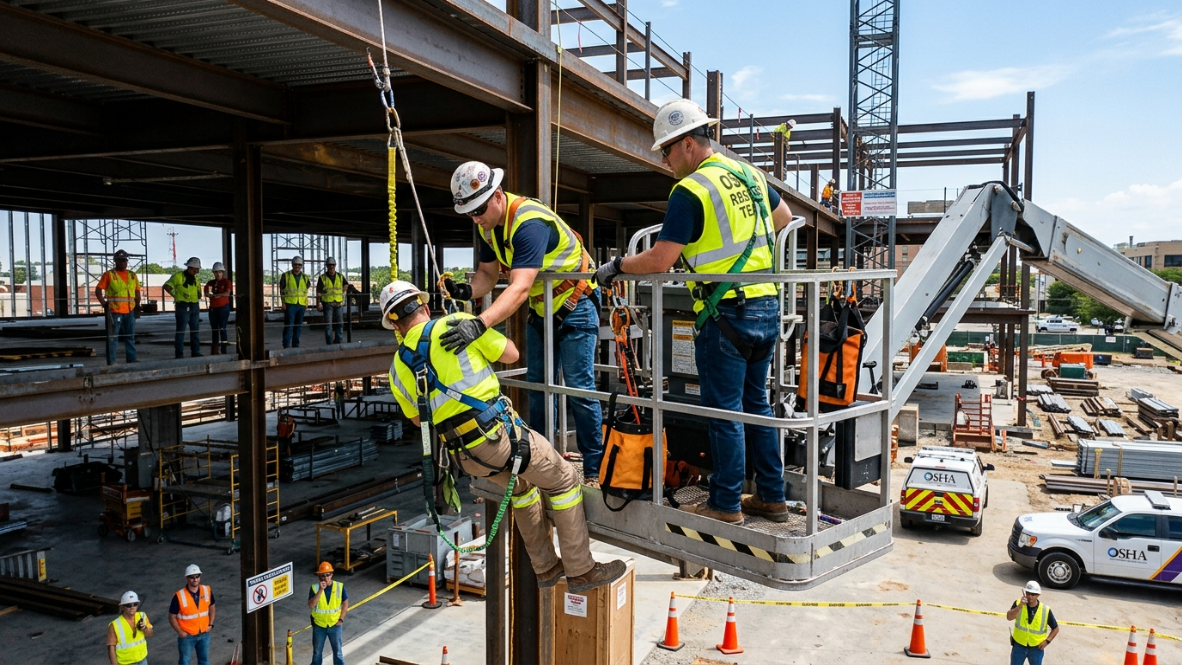
Suspension trauma (also called orthostatic intolerance) occurs when a worker hangs motionless in a harness after a fall arrest. The leg straps compress the femoral arteries and veins, pooling blood in the legs and reducing circulation to the brain and vital organs. According to OSHA, symptoms can begin in as little as five minutes after suspension. Without rescue, suspension trauma can be fatal within 30 minutes.
This is the hidden danger that almost no fall protection glossary covers, but experienced workers know about it. One forum user put it bluntly: “If you’re working by yourself and fall off a roof, then what? Hanging in a harness for half a day is not something anyone wants.” The point is valid. A personal fall arrest system that stops a fall is only half the equation. The other half is a prompt rescue plan.
Every contractor using PFAS must have a rescue plan in place before work begins. OSHA 29 CFR 1926.502(d)(20) requires employers to provide for prompt rescue of employees who have fallen. “Prompt” means within minutes, not when someone notices the worker is missing.
A suspended worker should be monitored continuously for signs of suspension trauma: dizziness, nausea, breathlessness, and loss of consciousness. If rescue is delayed, training the worker to push against a foot loop or stand in their harness straps can help restore blood flow.
Equipment Inspection Requirements
Every person who uses contractor fall protection equipment must inspect it before each use. This is not a recommendation. It is an OSHA requirement. A pre-use inspection takes two to three minutes and covers:
Webbing for cuts, burns, fraying, chemical damage, or UV degradation
Stitching for pulled or broken threads
D-rings for cracks, distortion, or corrosion
Buckles and grommets for proper function
Labels for legibility (if you can’t read the label, you can’t confirm the rating)
Shock absorber pack for signs of deployment
In addition to daily pre-use inspections, most manufacturers and many safety programs require formal annual inspections by a competent person. These inspections should be documented and records retained.
Equipment Retirement Criteria
This is the rule most contractors don’t know or choose to ignore: fall protection equipment must be immediately removed from service after any of the following events:
The equipment has been involved in a fall arrest, even if there is no visible damage
The shock absorber has deployed
Any component shows visible damage, corrosion, or excessive wear
The equipment has been exposed to chemicals, extreme heat, or electrical contact
The manufacturer’s recommended service life has expired
Most manufacturers require retirement of equipment after arresting a fall, regardless of appearance. The internal components of a shock absorber, the stitching in webbing, and the metallurgy of D-rings can all be compromised by forces that leave no visible trace. The cost of replacing a harness is trivial compared to the cost of a harness that fails during a second fall.
Contractors who manage high volumes of safety equipment will benefit from an organized PPE inventory management system that tracks inspection dates, deployment history, and retirement schedules.
The OSHA Six-Foot Rule vs. Four-Foot Rule
Two different height triggers apply depending on the industry classification:
Construction (29 CFR 1926.501): Fall protection required at 6 feet above a lower level
General industry (29 CFR 1910.28): Fall protection required at 4 feet above a lower level
Contractors working in industrial facilities for maintenance or repair should confirm which standard applies to their scope of work. A concrete repair job inside a manufacturing plant may fall under general industry standards, triggering the four-foot requirement instead of the more commonly known six-foot rule.
Leading Edge Work
Leading edge work occurs on any surface where the edge is being constructed or where the edge changes location as additional material is placed. The leading edge of a concrete pour, the advancing perimeter of a steel deck, and the progressing edge of a roof installation all qualify.
OSHA recognizes that conventional fall protection may be infeasible at leading edges because the edge is constantly moving. In these cases, a fall protection plan developed by a qualified person may be used as an alternative, but only with documented justification.
Concrete-Specific Fall Protection Requirements
OSHA has specific provisions for contractors engaged in precast concrete erection. Under 29 CFR 1926.501(b)(12), each employee engaged in the erection of precast concrete members who is 6 feet or more above lower levels must be protected by guardrail systems, safety net systems, or personal fall arrest systems.
For precast concrete work, a fall protection plan is one of the few situations where OSHA allows a written alternative to conventional systems. The plan must be prepared by a qualified person and kept at the jobsite. It must specify why guardrails, nets, or PFAS cannot be used and what alternative protections will be employed.
Contractors doing pile cap construction, structural wall erection, or elevated slab work should know these provisions specifically, because OSHA inspectors checking concrete jobsites will apply them.
Current OSHA Requirements: Quick Reference
Height Triggers
Setting | Fall Protection Trigger | Standard |
|---|---|---|
Construction | 6 feet above lower level | 29 CFR 1926.501 |
General Industry | 4 feet above lower level | 29 CFR 1910.28 |
2025 PPE Fit Rule
The December 2024 Final Rule, effective January 13, 2025, amends 29 CFR 1926.95 to require that construction PPE must properly fit each affected employee. This includes harnesses, hard hats, gloves, and all other protective equipment. The rule clarifies existing obligations rather than creating new ones, but it gives OSHA explicit authority to cite contractors whose harness programs do not account for worker size variation.
For guidance on meeting OSHA PPE standards across your organization, the PPE compliance construction guide covers the requirements in detail.
Penalty Schedule (2025)
Violation Type | Maximum Penalty |
|---|---|
Serious | $16,550 per violation |
Willful or Repeated | $165,514 per violation |
Failure to Abate | $16,550 per day |
Penalties are assessed per violation and per worker. Ten workers without fall protection on a single jobsite can result in ten separate citations. Understanding these costs is part of broader construction cost management, because OSHA fines are entirely preventable expenses.
Body Belt Prohibition
Body belts have been prohibited for fall arrest since January 1, 1998. They are still allowed for positioning work and fall restraint, but never as part of a personal fall arrest system.
National Emphasis Program on Falls
OSHA’s National Emphasis Program (NEP) on falls prioritizes fall protection inspections in construction. Since the NEP’s implementation, fatal falls investigated by federal OSHA dropped from 234 to 189, a 20% decrease. The program is ongoing and means fall protection inspections are not random. OSHA is actively targeting construction sites for fall protection compliance.
How Contractors Can Reduce Fall Protection Equipment Costs Without Reducing Protection
Fall protection is a non-negotiable expense, but the procurement process is not. Contractors who buy harnesses, SRLs, lanyards, and anchor systems through contractor purchasing networks typically access manufacturer pricing that individual buyers cannot. Group purchasing programs aggregate demand across multiple contractors, creating volume pricing on the same brand-name equipment.
The key is standardization. Contractors who standardize on a single harness platform and connector system simplify training, reduce inventory complexity, and create enough volume to negotiate better pricing. Standardization also makes pre-use inspections faster because workers become familiar with one equipment set rather than a rotating mix of brands.
For contractors evaluating which safety equipment vendors to partner with, applying a structured vendor selection criteria process ensures you’re getting compliant equipment at competitive pricing.
Key Takeaways
OSHA requires fall protection in construction at 6 feet or more.
A complete PFAS includes a harness, connector, and compliant anchor.
Harnesses must properly fit each worker under the 2025 PPE fit rule.
Every component should be inspected before each use.
Equipment involved in any fall arrest must be retired immediately.
Rescue planning is required whenever PFAS is used.
Passive protection such as guardrails should be prioritized whenever feasible.
Standardizing compliant equipment simplifies training, inspections, and procurement.
Frequently Asked Questions
What is the OSHA height requirement for contractor fall protection equipment in construction?
OSHA requires fall protection for construction workers at 6 feet above a lower level under 29 CFR 1926.501. General industry workers need fall protection at 4 feet. Contractors working inside industrial facilities should confirm which standard applies to their specific scope.
Can a body belt be used for fall arrest?
No. OSHA banned body belts for fall arrest on January 1, 1998 under 29 CFR 1926.502(d). Body belts may still be used for positioning and fall restraint, but never as part of a personal fall arrest system. Any contractor using body belts for fall arrest is in violation.
What is the difference between a competent person and a qualified person?
A competent person can identify fall hazards and has the authority to stop work and correct them. A qualified person has the education, degree, or demonstrated expertise to design fall protection systems and engineer solutions. A site foreman is typically the competent person. A qualified person is usually an engineer. Both roles have specific OSHA definitions and responsibilities.
Does fall protection equipment need to be replaced after a fall?
Yes. Equipment involved in a fall arrest must be immediately removed from service, even if no visible damage is apparent. This includes the harness, lanyard or SRL, and any connectors. Internal components can be compromised by forces that leave no visible trace. Most manufacturers explicitly require retirement after any fall event.
What is suspension trauma and how quickly does it become dangerous?
Suspension trauma occurs when a motionless worker hangs in a harness after a fall. Leg straps compress blood vessels, reducing circulation to vital organs. Symptoms can begin within 5 minutes, and the condition can become fatal within 30 minutes. Every contractor using personal fall arrest systems must have a prompt rescue plan before elevated work begins.
What is the maximum arresting force allowed on a worker?
OSHA limits the maximum arresting force to 1,800 pounds when using a full-body harness (29 CFR 1926.502(d)(16)). Shock-absorbing lanyards and self-retracting lifelines are engineered to keep forces below this threshold. Exceeding it risks spinal injuries, internal organ damage, and broken ribs.
What changed with the 2025 PPE fit rule?
The December 2024 Final Rule, effective January 13, 2025, requires that all construction PPE, including fall protection harnesses, must properly fit each individual worker. This eliminates one-size-fits-all approaches and gives OSHA explicit authority to cite contractors whose equipment does not fit the workers wearing it.
How much can OSHA fine a contractor for fall protection violations?
A serious violation carries a maximum penalty of $16,550. Willful or repeated violations can reach $165,514 per violation. Penalties are assessed per violation and per worker, so a crew of ten workers without fall protection can generate ten separate citations from a single inspection.
Recent Comments