
TL;DR
A PPE purchasing strategy for construction is the structured plan contractors use to source, stock, and distribute protective equipment across jobsites. OSHA’s 2025 proper fit rule now requires employers to stock PPE in multiple sizes, changing the math on inventory and budgets. Strategic buyers use tools like job hazard analyses, group purchasing organizations, and dual sourcing to cut costs by 10 to 20 percent while staying compliant. This glossary defines every key term and connects it to real purchasing decisions.
Most construction contractors buy PPE the same way they always have: someone realizes the jobsite is running low on gloves or safety glasses, makes a phone call, and pays whatever the supplier quotes that day. It works, until it doesn’t. Until an OSHA inspector flags improperly fitting hard hats and writes a $16,550 citation. Until respirator cartridges expire in a storage trailer because someone over-ordered six months ago. Until the project manager realizes the company spent $140,000 on PPE last year with zero volume discounts.
A PPE purchasing strategy for construction replaces that reactive cycle with a system. It starts with hazard assessments, runs through supplier negotiations and inventory planning, and ends with workers wearing the right gear in the right sizes on every project.
OSHA’s January 2025 proper fit rule, which requires construction employers to provide PPE that actually fits each worker, has made this shift from ad-hoc buying to strategic procurement urgent. Rising raw material costs for polypropylene and polyethylene (which account for 60 to 70 percent of PPE manufacturing costs) add further pressure.
This glossary covers every term you need to build, evaluate, or improve your company’s approach. Each entry explains what the term means and, more importantly, what it means for how you buy PPE.
Looking for broader procurement improvements across your operation? Our construction procurement best practices guide is a strong starting point.
Direct Answer: PPE Purchasing Strategy Construction
A PPE purchasing strategy for construction is a repeatable system for selecting, buying, stocking, and monitoring personal protective equipment based on actual jobsite hazards instead of reactive purchasing.
An effective strategy includes:
Hazard assessments and Job Hazard Analyses (JHAs)
OSHA and ANSI compliance verification
Proper-fit PPE for every worker
Approved supplier selection
Inventory forecasting
Total Cost of Ownership (TCO) evaluation
Regular purchasing audits
Worker feedback on comfort and durability
Companies that implement structured PPE procurement typically reduce purchasing costs through better forecasting, volume discounts, standardized products, and fewer emergency orders while improving OSHA compliance.
PPE Purchasing Strategy Checklist
Step | Action | Why It Matters |
|---|---|---|
1 | Complete Job Hazard Analysis | Determines required PPE |
2 | Verify OSHA requirements | Prevents compliance issues |
3 | Specify ANSI-certified products | Ensures quality |
4 | Purchase multiple sizes | Meets OSHA proper-fit rule |
5 | Request multiple supplier quotes | Reduces pricing |
6 | Compare Total Cost of Ownership | Prevents false savings |
7 | Forecast inventory usage | Avoids shortages |
8 | Track PPE issuance | Improves forecasting |
9 | Audit compliance quarterly | Maintains program quality |
10 | Collect worker feedback | Improves adoption |
Section 1: Foundational Terms
PPE (Personal Protective Equipment)
Equipment worn by construction workers to reduce exposure to hazards that cause injuries and illnesses. The main categories on construction sites are head protection, eye and face protection, hearing protection, respiratory protection, hand protection, foot protection, fall protection, and high-visibility clothing. OSHA requires employers to provide PPE at no cost to workers when hazards cannot be eliminated through other means. In procurement terms, PPE falls under the broader MRO spend category but should be tracked separately for compliance and budget analysis.
PPE Purchasing Strategy
The plan a construction contractor uses to source, procure, stock, and distribute protective equipment across all active projects. A complete PPE purchasing strategy for construction encompasses supplier selection, inventory management, compliance verification, budgeting, and worker feedback. The goal is to match the right equipment to each site’s specific hazards at the lowest total cost of ownership, not the lowest unit price.
Hierarchy of Controls
The five-level framework for managing workplace hazards: elimination, substitution, engineering controls, administrative controls, and PPE. PPE sits at the bottom because it’s the last line of defense, not the first. A good purchasing strategy buys only what the hazard assessment dictates. If a noise hazard can be engineered away, you don’t need to budget for 500 pairs of earplugs. Understanding this hierarchy prevents overspending on equipment that addresses hazards better solved upstream.
Job Hazard Analysis (JHA)
A formal process that identifies specific hazards at each step of a work task before selecting PPE. The JHA is the single most important input to your purchase list. Without one, you’re ordering generically and almost certainly overspending on some categories while under-protecting in others. A concrete crew handling rebar has different glove requirements than an asphalt paving crew working near heavy rolling equipment. The JHA captures those differences.
For a structured approach to planning procurement around these assessments, a procurement planning checklist can help organize the process.
Hazard Assessment
The OSHA-required evaluation under 29 CFR 1926.95 that determines what PPE is needed on a construction site. It’s related to the JHA but is a distinct regulatory obligation. Employers must certify in writing that the assessment was performed. This document is the legal backbone of every PPE purchase decision. If you can’t produce it during an inspection, compliance problems follow regardless of how good your equipment is.
Section 2: Regulatory and Compliance Terms
OSHA 29 CFR 1926 Subpart E
The federal PPE standard governing construction work. It covers general requirements plus specific standards for eye and face protection, respiratory protection, head protection, foot protection, electrical protective equipment, and fall protection. Every PPE purchasing decision for a construction project should trace back to a specific requirement within this subpart. OSHA mandates that all PPE meet or equal standards developed by ANSI, which creates a clear purchasing filter: reject any product without valid ANSI markings.
OSHA Proper Fit Rule (2025)
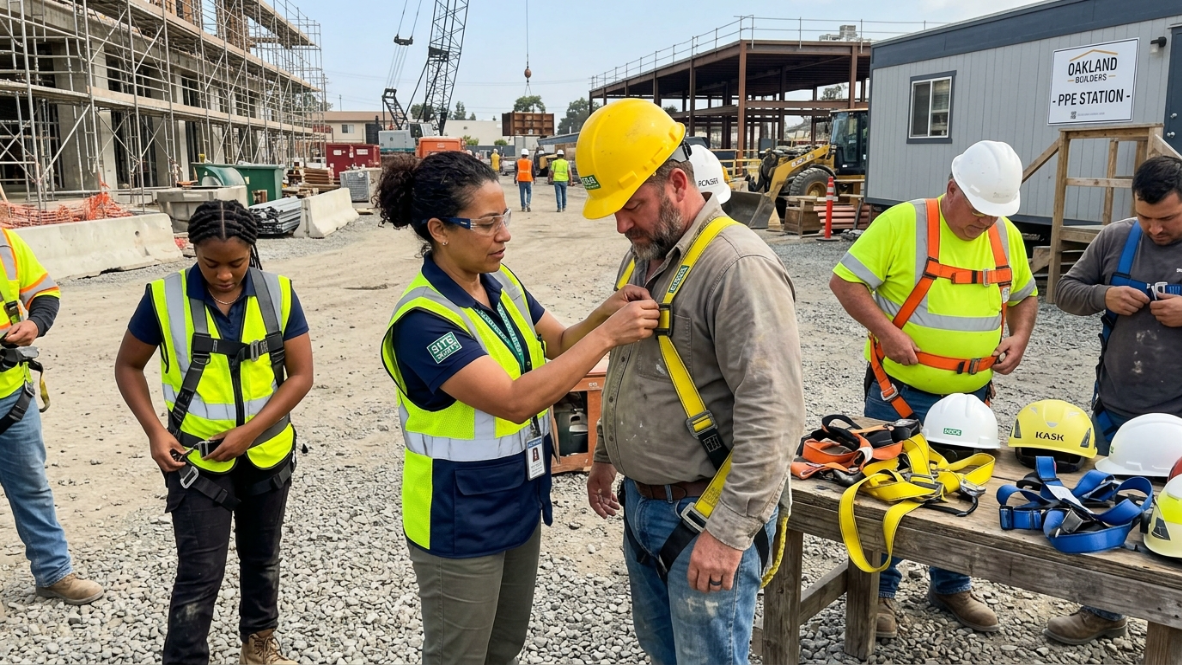
The revision to the construction PPE standard that became effective January 13, 2025. It adds explicit language requiring employers to provide PPE that properly fits each construction worker, aligning the construction standard with the general industry standard that already contained this requirement. The purchasing impact is significant: contractors now need to stock PPE in multiple sizes and styles to accommodate various body types, increasing SKU counts, storage needs, and per-project budgets. Penalty exposure reaches $16,550 per serious violation and $165,514 per willful or repeated violation.
Practitioners on Reddit and construction safety forums report that the fit rule has created the most friction around hard hats and fall harnesses, where sizing was historically treated as an afterthought. Several safety directors have noted they had to triple the number of harness sizes kept on jobsites.
OSHA’s own economic analysis estimated that the average cost for replacement PPE was approximately $51.24 per worker as of 2022, suggesting that per-worker compliance costs are modest compared to the penalty exposure. But the aggregate budget impact across a large crew is real.
For a deeper breakdown of compliance and fit requirements, see our construction PPE procurement guide.
ANSI Standards
The American National Standards Institute develops voluntary consensus standards that OSHA references as mandatory minimums for construction PPE. Key standards include:
ANSI Z87.1 for eye and face protection (the dominant standard in the construction PPE market)
ANSI Z89.1 for head protection
ANSI/ISEA 105 for cut resistance in gloves
ANSI/ISEA 138 for impact protection in gloves
ANSI/ISEA 107 for high-visibility garments
When writing RFQs, specify the applicable ANSI standard for each PPE category. This eliminates ambiguity and prevents suppliers from quoting non-compliant substitutes.
NIOSH Certification
The National Institute for Occupational Safety and Health certifies respirators (N95, P100, half-face, full-face) before they can be sold in the United States. Purchasing must verify NIOSH approval markings on every respirator, especially for silica dust exposure during concrete cutting, grinding, and demolition. After OSHA’s silica standard tightened enforcement, NIOSH-certified respirators became a non-negotiable line item for any concrete or asphalt operation.
CE Marking
The European conformity mark indicating that a product meets EU health, safety, and environmental standards. Relevant only if you’re purchasing from international suppliers. CE marking is not equivalent to ANSI compliance and will not satisfy OSHA requirements on its own. If a supplier quotes a CE-marked hard hat without ANSI Z89.1 certification, reject it.
Fit Testing
An OSHA-required process for respirators, using either quantitative or qualitative methods to verify that a specific respirator model creates an adequate seal on the wearer’s face. Following the 2025 proper fit rule, fit testing is also considered best practice for harnesses, hard hats, and gloves, even where not explicitly mandated. From a procurement standpoint, fit testing adds steps to the buying process: you need sizing samples from suppliers before committing to bulk orders, and you need test kits (for respirators) in your safety inventory.
Section 3: Procurement and Supply Chain Terms
Request for Quotation (RFQ)
A formal bid request sent to PPE suppliers specifying quantities, product specifications, delivery timelines, and compliance requirements. The most common mistake contractors make is sending generic RFQs pulled from a supplier catalog rather than building them from the JHA. An RFQ for a structural concrete project should specify ANSI/ISEA 105 A4-rated gloves for rebar handling, NIOSH-approved respirators for silica exposure, and Type II hard hats for overhead and lateral impact hazards. Specificity in the RFQ gets you accurate pricing and prevents scope mismatches later.
For guidance on building supplier relationships around these requests, our vendor sourcing guide walks through the full process.
Total Cost of Ownership (TCO)
The true cost of PPE when you account for purchase price, replacement frequency, training time, storage costs, and injury cost avoidance. A pair of cheap leather gloves that shreds after two hours of rebar work costs more over a week than a cut-resistant glove rated A5 that lasts five days. Higher-quality gear is often more cost-effective because it lasts longer, reduces injury rates, and prevents the project delays and workers’ compensation premium increases that follow on-site injuries.
A smart PPE purchasing strategy for construction always evaluates TCO, not shelf price. If you want to apply this same discipline across all your procurement categories, the construction procurement savings guide explains how.
Bulk Purchasing
Buying PPE in large volumes to reduce unit costs. The math is straightforward: order 10,000 pairs of safety glasses instead of 500 and the price per unit drops significantly. The trade-off is equally straightforward. Overstocking ties up capital, consumes storage space (often in already-cramped jobsite trailers), and creates the risk of products expiring or degrading before use. Respirator cartridges, certain harness webbing materials, and adhesive-backed products all have shelf life limits.
The solution is to forecast from project schedules and crew sizes, not from gut feeling. Match bulk quantities to realistic consumption timelines.
Group Purchasing Organization (GPO)
A collective that aggregates buying power from multiple contractors to negotiate tier-1 national-account pricing from suppliers. When contractors pool volume through a GPO, they access pricing that individual mid-size firms could never command alone. Research shows that GPO members pay roughly 13% less on average for supplies, and that figure doesn’t include annual rebate checks. Perhaps more striking, procurement cycle times compress from an average of 13.2 days down to 4.7 days under cooperative contracts.
GPO participation is one of the most underutilized cost levers in construction PPE procurement. Most contractors treat PPE buying as a standalone activity rather than part of the broader MRO spend category that benefits from centralized purchasing.
To understand how buying groups work for contractors specifically, see our contractor buying group guide.
Category Management
The practice of organizing PPE purchases by equipment category (head, hand, eye, respiratory, fall, hi-vis) rather than buying everything ad hoc from whoever answers the phone. Category management enables volume consolidation within each product type, standardized specifications across projects, and easier compliance tracking. Shifting from transactional buying to long-term category management can save 10 to 20 percent.
Dual Sourcing
Maintaining at least two qualified suppliers for each critical PPE category. A single-source relationship for respirators or fall harnesses is a supply chain risk. If that supplier faces a production disruption, backorder, or quality issue, your jobsites go unprotected or you pay rush-order premiums. A 2025 survey found that 60% of organizations plan to adopt dual sourcing by 2026 to make their supply chains more secure.
The PPE market’s structure actually supports this approach. The industry is highly fragmented, with many small producers and multiple large-scale global players, meaning suppliers have low bargaining power. Contractors should negotiate aggressively and avoid unnecessary single-source commitments for commodity items.
For strategies on managing the risks inherent in construction procurement, our procurement risk management guide covers the topic in depth.
Vendor Managed Inventory (VMI)
An arrangement where the PPE supplier manages stock levels at the contractor’s site or storage location. The supplier monitors consumption, triggers replenishment, and handles deliveries without the contractor placing individual orders. VMI reduces administrative burden, prevents stockouts, and is especially practical for high-consumption items like disposable gloves, safety glasses, and earplugs. The trade-off is less direct control over brand selection and timing.
Blanket Purchase Order
A pre-negotiated agreement covering multiple PPE deliveries over a set period, typically six to twelve months. It locks in pricing, simplifies reordering, and eliminates the need to re-quote every time you need supplies. Ideal for recurring items like disposable respirators, hearing protection, and work gloves. A blanket PO combined with a VMI arrangement for commodity PPE can dramatically reduce the administrative time spent on procurement.
A benchmark survey of 379 electrical contractors found that manual procurement processes cost field supervisors about two weeks of productive time per year and purchasing managers roughly seven weeks per year. Blanket POs and VMI are the primary tools for reclaiming that time.
MRO (Maintenance, Repair, and Operations)
The broad procurement category that includes PPE alongside tools, cleaning supplies, fasteners, and other consumables. In most purchasing systems, PPE falls under MRO spend by default. The problem is that when PPE is lumped into a general MRO bucket, it becomes invisible in budget analysis. Track PPE spend separately so you can measure it, benchmark it, and negotiate on it.
Common PPE Purchasing Mistakes Contractors Make
Many contractors spend more than necessary because purchasing decisions happen reactively rather than strategically.
The most common mistakes include:
Buying Based on Price Alone
Lowest-cost PPE often has the highest replacement rate.
Ignoring Proper Fit
Poor-fitting PPE reduces compliance and increases injury risk.
Using Only One Supplier
Single-source purchasing increases supply chain risk and weakens negotiating leverage.
Overstocking Disposable PPE
Products with expiration dates may become unusable before they’re consumed.
Failing to Track Usage
Without issuance logs, companies cannot accurately forecast future purchases.
Mixing Too Many Brands
Standardizing PPE improves training, inventory management, and volume discounts.
Section 4: Budgeting and Cost Terms
PPE Budget
The project-level allocation for all protective equipment. PPE budgets for construction projects typically range from $50,000 to $150,000 or more, with the final number depending on equipment quality, crew size, project duration, and specific hazard profiles. This line item is frequently underestimated because it gets rolled into general overhead or distributed across multiple cost codes. Building a dedicated PPE budget forces better forecasting and accountability.
For broader strategies on managing construction expenses, our construction cost management guide covers the full picture.
Per-Worker PPE Cost
The average cost to equip one construction worker with required protective equipment. OSHA estimated average replacement PPE at approximately $51 per worker in 2022, but that figure reflects replacement of individual items, not a full kit. A baseline outfit (hard hat, safety glasses, cut-resistant gloves, steel-toe boots, hi-vis vest) typically runs $150 to $300 or more. After the 2025 fit rule, per-worker costs may increase slightly because employers need to stock and sometimes test multiple sizes before finding the right fit.
Cost Avoidance
The money saved by preventing injuries, OSHA fines, and project delays through proper PPE investment. This is the hardest ROI line item to measure and often the largest. On-site injuries cause project delays. They also increase workers’ compensation claims, which drive premium costs higher. Properly fitting PPE reduces employee injuries and saves more than the cost of the equipment itself. When a safety director argues for better PPE, cost avoidance is the business case.
Rebate Structure
Volume-based refunds from PPE suppliers or GPOs, typically paid quarterly or annually. Rebates layer on top of negotiated discounts and can represent a meaningful return. Some GPO contracts include rebates calculated on aggregate member spend across PPE and MRO categories. Track rebate eligibility carefully, because many contractors leave money on the table by not filing claims or meeting minimum thresholds.
Price Escalation Clause
A contract term that allows price adjustments when raw material costs fluctuate beyond a predefined threshold. Since polypropylene and polyethylene prices directly affect PPE manufacturing costs, a multi-year supply agreement without a price escalation clause exposes either buyer or seller to unplanned cost swings. Include escalation language that references a specific commodity index and sets both floor and ceiling percentages.
Example PPE Budget by Crew Size
Crew Size | Estimated Annual PPE Spend |
|---|---|
10 workers | $2,000–$5,000 |
25 workers | $6,000–$12,000 |
50 workers | $15,000–$30,000 |
100 workers | $35,000–$60,000 |
250 workers | $90,000+ |
Section 5: Inventory and Distribution Terms
Safety Stock
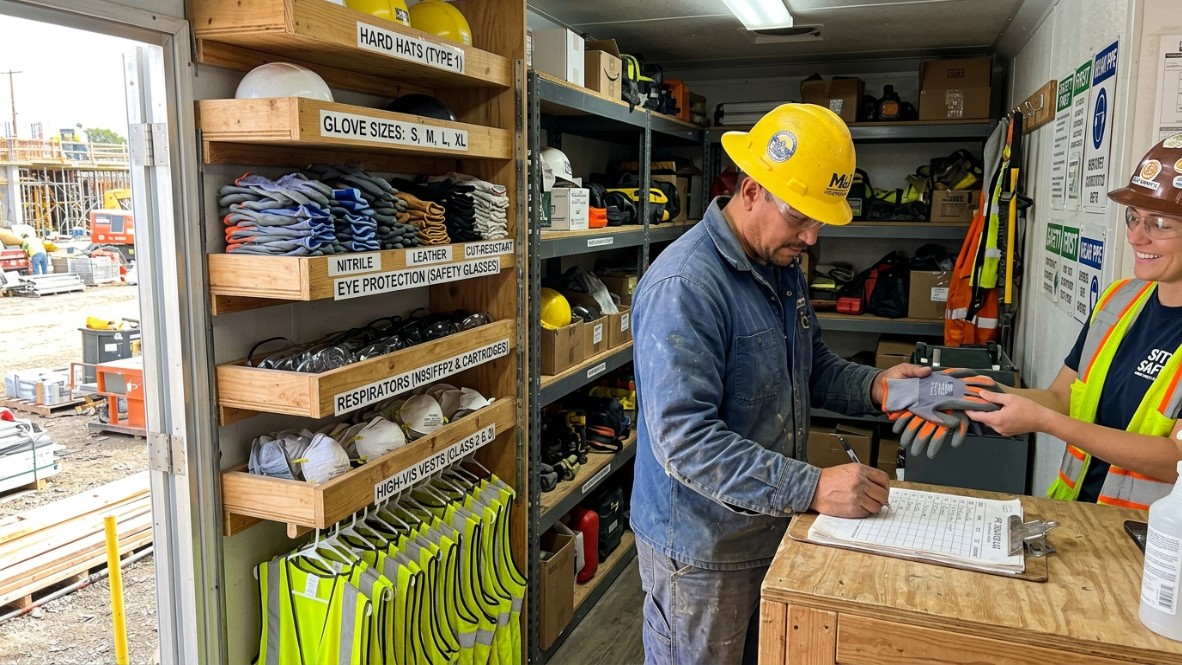
The minimum PPE inventory maintained to prevent stockouts between deliveries. Calculate it using a simple formula: crew size multiplied by daily consumption rate multiplied by a lead time buffer (typically 1.5 to 2 times the normal delivery window). Post-2025, safety stock calculations need to account for size variety. Stocking 200 pairs of large gloves doesn’t help if 30 crew members need medium.
Inventory Turnover
How quickly PPE stock is consumed and replenished. Disposable items like earplugs, N95 respirators, and nitrile gloves turn over rapidly, sometimes weekly. Durable items like hard hats, safety harnesses, and steel-toe boots may last months or years. Understanding turnover rates by category prevents both stockouts (under-ordering disposables) and dead inventory (over-ordering durables).
Jobsite PPE Trailer / Station
An on-site storage and distribution point for protective equipment. Having a dedicated PPE station reduces the time workers spend making supply runs and ensures immediate access to replacement gear. Stock based on the hazard assessment for that specific project, not a generic kit. A concrete jobsite PPE station will look different from an asphalt paving site.
PPE Issuance Log
A record of what PPE was distributed to which worker and when. Required for OSHA compliance documentation and useful for forecasting replacement cycles. If your issuance log shows that a particular brand of gloves is being replaced every three days on a structural concrete project, that data directly informs your next purchase order.
Shelf Life / Expiration
Some PPE products degrade over time regardless of use. Respirator cartridges have chemical absorption limits that decline in storage. Certain harness webbing materials weaken with UV exposure. Adhesive-backed reflective tape loses bonding strength. A PPE purchasing strategy for construction must match order quantities to realistic consumption timelines. Bulk buying a two-year supply of respirator cartridges makes no sense if they expire in 18 months.
PPE Inventory Forecast Formula
A simple inventory forecast helps avoid both stockouts and over-ordering.
Basic formula:
Monthly PPE Requirement =
Average Daily Usage × Number of Workers × Working Days
Example:
50 workers
× 2 glove pairs/week
≈ 400 pairs per month
Then add:
Safety stock
Seasonal demand
Delivery lead time
Emergency reserve
Section 6: Selection and Quality Terms
Cut Resistance Rating (ANSI/ISEA 105)
A standardized scale from A1 to A9 that rates a glove’s ability to resist cuts from sharp objects. Concrete and rebar work typically requires A4 or higher rated gloves. Asphalt milling crews handling sharp aggregate may need A3 or above. Always specify the required cut resistance level in your RFQ. Accepting unrated or under-rated gloves creates both injury risk and OSHA compliance exposure.
Impact Rating (ANSI/ISEA 138)
A rating system for back-of-hand impact protection on work gloves, using three performance levels. Critical for workers handling heavy materials, operating demolition equipment, or working around moving machinery. For structural concrete crews handling formwork and rebar, impact-rated gloves are increasingly specified alongside cut resistance. Include this standard in RFQs for crews in heavy-material handling roles.
Type I / Type II Hard Hats
Type I hard hats protect against impacts to the top of the head only. Type II hard hats protect against both top and lateral (side) impacts. Industrial and concrete jobsites increasingly mandate Type II because falling objects and swinging loads can strike from any direction. Know which type your jobsite hazard assessment requires before placing orders. A Type I hat costs less but provides less protection. Getting this wrong is a false economy.
Dielectric Rating
An electrical insulation rating for hard hats and footwear. Class E (electrical) is rated to withstand 20,000 volts. Essential for crews working near overhead power lines, electrical systems, or energized equipment. If your hazard assessment identifies electrical exposure, the dielectric rating becomes a mandatory purchasing specification rather than an optional upgrade.
High-Visibility (Hi-Vis) Classes
ANSI/ISEA 107 defines three classes of high-visibility garments based on the amount of background and retroreflective material. Class 1 provides the least visibility, Class 3 the most. Roadway construction and most commercial site work requires Class 2 or Class 3. State DOTs often have their own specific requirements that exceed the ANSI minimum. Check the applicable DOT standard for any roadway-adjacent project before ordering hi-vis vests or shirts.
PPE Purchasing Decision Matrix
PPE Category | Replace Frequently | Prioritize Fit | Prioritize Durability | Critical Certification |
|---|---|---|---|---|
Hard Hats | No | Yes | Yes | ANSI Z89.1 |
Gloves | Yes | Yes | Yes | ANSI/ISEA 105 |
Respirators | Yes | Yes | Moderate | NIOSH |
Eye Protection | Moderate | Moderate | Moderate | ANSI Z87.1 |
Hi-Vis Clothing | Moderate | Moderate | Moderate | ANSI/ISEA 107 |
Harnesses | Rare | Extremely High | Extremely High | OSHA/ANSI |
Section 7: Program and Compliance Terms
PPE Program
A written organizational policy that covers hazard assessment procedures, equipment selection criteria, fitting protocols, worker training, maintenance requirements, and periodic program review. OSHA expects this documentation to exist and be current. From a purchasing perspective, the PPE program is the master document that drives all buying decisions. If the program says “all structural concrete workers wear Type II hard hats,” that’s what goes on the purchase order.
PPE Compliance Audit
A periodic internal review verifying that purchased PPE matches the hazard assessments, ANSI/OSHA standards, and fit requirements for each active project. Audits should check that products carry current ANSI markings, that sizes match the workforce, and that shelf-life items haven’t expired. Every audit should produce a findings report that triggers replacement orders where needed. Link audit frequency to project milestones, not just calendar dates.
For tracking the effectiveness of your procurement decisions over time, our guide on procurement KPIs and metrics can help.
Training Documentation
Records proving that workers were trained on the proper use, limitations, and care of the specific PPE models they’ve been issued. Purchasing must coordinate with safety to ensure training matches the actual products procured. If you switch glove brands or respirator models mid-project, retraining and documentation updates are required. This coordination step is often missed when purchasing and safety departments operate in silos.
Worker Feedback Loop
A structured process for field workers to report PPE comfort, fit, or durability issues directly to whoever manages purchasing decisions. Workers provide valuable insights that no product specification sheet can capture. A glove might meet every ANSI standard but still cause hand fatigue after four hours of rebar tying. That feedback should inform the next order.
After the 2025 fit rule, worker feedback is essentially required. Employees who wear PPE that doesn’t fit properly tend to remove it, compromising their safety and exposing the employer to both injury liability and OSHA citations. Practitioners in construction safety forums consistently report that the single biggest predictor of PPE compliance is comfort, not enforcement.
Section 8: Market Context
PPE Market Size and Growth
The global PPE market for construction was estimated at $126 billion in 2024 and is projected to reach $234 billion by 2035, growing at a 5.79% compound annual rate. North America holds approximately 40% of global market share. This growth is driven by tightening regulations, increased enforcement, and rising awareness of occupational health risks. For contractors, a growing market means more product options and more supplier competition, both of which favor the buyer.
Supplier Fragmentation
The PPE industry is highly fragmented, with no single manufacturer dominating. Top players hold a comparatively small portion of total market share, and many smaller private producers compete actively. This fragmentation gives buyers meaningful negotiating power. Contractors who consolidate their PPE spend across fewer suppliers (while maintaining dual sourcing for critical items) can command better pricing, dedicated account management, and priority fulfillment.
Emerging Trends in Construction PPE Procurement (2026)
Include:
Digital inventory systems
Barcode and RFID tracking improve inventory accuracy.
AI demand forecasting
Historical usage data predicts future PPE needs more accurately than manual estimates.
Vendor-managed inventory expansion
More contractors are outsourcing replenishment.
Sustainable PPE
Manufacturers increasingly offer recyclable packaging and products made with recycled materials.
Connected PPE
Smart helmets, connected wearables, and sensor-enabled safety equipment are becoming more common on large projects.
Building Your PPE Purchasing Strategy: Putting the Terms Together
These glossary terms aren’t isolated concepts. They connect into a workflow:
Start with the JHA and hazard assessment. These documents determine what you need to buy. Everything else follows.
Write specific RFQs that reference ANSI standards, OSHA requirements, and the 2025 fit rule’s sizing implications.
Evaluate bids on TCO, not unit price. Factor in replacement frequency, training costs, and cost avoidance from injury prevention.
Set up procurement infrastructure using blanket purchase orders, VMI for high-turnover items, and dual sourcing for critical categories.
Join a GPO if your company lacks the individual volume to negotiate tier-1 pricing. The 13% average savings and compressed procurement timelines pay for themselves quickly.
Build the feedback loop. Worker input on fit and durability is a procurement input now, not just a safety formality.
A PPE purchasing strategy for construction doesn’t need to be complicated. It needs to be intentional. The difference between reactive buying and strategic procurement is the difference between $150,000 in untracked spend and a documented, auditable, cost-optimized program.
Ready to start reducing procurement costs across your operation? Explore our contractor supplier discounts guide to see what national pricing programs are available.
PPE Purchasing Strategy Workflow
Instead of treating each purchase independently, follow a repeatable procurement cycle.
Perform hazard assessment.
Identify required PPE.
Define specifications.
Request supplier quotations.
Compare Total Cost of Ownership.
Award supplier.
Receive and inspect products.
Issue PPE.
Monitor usage.
Audit compliance.
Collect worker feedback.
Improve purchasing decisions.
Key Performance Indicators (KPIs) for PPE Purchasing
Track these metrics to measure whether your purchasing strategy is improving.
KPI | Target |
|---|---|
PPE Cost per Worker | Stable or decreasing |
Emergency Purchases | <5% |
Stockout Rate | <2% |
Inventory Turnover | Category dependent |
Supplier On-Time Delivery | >95% |
OSHA PPE Violations | Zero |
Worker Satisfaction | Increasing |
PPE Waste | Decreasing |
How to Choose PPE Suppliers
Evaluate suppliers using more than price.
Consider:
OSHA-compliant products
ANSI-certified inventory
Multiple sizing options
Delivery reliability
National inventory availability
Product warranties
Return policy
Technical support
Inventory management options
Pricing transparency
Key Takeaways
PPE purchasing should begin with hazard assessments, not supplier catalogs.
OSHA’s proper-fit requirement makes sizing strategy a core procurement responsibility.
Evaluate PPE using Total Cost of Ownership rather than unit price alone.
Standardize products where possible while maintaining dual sourcing for critical categories.
Forecast inventory based on actual usage to reduce emergency purchases and waste.
Monitor KPIs, supplier performance, and worker feedback to continuously improve purchasing outcomes.
Frequently Asked Questions
What is a PPE purchasing strategy in construction?
It’s the structured plan a construction contractor uses to source, procure, stock, and distribute personal protective equipment across all projects. It covers supplier selection, compliance verification, inventory management, budgeting, and worker feedback. The goal is to match the right equipment to each site’s hazards at the lowest total cost of ownership while meeting OSHA requirements.
How did the 2025 OSHA fit rule change PPE purchasing?
The rule, effective January 13, 2025, requires construction employers to provide PPE that properly fits each worker. This means stocking equipment in multiple sizes and styles, conducting fit assessments, and incorporating worker feedback. It increases SKU counts, storage requirements, and per-project budgets, but the per-worker compliance cost remains modest compared to penalties of up to $16,550 per serious violation.
How much should a construction company budget for PPE?
Project-level PPE budgets typically range from $50,000 to $150,000 or more, depending on crew size, project duration, and hazard profiles. A baseline kit for one worker (hard hat, glasses, gloves, boots, vest) runs $150 to $300. The key is building a dedicated PPE budget line item rather than burying it in general overhead.
What is Total Cost of Ownership for PPE?
TCO accounts for purchase price plus replacement frequency, training time, storage costs, and injury cost avoidance. A cheap product that wears out quickly or fails to protect workers costs more over time than a higher-priced item with better durability and compliance ratings.
How can small contractors get better PPE pricing?
Joining a Group Purchasing Organization (GPO) is the most effective lever. GPO members collectively aggregate volume to negotiate national-account pricing, paying roughly 13% less on average before rebates. This approach is especially valuable for mid-size contractors who lack the individual volume to command tier-1 pricing on their own.
What ANSI standards should construction PPE meet?
Key standards include ANSI Z87.1 for eye protection, ANSI Z89.1 for head protection, ANSI/ISEA 105 for cut-resistant gloves, ANSI/ISEA 138 for impact-rated gloves, and ANSI/ISEA 107 for high-visibility garments. OSHA mandates that all construction PPE meet or equal applicable ANSI standards. Reject any supplier product without valid ANSI markings.
Why is dual sourcing important for construction PPE?
Relying on a single supplier for critical PPE categories creates supply chain risk. If that supplier faces a disruption, your jobsites go unprotected or you pay rush premiums. The PPE market is highly fragmented with many producers, making it straightforward to qualify two or more suppliers per category. Sixty percent of organizations plan to adopt dual sourcing by 2026.
How often should PPE purchasing decisions be reviewed?
Tie reviews to PPE compliance audits, which should happen at project milestones rather than arbitrary calendar dates. Each audit should verify that purchased equipment matches current hazard assessments, carries valid ANSI certifications, fits the current workforce, and hasn’t exceeded shelf life. Audit findings should directly trigger updated purchase orders.
Recent Comments