
TL;DR
Construction fleet purchasing is the process of acquiring vehicles, heavy equipment, and support assets needed to execute construction projects. It covers everything from pickup trucks to excavators, and involves decisions about buying, leasing, or renting. Fleet is typically a construction company’s second-largest expense, so getting the purchasing process right directly impacts profitability. This guide breaks down every major concept, from total cost of ownership to group purchasing, so you can make smarter acquisition decisions.
Quick Answer: How to Buy Construction Fleet Equipment in 2026
Construction fleet purchasing is about choosing the right acquisition method (buy, lease, or rent) based on utilization, total cost of ownership (TCO), cash flow, and replacement strategy—not simply selecting the lowest purchase price.
For most contractors:
– Buy equipment used over 70% of the year.
– Lease vehicles requiring predictable replacement every 3–5 years.
– Rent specialized or seasonal equipment.
– Evaluate every purchase using total cost of ownership instead of sticker price.
– Compare at least four dealer quotes.
– Consider GPO purchasing for additional discounts.
– Use telematics to determine actual utilization before purchasing new assets.
Companies that standardize fleet specifications, monitor lifecycle costs, and replace assets at the optimal point typically reduce fleet operating costs while improving uptime.
What Is Construction Fleet Purchasing?
Construction fleet purchasing refers to the systematic process of acquiring the vehicles, heavy equipment, and supporting assets a construction company needs to operate. This includes light-duty pickups and service vans, medium-duty flatbeds and dump trucks, heavy equipment like excavators and loaders, concrete mixers, and specialized attachments.
The scope goes beyond simply buying a truck. A proper construction fleet purchasing strategy accounts for how assets will be acquired (bought, leased, or rented), when they should be replaced, how to minimize lifetime costs, and how to dispose of them at the right time.
Why does this matter so much? Fleet is typically a company’s second biggest expense after labor. The U.S. construction equipment market alone generated $64.4 billion in revenue in 2025 and is projected to reach $92.9 billion by 2034. Equipment prices are 30% higher than they were in 2020. Every purchasing decision carries more financial weight than it did five years ago.
If you’re looking to build a broader framework around how your company buys, our construction procurement savings guide covers the full picture beyond fleet.
Construction Fleet Purchasing Process
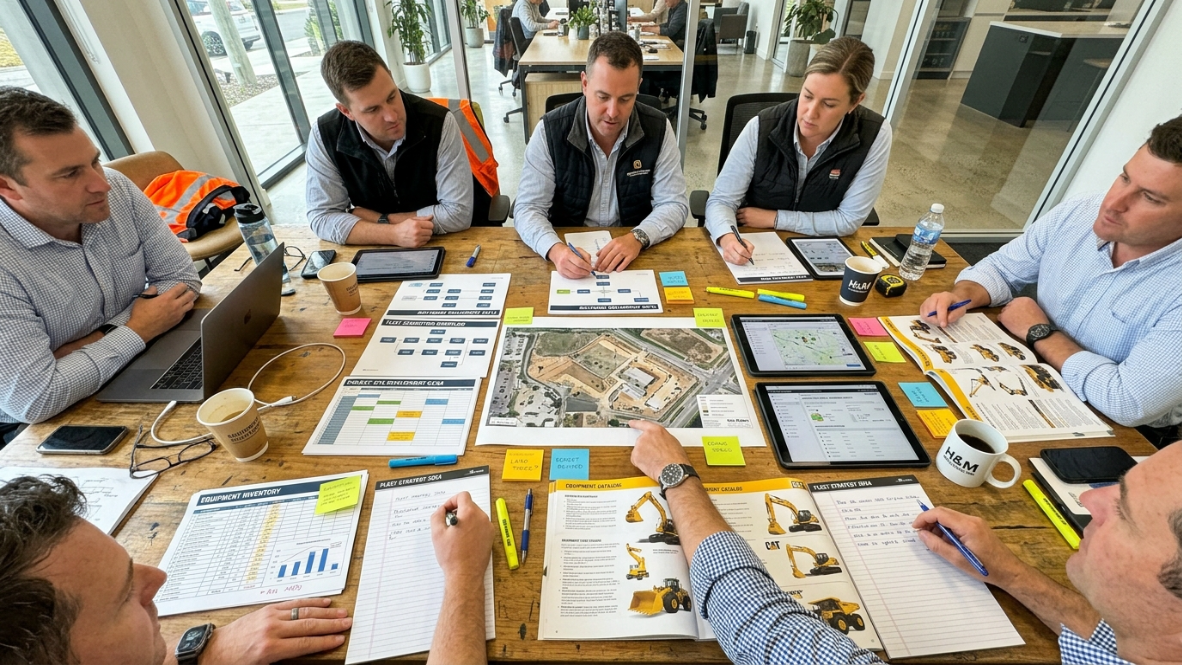
Typical Fleet Purchasing Workflow
Step | What Happens |
|---|---|
Identify operational need | Determine project requirements and utilization |
Analyze existing fleet | Check idle assets before buying |
Calculate TCO | Compare lifetime costs |
Decide Buy vs Lease vs Rent | Select acquisition method |
Request dealer quotes | Obtain 4–6 competitive bids |
Evaluate financing | Compare loans, leasing, and cash purchase |
Purchase and upfit | Order equipment and install required accessories |
Deploy and monitor | Track utilization using telematics |
Replace at optimal lifecycle | Dispose before maintenance costs accelerate |
Fleet Acquisition Methods: Buy vs. Lease vs. Rent
Most construction companies don’t rely on a single acquisition method. They use a mix of owned, leased, and rented assets depending on utilization rates, project timelines, and cash flow priorities. Each approach carries different levels of flexibility, risk, and financial commitment.
Buying (Owning Outright)
Buying makes the most sense for assets with stable, predictable utilization. You control the asset completely, build equity, and can customize specs to your exact needs.
One fleet manager on a River Daves Place forum thread, responsible for 450 trucks, vans, and SUVs, explained the approach simply: “I handle our fleet of 450 trucks/vans/SUVs and always buy new or used. We run the trucks and vans on the road for about 7 years then send to a big job site to die.”
A major tax advantage is the Section 179 deduction, which allows construction companies to deduct the full purchase price of qualifying equipment in the year it’s placed in service rather than depreciating it over several years. This benefit alone can shift the buy-vs-lease math significantly.
Another fleet owner with 35 trucks on the same forum was firm in his preference: “Leasing is way more money. We either buy new and finance or buy used and pay cash.”
Leasing
Leasing gives you planned replacement cycles and predictable monthly payments. If you lease fleet vehicles, you’ll typically have a set lifecycle of around 3 to 5 years built into your contract. The leasing company often absorbs maintenance risk, and the vehicles stay off your balance sheet.
A particularly striking example from practitioners on forums: one contractor running a 200-vehicle construction fleet on an Enterprise lease program rolls the complete fleet every 24 months. They buy at such a deep discount that they sell the used vehicles for close to purchase price.
Another owner with 50 trucks who switched to Enterprise leasing noted that his company still gets the Section 179 deduction: “So far it looks like it will pencil better than buying for us.”
The key insight one commenter offered applies broadly: “Consider your cost of capital. If the lease rate is less than what you can borrow at, leasing may be better given all other things the same.”
Renting
Renting is the fastest-growing acquisition channel in construction, with rental channels commanding 54.28% of the North American construction equipment market in 2024 and growing at a 6.37% CAGR. Elevated interest rates and stricter balance-sheet management are driving this trend.
Rental works best for project-based needs. Equipment can often be deployed when work begins, avoiding long procurement and spec-build cycles. Contractors also appreciate built-in maintenance clauses and the off-balance-sheet treatment.
Buy vs Lease vs Rent Decision Matrix
If your equipment will… | Best Option |
|---|---|
Be used daily for 5+ years | Buy |
Need replacement every 3–5 years | Lease |
Be used only on one project | Rent |
Require specialized attachments | Rent |
Need customization | Buy |
Experience uncertain workload | Lease or Rent |
Have rapidly changing technology | Lease |
Quick Comparison Table
Factor | Buy | Lease | Rent |
|---|---|---|---|
Best for | Stable, long-term use | Predictable replacement cycles | Project-based or seasonal needs |
Upfront cost | High | Low to moderate | Lowest |
Monthly cost | Loan payment (if financed) | Fixed lease payment | Rental rate (often higher per month) |
Maintenance | Your responsibility | Often included or shared | Included |
Tax treatment | Section 179, depreciation | Section 179 (in many cases), deductible payments | Fully deductible as expense |
Balance sheet | On balance sheet | Often off balance sheet | Off balance sheet |
Flexibility | Low (you own it) | Moderate (contract terms) | High |
Equity | Yes | No (unless buyout) | No |
Total Cost of Ownership (TCO)
Sticker price is the number most contractors fixate on. It’s also the number most likely to mislead you.
Total cost of ownership is the sum of every expense associated with a fleet asset across its entire life: acquisition, operation, maintenance, and disposal. According to industry research, hidden costs can add 40% to 60% above the purchase price.
The TCO Formula
Initial purchase price + operating costs + maintenance costs – resale value = TCO
The components that feed into this formula include:
Acquisition cost: Purchase price or capitalized lease cost, plus taxes, registration, and upfitting
Fuel: Typically the largest single TCO expense, surpassing even acquisition and depreciation costs
Maintenance and repairs: Scheduled maintenance, unplanned repairs, tires, and parts
Insurance: Liability, physical damage, and workers’ compensation related to fleet operation
Downtime: Lost productivity when equipment is out of service
Financing costs: Interest on loans or implicit lease rates
Depreciation: The decline in asset value over time
Resale/residual value: What the asset is worth when you dispose of it
For a deeper look at managing these costs across your business, our guide on construction cost management strategies covers the broader framework.
Why TCO Matters More Than Purchase Price
Assets over 10 years old can cost up to 35% more per mile to operate than newer equivalents, according to Fleetio’s 2025 Fleet Benchmark Report. That “cheap” used truck with no monthly payment might be costing you far more than a financed new one.
A TCO study by Ryder and KPMG revealed something alarming: there’s a massive gap between what fleets think they spend and what they actually spend. Self-reported Class 8 tractor costs came in at least 14% below third-party verified data, with the actual gap approaching 38% in some cases. Up to 41% of fleets reported $0 for critical line items like roadside assistance or administrative costs.
The takeaway is straightforward. If you aren’t tracking every cost category, you’re making construction fleet purchasing decisions with incomplete data.
Hidden Costs Contractors Frequently Miss
Common Hidden Fleet Costs
Cost Category | Often Forgotten |
|---|---|
Driver training | ✓ |
Registration renewals | ✓ |
Shop labor overhead | ✓ |
Downtime during repairs | ✓ |
Fuel card fees | ✓ |
Administrative labor | ✓ |
Replacement rentals | ✓ |
Idle equipment depreciation | ✓ |
Disposal costs | ✓ |
Group Purchasing Organizations (GPOs) for Fleet
A contractor group purchasing organization pools the purchasing volume of multiple companies to negotiate better pricing, rebates, and terms that individual companies couldn’t access alone. Think of it as collective bargaining for equipment and services.
GPOs have been standard in healthcare for decades, with nearly 90% of U.S. hospitals using GPO services for procurement. Adoption is now growing rapidly across manufacturing, construction, and hospitality.
For fleet specifically, one industry source claims the average 100-truck fleet saves up to 20% annually by purchasing through a commercial vehicle procurement system. Even large contractors with their own procurement teams benefit from GPOs for indirect spend categories like fleet management, auto parts, and fuel programs.
The construction fleet purchasing advantages of a GPO include:
Pre-negotiated volume pricing on vehicles and equipment
Access to OEM fleet incentive programs that require minimum purchase volumes most individual contractors can’t hit
Fuel card programs with negotiated per-gallon discounts
Parts and maintenance agreements at below-retail rates
To understand how vendor programs work in practice, see our contractor vendor programs guide.
Volume Discounts and OEM Fleet Programs
Construction fleet purchasing at scale unlocks pricing that single-unit buyers never see. Volume consolidation across business units typically yields immediate 8% to 15% price reductions. Strategic timing at quarter-end and model-year transitions creates another 5% to 10% in savings.
How Manufacturer Incentive Programs Work
Most major OEMs offer fleet-specific incentive programs with tiered pricing structures. Some manufacturers use “stair-step” incentives where the discount per unit increases as your total volume hits specific thresholds. For example, the 2026 Stellantis Fleet Empowerment Program offers incentives like $7,000 per vehicle for a Ram ProMaster.
These OEM fleet incentives often go unclaimed. Stacking manufacturer incentives on top of dealer discounts can unlock an additional 5% to 8% beyond what you’d get from the dealer alone.
Competitive Bidding Best Practices
Soliciting four to six dealer quotes creates pricing transparency that outperforms single-source negotiations by 8% to 12%. This isn’t about grinding dealers down to zero margin. It’s about understanding the real market price.
Our vendor price negotiation tactics guide covers the specific strategies that work in construction procurement, and a vendor comparison checklist can help structure the evaluation process.
Procurement Scoring
Price matters, but it shouldn’t dominate your decision. Fleet procurement experts suggest price should account for 25% to 40% of your scoring criteria. Giving price 50% or more of the weight leads to decisions that look good on paper but cost more over the asset’s lifetime. Factor in warranty terms, dealer service network proximity, parts availability, and residual value projections.
Fleet Replacement Cycles
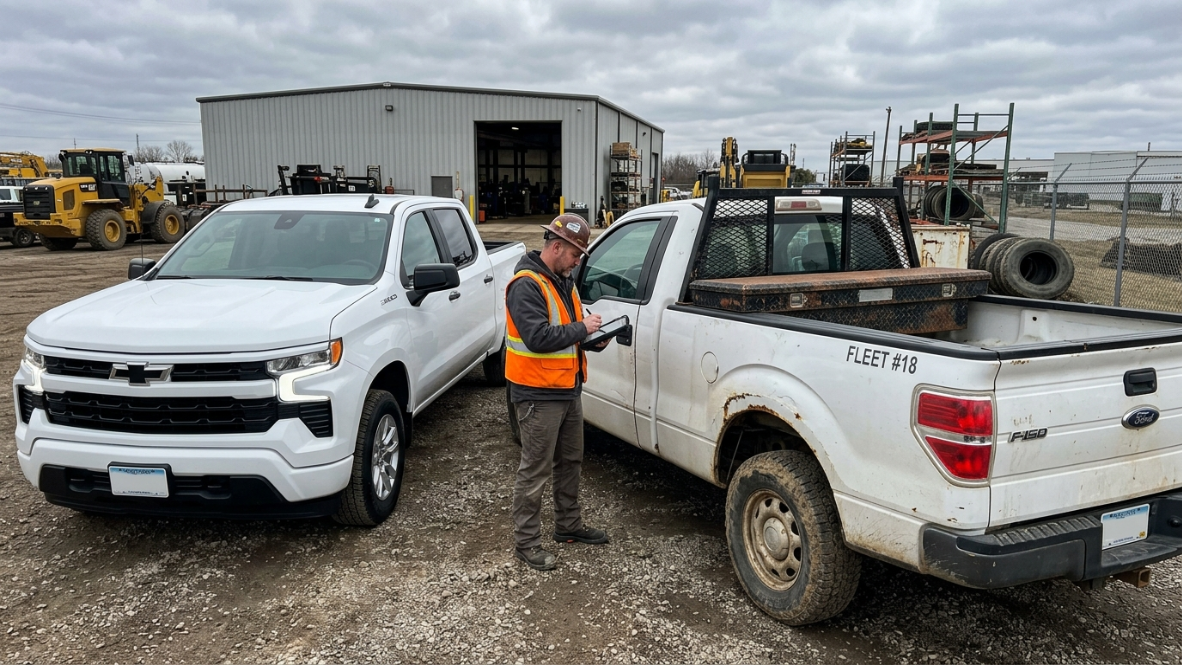
Fleet replacement cycles define the optimal timeframes for cycling out aging equipment and bringing in new assets. Getting this right prevents the two most expensive mistakes in construction fleet purchasing: replacing too early (wasting remaining useful life) and replacing too late (paying escalating maintenance and downtime costs).
Benchmarks by Vehicle Class
Replacement timing varies dramatically by vehicle type:
Vehicle Class | Typical Replacement Cycle | Mileage/Hours Trigger |
|---|---|---|
Sedans/light vehicles | 36 months | 75,000 miles |
Light-duty trucks (pickups) | 48 months | 100,000 miles |
Medium-duty trucks | 3 to 4 years | 75,000 to 90,000 miles |
Class 8 line-haul tractors | 7 to 8 years | 700,000 to 900,000 miles |
Regional day cabs | 8 to 10 years | 500,000 to 650,000 miles |
Vocational/heavy equipment | Hours-based | 10,000 to 12,000 hours |
ATRI’s 2024 data showed average fleet truck age fell to 3.4 years, with replacement cycles shortening to 7.3 years. Fleet replacement rates across the industry held at approximately 11% in 2024, with similar rates expected in 2025. These are historically high replacement rates, signaling that fleets may be reaching the end of extended lifecycle management caused by supply chain disruptions and steep new-machine price increases.
The Optimal Replacement Point
The optimal replacement point is where a vehicle’s rising operating costs cross above the annualized cost of a new replacement asset. Before that point, you’re getting good value from the existing machine. After it, every additional month costs you more than buying new would.
For a complete look at how replacement cycles fit into broader fleet strategy, see our contractor fleet management guide.
Fleet Standardization
Every unique vehicle specification in a fleet increases parts inventory cost by 8% to 12% and adds a similar burden to mechanic training requirements. Standardization is one of the simplest ways to reduce total cost of ownership, but it’s frequently overlooked during construction fleet purchasing.
What to standardize:
Engine platforms: Limit to three or fewer across your fleet
Transmissions: Two models should cover most needs
Tire sizes: Consistency here reduces inventory and simplifies procurement
Upfit packages: Standardized bed configurations, toolbox setups, and lighting packages
Standardization doesn’t mean every truck must be identical. It means minimizing unnecessary variation. When your mechanics know three engine platforms instead of eight, repair times drop. When your parts room stocks components for two transmission types instead of five, inventory costs shrink.
This is a meaningful contractor overhead reduction strategy that pays dividends year after year.
Fleet Standardization Checklist
Standardize | Why |
|---|---|
Engines | Easier repairs |
Tires | Lower inventory |
Batteries | Simpler stocking |
Oil types | Reduced purchasing complexity |
Filters | Lower inventory |
Upfits | Faster technician training |
Diagnostic software | Less tooling |
Technology in Construction Fleet Purchasing Decisions
Telematics and fleet management software have fundamentally changed how smart contractors approach fleet purchasing. Instead of guessing which assets are underutilized or overworked, you can see it in real time.
A fleet manager at Active Construction Inc. described the transformation in a case study: “Within a few minutes, I can tell you whether or not they’ve been using a piece of equipment. My utilization is up 25%.” The change resulted in smarter equipment purchasing decisions, fewer idle assets, and better deployment of existing machines.
Telematics data feeds construction fleet purchasing decisions in several ways:
Utilization tracking reveals which assets sit idle and which ones need backup or replacement
Maintenance alerts help predict when an asset is approaching its optimal replacement point
Fuel consumption data informs vehicle selection for future purchases
Operator behavior monitoring identifies abuse that accelerates depreciation
For contractors measuring purchasing effectiveness, purchasing efficiency KPIs provide a structured framework.
Fuel Management as a Purchasing Cost Lever
Fuel is typically the largest single expense in fleet TCO, surpassing even acquisition and depreciation costs. This makes fuel management a critical part of any construction fleet purchasing strategy, both in terms of which vehicles you buy and how you manage fueling after purchase.
Fleet fuel card programs offer per-gallon discounts, centralized billing, and detailed reporting by vehicle, driver, and project. For construction companies running dozens or hundreds of vehicles, even a few cents per gallon adds up fast.
Fuel costs also shape vehicle selection decisions. When comparing two comparable trucks, the one with better fuel economy might have a higher sticker price but a significantly lower TCO over a five-year ownership period. Our fleet fuel cards guide covers the specific programs available to contractors, and our fleet fuel rebate programs guide explains how to maximize those savings.
Equipment Theft and Security Considerations
The National Equipment Register reports that approximately $1 billion in heavy equipment is stolen annually. This number should factor into every construction fleet purchasing plan.
Equipment theft affects purchasing decisions in several ways. Insurance premiums are higher for assets without GPS tracking or immobilization systems. Replacing stolen equipment disrupts project timelines and forces emergency procurement at premium prices. Telematics with geofencing capabilities have become standard specifications on new fleet purchases for good reason.
Emerging Trends in Construction Fleet Purchasing
Equipment-as-a-Service
A newer model gaining traction is equipment-as-a-service, where contractors pay only for productive hours rather than owning or leasing the asset outright. The Rental Equipment Register notes rising experimentation with these contracts among mid-size contractors who want the flexibility of rental with the predictability of a long-term agreement.
Infrastructure Investment and Jobs Act Impact
The multi-year disbursements from the Infrastructure Investment and Jobs Act give contractors more predictable workloads over longer time horizons. This predictability is prompting earlier fleet procurement and replacement decisions, since contractors can plan purchases against known project pipelines rather than speculative backlogs.
The Rental Shift
With rental channels now commanding over 54% of the North American construction equipment market and growing at 6.37% annually, the definition of “fleet purchasing” itself is evolving. Many contractors now consider rental agreements as a core component of their fleet acquisition strategy rather than a stopgap measure.
Key Takeaways
Concept | What It Means | Why It Matters | Benchmark |
|---|---|---|---|
TCO | Total lifetime cost of a fleet asset | Sticker price alone misleads | Hidden costs add 40-60% above purchase price |
GPO purchasing | Pooled volume for better pricing | Individual contractors can’t access top-tier discounts | 100-truck fleets save up to 20% annually |
Volume discounts | Consolidating purchases for price breaks | Immediate savings on every unit | 8-15% reduction from consolidation alone |
Replacement cycles | Optimal timing to swap old for new | Late replacement costs more than new acquisition | Light trucks: 48 mo/100K mi; Heavy: 7-8 yr/700K+ mi |
Standardization | Minimizing unique specs | Reduces parts, training, and maintenance costs | Each unique spec adds 8-12% to parts/training costs |
Competitive bidding | Soliciting 4-6 dealer quotes | Creates pricing transparency | Outperforms single-source by 8-12% |
Getting construction fleet purchasing right is not about finding the cheapest truck on the lot. It’s about building a system that accounts for acquisition, operation, maintenance, and disposal costs across every asset in your fleet. The contractors who formalize this process, track their TCO honestly, and use collective purchasing power consistently outperform those who buy on instinct.
To start putting these strategies into practice across your procurement operation, explore our construction procurement savings guide for a comprehensive action plan.
Frequently Asked Questions
What is construction fleet purchasing?
Construction fleet purchasing is the process of acquiring the vehicles, heavy equipment, and support assets a construction company needs to execute projects. It includes decisions about whether to buy, lease, or rent, along with strategies for minimizing total cost of ownership across the fleet’s lifecycle.
Should a construction company buy or lease fleet vehicles?
It depends on utilization patterns, cost of capital, and cash flow priorities. Buying works best for assets with stable, long-term use and offers Section 179 tax benefits. Leasing provides predictable payments and planned replacement cycles. Many contractors use a mix of both. The deciding factor often comes down to whether your lease rate is lower than your borrowing cost.
How do you calculate total cost of ownership for fleet equipment?
Use this formula: Initial purchase price + operating costs + maintenance costs – resale value = TCO. Operating costs include fuel, insurance, financing, and downtime. Many fleets undercount their true costs by 14% to 38%, so tracking every expense category is critical.
What is a group purchasing organization (GPO) for construction fleet?
A GPO pools the purchasing volume of multiple contractors to negotiate better pricing, rebates, and terms from vehicle manufacturers, parts suppliers, and service providers. The model is well established in healthcare and is growing rapidly in construction. Members typically access pricing they couldn’t qualify for individually.
How often should construction fleet vehicles be replaced?
Light-duty trucks are typically replaced at 48 months or 100,000 miles. Class 8 tractors last 7 to 8 years or 700,000 to 900,000 miles. Heavy vocational equipment is usually tracked by hours rather than miles, with 10,000 to 12,000 hours as a common trigger. Assets over 10 years old can cost 35% more per mile to operate.
How does fleet standardization save money?
Every unique vehicle specification in a fleet adds 8% to 12% to parts inventory costs and mechanic training requirements. By standardizing on a limited number of engine platforms, transmissions, and tire sizes, contractors reduce maintenance complexity and procurement costs without sacrificing capability.
What role does telematics play in fleet purchasing decisions?
Telematics data reveals actual utilization rates, fuel consumption patterns, and maintenance needs across your fleet. This information prevents over-buying (purchasing equipment that sits idle) and under-buying (running assets past their optimal replacement point). Some fleet managers report utilization improvements of 25% or more after implementing telematics-driven purchasing decisions.
Can small contractors benefit from fleet purchasing strategies?
Yes. Even contractors with five to ten vehicles benefit from strategies like competitive bidding (soliciting multiple dealer quotes), timing purchases around quarter-end or model-year transitions, and joining a GPO to access volume pricing. The principles of TCO analysis and replacement cycle management apply regardless of fleet size.
Recent Comments