
TL;DR
A construction fleet purchasing strategy is the structured plan contractors use to acquire, finance, and replace vehicles and heavy equipment across their operations. It covers everything from total cost of ownership analysis and buy vs. lease vs. rent decisions to replacement cycles, standardization, and demand forecasting. In 2025 and 2026, tariffs and supply chain volatility make a disciplined fleet purchasing approach more important than ever, with structured TCO comparisons improving procurement decisions by $2,400 to $4,100 per vehicle.
Construction fleet management is a different animal from standard corporate fleet operations. Construction companies manage a much broader range of vehicles and equipment, from pickup trucks and service vans to excavators, cranes, and concrete pumps. That complexity demands a formal purchasing strategy rather than ad hoc buying decisions made project by project.
This glossary covers the essential terms, frameworks, and benchmarks that shape a sound construction fleet purchasing strategy. Whether you’re running 15 trucks or 450, these concepts will help you spend less, reduce downtime, and match your fleet to actual project demand.
For a broader look at how fleet purchasing fits into your overall procurement approach, see our construction procurement savings guide.
Construction Fleet Purchasing Strategy at a Glance
If you only remember one thing, remember this:
A successful construction fleet purchasing strategy focuses on total cost of ownership (TCO) rather than purchase price alone. Contractors should evaluate every vehicle or piece of equipment based on utilization, lifecycle costs, financing method, replacement timing, maintenance history, and expected project demand.
Most successful construction companies follow these principles:
– Buy equipment used year-round.
– Lease assets that benefit from frequent upgrades.
– Rent specialty or seasonal equipment.
– Replace vehicles before maintenance costs exceed depreciation savings.
– Standardize fleet specifications where practical.
– Use telematics to guide replacement decisions with real operating data instead of assumptions.
Companies that consistently apply these practices reduce downtime, improve budgeting accuracy, and often lower lifecycle fleet costs compared to reactive purchasing.
Construction Fleet Purchasing Strategy
Definition: A construction fleet purchasing strategy is the structured plan a contractor uses to acquire, finance, and cycle vehicles and heavy equipment across their operations. It covers the entire process, from identifying what vehicles the fleet needs to the point of purchase, including how those assets will be financed, maintained, and eventually replaced.
The more comprehensive your strategy, the better your chances of decreasing your total cost of ownership. A strategy without clear replacement cycles, utilization targets, and financing guidelines is just a wish list.
Why it matters for contractors specifically: Unlike a corporate fleet that might consist entirely of sedans and SUVs, a construction fleet includes light-duty pickups, dump trucks, flatbeds, concrete mixers, heavy equipment, and specialty machines. Each category has different depreciation curves, maintenance profiles, and utilization patterns. A one-size-fits-all approach fails.
For a deeper walkthrough of fleet purchasing from start to finish, our fleet purchasing guide covers the full process.
The Fleet Purchasing Process

Most contractors follow a repeatable purchasing workflow rather than buying vehicles only when an immediate need arises.
Step 1: Forecast future demand
Review upcoming projects, backlog, seasonal workload, and expected equipment utilization.
Step 2: Analyze existing fleet
Evaluate:
age
maintenance history
utilization
operating costs
replacement candidates
Step 3: Compare acquisition methods
Determine whether buying, leasing, or renting produces the lowest total lifecycle cost.
Step 4: Standardize specifications
Whenever practical, reduce unnecessary variations in:
engines
body styles
upfits
drivetrain
technology packages
Step 5: Negotiate pricing
Leverage:
fleet discounts
manufacturer incentives
GPO pricing
financing offers
Step 6: Measure performance
Track KPIs including:
Cost per mile
Fleet utilization
Maintenance cost
Downtime
Fuel consumption
Asset age
The Five Factors That Drive Fleet Purchasing Decisions
Every fleet purchase should balance five competing priorities.
Decision Factor | Why It Matters |
|---|---|
Utilization | Determines whether ownership is financially justified |
Total Cost of Ownership | Measures the true lifecycle cost |
Capital Availability | Influences buy vs lease decisions |
Project Pipeline | Determines future demand |
Replacement Timing | Prevents excessive maintenance costs |
Total Cost of Ownership (TCO)
Definition: Total cost of ownership is the complete financial picture of owning and operating a piece of equipment over its entire lifecycle. For construction fleets, TCO goes far beyond the sticker price. It includes acquisition costs, operational expenses (fuel, insurance), maintenance, repairs, depreciation, downtime losses, and administrative overhead.
The formula:
TCO = Initial Cost + Operation Costs + Maintenance + Downtime Costs + Production Impact, minus Remaining Value
Key benchmarks:
The median TCO for a construction fleet asset in 2025 is $9,436.69, slightly below the fleet-wide average of $10,168.71
Construction fleets average $0.23 per mile in operating costs despite harsh working conditions
Depreciation alone accounts for roughly 38% of total vehicle costs
Why sticker price misleads: Organizations that focus on total cost of ownership save up to 30% over a vehicle’s lifespan compared to those who only consider purchase price. A cheaper truck that breaks down constantly and burns more fuel can easily cost more over five years than a premium model with lower maintenance and better fuel economy.
Structured TCO comparisons improve procurement decisions by $2,400 to $4,100 per vehicle. If you’re running 50 trucks, that’s $120,000 to $205,000 in better decisions.
For benchmarking your fleet costs against industry standards, our cost benchmarking guide walks through the methodology.
Example Total Cost of Ownership Calculation
Cost Component | Amount |
|---|---|
Purchase Price | $68,000 |
Fuel | $31,000 |
Maintenance | $18,000 |
Insurance | $8,500 |
Repairs | $10,000 |
Downtime | $12,500 |
Resale Value | -$24,000 |
Five-Year TCO | $124,000 |
Fleet Purchasing Decision Tree
Use the following framework when evaluating any fleet purchase.
Question | Recommended Action |
|---|---|
Will the asset be used more than 70% of the year? | Buy |
Needed for 2–4 years with predictable usage? | Lease |
Needed for one project only? | Rent |
Specialized equipment with uncertain demand? | Rent |
Frequently modified work truck? | Buy |
Rapidly changing technology? | Lease |
Buy vs. Lease vs. Rent
Definition: The three primary methods for acquiring fleet vehicles, each with distinct financial, operational, and tax implications. For construction fleets, it’s rarely a pure either/or choice. Most well-run fleets use a combination of all three.
Buying
Purchasing gives the fleet complete control over the asset, including the freedom to make modifications, set custom maintenance schedules, and benefit from accelerated depreciation tax deductions. You build equity and have no mileage restrictions.
Practitioners on construction forums offer a clear picture of the buy strategy in practice. One fleet manager responsible for 450 trucks, vans, and SUVs shared that they always buy new or used, run the trucks on the road for about seven years, then “send them to a big job site to die.” Another owner of a 35-truck commercial construction firm called leasing “way more money” and described a mix approach: buy new trucks with financing, buy used trucks with cash, and keep some older paid-off trucks in the fleet alongside newer financed ones.
Leasing
Leasing allows fleets to operate newer equipment more frequently than outright purchasing would allow. Newer vehicles tend to be more fuel-efficient and reliable, which reduces maintenance costs and can even help with driver recruitment and retention. Lease agreements often include swap provisions for upgrading to current models.
One particularly revealing example from a contractor forum describes a 200-plus vehicle fleet on an Enterprise lease program that rolls the complete fleet every 24 months. They buy at such a deep discount that they can sell the used vehicles for close to the original purchase price, making the cycling nearly cash-flow neutral at scale.
A useful rule from the same discussion: consider your cost of capital. If the lease rate is less than your borrowing rate, leasing may be the better financial move regardless of your personal preference.
Renting
Renting is typically the best option for seasonal demand swings, short-term project needs, or testing new technology before committing capital. A specialty crane that costs millions to purchase might rent for $12,000 per week, and if you only need it for three projects a year, renting is clearly the right call.
The bottom line: Fleet size, project pipeline stability, and cost of capital dictate the right mix. Real contractors split roughly evenly between buying and leasing preferences, with renting filling the gaps.
For strategies on negotiating better terms from vehicle vendors, see our vendor cost negotiation guide.
Buy vs. Lease vs. Rent Decision Matrix
Factor | Buy | Lease | Rent |
|---|---|---|---|
Best for | High-utilization core fleet vehicles | Fleets wanting newer models and predictable payments | Short-term, seasonal, or specialty needs |
Capital impact | Large upfront outlay or financing | Lower monthly payments, preserves capital | Expense-only, no capital commitment |
Tax treatment | Section 179 deduction, accelerated depreciation | Section 179 may still apply (confirmed by multiple fleet operators) | Fully deductible as operating expense |
Flexibility | Full control over modifications and schedule | Moderate, constrained by lease terms | Maximum flexibility, return when done |
Best fleet size | Any size with stable, predictable demand | Mid to large fleets cycling frequently | Any size with variable project loads |
Hybrid Fleet Model
Definition: The hybrid fleet model is a deliberate strategy where a contractor owns a “core fleet” of high-utilization, recurring-use machines while renting project-specific or specialized equipment as needed. This approach aligns capital deployment with actual utilization rather than theoretical capacity.
Utilization target: Owned assets should hit 65% to 75% utilization. If a machine sits idle more than a third of the time, you’re paying for an asset that isn’t earning its keep. Anything below that threshold is a candidate for renting instead of owning.
This model protects contractors from two common mistakes: over-investing in equipment that collects dust between projects, and under-investing in core assets that end up rented at premium rates year-round.
For more on reducing fleet operating costs through strategic models like this, explore our fleet cost reduction strategies.
Fleet Replacement Cycle
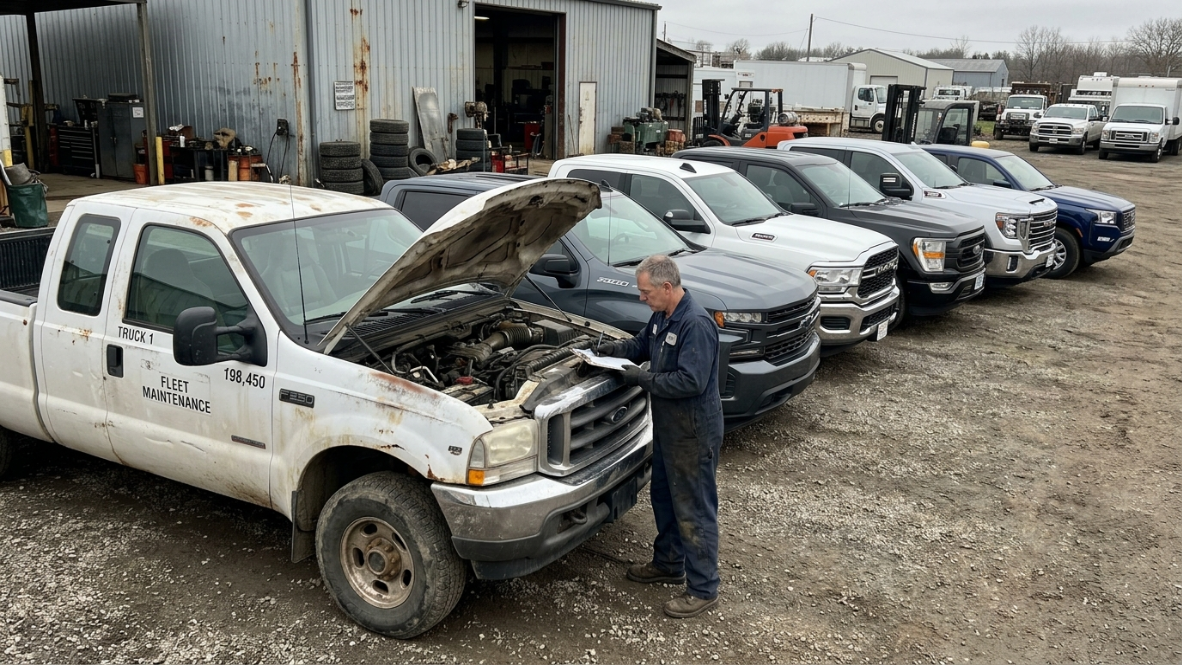
Definition: The planned schedule for retiring and replacing fleet vehicles based on age, mileage, condition, or cost-per-mile thresholds. Proactive replacement is one of the highest-impact elements of a construction fleet purchasing strategy.
General benchmarks:
Sedans: 36 months or 75,000 miles
Light-duty trucks: 48 months or 100,000 miles
Replace 15% to 25% of your fleet each year to spread costs and maintain operational readiness
Why proactive replacement matters: The numbers are stark. Cost per mile increases by 35% for vehicles over 10 years old. Vehicles past the decade mark account for 34% of service spending despite covering only 12% of total miles driven. Their maintenance costs average $1.10 per mile compared to $0.15 per mile for newer models. Holding onto aging assets is not frugal. It’s expensive.
Building a rotating replacement schedule spreads capital expenditure across budget cycles and keeps the fleet modern enough to benefit from better fuel economy, improved safety features, and lower maintenance burdens.
This concept connects directly to the broader procurement lifecycle, where replacement timing is one phase of a continuous procurement process.
Warning Signs That a Vehicle Should Be Replaced
Replace or evaluate fleet assets when several of these indicators appear:
Increasing maintenance frequency
Cost per mile exceeds fleet average
Declining reliability
Excessive downtime
Parts becoming difficult to source
Poor fuel economy
Safety technology significantly outdated
Repair costs exceed projected depreciation savings
Fleet Standardization
Definition: Fleet standardization means selecting a consistent set of equipment models, brands, or configurations to streamline operations. Standardized fleets simplify parts inventory, reduce mechanic training requirements, and enable bulk purchasing discounts.
The trade-off in 2025-2026: Traditional standardization strategies assumed a stable supply chain. That assumption no longer holds. When an organization locks into a single OEM or specific configuration, even minor supply disruptions can cascade into major operational problems. The modern approach is “flexible standardization,” where you standardize around a base platform (engine type, cab configuration, bed size) while maintaining the flexibility to source from multiple manufacturers when needed.
Advantages and Disadvantages of Fleet Standardization
Advantages | Disadvantages |
|---|---|
Lower inventory costs | Reduced purchasing flexibility |
Easier technician training | Greater dependence on one OEM |
Bulk purchasing discounts | Supply chain disruptions affect entire fleet |
Faster repairs | Less flexibility for specialized work |
Simplified driver training | Possible longer lead times |
Fleet Demand Forecasting
Definition: The process of using past data and market indicators to predict when fleet inventory demand will peak. Good forecasting helps determine the quantity and types of vehicles needed, avoiding both shortages (scrambling to rent at premium rates) and excess inventory (paying insurance and depreciation on idle equipment).
For construction companies, forecasting ties directly to the project pipeline. A contractor with $50 million in backlog needs a different fleet posture than one with $15 million. Seasonal patterns matter too. Concrete and asphalt work in the Southeast picks up dramatically in spring and summer, which means fleet demand follows the same curve.
Connecting fleet forecasting to your broader purchasing efficiency KPIs ensures fleet decisions are measured and improved over time.
Common Fleet Purchasing Mistakes
Many contractors increase costs by making avoidable purchasing decisions.
The most common mistakes include:
Buying based only on purchase price
Delaying replacements too long
Purchasing equipment for peak demand instead of average utilization
Ignoring telematics data
Maintaining too many vehicle configurations
Failing to negotiate fleet pricing
Skipping lifecycle cost analysis
Not documenting purchasing policies
Depreciation
Definition: The decline in an asset’s value over time due to use, wear, and age. For fleet vehicles, depreciation represents approximately 38% of the total cost of owning and operating each vehicle, making it the single largest cost component.
Strategic considerations: Accelerated depreciation methods (like Section 179 deductions) can front-load tax benefits, improving cash flow in the year of purchase. Understanding depreciation curves also determines the optimal disposal timing. Sell too early and you leave useful life on the table. Sell too late and maintenance costs overtake the remaining value.
Group Purchasing Organization (GPO)
Definition: A GPO aggregates the buying power of multiple companies to negotiate volume discounts from manufacturers and dealers. Organizations using GPOs typically save 10% to 25% annually across various spending categories.
Fleet-specific impact: The average 100-truck fleet saves up to 20% annually by purchasing through a commercial vehicle procurement network. By tapping into the collective volume of hundreds of thousands of vehicles, a mid-size contractor can access the same pricing that large national firms negotiate on their own.
For smaller construction companies, a GPO can be the single fastest way to reduce fleet acquisition costs without changing anything about how they operate.
Explore how contractor supplier discounts work across equipment and materials purchasing, including fleet vehicles.
Fleet Utilization Rate
Definition: The percentage of time a fleet asset is actively being used versus sitting idle. Calculated as: (Hours or days in use / Total available hours or days) x 100.
Target thresholds: Top-performing construction fleets target 65% to 75% utilization for owned assets. Below 65%, the asset may be costing more to own than it would to rent on demand. Above 75% can indicate the fleet is stretched thin, increasing the risk of breakdowns and schedule delays.
Unscheduled downtime accounts for around 25% of equipment operating time in less-optimized fleets, while top performers reduce this to under 5%. The gap between these two numbers represents enormous cost savings.
Cost Per Mile (CPM)
Definition: The total operating cost of a vehicle divided by the miles it travels. CPM includes fuel, maintenance, insurance, depreciation, and administrative costs.
Construction benchmark: $0.23 per mile for construction fleets, which demonstrates solid efficiency given the stop-and-go, heavy-load nature of construction driving.
As a replacement signal: When a vehicle’s CPM begins climbing significantly above fleet averages, it’s signaling that the asset is approaching the end of its economically useful life. This metric, more than age or mileage alone, should trigger replacement evaluation.
For managing the fuel component of CPM, our guide on fleet fuel cards for contractors covers how to capture savings at the pump.
Telematics
Definition: GPS and sensor technology installed in fleet vehicles that captures real-time data on location, speed, fuel consumption, engine diagnostics, idle time, and driver behavior.
How it drives purchasing decisions: Telematics data reveals which vehicles are underutilized (candidates for disposal), which routes and behaviors burn the most fuel (training opportunities), and which assets have rising maintenance patterns (approaching replacement thresholds). Construction companies typically see a 15% to 25% reduction in operational costs within the first year of implementing fleet management software, including 10% to 15% fuel savings and 20% to 30% reductions in maintenance costs.
Without telematics, fleet purchasing decisions rely on gut feel and spreadsheets. With it, they’re grounded in actual usage data.
Section 179 Deduction
Definition: A U.S. tax provision allowing businesses to deduct the full purchase price of qualifying equipment and vehicles in the year of purchase, rather than depreciating it over multiple years.
Key detail for fleet buyers: Multiple contractors on forums confirm that Section 179 deductions apply to both purchased and leased vehicles (through Enterprise Fleet Management and similar programs). This means the tax strategy works regardless of acquisition method, though the specific structure of the lease matters. Consult with a tax professional to confirm eligibility for your situation.
Upfitting and Outfitting
Definition: The process of adding specialized equipment, storage systems, tool racks, safety features, or work-specific modifications to a base vehicle before it enters service.
Why it belongs in your purchasing strategy: Upfit specifications should be determined before purchase, not after. Choosing the right base vehicle for planned modifications avoids costly rework. A truck that needs a service body, for example, requires specific cab-to-axle dimensions. Ordering the wrong configuration means expensive modifications or, worse, starting over. Smart construction fleet purchasing strategies include upfit specs in the original vehicle order.
Price Adjustment Clauses
Definition: Contract provisions that allow the purchase price of vehicles or equipment to change based on documented cost fluctuations in raw materials, tariffs, or market conditions.
In the current environment, these clauses have shifted from nice-to-have to essential. With tariffs creating unpredictable price swings, locking in a fixed price months before delivery can either save or cost a contractor significantly. Price adjustment clauses protect both buyer and seller by tying final pricing to objective market indicators.
For broader guidance on structuring contracts with fleet vendors, see our vendor contracting best practices.
Fleet Purchasing KPIs
Successful fleet managers monitor a consistent group of performance metrics.
KPI | Target |
|---|---|
Fleet Utilization | 65–75% |
Replacement Rate | 15–25% annually |
Preventive Maintenance Compliance | >95% |
Vehicle Downtime | <5% |
Average Fleet Age | Under 8 years |
Fuel Efficiency | Improving year over year |
Cost per Mile | Track against fleet benchmark |
2025-2026 Tariff Impact on Fleet Purchasing
The tariff environment is the biggest factor reshaping construction fleet purchasing strategy right now, and most existing guides barely mention it.
What happened: A 25% tariff on passenger vehicles, light trucks, medium-duty, and heavy-duty vehicles went into effect on April 3, 2025, under Section 232 provisions. This applies to both imported finished vehicles and certain components.
What it’s doing to construction fleets:
10% of construction equipment respondents report delaying acquisition plans because of tariffs
The largest fleets (estimated replacement value above $10 million) are hit hardest, with 14% delaying acquisitions and 24.6% reporting price increases above the inflation rate
Fleet managers replaced machines at a rate of 9.2% in 2025, significantly below the expected rate of 10.9%
J.D. Power expects average new-vehicle prices to increase by 5% by year-end
How contractors are responding: Outright purchasing is trending up. Six in ten respondents said they purchased equipment outright in 2025, up from 51% in 2024. The logic: if prices are rising, own the asset now rather than pay inflated lease rates over time.
Constantly fluctuating tariffs have made capital planning difficult. When tariffs are unpredictable, construction companies struggle to make big decisions about major equipment purchases. Price adjustment clauses, earlier ordering timelines, and GPO membership are all strategies for managing this uncertainty.
Key Takeaways: When to Revisit Your Fleet Purchasing Strategy
Revisit your construction fleet purchasing strategy when any of these conditions apply:
Your fleet is aging. If more than 30% of vehicles are over 8 years old, maintenance costs are likely eating into margins.
Utilization is below 65%. You’re paying for equipment that isn’t working. Shift those assets to the rental column.
You’re making one-off buying decisions. Every purchase should fit a documented strategy with TCO analysis, not just “we need another truck.”
Tariffs or market conditions shifted. The 2025 tariff environment demands a fresh look at timing, financing, and pricing protections.
You’ve grown or contracted significantly. A fleet strategy built for 20 trucks doesn’t work for 60, and vice versa.
Poor maintenance strategies alone can reduce a company’s production capacity by 20%, according to Deloitte. The fleet purchasing strategy isn’t separate from operations. It is operations.
For a complete guide on managing your fleet from acquisition through maintenance and disposal, explore our contractor fleet management guide.
Fleet Purchasing Checklist
Before approving any fleet purchase, confirm that:
A business need has been documented.
Utilization supports ownership.
TCO analysis has been completed.
Buy vs. lease vs. rent has been evaluated.
Replacement timing has been reviewed.
Upfit requirements have been finalized.
Vendor pricing has been compared.
Warranty coverage has been reviewed.
Financing has been approved.
Delivery timeline matches project schedules.
Frequently Asked Questions
What is a construction fleet purchasing strategy?
A construction fleet purchasing strategy is the structured plan a contractor uses to acquire, finance, maintain, and replace vehicles and heavy equipment. It covers everything from deciding whether to buy, lease, or rent each asset to setting replacement cycles, utilization targets, and financing approaches. The goal is to minimize total cost of ownership while keeping the fleet matched to project demand.
How do I decide whether to buy, lease, or rent fleet vehicles?
It depends on fleet size, cost of capital, project pipeline stability, and how long you need the asset. High-utilization vehicles used year-round are typically best purchased. Vehicles you want to cycle every two to three years suit leasing. Short-term or specialty equipment is best rented. Most successful construction fleets use a combination of all three methods.
What is a good utilization rate for construction fleet equipment?
The target for owned construction equipment is 65% to 75% utilization. Assets consistently below 65% are costing more to own than they would to rent. Assets above 75% may indicate the fleet is stretched too thin, increasing breakdown risk.
How often should construction fleet vehicles be replaced?
Light-duty trucks should generally be cycled at 48 months or 100,000 miles. A best practice is to replace 15% to 25% of your fleet annually to spread costs and keep the fleet modern. Vehicles over 10 years old cost $1.10 per mile in maintenance compared to $0.15 for newer models.
How are 2025 tariffs affecting fleet purchasing decisions?
The 25% tariff on vehicles that took effect in April 2025 has caused 10% of construction equipment buyers to delay acquisitions. New-vehicle prices are expected to rise 5% by year-end. In response, more contractors are purchasing outright (60% in 2025, up from 51% in 2024) to lock in current pricing rather than face higher lease rates over time.
What is a Group Purchasing Organization and how does it help with fleet buying?
A GPO aggregates the buying power of multiple companies to negotiate volume discounts. The average 100-truck fleet saves up to 20% annually through GPO procurement. For mid-size contractors who lack the volume to negotiate enterprise-level pricing on their own, a GPO is one of the fastest ways to reduce fleet acquisition costs.
Does the Section 179 tax deduction apply to leased fleet vehicles?
Multiple contractors confirm that Section 179 deductions can apply to leased vehicles through programs like Enterprise Fleet Management. The specific eligibility depends on the lease structure, so work with a tax professional to confirm your situation. This means the tax advantages of fleet purchasing aren’t limited to outright buying.
How much can fleet management software reduce operating costs?
Construction companies typically see a 15% to 25% reduction in operational costs within the first year of implementing fleet management software. Specific benefits include 10% to 15% fuel savings and 20% to 30% reductions in maintenance costs, driven by telematics data that identifies underutilized assets, inefficient routes, and emerging maintenance issues before they become expensive problems.

Recent Comments