
TL;DR
Contractor fleet vendor programs are structured agreements between construction companies and third-party suppliers that cover fuel, tires, maintenance, parts, telematics, and vehicle leasing at negotiated rates with defined service standards. They replace ad hoc purchasing with volume discounts, accountability mechanisms, and measurable performance benchmarks. The most effective contractors use a hybrid model, keeping routine maintenance in-house while outsourcing specialty work to trusted vendor partners. The cost gap between planned and unplanned maintenance (roughly 7x) matters far more than whether you do the work yourself or send it out.
Contractor fleet vendor programs help construction companies reduce fleet operating costs by negotiating standardized pricing, service levels, and purchasing agreements with suppliers for maintenance, fuel, tires, telematics, leasing, and fleet services.
The best programs focus on preventive maintenance, vendor accountability, measurable service-level agreements (SLAs), and quarterly performance reviews rather than simply obtaining the lowest labor rate.
For most contractors, the most effective approach is a hybrid model that combines in-house preventive maintenance with specialized outsourced repairs.
Key Takeaways
Vendor programs reduce purchasing costs through negotiated pricing and standardized contracts.
Preventive maintenance compliance has a larger financial impact than hourly labor rates.
Vendor scorecards should be reviewed quarterly.
Most successful contractors outsource specialty work while keeping routine maintenance in-house.
Annual contract renegotiation helps maintain competitive pricing.
Total Cost of Ownership (TCO) should guide vendor decisions instead of purchase price.
What Are Contractor Fleet Vendor Programs?
Contractor fleet vendor programs are formalized relationships between construction firms and third-party suppliers who provide fleet-related goods and services. Instead of calling whoever is available when a truck breaks down or buying fuel wherever the driver happens to stop, these programs establish pre-negotiated pricing, defined service standards, and clear accountability between both parties.
The “contractor” distinction matters. Generic fleet programs built for delivery companies or sales organizations don’t account for off-road diesel consumption, mixed fleets that include heavy equipment alongside pickups and dump trucks, or the reality of multi-site operations where vehicles move between jobsites every few weeks. Construction fleets have unique demands, and vendor programs need to reflect that.
For a broader look at how these programs fit into your overall purchasing approach, see our contractor vendor programs guide.
These programs typically fall into several categories: fuel cards, maintenance networks, tire programs, parts and inventory agreements, telematics platforms, full-service leasing, and cooperative purchasing arrangements. Most mid-size contractors participate in at least two or three of these simultaneously.
The core promise is straightforward. Volume purchasing power, predictable costs, and reduced administrative burden. Whether that promise gets delivered depends entirely on how the program is structured and how aggressively you manage the vendor relationship after signing.
Types of Contractor Fleet Vendor Programs
Fuel Card Programs
Fuel is the single largest variable cost in most construction fleets. An EquipmentWatch analysis found that fuel comprises nearly 42% of machine operating costs. For companies purchasing more than 1,000 gallons per month, a dedicated fleet fuel card program generates meaningful savings through volume discounts, rebates, and centralized expense tracking.
The major programs include WEX, Coast, Fuelman/Corpay, CFN cardlock networks, and Voyager (accepted at over 97% of stations nationwide). Each has different strengths. CFN cardlock networks are popular with contractors who want to avoid retail markup entirely, while Voyager’s near-universal acceptance works better for fleets that operate across wide geographic areas.
Beyond the per-gallon discount, fuel cards provide spending controls (limits by driver, vehicle, time of day, or fuel type) and automated reporting that eliminates manual receipt tracking. For contractors running fleet fuel cards, the administrative savings alone can justify the program.

Maintenance Vendor Networks
These are pre-arranged agreements with repair shops and service centers that give your fleet priority scheduling, negotiated labor rates, and standardized quality expectations. The most visible example in the construction industry is the partnership between Enterprise Fleet Management and the Associated General Contractors of America (AGC). Since 2006, Enterprise has provided AGC members with custom fleet solutions, including a vehicle maintenance program that can save members up to 15% on maintenance and repair costs.
Enterprise’s network includes national partners like Firestone (with more than 2,200 service centers), Pep Boys, Jiffy Lube, and Discount Tire, plus thousands of independent dealers nationwide. The Associated Builders and Contractors (ABC) has a similar partnership arrangement with Enterprise.
The value here isn’t just the discount. It’s having a pre-vetted network so your drivers aren’t Googling repair shops in unfamiliar cities and hoping for the best.
Tire Programs
Tires are a deceptively expensive line item for construction fleets, especially when you factor in the downtime caused by blowouts and flats on jobsites. Discount Tire Fleet, for example, customizes pricing based on fleet size (fleets of five or more vehicles qualify) and includes free tire inspections, rotations, flat repairs, and TPMS resets with their program.
For contractors managing heavy-duty trucks and equipment trailers, a tire vendor program that includes regular inspections can prevent the kind of roadside failures that cascade into project delays.
Cooperative Purchasing Agreements
Cooperative purchasing allows organizations to piggyback on contracts that have already been competitively bid, eliminating the need for individual RFPs. Sourcewell is the dominant player in fleet-related cooperative purchasing, offering competitively solicited contracts for vehicles, parts, telematics, tires, fuel, fleet management software, and fleet vehicle leasing from top suppliers.
Vector Fleet Management’s Sourcewell contract, for instance, allows organizations to access fleet maintenance services without going through a separate RFP or RFI process. This model combines local dealer access with the national buying power of more than 50,000 government, education, and nonprofit organizations.
Construction firms that also do public-sector work find cooperative purchasing especially valuable because the contracts already satisfy competitive bidding requirements. For more on how these models work, read our guide on supplier partnership models.
Full-Service Fleet Leasing
Rather than buying vehicles outright and holding them until they fall apart, full-service leasing programs move contractors to a shorter replacement cycle with predictable monthly costs. Enterprise Fleet Management pitches this as a way to reduce fleet age within your existing budget by shifting from owned, buy-and-hold fleet management to a more flexible program.
The trade-off is real. You lose the equity in owned vehicles but gain newer, more reliable trucks with warranty coverage and lower maintenance costs. For contractors whose core competency is building things (not managing vehicle depreciation schedules), leasing can simplify operations.
Telematics and Fleet Management Software Programs
Fleet software ranges from basic maintenance tracking tools like Fleetio (starting at $4 per vehicle per month) to mid-tier construction-specific platforms like Fleet Chaser ($20 to $25 per vehicle per month). These programs handle GPS tracking, preventive maintenance scheduling, fuel consumption monitoring, and driver behavior analysis.
A notable development: in February 2026, John Deere completed its acquisition of Tenna, which now operates as an independent business. That acquisition, backed by a $100M funding round, signals growing OEM interest in integrating telematics directly into equipment vendor programs.
The catch with fleet software is implementation. According to FleetRabbit, 67% of fleet software deployments in construction take longer than planned, 40% never achieve full user adoption, and the average company wastes $15,000 to $40,000 on failed implementations. Auto-renewal clauses, per-seat pricing, and early termination fees that equal the remaining contract balance are common traps. Our contractor fleet management guide covers how to evaluate these platforms more carefully.
Association and Buyers’ Group Programs
Trade associations like AGC and ABC negotiate fleet vendor programs on behalf of their members, creating a distinct category that sits between cooperative purchasing and direct vendor programs. Buyers’ groups operate similarly, pooling purchasing volume across multiple contractors to negotiate better terms than any single company could get alone.
Explore how construction buying groups work to understand whether this model fits your fleet purchasing strategy.
Contractor Fleet Vendor Program Comparison
Program Type | Best For | Typical Savings | Primary Benefit | Possible Drawback |
|---|---|---|---|---|
Fuel Cards | Medium to large fleets | Fuel discounts + rebates | Expense control | Network limitations |
Maintenance Networks | Multi-location contractors | Lower repair costs | Faster repairs | Vendor quality varies |
Tire Programs | Heavy truck fleets | Longer tire life | Reduced downtime | Limited specialty inventory |
Cooperative Purchasing | Public contractors | Lower acquisition cost | Simplified procurement | Limited vendor selection |
Full-Service Leasing | Growing fleets | Predictable costs | Newer vehicles | No ownership equity |
Fleet Software | Fleets with 10+ vehicles | Lower administrative cost | Better visibility | Implementation challenges |
Key Terms in Fleet Vendor Programs
Service Level Agreement (SLA)
An SLA is a contract between a vendor and the fleet operator that defines the specific level of service expected. Done right, SLAs create an objective basis for measuring vendor performance. They should include two components: service standards (what the vendor will do and how fast) and management focus (how both parties will track, report, and resolve issues).
A complete SLA specifies: the maintenance or services to be provided, time frames for completion, what constitutes a breach and how it gets remediated, responsibilities of both parties, and costing details including escalation factors. For deeper guidance on structuring these agreements, see our vendor contracting best practices guide.
Critical point: for an SLA to work, the vendor must be involved in creating it. RTA Fleet emphasizes that effective SLAs require time spent researching, analyzing data, documenting workflows, and negotiating. One-sided SLAs that the vendor had no hand in writing tend to get ignored.
Quality Control Inspection (QCI)
A QCI is a formal post-repair review process that should be written into every maintenance SLA. Quality checks can range from simple road tests to detailed checklists to complete observation of the repair. The purpose is to catch problems before the vehicle goes back into service, not after it breaks down again on a jobsite.
Vendor Scorecard
A structured framework for measuring vendor performance across metrics like turnaround time, cost accuracy, first-time fix rate, and preventive maintenance compliance. OxMaint recommends that scorecards be reviewed quarterly with vendors, not just used internally as a report card.
Sample Fleet Vendor Scorecard
KPI | Target | Why It Matters |
|---|---|---|
PM Compliance | 90%+ | Reduces breakdowns |
First-Time Fix Rate | 95%+ | Prevents repeat repairs |
Comeback Rate | Under 3% | Measures repair quality |
Average Downtime | As low as possible | Keeps projects moving |
Cost Accuracy | ±5% of estimate | Controls budgeting |
SLA Compliance | 95%+ | Holds vendors accountable |
Comeback Rate
The percentage of repairs that need to be redone for the same issue on the same asset. Industry best practice holds that comeback rate should stay under 3%. Anything higher signals a vendor quality problem that needs immediate attention.
Preventive Maintenance (PM) Compliance
The percentage of scheduled maintenance events completed on time. High PM compliance (above 90%) correlates strongly with lower unplanned repair costs and longer vehicle life. This is the single most important metric for predicting fleet reliability.
Total Cost of Ownership (TCO)
The full cost of a vehicle over its lifetime, including purchase price, fuel, maintenance, insurance, downtime, and disposal value. TCO is the right lens for evaluating fleet vendor programs because a vendor that charges slightly more per service visit but keeps vehicles running with less downtime often costs less overall.
How Contractor Fleet Vendor Programs Are Structured
Contract vs. Program Enrollment Models
Some vendor programs require formal contracts with minimum volume commitments and multi-year terms. Others operate on an enrollment basis where you sign up, get access to negotiated pricing, and use the program as much or as little as you want. Fuel card programs typically use the enrollment model, while maintenance networks and leasing programs almost always involve contracts.
Association-Based Programs
These programs use the collective membership of organizations like AGC or ABC to negotiate vendor terms. Enterprise Fleet Management’s AGC partnership is the clearest example. Members get access to pre-negotiated rates without having to negotiate individually. The association handles the relationship management at the national level, while individual members interact with local vendors.
Buyers’ Group Models
Similar to association programs but focused specifically on purchasing power. A buyers’ group aggregates volume across member companies and negotiates pricing that reflects total group spend, not individual company spend. This is particularly valuable for small and mid-size contractors whose individual volume wouldn’t qualify for the best pricing tiers.
If you’re evaluating how vendor discounts work through these group structures, the savings potential grows with the size of the buying pool.
Direct Vendor Programs
Programs offered directly by vendors to qualifying fleets. Discount Tire Fleet, fuel card providers, and telematics companies all run their own programs with their own qualification thresholds (usually a minimum fleet size of 5 to 15 vehicles). These are the simplest to set up but offer the least negotiating flexibility for smaller contractors.
Evaluating Fleet Vendors: What to Measure
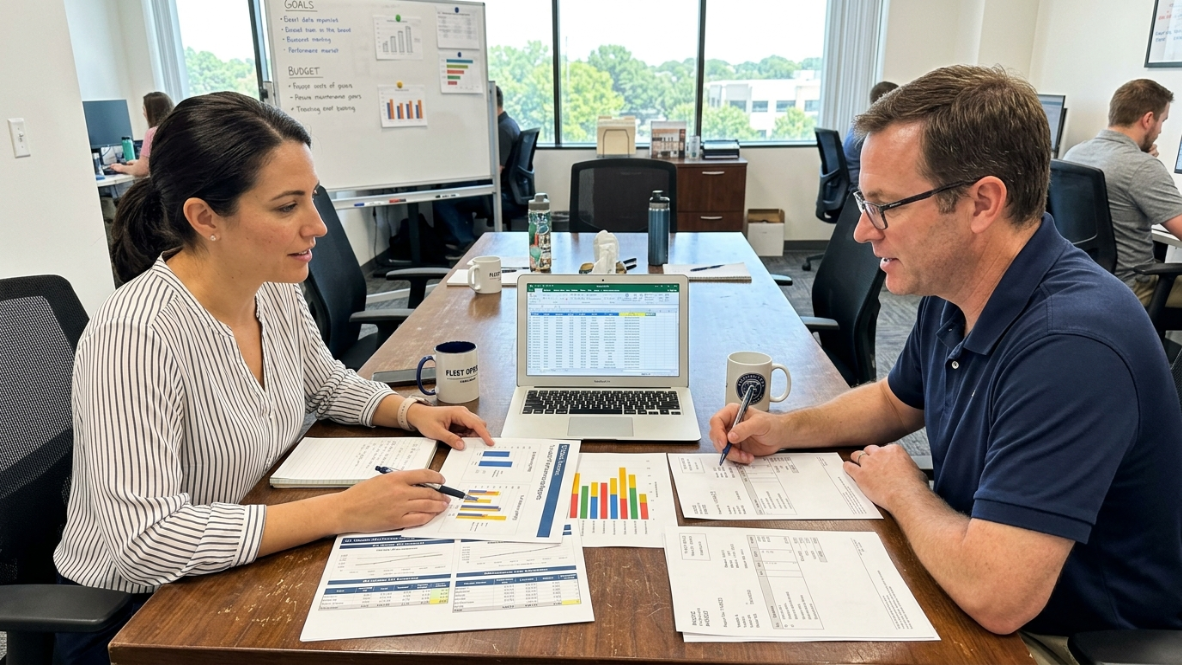
Core KPIs
The metrics that matter most for contractor fleet vendor programs:
PM compliance rate. Are scheduled maintenance events happening on time? Target: above 90%.
Comeback rate. How often does the same vehicle come back for the same problem? Target: below 3%.
Turnaround time. How long is the vehicle out of service? Every day of downtime costs fleets $448 to $760 per vehicle according to Work Truck.
Cost per mile. For medium-duty commercial fleets, the American Transportation Research Institute reported average cost per mile reached $2.26 in 2024, up 38% since 2020. Track your own number against this benchmark.
First-time fix rate. What percentage of repairs are completed correctly on the first visit? This directly affects downtime and comeback rate.
For a structured approach to evaluating these numbers across multiple vendors, use our vendor comparison checklist.
Annual Renegotiation
Vendor contracts must be reviewed routinely. Rates should be renegotiated annually based on volume changes, service quality, and technology shifts. High-use outsource providers especially deserve this scrutiny. If your volume grew 20% over the past year, your pricing should reflect that. If a vendor’s comeback rate crept above 3%, that’s a renegotiation trigger too.
How to Choose the Right Fleet Vendor Program
Most contractors should evaluate vendors using a structured process instead of selecting the lowest bid.
Step 1: Define Your Fleet Needs
Consider:
fleet size
average vehicle age
annual mileage
number of jobsites
in-house maintenance capability
geographic operating area
Step 2: Compare Vendor Capabilities
Evaluate:
response times
maintenance coverage
parts availability
technician certifications
reporting quality
telematics integration
warranty administration
Step 3: Calculate Total Cost of Ownership
Include:
labor
downtime
fuel
replacement parts
warranty claims
administrative labor
contract fees
Step 4: Measure Performance
Review quarterly:
PM compliance
comeback rate
repair turnaround
invoice accuracy
customer service
emergency response
Signs It’s Time to Replace a Fleet Vendor
Replace or renegotiate when you consistently experience:
missed SLA targets
increasing repair turnaround times
repeated repairs on the same vehicle
poor communication
inaccurate invoices
declining technician quality
outdated reporting
rising costs without improved service
Common Mistakes and Practitioner Warnings
The Rural SLA Enforcement Paradox
Rob Barbur, fleet superintendent at Nebraska Public Power District, shared a critical insight about managing vendor relationships in areas with limited options: “The shop owners talk to each other, so you have to be realistic about enforcement because you could wind up without a provider.”
This is a real concern for contractors working in rural areas. Aggressive SLA enforcement that makes sense in a city with dozens of competing shops can backfire in a small town where there are only two or three options. NPPD’s approach is to use a matrix to assess shops, gathering information about facility size, capabilities, number of technicians, and certifications, and then setting expectations accordingly.
Choosing Vendors on Price Alone
Practitioners on Heavy Equipment Forums are blunt about this one. A commenter who sold vendor service contracts stated: “I have never had one filled out where the contractor came out lower than the dealer.” The context was a shop cost analysis comparing in-house technician costs to outsourced vendor rates.
But the same forum thread includes an equally important warning: “You have to find someone you trust or outsourcing becomes a hassle and very spendy.” Price matters, but trust and turnaround time matter more. A vendor who charges $125/hour but gets your truck back in service the same day costs less than a vendor charging $95/hour who takes three days.
Ignoring the Planned vs. Unplanned Maintenance Gap
This is the most underappreciated cost insight in fleet management. The planned-versus-unplanned cost gap runs roughly 7x, meaning unplanned repairs cost about seven times more than the same work done proactively. Meanwhile, the in-house-versus-outsource gap is only about 1.5x. In-house labor rates for LTL carriers run $45 to $75 per hour versus $125 to $175 per hour for outsourced work.
What this means practically: spending energy on preventive maintenance compliance inside your vendor programs will save you far more money than obsessing over whether to do the work in-house or send it out.
Overlooking Hidden Fees in Software Programs
Fleet management software contracts often include auto-renewal clauses that lock you in for another year if you miss a narrow cancellation window. Per-seat pricing can balloon costs as you add users. And early termination fees sometimes equal the entire remaining contract balance. Read the fine print. Our vendor onboarding checklist walks through due diligence steps that catch these issues before you sign.
The Hybrid Model: Where Most Successful Contractors Land
Across forums, industry publications, and expert interviews, one recommendation appears repeatedly: the hybrid model. Keep routine preventive maintenance in-house. Outsource specialty work (alignments, body work, transmission rebuilds, major engine work) to trusted vendor partners.
Veteran fleet manager Chuck Metoyer described his progression in Construction Business Owner: he moved from farming out all maintenance and repair services, then to a blend, and finally settled on handling nearly everything in-house. “The only thing I farm out now would be alignments and body work, and that’s it.”
That progression is common, but the starting point depends on your situation. As one Heavy Equipment Forums contributor put it, “The choice seems to depend much more on your business strategy and negotiating skill than it does on the size or makeup of your fleet.”
The hybrid model works because it keeps the highest-volume, lowest-complexity work (oil changes, filter replacements, brake jobs) where it’s cheapest, under your own roof, while sending the work that requires specialized equipment and expertise to vendors who do it every day.
Fleet Vendor Program Implementation Roadmap
Month 1
Audit fleet spending
Identify highest-cost vendors
Establish baseline KPIs
Month 2
Request proposals
Compare contracts
Evaluate SLAs
Month 3
Launch pilot program
Train drivers
Implement reporting
Month 4–6
Review KPIs
Conduct vendor meetings
Adjust service levels
Month 6–12
Renegotiate pricing
Expand successful vendors
Remove underperforming vendors
How Fleet Vendor Programs Connect to Broader Procurement
Fleet vendor programs don’t exist in isolation. They’re one piece of a construction company’s total procurement strategy that also includes materials purchasing, equipment rental, subcontractor management, and service agreements.
Fuel is worth calling out specifically because it’s the most volatile line item across all of these categories. Diesel prices can swing 30% or more in a single year, making fuel card programs with locked-in discounts or rebate structures especially valuable for budget predictability.
The contractors who get the most value from fleet vendor programs are the ones who treat them as part of a coordinated vendor strategy rather than isolated deals. When your fuel card vendor, maintenance network, and telematics platform all feed data into the same reporting system, you can actually calculate true cost per mile and make informed decisions about vehicle replacement timing, route optimization, and vendor performance.
For contractors looking to connect fleet vendor programs with their broader purchasing power, CNBA’s supplier discounts guide explains how group purchasing extends beyond fleet into materials, equipment, and services.
Frequently Asked Questions
What is the minimum fleet size needed to qualify for contractor fleet vendor programs?
Most programs set the bar relatively low. Discount Tire Fleet requires just five vehicles. Fuel card programs generally have no minimum fleet size, though volume-based rebates kick in at higher usage levels (typically 1,000+ gallons per month). Maintenance networks through associations like AGC are available to all members regardless of fleet size.
How much can contractor fleet vendor programs actually save?
Savings vary by program type and volume. AGC members report up to 15% savings on maintenance and repair costs through the Enterprise Fleet Management partnership. Fuel card programs typically offer per-gallon discounts of $0.03 to $0.08, plus rebates that can add another 2% to 6%. Cooperative purchasing through Sourcewell can reduce vehicle acquisition costs by thousands per unit compared to individual negotiation.
Should contractors keep maintenance in-house or outsource through vendor programs?
The industry consensus favors a hybrid approach. Handle routine preventive maintenance in-house where your labor costs are $45 to $75 per hour, and outsource specialty work (alignments, body work, transmission rebuilds) to vendor partners where the expertise justifies the $125 to $175 per hour rate. The deciding factor isn’t fleet size, it’s your business strategy and the quality of vendors available in your market.
How often should fleet vendor contracts be renegotiated?
Annually, at minimum. Review should cover volume changes, service quality metrics (especially comeback rate and turnaround time), pricing relative to market rates, and any technology changes. High-use outsource providers deserve the most scrutiny since they represent the largest spend and the greatest opportunity for both savings and waste.
What is the biggest cost factor in fleet maintenance that vendor programs should address?
Planned versus unplanned maintenance. The cost gap is roughly 7x, meaning a repair that costs $500 when planned can cost $3,500 or more when it happens as an emergency breakdown. Any vendor program worth its contract should help improve preventive maintenance compliance, which directly reduces the frequency and cost of unplanned repairs.
Are cooperative purchasing agreements only for government fleets?
No. While Sourcewell’s cooperative purchasing network originated in the public sector (combining the buying power of over 50,000 government, education, and nonprofit organizations), many contracts are available to private-sector companies as well. The key benefit is access to competitively bid pricing without conducting your own RFP process.
What should a fleet vendor scorecard include?
At minimum: turnaround time, cost accuracy (invoiced versus estimated), first-time fix rate, comeback rate (target under 3%), PM compliance rate, and overall responsiveness. Review scorecards quarterly with each vendor. The scorecard conversation itself is valuable because it signals to vendors that you’re tracking their performance and will act on the data.
How do fleet telematics vendor programs differ for construction versus other industries?
Construction fleets deal with mixed asset types (pickups, dump trucks, excavators, trailers), off-road usage that GPS and OBD-II systems don’t always handle well, frequent jobsite changes, and harsh operating conditions. Construction-specific platforms like Fleet Chaser and the newly acquired Tenna are built for these realities, while general-purpose platforms like Fleetio work better for on-road light-duty fleets.

Recent Comments