
TL;DR
Construction vendor contracting is the process of establishing formal agreements with external suppliers, service providers, and trade partners who furnish goods, materials, equipment, or specialized services to a construction project. Choosing the right contract type determines who absorbs financial risk, while proper vendor prequalification and airtight contract clauses prevent the disputes that plague roughly 56% of construction projects worldwide. This guide breaks down every contract type, the vendor vs. subcontractor distinction, essential clauses, and the best practices that protect your margins.
Quick Answer: What Is Construction Vendor Contracting?
Construction vendor contracting is the process of selecting, negotiating, and managing agreements with suppliers, material providers, and service vendors in construction projects. It defines pricing, delivery terms, scope, risk allocation, and performance standards. The main goal is to reduce cost overruns, prevent disputes, and ensure materials and services are delivered on time and to specification.
In simple terms: it determines who supplies what, at what price, under what risk, and under which rules before construction begins.
What Is Construction Vendor Contracting?
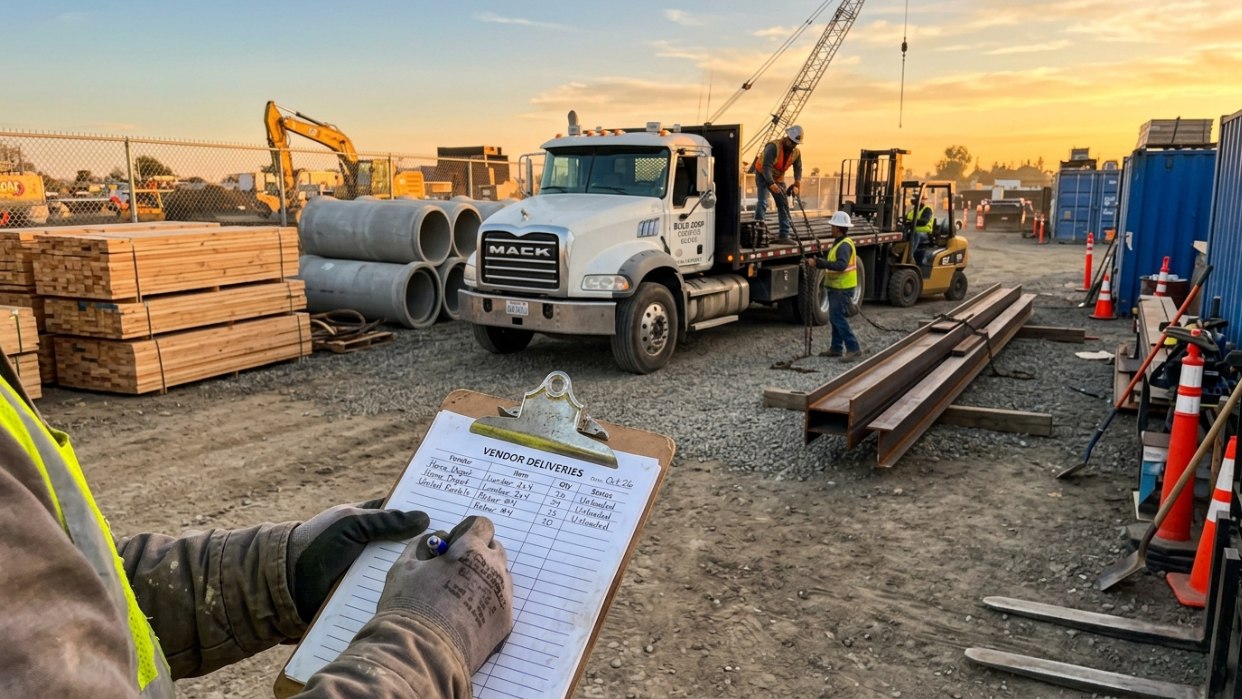
Construction vendor contracting refers to the formal process of selecting, negotiating with, and binding external vendors through legally enforceable agreements for a construction project. These vendors might supply ready-mix concrete, rent heavy equipment, deliver lumber, or provide specialized testing services. The contract governs price, delivery schedule, quality standards, liability, and dispute procedures.
Where does vendor contracting sit in the bigger picture? It falls squarely within the construction procurement lifecycle, after sourcing and prequalification but before mobilization. Think of it as the step where handshake agreements become binding commitments.
For general contractors, property owners, and procurement managers, getting this step right matters more than most people realize. A poorly structured vendor contract does not just create legal exposure. It bleeds margin. One construction cost accounting practitioner put it bluntly: “Your contract structure is really a risk allocation document. It answers one question before a single nail is driven: who absorbs the unexpected?”
That framing should guide everything that follows.
Looking for structured vendor programs to streamline your procurement? Explore our contractor vendor programs guide for a practical starting point.
Vendor vs. Subcontractor: Why the Distinction Matters
The terms “vendor” and “contractor” get used interchangeably in construction, and that casual habit creates real problems. The distinction is not academic. It affects insurance requirements, liability exposure, tax obligations, and how risk flows through your project.
What Makes a Vendor?
A vendor in construction is an entity that sells or delivers products, materials, or standardized services to a project. Sometimes called a dealer, distributor, or merchant, a vendor operates under purchase orders or supply contracts, usually at a fixed price. Vendors have limited involvement in the actual construction process. They supply what you ordered; they do not control how it gets installed.
Example: A ready-mix concrete supplier delivers 40 yards of 4,000 PSI concrete to your job site. They batch it, truck it, and pour it into your pump. But they do not place, finish, or cure the slab. That is vendor work.
What Makes a Subcontractor?
A subcontractor is hired by a general contractor or construction manager to perform a specific, substantive portion of the construction project. Subcontractors execute physical work or specialized tasks that contribute directly to the project’s completion. They carry their own insurance, manage their own crews, and assume responsibility for quality within their scope.
Example: A concrete flatwork crew that forms, places, finishes, and cures that same 40 yards of concrete is a subcontractor. They control the means and methods of how the work gets done.
Key Differences at a Glance
Factor | Vendor | Subcontractor |
|---|---|---|
Primary role | Supplies goods or standard services | Performs physical construction work |
Project control | None over installation or methods | Controls means and methods of their scope |
Insurance required | Product liability, commercial general liability | Workers’ comp, general liability, often umbrella |
Payment structure | Purchase order or supply contract | Subcontract agreement with progress payments |
On-site presence | Delivery only (usually) | Extended on-site work |
Misclassification risk | Moderate | High |
For a deeper look at sourcing the right suppliers, see our construction supplier sourcing guide.
The Misclassification Problem
Misclassifying vendors and subcontractors can expose contractors to costly insurance and liability risks. If you treat a subcontractor as a vendor, you may skip workers’ compensation verification, fail to secure proper indemnification, or miss tax reporting obligations. The consequences range from audit penalties to being held liable for injuries on your job site.
Construction forums are full of cautionary tales. Practitioners on industry discussion boards report that the line blurs most often with equipment operators, testing firms, and specialty service providers who show up on-site regularly but do not perform traditional “construction work.” When in doubt, consult construction-literate legal counsel before categorizing.
Construction Vendor Contracting Process (Step-by-Step)
Project requirement identification
Vendor sourcing and shortlisting
Vendor prequalification
Request for proposal (RFP) or quotation
Contract type selection
Negotiation of terms
Legal review and risk assessment
Contract signing
Vendor onboarding and mobilization
Performance monitoring and change order control
Missing any step increases the probability of disputes or cost overruns.
Types of Construction Vendor Contracts
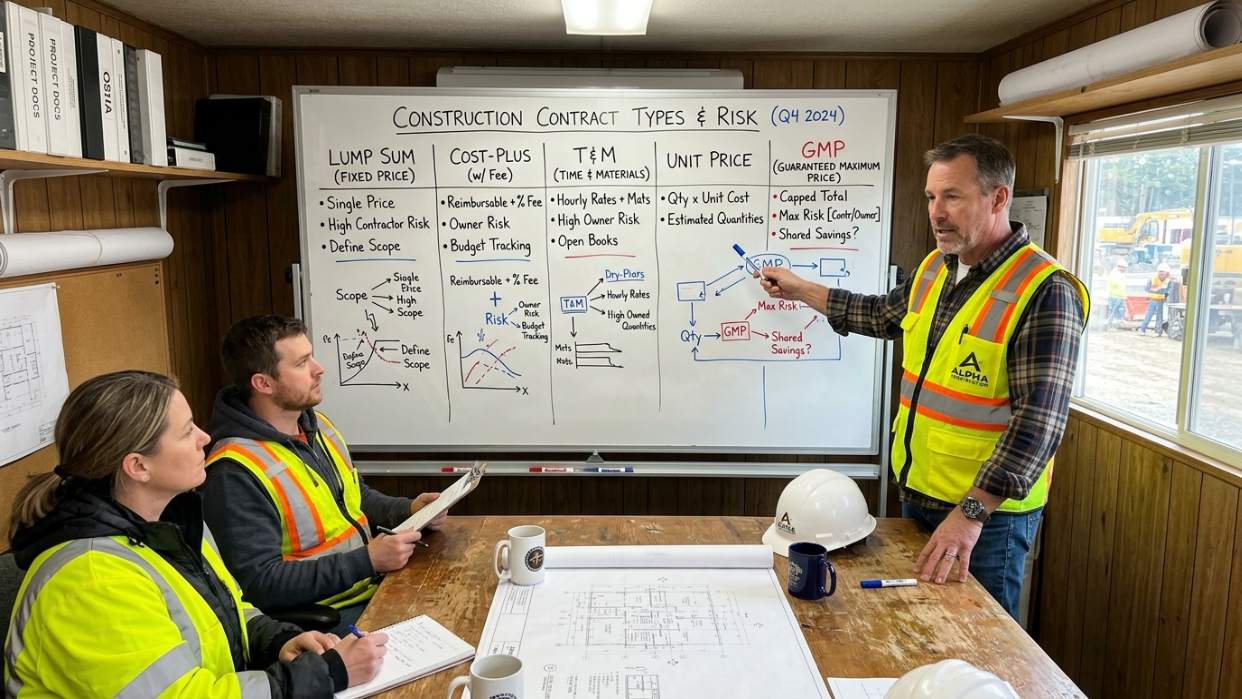
Choosing the right contract type is one of the highest-impact decisions in construction vendor contracting. It dictates who carries financial risk, how billing works, and whether you have built-in incentives for efficiency or cost control.
There are five common types of construction contracts: lump sum, time and materials, unit price, guaranteed maximum price, and cost-plus. Each fits different situations. The mistake most contractors make, according to experienced practitioners, is defaulting to whatever contract type they have always used. “Fixed price for everything, or T&M because ‘that’s how we do it,’” as one construction advisor put it. “But every project is different, and the contract should match the job, not your habit.”
Lump Sum (Fixed Price)
A lump sum contract is an agreement where the vendor or contractor agrees to complete the work for a single, predetermined price that includes all labor, materials, equipment, and overhead.
Risk allocation: The vendor absorbs cost overruns but keeps any savings. Well-run operations consistently hit 12 to 18% net margins on lump sum work, but the same structure that rewards efficiency punishes estimation errors ruthlessly.
Best for: Clearly defined scopes with minimal unknowns. Standard material supply agreements, concrete paving with known quantities, straightforward equipment rentals.
Cost-Plus
A cost-plus contract (also called cost-reimbursable) requires the owner to pay the vendor for actual costs incurred during the project, plus a predetermined fee or percentage for overhead and profit.
Risk allocation: The owner absorbs most of the cost risk. The vendor earns a guaranteed margin but has less incentive to minimize expenses unless the contract includes cost-control mechanisms.
Best for: Projects with uncertain scope, emergency repairs, or situations where the full extent of work cannot be defined upfront.
For strategies on managing fluid pricing in cost-plus arrangements, our guide on vendor price negotiation tactics offers practical frameworks.
Time and Materials (T&M)
Time and materials contracts reimburse vendors for material costs and pay a fixed daily or hourly wage for labor. T&M offers additional protection for vendors, who have greater assurance that their costs will be covered.
Risk allocation: Shared, but leaning toward the owner. Without a cap, T&M costs can escalate quickly.
Best for: Exploratory or investigative work, change order-driven scopes, maintenance contracts where volume varies month to month.
Unit Price
A unit price contract sets a price per unit of work (per cubic yard of concrete, per linear foot of pipe, per ton of asphalt). The final contract amount depends on actual quantities installed.
Risk allocation: Balanced. The owner controls quantities; the vendor controls unit cost. Both parties benefit from clear measurement standards.
Best for: Infrastructure work, site utilities, any scope where quantities are estimated but not guaranteed.
Guaranteed Maximum Price (GMP)
A GMP contract combines elements of lump sum and cost-plus. The vendor agrees to complete work for a set maximum price, with cost savings typically shared between owner and vendor. This creates a built-in incentive for the vendor to come in under budget.
Risk allocation: The vendor caps the owner’s exposure while retaining upside from efficiency gains.
Best for: Large, complex projects where the owner wants cost certainty but the scope is still being refined.
Hybrid Approaches
Many general contractors use lump sum for clearly scoped line items and T&M for allowance-based or exploratory work within the same project. The key is contract language that explicitly defines which portions fall under which structure. Ambiguity here is where disputes start.
Contract Type Comparison Table
Contract Type | Who Bears Cost Risk | Billing Method | Best Use Case |
|---|---|---|---|
Lump Sum | Vendor/Contractor | Single fixed price | Well-defined scope |
Cost-Plus | Owner | Actual costs + fee | Uncertain scope |
T&M | Owner (primarily) | Hourly/daily rates + materials | Variable or exploratory work |
Unit Price | Shared | Per-unit rate × actual quantities | Infrastructure, utilities |
GMP | Vendor (capped) | Actual costs up to ceiling | Complex projects, evolving scope |
Understanding how contract type affects your bottom line is a core part of construction cost management.
How to Choose the Right Construction Vendor Contract Type
Selecting the correct contract type depends on scope clarity, risk tolerance, and project complexity. Using the wrong model is one of the most common causes of cost overruns and disputes.
Decision Guide
Project Condition | Best Contract Type | Why It Works |
|---|---|---|
Clearly defined scope | Lump Sum | Fixed cost reduces uncertainty |
Unknown or evolving scope | Cost-Plus | Flexibility for changes |
Repetitive work with variable quantity | Unit Price | Pricing scales with output |
Short-term or urgent work | Time & Materials | Fast setup, flexible execution |
Large complex project needing cap | GMP | Cost ceiling + shared savings |
Rule of Thumb
If you can clearly measure everything upfront → use Lump Sum or Unit Price
If you cannot define scope → use Cost-Plus or T&M
Essential Clauses in a Construction Vendor Contract
A construction vendor contract is only as strong as its individual clauses. Skip or weaken any of these, and you are inviting the kind of disputes that cost real money.
According to a study by Arcadis, poorly drafted or incomplete contracts were ranked as the top cause of construction disputes in North America, with errors and omissions in the contract ranked second.
Scope of Work (SOW)
The scope of work clause is the foundation of every vendor agreement. It details the specific products or services a vendor is expected to deliver, along with quality standards, specifications, quantities, and timelines. Vague scopes are the single fastest path to change order disputes.
Be specific. “Deliver concrete” is not a scope of work. “Deliver 200 cubic yards of 4,000 PSI ready-mix concrete to Site A per the attached schedule, meeting ASTM C94 specifications” is.
Payment Terms
This section should specify the total amount, how payments will be made, and the payment schedule. For vendor contracts, this often means net-30 or net-60 terms tied to delivery milestones.
Watch for pay-when-paid clauses. As practitioners on JohnTalk and other construction forums note, a pay-when-paid provision means your vendor will not receive payment until the general contractor gets paid by the owner. A pay-if-paid clause goes further, making the owner’s payment a condition precedent to any obligation to pay the vendor at all. Some states restrict or ban these clauses, so check local law.
For a step-by-step approach to writing these provisions, see our guide on drafting contractor vendor agreements.
Change Order Procedures
Scope changes are inevitable in construction. Your contract needs a variation clause that defines how changes are requested, documented, priced, and approved before work proceeds. One construction advisor shared that they have “worked with contractors who lost $50,000 on a $300,000 project, not from bad work, but from a missed mechanical condition and a change order process that was never enforced.”
Indemnification
An indemnification clause ensures that one party compensates the other for damages or legal claims arising from the project. In vendor contracts, this typically means the vendor indemnifies the contractor for defective materials or delivery failures, while the contractor indemnifies the vendor for misuse of properly delivered goods.
Insurance Requirements
Vendors should provide proof of commercial general liability insurance and, where applicable, product liability coverage. Unlike subcontractors, vendors typically do not carry workers’ compensation for on-site labor since they are not performing work on the site. But if vendor employees do enter the site (for equipment installation, for instance), workers’ comp verification becomes critical.
Dispute Resolution
The dispute resolution clause should outline the rules for submitting claims, including notice provisions and deadlines. It should specify whether mediation is mandatory and what happens if the dispute remains unresolved: arbitration, litigation, or some combination.
Given that approximately 56% of construction projects face disputes globally and the average dispute value in North America reached $42.8 million in 2022, this clause is not boilerplate. It is a survival mechanism.
Termination
A termination clause defines the conditions under which either party can end the contract. This includes termination for cause (material breach, insolvency) and termination for convenience (the owner decides to cancel). Specify notice periods, cure periods, and how partial work or delivered materials will be handled.
Common Mistakes in Construction Vendor Contracting
Many disputes in construction are not caused by poor execution—but by avoidable contract errors.
1. Vague Scope of Work
Generic descriptions like “supply materials as needed” lead to disputes and change orders.
2. No Formal Change Order Process
Without written approval requirements, scope creep becomes uncontrolled.
3. Using One Contract Type for Everything
Applying lump sum pricing to uncertain work leads to major cost overruns.
4. Missing Insurance Verification
A single uninsured vendor incident can create full project liability exposure.
5. Ignoring Flow-Down Clauses
Failure to align vendor contracts with the main project contract creates legal gaps.
Vendor Prequalification: The Front Door to Sound Contracting
Prequalification is the process of vetting vendors before they ever bid on or receive a contract. It is crucial in construction, yet general contractors routinely overlook it or save it until after they have already used a vendor’s quote in their own bid. This creates problems.
Most construction companies wait until after they have made soft commitments to do their due diligence. By then, switching vendors is expensive and disruptive.
What Prequalification Covers
When a vendor responds to a request for prequalification, they present documents that verify compliance and financial health. Common documents include:
Business references from similar projects
Employee profiles and key personnel qualifications
Financial statements or credit history
Relevant certifications and licenses
Historical project portfolio
The goal is to confirm that a vendor can actually deliver what they claim, at the quality and timeline required. One key risk the prequalification process aims to mitigate: vendors misrepresenting their experience, qualifications, or references.
The Cost Barrier
Full-featured prequalification platforms like ISNetworld charge subcontractors and vendors $875 or more per year just to register. This shrinks bidder pools and can price out small and minority-owned firms. Many contractors balance this by using tiered prequalification: formal platforms for high-value or high-risk vendors, and simpler in-house processes for routine suppliers.
Building a strong prequalified vendor base is closely tied to building a construction vendor network that can support multiple projects over time.
Construction Vendor Risk Checklist (Before Signing Any Contract)
Before finalizing any vendor contract, verify the following to reduce legal and financial exposure:
Valid business registration and licenses
Active insurance certificates (general liability + workers’ comp if applicable)
Verified project references (minimum 3 similar projects)
Clear scope of work documentation
Defined delivery schedule and penalties for delays
Written change order process
Payment terms clearly stated (avoid ambiguity in “pay-if-paid” clauses)
Warranty terms for materials or services
Indemnification and liability clauses reviewed by counsel
If even two items are missing, the contract is considered high-risk.
Common Dispute Triggers in Vendor Contracting
Construction disputes are not rare events. They are a statistical likelihood. According to HKA’s CRUX Insight report, the top four conflict-causing issues worldwide are change in scope, incorrect design, incomplete design, and poor management of subcontractors and suppliers.
Notice that last one. Poor vendor and supplier management is a top-four cause of construction disputes globally.
By the Numbers
Approximately 56% of construction projects face disputes worldwide
The average value of a construction dispute in North America swelled to $42.8 million at the end of 2022, up from $30.1 million the prior year
According to Bureau of Labor Statistics data, of the 69,296 private construction firms that launched in 2001, only 17.2% remained in operation after two decades, an 82.8% failure rate
These numbers are not just statistics. They represent real firms that failed, often because of cash flow problems triggered by disputes, change orders, and poorly structured contracts.
Prevention Strategies
The most effective dispute prevention strategies tie directly back to construction vendor contracting fundamentals:
Write complete, specific scopes of work
Match contract type to scope certainty (do not use lump sum when the scope is still being developed)
Enforce change order procedures every single time
Maintain detailed documentation of deliveries, inspections, and communications
Include clear dispute resolution mechanisms before the first purchase order is issued
For a broader view of managing procurement risk, our procurement risks and strategies guide covers the full spectrum of exposure.
Construction Vendor Contracting: Key Industry Stats
~56% of construction projects experience disputes
Average dispute value in North America: $42.8 million
Up to 20% of project value can be lost to poor contract management
Only 17.2% of construction firms survive 20+ years
Poor vendor/supplier management is a top 4 global dispute driver
These numbers show that contract structure is not administrative—it is financial risk control.
Best Practices for Construction Vendor Contracting
Experienced contractors converge on a consistent set of principles for vendor contracting in construction. None of these are complicated. The challenge is discipline.
Match the Contract to the Job
An industrial project advisor from Hansen-Rice captured a common failure mode: “Too often, well-intended parties take a myopic, procurement-driven view of contract type selection, leading to unknown contractual risk embedded in the agreements.” If the scope is tight and well-documented, lump sum works. If the scope is uncertain, cost-plus or T&M protects both parties. If quantities are known but totals are not, unit price fits. Stop using the same contract type for everything.
Never Skip Prequalification
Even for small vendors. Even for vendors you have used before. Financial conditions change. Insurance lapses. Key personnel leave. A five-minute verification call can save months of headaches.
Enforce Change Orders Religiously
The most common margin killer in construction is not material costs or labor rates. It is uncompensated scope changes that never went through a formal change order process. If it is not in writing, it did not happen.
Keep Meticulous Records
Every delivery ticket, every email confirming specifications, every inspection report. In a dispute, the party with better documentation wins. Period.
Use Construction-Literate Counsel
A business attorney who primarily handles commercial leases or employment law is not equipped to review a GMP contract with shared-savings provisions. Construction law is specialized. Pay for someone who understands it.
Review Vendor Contracts Against Your Prime Contract
Your vendor agreements need to flow down the relevant terms from your prime contract with the owner. If your prime contract requires a specific insurance threshold, your vendor contracts need to match or exceed it. If the prime contract includes liquidated damages for delays, your vendor contracts need delivery guarantees that protect you.
For more on strengthening vendor relationships strategically, explore our guide to construction vendor partnership strategies.
How CNBA Helps Contractors Manage Vendor Relationships
Construction vendor contracting gets easier when you are not starting from scratch on every project. The Contractors National Buyer Alliance (CNBA) provides structured vendor programs, procurement resources, and collective purchasing power that give contractors a head start on vendor selection, pricing, and relationship management.
Whether you need help identifying prequalified vendors, negotiating better material pricing, or building a procurement process that scales, CNBA’s resources are designed for contractors who want to stop leaving money on the table.
Ready to strengthen your vendor contracting process? Start with our contractor vendor programs guide for practical next steps.
Frequently Asked Questions
What is the difference between a vendor and a subcontractor in construction?
A vendor supplies goods, materials, or standardized services but does not perform construction work on-site. A subcontractor performs a specific portion of the physical construction work and controls the means and methods of that work. The distinction affects insurance requirements, liability exposure, tax treatment, and contract structure.
What are the most common types of construction vendor contracts?
The five most common types are lump sum (fixed price), cost-plus, time and materials (T&M), unit price, and guaranteed maximum price (GMP). Many projects use hybrid approaches that combine two or more types for different scopes within the same project.
Why does construction vendor contracting matter for risk management?
Your contract determines who absorbs unexpected costs, how disputes get resolved, and what happens when scope changes. Approximately 56% of construction projects face disputes, and poorly drafted contracts are the leading cause. The right contract structure is your first line of defense.
What should be included in a construction vendor contract?
At minimum: a detailed scope of work, payment terms, change order procedures, indemnification clauses, insurance requirements, dispute resolution mechanisms, and termination provisions. Each clause should be specific to the project, not copied from a generic template.
What is vendor prequalification in construction?
Prequalification is the process of vetting vendors before they bid on or receive a contract. It involves collecting and verifying references, financial statements, certifications, insurance documentation, and project history. The goal is to confirm a vendor can deliver what they promise.
How do pay-when-paid clauses affect vendor contracts?
A pay-when-paid clause means the vendor will not receive payment until the general contractor gets paid by the owner. A pay-if-paid clause makes the owner’s payment a condition precedent to any payment obligation. These clauses shift cash flow risk to the vendor and are restricted or banned in some states.
What is the average cost of a construction dispute?
According to Arcadis research, the average value of a construction dispute in North America reached $42.8 million in 2022. Even for smaller projects, disputes can easily consume 10 to 20% of the contract value in legal fees, delays, and rework costs.
Can you use different contract types on the same construction project?
Yes. Hybrid approaches are common and often advisable. For example, a general contractor might use lump sum pricing for well-defined concrete work and T&M for exploratory site work where the full scope is not yet known. The key is clear contract language specifying which portions fall under which pricing structure.

Recent Comments