
TL;DR
Most fleet management software was built for long-haul trucking, not construction. Construction fleets need hours-based preventive maintenance, mixed fleet tracking (vehicles and heavy equipment on one screen), and offline capability for remote job sites. The seven tools reviewed here range from $4/vehicle/month (Fleetio) to $50,000+/year (HCSS Equipment360). Tenna is the strongest construction-specific option for mixed fleets. Fleetio is the lowest-risk entry point. Samsara leads on safety features. Avoid signing multi-year contracts until you’ve survived one full season with any platform.
Construction Fleet Management Software: Quick Answer
Construction fleet management software helps contractors monitor vehicles and heavy equipment from one platform. Unlike trucking software, construction fleet systems support engine-hours maintenance scheduling, mixed fleet tracking, equipment utilization reporting, geofencing, inspections, and job costing integration.
For most contractors:
– Best construction-specific platform: Tenna
– Best budget option: Fleetio
– Best for driver safety: Samsara
– Best month-to-month contract: Fleet Chaser
– Best heavy civil contractors: HCSS Equipment360
The best software depends on whether your priority is reducing equipment downtime, improving driver safety, lowering maintenance costs, or managing both vehicles and heavy equipment together.
Why Most Fleet Software Fails Construction Companies
Construction companies routinely own 20 to 30% more equipment than they actively use at peak utilization. Each hour of unplanned downtime costs $150 to $500 in lost production, not counting emergency repair expenses. Reducing unplanned downtime by just 20% through automated preventive maintenance tracking typically saves $500 to $2,000 per asset annually.
These numbers should make fleet management software an obvious investment. The problem is that most platforms were designed for one of two worlds: over-the-road trucking or service van fleets. Construction is its own animal. A dump truck doing site work might accumulate 500 engine hours in 60 days, which is the equivalent of 25,000+ road miles in wear. If your fleet tool only triggers maintenance by mileage, it will miss every critical service interval on that truck.
The construction and mining fleet management market is projected to grow from $4.04 billion in 2025 to $7.28 billion by 2030, at a 12.5% CAGR. Construction alone accounts for 18% of the fleet management software market. The money is flowing in, and vendors are paying attention, but not all of them are building for construction-specific workflows.
This guide evaluates seven construction fleet management tools from a buyer’s perspective. No vendor sponsored this article. Where pricing is publicly available, it’s included. Where it’s hidden, that’s flagged too.
For a broader look at fleet strategy beyond software, see our contractor fleet management guide.
At-a-Glance Comparison Table
Tool | Starting Price | Best For | Contract | Mixed Fleet Support | Hours-Based PM | Rating | Free Trial |
|---|---|---|---|---|---|---|---|
Tenna | Custom quote | Construction-only mixed fleets | Custom | ✅ Full | ✅ | ~4.6/5 | No (demo) |
Samsara | $27–33/vehicle/mo | Safety and AI dashcams | 3-year min | Partial | Partial | ~4.4/5 | Yes |
Motive | ~$35/vehicle/mo | Driver accountability/ELD | Quote-based | Partial | Partial | ~4.5/5 | Demo only |
Fleetio | $4–10/vehicle/mo | Maintenance management | Annual | ✅ (add-on) | ✅ | ~4.5/5 | Yes (14-day) |
HCSS Equipment360 | $10K–50K+/year | Heavy civil contractors | Custom | Maintenance only | ✅ (3 params) | ~4.1–4.6/5 | No |
Verizon Connect | ~$20/vehicle/mo | Midsize multi-industry fleets | 3-year min | Partial | No | ~3.8/5 | 30-day |
Fleet Chaser | $20–25/vehicle/mo | Construction SMBs | Month-to-month | ✅ | ✅ | Newer | Demo |
What Makes Construction Fleet Software Different
Before picking a tool, understand the five capabilities that separate construction-grade fleet management from generic platforms. These are the criteria where most vendors fall short, and where bad choices cost real money.
Hours-Based Preventive Maintenance
This is the single most important differentiator. Construction equipment wears by engine hours, not odometer readings. An excavator running 10 hours a day on a site might never move more than a quarter mile. Mileage-based PM triggers are meaningless for it. Any platform you consider must support hours-based maintenance scheduling at a minimum.
True Mixed Fleet Tracking
A 25-truck operation with 15 pieces of heavy equipment is a 40-asset fleet. Most “fleet management software” handles the 25 trucks well and treats the 15 machines as an afterthought. The cost of that gap: two tools, two logins, two invoices, and double the administrative overhead. The tools that handle pickups, dump trucks, excavators, skid steers, dozers, and trailers on a single dashboard are the ones built for construction.
Offline Capability
If inspections, work orders, and parts lookups don’t function without cell signal, the software doesn’t work for construction. Remote job sites, rural highway projects, and mountainous terrain create dead zones that are the norm, not the exception. Data should sync automatically when connectivity returns.
Job Costing Integration
Job costing integration is the most underrated feature in this category. When your fleet platform connects to project management software (Procore, Viewpoint, or similar), equipment hours and vehicle mileage flow directly into job cost reports. At $300 to $500 per hour for heavy equipment rental equivalents, a single under-billed project can exceed a year of fleet software costs. This capability directly supports your broader construction cost management strategies.
Pricing Model Awareness
Per-seat user pricing is a hidden tax. A 30-vehicle fleet can easily have 6 managers, 4 mechanics, and 1 safety officer logging in. Choose vendors that price by vehicle or asset, not per user. Otherwise, role-based dashboards become an upsell opportunity for the vendor and a budget leak for you.
1. Tenna
Best for: Construction-only mixed fleets (mid-to-enterprise contractors)
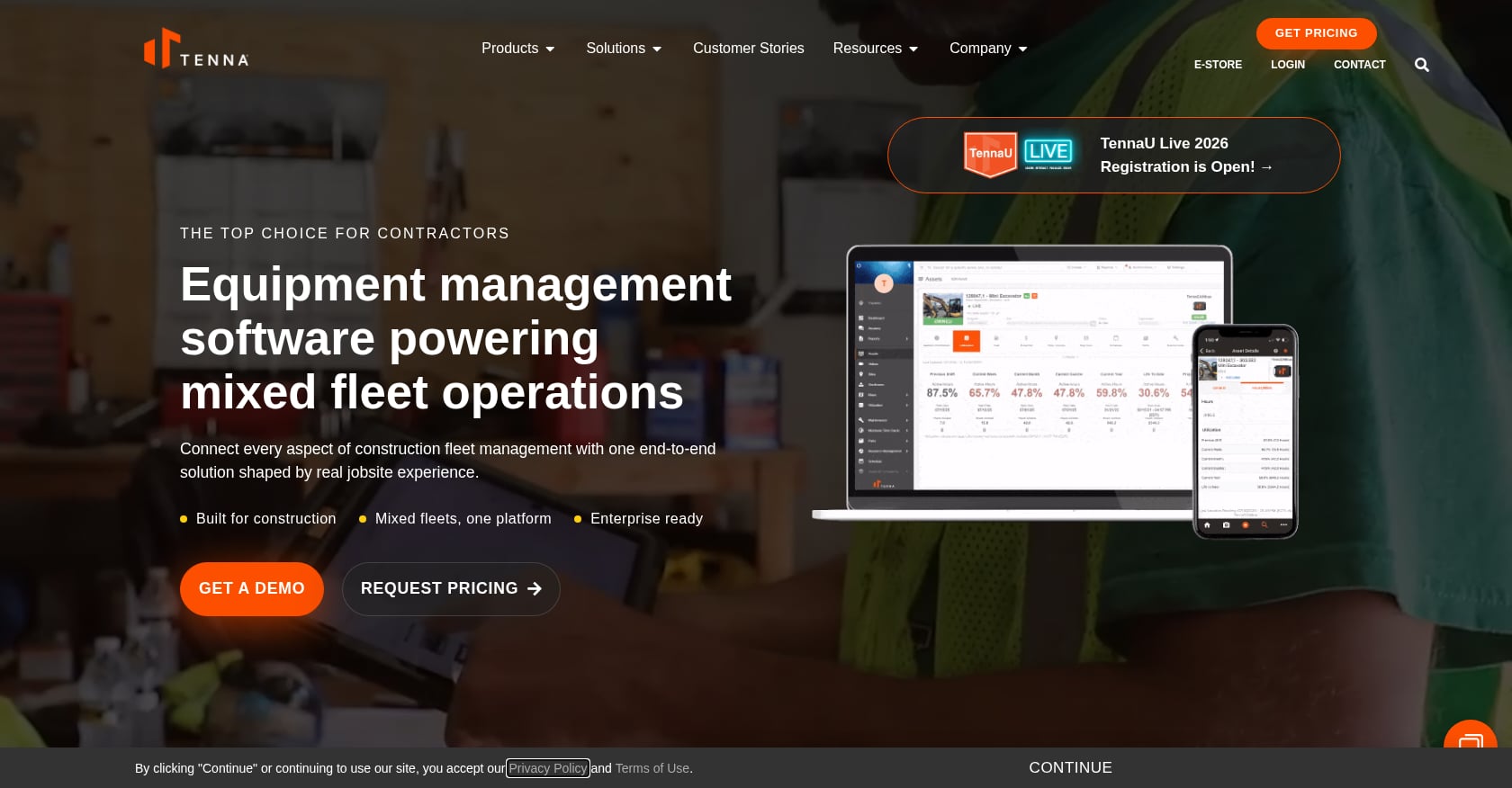
Tenna is the only platform on this list built exclusively for construction. It’s a cloud-based fleet management tool designed for companies managing heavy equipment, vehicles, and tools on one platform. In February 2026, John Deere completed its acquisition of Tenna, which now operates as an independent business under the Tenna name. That acquisition, backed by a $100M funding round, signals both serious investment and potential future implications for OEM integration.
Key features:
Full mixed fleet tracking: powered vehicles, heavy equipment, and small tools on one dashboard
OEM telematics integration with John Deere, CAT, Komatsu, and Volvo via AEMP/ISO 15143-3 standards
Hours-based preventive maintenance scheduling
Equipment utilization reporting with idle time analytics
Geofencing for job site entry/exit tracking
700+ construction customers across US, Canada, and Mexico
Pricing: Custom quote only. Pricing is based on asset count, installation/training locations, and selected features. No public pricing is available, which is frustrating for buyers doing initial research.
Hardware: Hardwired trackers for powered vehicles ($150–400 range typical in the industry), solar/BLE trackers for non-powered assets.
What users say: Tenna maintains consistently high ratings, averaging 4.6 stars or above across 300+ combined reviews. One Capterra reviewer reported: “Using the reports in Tenna for Idling and Asset Utilization reports we have been able to show a $20,000 a month savings.” The recurring theme in positive reviews is measurable ROI. The recurring theme in complaints is the mobile app, which multiple users describe as less intuitive or glitchy compared to the desktop experience. Some also report that setup and implementation can be time-consuming.
Tradeoffs:
Custom pricing makes apples-to-apples comparison difficult before the sales call
Mobile app is the weakest link in an otherwise strong platform
John Deere acquisition creates uncertainty about long-term vendor independence
No free trial; demo only
Bottom line: If you run a construction company with a genuinely mixed fleet (trucks, iron, and tools), Tenna is the most construction-native option available. The John Deere backing could accelerate OEM integration or eventually create ecosystem pressure. Worth watching closely.
2. Samsara
Best for: Safety-focused construction fleets prioritizing AI dashcams and compliance
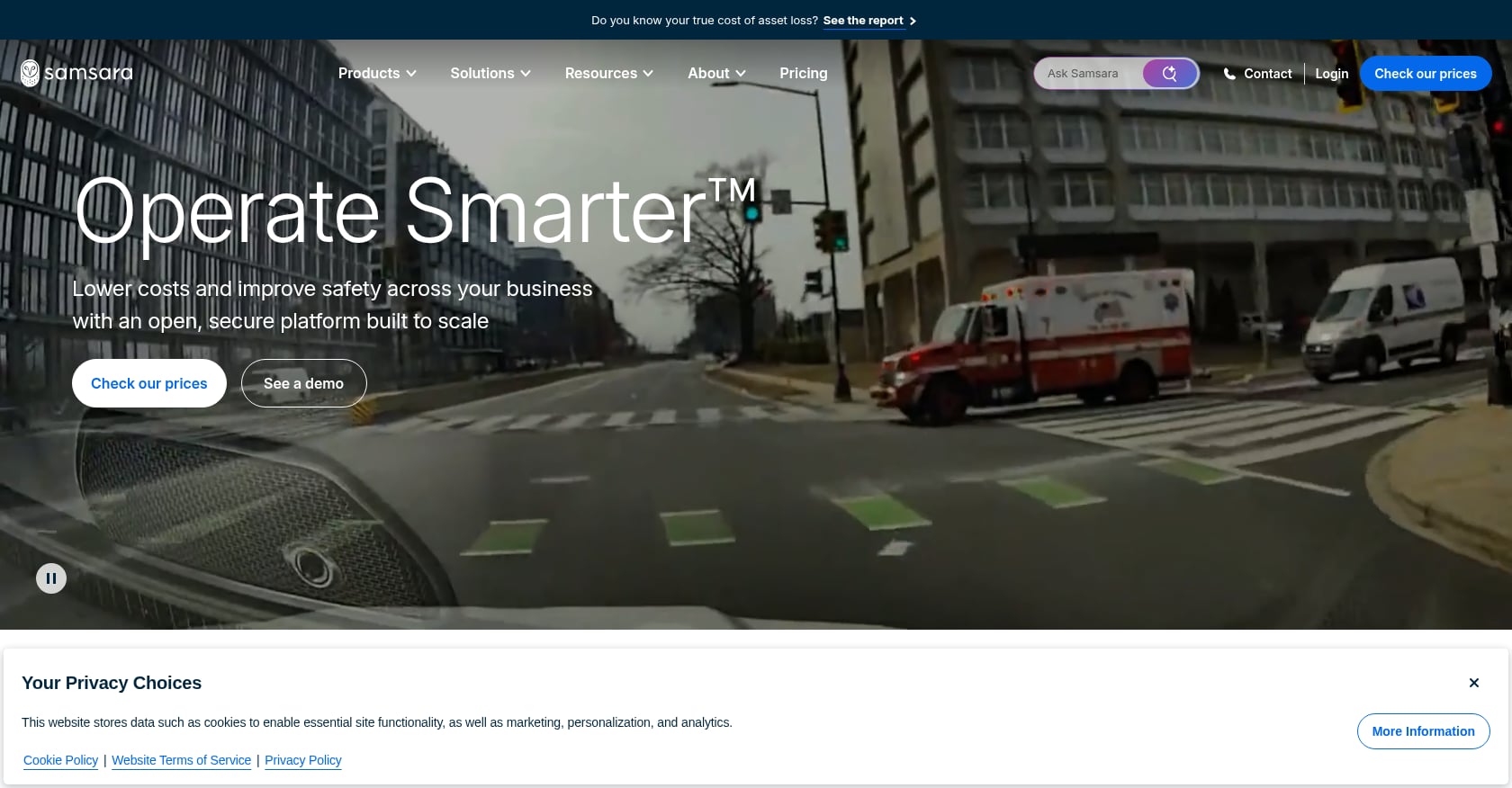
Samsara is a comprehensive fleet management platform with real-time GPS tracking, HD dash cams, and advanced driver safety features. It’s industry-agnostic, which means it serves trucking, logistics, and construction equally, but it doesn’t build features specifically for construction workflows.
Key features:
AI-powered dashcams detecting 15+ unsafe driving behaviors (phone use, forward collision, etc.)
Real-time GPS tracking with geofencing
ELD compliance and DVIR inspections
Equipment monitoring for powered assets
Fuel usage and idle time reporting
Driver coaching tools with video evidence
Pricing: $27 to $33 per vehicle per month with a mandatory 3-year contract. Hardware runs $99 to $148 per vehicle. This is where Samsara gets expensive fast: a 30-vehicle fleet at $30/month plus hardware costs $12,840 in year one, and you’re locked in for three.
What users say: Samsara holds a user satisfaction rating of 84% based on 457 reviews. Practitioners report that the AI dashcam features are genuinely useful for reducing insurance claims and improving driver behavior. However, more than 80% of users who mentioned customer support as a negative said technical analysts are slow to respond and not always helpful. Construction firms specifically note limitations with non-powered asset tracking.
Tradeoffs:
3-year contract lock-in is a significant commitment, especially for seasonal operations
Features demonstrated during sales calls sometimes require additional licenses (a common complaint on review sites)
Not built for construction-specific workflows like job costing or hours-based PM
Weak on heavy equipment and non-powered asset tracking
Interface can be tricky for first-time users
Bottom line: Samsara is the right tool if driver safety is your primary concern and your fleet is mostly powered vehicles. It’s the wrong tool if you need to track excavators and dozers alongside your trucks. The 3-year contract deserves serious pause. Sign annual on your first year if the vendor allows it.
For fleets where fuel costs are a bigger concern than safety tech, explore fleet fuel savings tactics that work independently of any software platform.
3. Motive
Best for: Driver accountability, ELD compliance, and high-frequency GPS tracking
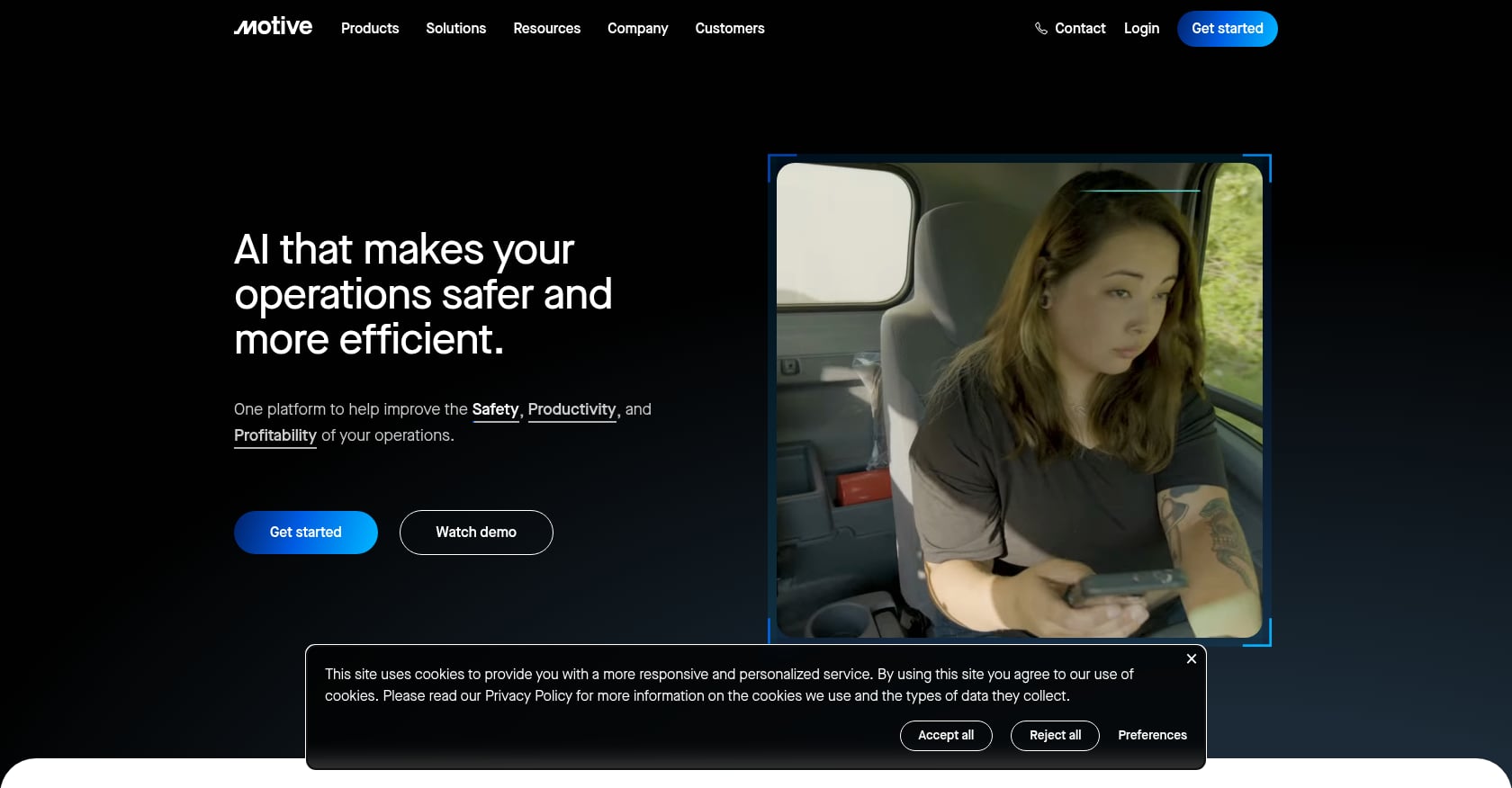
Motive (formerly KeepTruckin) started in 2013 as a compliance-focused ELD provider and has grown into a platform trusted by over 120,000 businesses. Its DNA is in regulatory compliance and driver monitoring, making it strong for operations where FMCSA requirements matter.
Key features:
AI dashcams detecting 15+ unsafe behaviors including cell phone use and forward collision risk
ELD compliance with automatic hours-of-service tracking
High-frequency GPS tracking
Structured driver safety programs with scoring
IFTA fuel tax reporting
Fleet maintenance scheduling (vehicle-centric)
Pricing: Starts at approximately $35 per vehicle per month. Not publicly listed; quote-based. Pricing and contract structure make the most financial sense at the 10-or-more-vehicle mark.
What users say: Enterprise customers reported getting up and running 26% faster than Samsara customers and 48% faster than Lytx customers. Motive scores highest among reviewers for GPS tracking accuracy and ELD compliance. The gaps appear in pricing transparency and support consistency, with some users reporting difficulty reaching helpful support agents.
Tradeoffs:
Primarily a vehicle and driver platform; equipment tracking is secondary
No public pricing makes budgeting difficult before engaging sales
Less relevant for fleets dominated by heavy equipment rather than trucks
Construction-specific features (hours-based PM, job costing integration) are limited
Bottom line: Motive is a strong choice for construction companies that run significant trucking operations (hauling, material delivery) and need tight compliance and driver safety tools. It’s not the right fit for equipment-heavy operations. Think of it as the best driver platform, not the best construction platform.
4. Fleetio
Best for: Budget-conscious contractors who need strong maintenance management
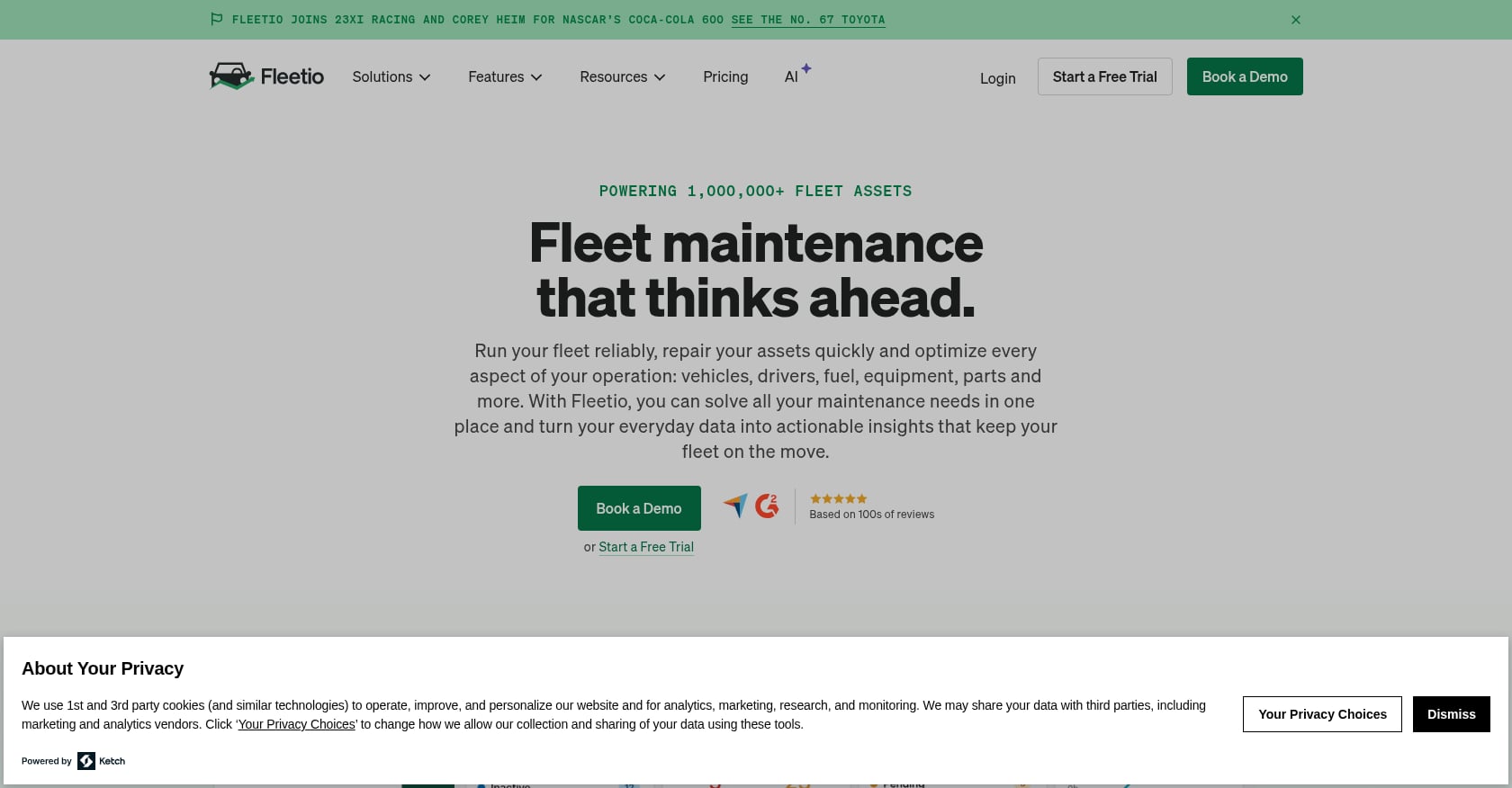
Fleetio is a cloud-based fleet maintenance and management tool that takes a fundamentally different approach than the GPS-first platforms above. It focuses on maintenance workflows, parts management, and cost tracking, then integrates with your existing GPS/telematics hardware rather than replacing it.
Key features:
Maintenance scheduling with hours-based and mileage-based triggers
Parts inventory management
Outsourced maintenance management with vendor integration
Fuel tracking and cost analysis
Vehicle inspection checklists (digital DVIR)
Tools and equipment tracking add-on at ~$0.50/asset/month
API access for third-party integrations (Professional plan and above)
Free 14-day trial, no credit card required
Pricing: The most transparent in the category.
Plan | Price | Key Inclusions |
|---|---|---|
Essential | $4/vehicle/mo | Basic maintenance, fuel tracking, inspections |
Professional | $7/vehicle/mo | + outsourced maintenance, parts management, API access |
Premium | $10/vehicle/mo | + advanced analytics, automations, priority support |
All plans billed annually. The tools and equipment tracking add-on is roughly $0.50 per asset per month for non-powered equipment.
What users say: Most reviewers highlight the affordable entry point, transparent pricing, and genuine value for money. Multiple users report the platform helps clients save up to 48% on maintenance costs. The community sentiment is that Fleetio punches well above its price tier for maintenance workflows.
Tradeoffs:
No built-in GPS hardware; relies on third-party telematics integrations
Essential plan includes zero automations
Falls short for construction companies looking to manage mixed fleets, heavy iron, and job site-specific operations
Not a dispatching or real-time tracking platform on its own
Bottom line: Fleetio is the lowest-risk entry point into fleet management software. At $4/vehicle/month with a free trial and no contract, you can test it before committing anything meaningful. It’s particularly strong if you already have GPS hardware installed and just need a maintenance, inspection, and cost-tracking layer on top. It’s not a complete construction fleet management solution on its own, but it’s an excellent foundation.
5. HCSS Equipment360
Best for: Heavy civil contractors already using the HCSS ecosystem
HCSS Equipment360 is a comprehensive equipment maintenance platform designed specifically for the heavy civil construction industry. Unlike the other tools on this list, it doesn’t try to be a fleet tracking platform. It focuses entirely on maintenance management, shop workflows, and equipment lifecycle tracking.
Key features:
Preventive maintenance alerts based on three parameters: calendar days, runtime hours, and odometer
Work order management with mechanic time tracking
Parts inventory and procurement
Equipment cost tracking by project
Integration with HeavyBid and HeavyJob (HCSS suite)
Reporting on equipment utilization and maintenance costs
Pricing: Best suited for mid-sized to large construction companies. Budget thresholds range from $10,000 to $50,000+ annually depending on scale. Custom quotes only. No free trial.
What users say: Equipment360 users report experiencing 65% fewer breakdowns after implementation, which is a compelling number. However, the platform has notable limitations. The mobile version is iPad only, with no Android support, a significant gap for field crews. One long-term user shared: “It has developed some very strange quirks over the last 2 years and it is impossible to customize to your specific needs. If you are a smaller company, expect pricy annual maintenance fees.”
Tradeoffs:
iPad-only mobile app eliminates most field devices
Expensive for smaller companies, with annual maintenance fees that add up
Not a GPS tracking platform; handles maintenance and shop management only
Best fit requires commitment to the broader HCSS ecosystem (HeavyBid, HeavyJob)
No free trial means a significant financial commitment before seeing results
Bottom line: Equipment360 is the right tool for heavy civil contractors (road, highway, utility construction, site work) who are already invested in HCSS products. The integration between Equipment360, HeavyBid, and HeavyJob creates genuine workflow continuity. For everyone else, the iPad-only limitation and high price floor make it a hard sell.
6. Verizon Connect
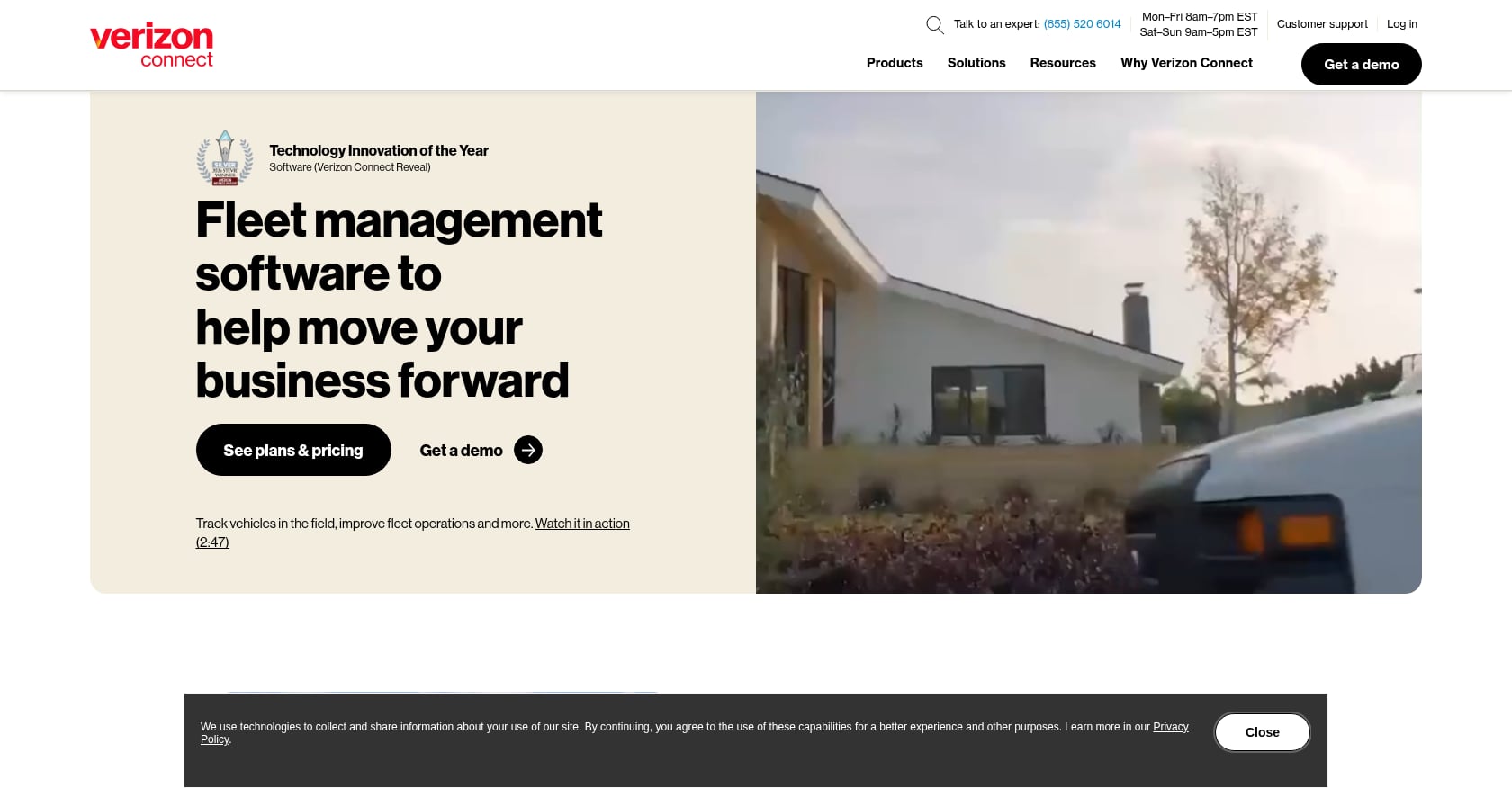
Best for: Midsize multi-industry fleets needing deep analytics
Verizon Connect (specifically the Reveal platform) is a comprehensive GPS fleet tracking solution with advanced reporting and scalability. It benefits from massive brand recognition and infrastructure but is not construction-specific.
Key features:
Real-time GPS tracking with configurable update intervals
Customizable reporting and analytics dashboards
Geofencing with automated alerts
ELD compliance tools
Fuel usage monitoring
Asset labeling customization (rename “vehicle” to “crane,” for example)
30-day free trial available
Pricing: The Reveal Starter Plan runs approximately $20 per vehicle per month. Requires a minimum three-year contract if Verizon supplies and installs tracking equipment. Hardware costs run $150 to $400 per vehicle.
What users say: This is where Verizon Connect struggles. Customer service is the number one complaint across every review platform. Verizon Connect received a failing BBB grade with over 100 unresolved complaints as of 2025. Practitioners on forums consistently warn about the difficulty of canceling contracts and resolving billing disputes. The analytics and reporting features get praise; the support experience does not.
Tradeoffs:
Customer service is widely reported as poor, with long resolution times
Custom-only pricing, three-year default contracts, and auto-renewal terms create significant buying risk
Not construction-specific; no hours-based PM, no mixed fleet depth
BBB complaint history should give any buyer pause
Contract exit is reportedly difficult
Bottom line: Verizon Connect offers solid GPS tracking and reporting capabilities at a competitive price point. But the contract structure and customer service record represent real risk. If you go this route, read every line of the contract, understand the auto-renewal terms, and get cancellation procedures in writing before signing. For help evaluating vendor agreements, use our vendor comparison checklist.
7. Fleet Chaser
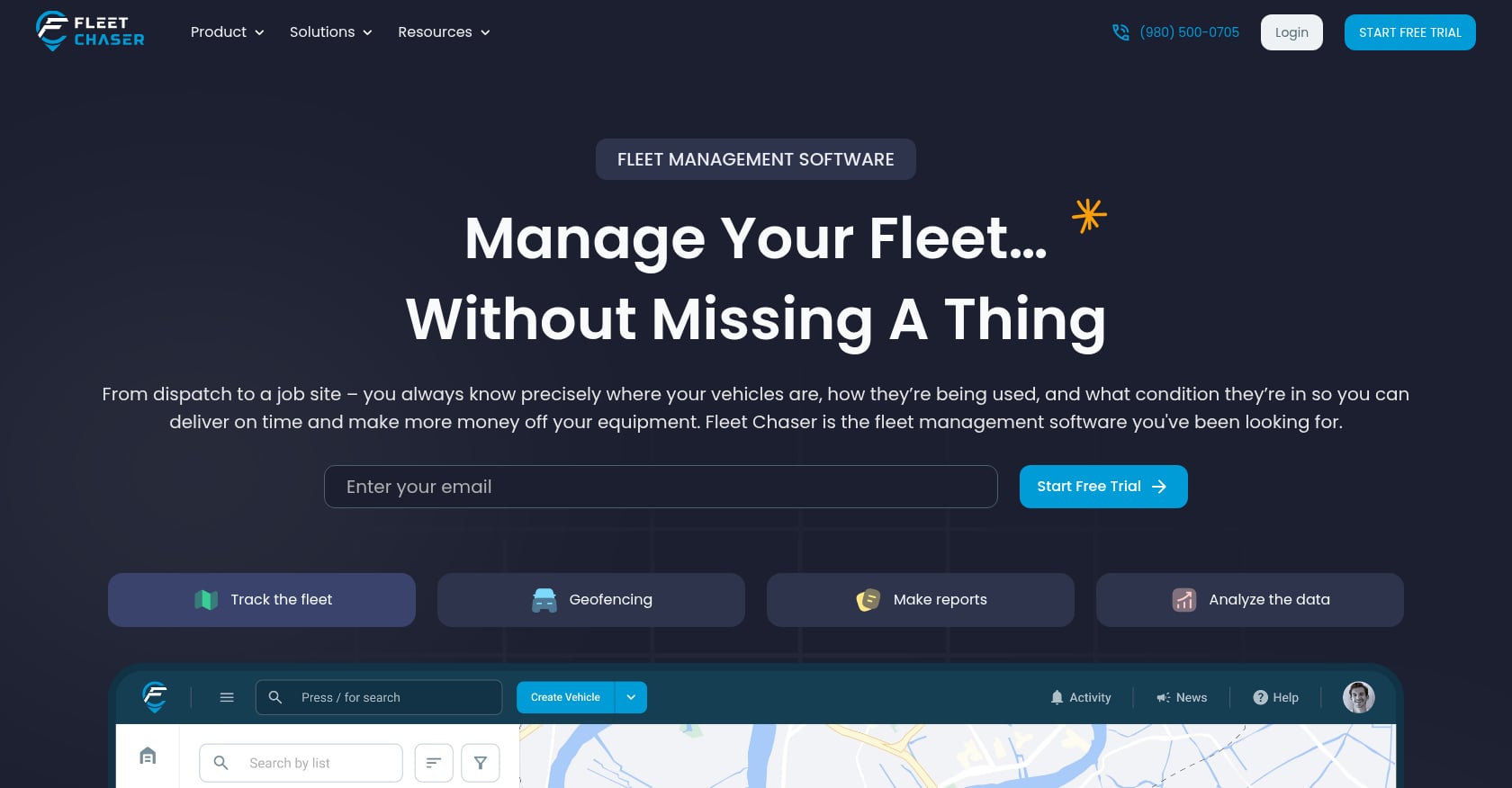
Best for: Construction SMBs (10 to 300 assets) wanting month-to-month flexibility
Fleet Chaser is built specifically for construction and construction-adjacent fleets, including roofing, landscaping, waste management, and regional logistics. It’s the smallest vendor on this list but also the most transparent about pricing and the most focused on the construction SMB segment.
Key features:
GPS tracking for vehicles and heavy equipment on the same dashboard
Hours-based and mileage-based PM scheduling
Dashcam integration
Dispatching and route optimization
Inspection and compliance tools
Unlimited users included (no per-seat pricing)
Month-to-month contracts with no lock-in
Pricing: $20 to $25 per vehicle per month for GPS tracking and fleet management. $25+ per vehicle per month for dashcam functionality. No contract minimums. Unlimited users. This is the most transparent pricing in the construction fleet management tools category.
What users say: Fleet Chaser publishes detailed case studies with specific numbers. Landmark Materials reported saving $100K+ in fraudulent accident claims, cutting idle time by 60%, and lifting fleet efficiency by 40%. Home Evolution Roofing reported $60K+ saved annually, 3x faster maintenance scheduling, and 20% faster on-site work completion.
Tradeoffs:
Newer and smaller vendor with limited brand recognition
Less enterprise depth than Tenna or Samsara
Fewer third-party integrations than larger platforms
Limited independent review data (newer to market)
Bottom line: Fleet Chaser is the construction-specific alternative to Samsara and Motive for smaller operations. The month-to-month pricing eliminates contract risk, and the unlimited user model avoids the per-seat tax. The trade-off is betting on a smaller vendor. For a 15-truck, 10-machine operation that wants construction-specific functionality without a 3-year commitment, Fleet Chaser deserves a demo.
How Construction Fleet Management Software Works
Many contractors think fleet software simply shows GPS locations. Modern construction fleet platforms combine telematics, maintenance management, inspections, utilization tracking, and reporting into one system.
A typical workflow looks like this:
Step | What Happens |
|---|---|
Vehicle or equipment sends GPS and engine-hour data | Hardware tracker records location and usage |
Software receives data | Platform updates utilization, maintenance, and inspections |
Maintenance thresholds reached | Automatic work order is created |
Mechanic completes repair | Maintenance history updates automatically |
Equipment returns to project | Job costing and utilization reports update |
This automation reduces manual spreadsheets while helping contractors schedule preventive maintenance before breakdowns occur.
How to Choose: A Decision Framework
Picking from seven options is still overwhelming. Here’s how to narrow the list based on what actually matters to your operation.
By Budget
Under $500/month (small fleets, 10-15 assets): Start with Fleetio ($4-10/vehicle) for maintenance, then add a GPS-only solution ($5-15/vehicle) if needed. Total cost: $100-375/month for a 15-asset fleet. This approach lets you build your fleet management strategy incrementally.
$500 to $1,500/month (mid-size fleets, 15-50 assets): Fleet Chaser ($20-25/vehicle) or Samsara ($27-33/vehicle) depending on whether you prioritize construction-specific workflows or driver safety. A 30-vehicle fleet runs $600-990/month in this tier.
$1,500+/month (enterprise fleets, 50+ assets): Tenna for construction-only mixed fleets or HCSS Equipment360 for heavy civil operations with an existing HCSS ecosystem.
By Primary Need
“I need to stop breakdowns”: Fleetio (budget) or Tenna (full platform). Both support hours-based PM triggers. Explore vehicle maintenance program strategies for the operational framework behind the software.
“I need to reduce accidents and insurance costs”: Samsara or Motive. Both offer AI dashcams and driver coaching. Samsara has the edge on camera technology; Motive has the edge on deployment speed.
“I need to track everything on one screen”: Tenna or Fleet Chaser. These are the only two platforms that genuinely handle vehicles, heavy equipment, and small tools in a unified dashboard.
“I need to connect fleet data to job costing”: Tenna (direct construction integrations) or Fleetio (API access on Professional plan and above). This capability directly ties to construction operational cost savings.
Red Flags to Watch For
No free trial and no public pricing. If a vendor won’t let you test the product or see ballpark pricing, they’re optimizing for their sales process, not your buying process.
Per-seat pricing on any plan. Your mechanics, safety officers, and project managers all need access. Per-user fees punish the companies that actually use the software.
Multi-year contract required on day one. Insist on annual for your first year. Multi-year discounts of 20-30% sound great until you need to exit in month nine.
“Construction-ready” claims without hours-based PM. If the platform can’t trigger maintenance by engine hours, it wasn’t built for construction.
Which Construction Fleet Management Software Should You Choose?
If your company looks like…
Your Situation | Best Choice |
|---|---|
Under 15 vehicles | Fleetio |
Mixed fleet with heavy equipment | Tenna |
Heavy trucking operation | Motive |
Driver safety priority | Samsara |
Heavy civil contractor | HCSS Equipment360 |
No long-term contracts | Fleet Chaser |
Existing Verizon customer | Verizon Connect |
Common Mistakes Contractors Make When Buying Fleet Software
Many contractors purchase fleet software based on demonstrations instead of real operational needs.
The most common mistakes include:
Choosing mileage-based maintenance instead of engine-hour maintenance
Ignoring implementation time
Underestimating hardware installation costs
Paying per-user licensing fees
Signing three-year contracts before testing the software
Buying separate systems for vehicles and heavy equipment
Not confirming accounting or ERP integrations before purchase
Avoiding these mistakes often saves more money than selecting a different vendor.
The Hidden Costs No One Mentions
The per-vehicle price on a vendor’s website is rarely the total cost. Here’s what adds up.
Hardware: Hardwired GPS units for heavy trucks run $150 to $400 per vehicle. Solar or BLE trackers for non-powered equipment cost $75 to $200 per asset. A 40-asset fleet can easily hit $8,000 to $12,000 in upfront hardware before a single month of software fees.
API and integration fees: Connecting your fleet management system to accounting software (QuickBooks, Sage, Viewpoint), ERP systems, or project management platforms frequently requires API access sold as a premium add-on. Expect $200 to $1,000 per month for integration capabilities that many buyers assume are included.
Implementation and training: Custom-quote vendors (Tenna, HCSS, Verizon Connect) build implementation costs into their pricing, but the time cost is real. Training field crews, configuring maintenance schedules, and migrating data from spreadsheets can consume 40-80 hours of internal time.
Contract exit costs: Samsara and Verizon Connect both default to 3-year contracts. Early termination fees can equal the remaining contract balance. Auto-renewal clauses that kick in 30-60 days before expiration catch buyers off guard.
These hidden expenses are part of a broader pattern in contractor overhead. Understanding them upfront prevents budget surprises. For a deeper look at strategies for reducing contractor overhead, we’ve published a separate guide.
Putting It All Together
The construction fleet management tools market in 2026 is better than it was five years ago. Tenna’s acquisition by John Deere, the growth of construction-specific features in platforms like Fleet Chaser, and the emergence of budget options like Fleetio all give contractors real choices. But the gap between marketing promises and construction-ready reality remains wide.
The core advice: start with the problem you’re actually trying to solve. If breakdowns are killing your schedule, start with maintenance. If insurance claims are eating your margins, start with dashcams. If you can’t tell which jobs are profitable because you don’t know where your equipment hours go, start with utilization tracking and job costing integration.
Don’t try to solve everything at once. And don’t sign a 3-year deal on day one.
CNBA members may have access to negotiated pricing on fleet management tools and related services through our vendor programs. If you’re evaluating new vendors, our vendor onboarding guide can help you structure the implementation process.
Key Metrics to Track After Implementation
Installing software isn’t the goal. Improving fleet performance is.
Monitor these KPIs monthly:
KPI | Target |
|---|---|
Fleet utilization | 75–90% |
Unplanned downtime | Under 10% |
Preventive maintenance compliance | Above 95% |
Fuel cost per mile/hour | Trending downward |
Idle time | Under 15% |
Equipment availability | Above 90% |
Driver safety events | Decreasing monthly |
Frequently Asked Questions
What is construction fleet management software?
Construction fleet management software is a digital platform that helps contractors track, maintain, and optimize their vehicles and heavy equipment. Unlike generic fleet tools built for trucking, construction-specific platforms support hours-based preventive maintenance, mixed fleet tracking (trucks and heavy iron on one dashboard), and job site-level reporting including geofencing and utilization analytics.
How much does construction fleet management software cost?
Pricing ranges widely. Budget maintenance tools like Fleetio start at $4 per vehicle per month. Mid-tier construction platforms like Fleet Chaser run $20 to $25 per vehicle per month. Full-featured platforms like Samsara cost $27 to $45 per vehicle per month. Enterprise solutions like HCSS Equipment360 can reach $10,000 to $50,000+ annually. Add $75 to $400 per asset for hardware, plus potential API and integration fees of $200 to $1,000 per month.
Why can’t I just use trucking fleet software for my construction company?
Trucking fleet software typically schedules preventive maintenance by mileage, tracks only powered vehicles, and doesn’t support job costing workflows. Construction equipment wears by engine hours, not miles driven. A skid steer might never leave a site but still needs service every 250 hours. You also need one platform that handles pickups, dump trucks, excavators, and trailers together, which most trucking platforms cannot do.
What is hours-based preventive maintenance and why does it matter?
Hours-based PM triggers maintenance alerts based on engine runtime hours rather than odometer readings. This is critical for construction because equipment like generators, compactors, and excavators accumulate significant wear without moving far. A dump truck doing site work may log 500 engine hours in 60 days, equivalent to over 25,000 miles of road wear. Mileage-based triggers would miss every service interval.
Should I sign a multi-year contract for fleet management software?
Not on your first year. Multi-year discounts of 20-30% are attractive, but they lock you into a platform you haven’t fully tested through a complete project cycle. Sign annual initially. If the tool performs well through one full season, negotiate a multi-year renewal at that point. Samsara and Verizon Connect both require 3-year commitments upfront, which is a meaningful risk factor.
How do I track non-powered equipment like trailers and generators?
Most GPS-first platforms offer solar or Bluetooth Low Energy (BLE) trackers for non-powered assets at $8 to $15 per asset per month. Tenna and Fleet Chaser handle these on the same dashboard as powered vehicles. Fleetio offers a tools and equipment tracking add-on at approximately $0.50 per asset per month, though it relies on third-party hardware for location data.
What’s the ROI of construction fleet management tools?
The numbers vary by fleet size, but benchmarks are consistent. Fleet management software can reduce equipment downtime by 15 to 25%, improve fuel efficiency by 8 to 12%, and extend equipment life through optimized maintenance. Users of Tenna have reported $20,000 per month in savings from utilization and idling reports alone. Fleet Chaser customers have documented $60K to $100K+ in annual savings from reduced fraud, idle time, and maintenance improvements.
Can fleet management software integrate with my accounting or project management tools?
Some can, but integration often comes at a cost. Fleetio offers API access starting at the Professional tier ($7/vehicle/month). Tenna integrates with major construction software platforms. Be aware that connecting to QuickBooks, Sage, Viewpoint, or Procore through API access is frequently sold as a premium add-on ranging from $200 to $1,000 per month. Always confirm integration costs during the sales process, not after signing.
Recent Comments