
TL;DR
Contractor fleet efficiency comes down to two things: putting the right assets in the right places, and having the data to prove it. Fuel eats 20% to 42% of operating costs, unplanned downtime runs $2,000 to $10,000 per day, and most fleets operate well below optimal utilization benchmarks. This guide covers 10 prioritized tactics, from right-sizing your fleet mix to negotiating better vendor deals with real data, that can cut hundreds of thousands in annual waste.
Contractor Fleet Efficiency at a Glance
Improving contractor fleet efficiency means maximizing equipment utilization while reducing unnecessary operating costs. The highest ROI usually comes from:
– Right-sizing owned vs rented equipment
– Tracking utilization and idle time
– Preventive maintenance
– Fuel management
– Telematics
– Operator training
– Vendor negotiation using fleet data
Most contractors can reduce fleet costs by 10–25% within the first year by improving visibility before buying additional equipment.
Why Contractor Fleet Efficiency Is the Margin Lever You Control
Construction margins are thin. Material prices fluctuate. Labor is scarce. But your fleet? That’s the cost center where operational decisions translate directly into profit or waste, every single day.
Consider the numbers. Fuel represents 20% to 30% of operating costs for fleet-dependent contractors, climbing as high as 42% for heavy equipment operations. When critical equipment goes down unexpectedly, project delays cost $2,000 to $10,000 per day in idle labor, missed milestones, and subcontractor penalties. And unplanned downtime rates of 20% to 30% are common across the industry.
For a contractor running 50 pieces of equipment, poor fleet management can mean $2 million in annual losses. Scale that to 200 assets and the figure reaches $8 million.
The good news: contractor fleet efficiency improvements compound. Fix utilization and your fuel costs drop. Implement preventive maintenance and your downtime shrinks. Get better fleet data and your vendor negotiations sharpen. Each lever amplifies the others.
For contractors looking to build a broader fleet management framework, the tactics below are organized from strategic (do these first) to operational (layer these on top).
Fleet Efficiency Levers at a Glance
Efficiency Lever | Implementation Effort | Typical Cost Savings | Payback Timeline | Best For |
|---|---|---|---|---|
Right-size fleet (own/rent mix) | High (strategic) | $15K–$40K/yr per idle asset cut | 3–6 months | Contractors with 20+ assets |
Track utilization rates | Medium (software needed) | 8–12% fleet reduction possible | 60–90 days | Any fleet size |
Reduce idle time | Low (process + alerts) | $1,400+/yr per heavy asset | Immediate | Equipment-heavy fleets |
Preventive maintenance program | Medium (system + culture) | 25–30% maintenance cost reduction | 90 days | Fleets with 20%+ unplanned downtime |
Fleet fuel cards | Low (enrollment) | 3–6¢/gallon + fraud prevention | Immediate | Fleets buying 1,000+ gal/month |
Telematics adoption | Medium (hardware + training) | 15–25% fuel reduction | 60–90 days | Fleets without data visibility |
Data-driven vendor negotiation | Low–Medium | 10–20% on parts/service | 30–60 days | Multi-site contractors |
Operator training | Low (ongoing) | 10–15% productivity gains | 30–60 days | High operator turnover fleets |
System consolidation | High (integration project) | Hard to quantify, high strategic value | 3–6 months | Contractors running 3+ separate systems |
Seasonal demand planning | Medium (analytical) | Variable, prevents overspending | Ongoing | Southeast and weather-exposed regions |
1. Right-Size Your Fleet: Own, Rent, or Go Hybrid
Best for: Contractors carrying underutilized assets that cost money sitting in the yard.
The “own everything” mentality is fading fast. In 2024, 72% of contractors rented equipment at some point during the year, up from 69% the year before. The typical fleet composition now runs about 65% owned, 20% rented, and 15% leased.
This shift isn’t about being cheap. It’s about matching fleet capacity to actual work volume. As one industry observer put it, “The contractors winning in 2026 aren’t the ones with the biggest fleets; they’re the ones whose fleets match their actual work.”
Practitioners on construction forums and at industry events frequently note that contractors buy equipment “because it’s cool” rather than running the math. BuildWitt’s Randy Blount has specifically called out this tendency. The emotional pull of ownership is real, but the financial cost of an underutilized excavator sitting in your yard is equally real.
The decision framework is straightforward:
If an asset exceeds 60–70% utilization of available hours, lean toward buying.
If utilization falls below that threshold, rent or lease for project-specific needs.
Aim for EquipmentShare’s 70/30 deployment ratio: 70% of assets in the field on any given day, 30% in yards for service and maintenance capacity.
Right-sizing your fleet is also one of the most effective ways to reduce contractor overhead, since every eliminated idle asset removes insurance, depreciation, and storage costs from your books.
What to do this quarter: Pull utilization reports for every asset. Flag anything below 50% utilization over the past six months. Run a cost-per-hour comparison of owning vs. renting those specific machines.
2. Track Utilization Rates Religiously
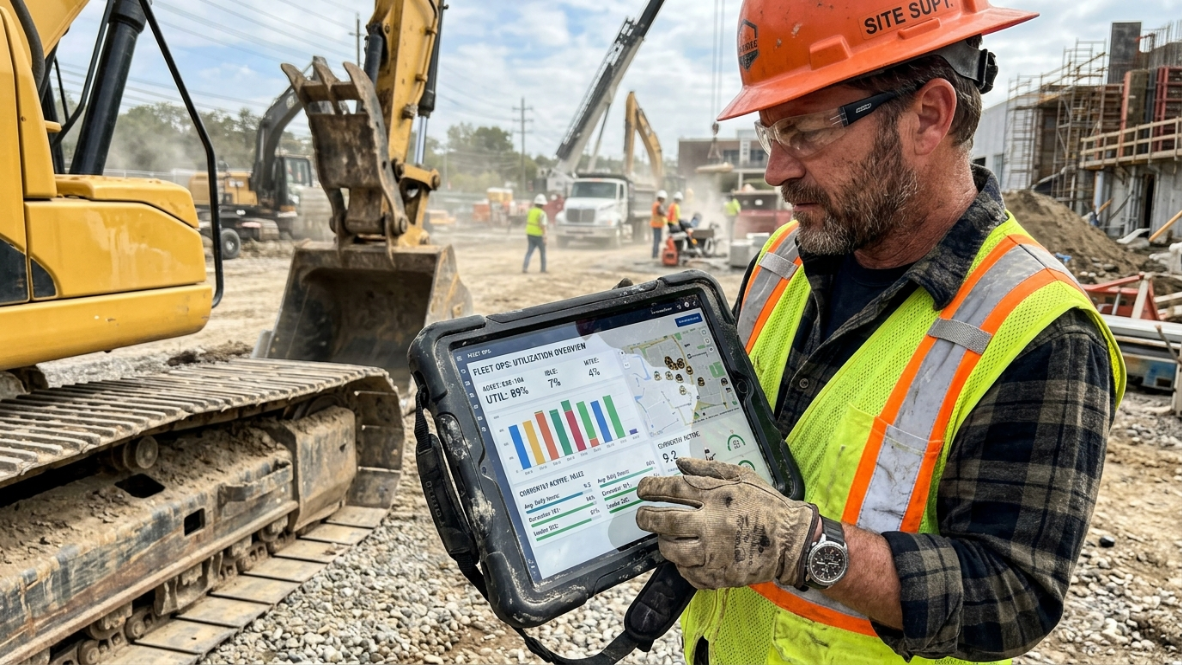
Best for: Any contractor who suspects they have more equipment than they need but can’t prove it.
The benchmark is clear: optimal utilization sits between 70% and 85%. Most construction fleets operating below 60% are carrying $200,000 to $800,000 in underutilized assets that generate cost every day they sit idle.
Seasonal fleets (common in the Southeast) typically run 50–65% utilization with spikes to 80% during peak months. That’s expected. What’s not acceptable is having no measurement system at all.
Virginia Tech’s Mike Vorster offers a framework that none of the typical fleet efficiency articles mention: deployment before utilization. His logic is simple. You cannot use a machine unless you have the right machine in the right place at the right time. Tracking utilization without first getting deployment right is measuring the wrong thing.
Three types of utilization matter:
Time utilization: Is the machine running during scheduled hours?
Financial utilization: Is it generating revenue that exceeds its cost-per-hour?
Deployment utilization: Is it assigned to the jobsite where it creates the most value?
Contractors who run quarterly utilization reviews consistently reduce fleet size by 8–12% while maintaining the same project volume. That translates directly into freed capital and lower overhead.
What to do this quarter: Establish a baseline. Even if you’re tracking manually, record hours for every asset over the next 90 days. Compare against the 70–85% benchmark and identify your bottom 10% performers.
3. Kill Nonproductive Idle Time
Best for: Equipment-heavy fleets burning fuel without producing anything.
This is the fastest win on the list. According to industry research, 10–30% of construction equipment fuel consumption goes to nonproductive idling. That’s fuel burned while machines sit running but doing zero work.
The numbers get specific quickly. A 36-ton excavator in North America typically runs about 1,000 hours per year but spends roughly 40% of that time idling. During idle time, it burns about a gallon of fuel per hour, adding up to 400 gallons annually, just from idling one machine. With diesel averaging $4.92 per gallon in mid-2026, that’s nearly $2,000 wasted per excavator per year.
Idle time also inflates maintenance schedules. Hour meters keep running whether the machine is working or sitting, which means you’re hitting service intervals faster than actual wear justifies.
Simple fixes work:
Set idle alerts at 10, 15, and 20-minute thresholds in your telematics system.
Enforce warmup and shutdown guidelines (most modern equipment needs far less warmup than operators assume).
Share idle time reports with operators weekly, not monthly.
The results can be dramatic. Royal Electric used idling reports to expose high-consumption habits across their fleet. Simple behavioral changes led to $9,000 per month in fuel savings.
What to do this week: If you have telematics, pull idle time reports for the last 30 days. If you don’t, assign a supervisor to spot-check idle behavior on your two busiest jobsites.
Fleet Efficiency Calculator Example
Fleet Size | Idle Reduction | Estimated Annual Savings |
|---|---|---|
20 assets | 10% | $18,000 |
50 assets | 10% | $46,000 |
100 assets | 10% | $92,000 |
200 assets | 10% | $184,000 |
Then explain that actual savings depend on equipment type, operating hours, and fuel costs.
4. Shift from Reactive to Preventive Maintenance
Best for: Contractors losing money to breakdowns that could have been prevented.
Unplanned downtime is the silent killer of contractor fleet efficiency. The industry norm is ugly: 20–30% unplanned downtime rates are common, and failure to keep up with preventive maintenance is the leading cause.
The data on fixing this is compelling. In a study of 1,000 commercial fleet maintenance programs, fleets running documented preventive maintenance checklists experienced 47% fewer unscheduled breakdowns than those relying on informal or verbal PM programs. Fleets that moved from paper-based schedules to digital PM programs achieved 98% vehicle uptime, reduced per-vehicle maintenance costs by 25–30%, and cut unplanned breakdowns by 55%.
Think about the cost cascade. A missed oil change on an excavator, maybe a $200 service, can destroy an engine worth $80,000 to $150,000. According to Deloitte, poor maintenance strategies can reduce a company’s production capacity by 20%.
Construction jobsite conditions make this worse. Dust, vibration, extreme heat (especially for Southeast contractors operating through summer), and constant material exposure demand shorter maintenance intervals than highway fleets. You cannot use the same PM schedule for a pickup truck and a loader working in Alabama in July.
For contractors developing formal vehicle maintenance programs, the investment pays back within a single quarter for most fleet sizes.
What to do this month: Audit your current maintenance tracking. If it’s on a whiteboard or in someone’s head, move it to a digital system. Set non-negotiable PM intervals for your top 10 highest-value assets.
Preventive vs Reactive Maintenance Comparison
Preventive Maintenance | Reactive Maintenance |
|---|---|
Planned service | Emergency repairs |
Lower downtime | Higher downtime |
Longer equipment life | Faster wear |
Lower repair costs | Expensive failures |
Predictable scheduling | Project delays |
Higher resale value | Lower resale value |
5. Get Fuel Spend Under Control with Fleet Fuel Cards
Best for: Contractors buying 1,000+ gallons per month without per-transaction visibility.
Fuel is the most widely distributed and least consistently tracked expense in construction. Trucks refuel at different stations. Equipment takes diesel on-site from mobile tanks. Operators use personal cards and submit receipts (or don’t). The result is a spending black hole.
Fleet fuel cards solve this by providing per-transaction visibility, spending controls, per-gallon discounts, IFTA reporting, and job-cost allocation. The fraud prevention alone justifies the switch: construction leaders estimate that up to 22% of fleet payments are lost to fraud or theft.
The savings stack up. Dyed diesel exemptions can save roughly $1 per gallon for off-road equipment. Volume discounts through card programs typically run 3–6 cents per gallon. And the data you gain, which transactions happened where, for which job, at what price, feeds directly into the cost-per-hour calculations that drive smart fleet decisions.
Asphalt paving contractor Hardy & Harper demonstrated the impact: they reduced fuel spend by 24% using fleet cards and visibility tools. For a mid-size contractor spending $30,000 per month on fuel, a 24% reduction is $86,400 annually.
For a complete breakdown of card types, rebate structures, and program options, the fleet fuel cards guide covers the full picture. Contractors interested in comparing specific fuel rebate programs can find detailed breakdowns there as well.
What to do this month: Calculate your total fuel spend across all payment methods. If you’re over $5,000 per month and using mixed payment methods, you’re almost certainly leaving money on the table.
6. Invest in Telematics (The ROI Is Faster Than You Think)
Best for: Contractors still managing fleets with spreadsheets, whiteboards, or gut feel.
At CONEXPO 2026, the reality on the ground was telling. According to Tenna, several contractors described still managing equipment maintenance and inspections using spreadsheets, whiteboards, or paper logs. Others had no centralized tracking system at all. For these contractors, the first step toward fleet efficiency isn’t advanced analytics. It’s simply gaining visibility.
The ROI case for telematics is strong. Modern platforms deliver a 60–90 day payback and create the data foundation needed for every other efficiency tactic on this list. Typical results include 15–25% fuel cost reduction and 10–15% utilization improvement. A G2 survey found that 55% of fleets reported reduced fuel costs by an average of 8% after adopting telematics.
Beyond basic GPS tracking, modern telematics covers engine diagnostics, PTO monitoring, fuel consumption measurement, and driver behavior scoring. The data feeds utilization tracking, maintenance scheduling, idle time alerts, and cost-per-hour calculations simultaneously.
One contractor (GS Construction) even used historical fuel data from their telematics platform to calculate potential savings when evaluating a new office location, proving that fleet data informs strategic business decisions far beyond daily operations.
What to do this quarter: If you have zero telematics, start with your 10 highest-value assets. The data from even a small deployment will reveal patterns you’ve been missing. If you already have telematics, audit whether you’re actually using the reports it generates.
7. Use Fleet Data to Negotiate Better Vendor and Supplier Deals

Best for: Multi-site contractors who buy significant volumes of fuel, parts, and maintenance services.
Once you have utilization, fuel, and maintenance data, you have something most contractors don’t: negotiating power backed by numbers. Every vendor conversation changes when you can show exactly how much you spend, how frequently, and with whom.
Benchmark your fleet costs against industry data. The CFMA/AEMP Heavy Equipment Comparator tracks 26 KPIs across construction fleets. Knowing where you stand relative to peers tells you whether your parts costs are high, your fuel per-hour is out of line, or your maintenance spending is above average.
Then use that data:
Fuel: Volume data supports negotiating better per-gallon pricing, rebate tiers, and bulk delivery rates.
Parts and service: Documented maintenance histories prove your fleet is well-maintained, which can lower warranty dispute rates and strengthen dealer relationships.
Equipment acquisition: Utilization data showing you’ll actually use a machine 1,500+ hours per year strengthens your position when negotiating purchase or lease terms.
Group purchasing alliances multiply individual contractor leverage significantly. A single contractor buying 5,000 gallons of diesel monthly has some negotiating power. Fifty contractors buying collectively have substantially more. For a deeper look at how supplier discount programs work for contractors, the math gets interesting quickly.
Detailed guidance on vendor price negotiation tactics can help contractors translate fleet data into concrete savings at the negotiating table.
What to do this quarter: Compile your total annual spend across fuel, parts, tires, and maintenance services. Identify your top five vendors by spend. Approach each with data and ask for volume-based pricing improvements.
8. Train Operators on Efficiency, Not Just Safety
Best for: Contractors with high operator turnover or inconsistent equipment handling practices.
Operator behavior directly impacts fuel consumption, equipment wear, and daily productivity. Two operators running the same excavator on the same job can produce wildly different cost-per-hour numbers depending on their habits.
In-cab coaching and driver behavior monitoring yield 10–15% productivity gains through better operator-equipment matching alone. A Colorado-based general contractor documented measurable improvements simply by using AI-assisted scheduling to pair the right operators with the right machines on specific tasks.
Safety training deserves mention here too, not as a separate initiative, but as an efficiency lever. OSHA estimates that companies save $4 to $6 for every $1 invested in safety programs. Those savings come through reduced downtime from injuries, lower insurance premiums, fewer equipment damage incidents, and less project disruption.
Training topics that actually move the needle:
Idle reduction protocols (specific to each equipment type)
Proper load optimization for haul trucks
Equipment-specific operating techniques that reduce wear
Pre-operation inspection habits that catch problems before they become breakdowns
Heat management procedures (critical for Southeast contractors running through 95°F summers)
What to do this month: Identify your three operators with the highest fuel consumption or most frequent equipment complaints. Pair them with your most efficient operators for a week of ride-along coaching.
9. Consolidate Your Systems into One Platform
Best for: Contractors running separate, disconnected systems for tracking, maintenance, and accounting.
Many contractors operate with a patchwork of tools: one system for telematics, another for maintenance scheduling, a third for accounting, separate OEM portals for each equipment brand, plus a camera system, a field management app, and a fuel card portal. The result is fragmented data that nobody can act on efficiently.
System consolidation was a top theme at CONEXPO 2026. Contractors increasingly want a single platform that handles tracking, maintenance, inspections, safety, compliance, and financial reporting. The reason is simple: when your idle time data lives in one system and your maintenance schedule lives in another, nobody connects the dots between a machine that’s been idling excessively and one that’s overdue for service.
Start with the highest-impact integration: connect fuel data with equipment records and your accounting system. This single connection lets you calculate true cost-per-hour per asset, the metric that actually drives fleet composition decisions.
For contractors still running procurement and vendor management separately from fleet operations, integrating these procurement systems with fleet data can reveal spend patterns that neither system shows on its own.
What to do this quarter: Map every system that touches fleet data. Identify which two systems, if connected, would give you the most useful insight. Start there.
10. Plan for Seasonal Demand and Market Volatility
Best for: Southeast contractors who face year-round operations with shifting demand patterns and weather exposure.
Contractor fleet efficiency isn’t a set-it-and-forget-it calculation. Seasonal demand, fuel price swings, and market disruptions all shift the equation.
Fuel price volatility is a constant. While 2025 was “remarkably stable” with only a 35-cent spread between annual highs and lows, 2026 has already seen U.S. regular gasoline average $4.305 per gallon and diesel reach $4.92 per gallon. Tariffs on steel, aluminum, and vehicle components are adding 15–25% to vehicle acquisition costs, making the own-vs-rent calculation even more important.
Southeast contractors face a unique planning challenge. Unlike Northern contractors with clear seasonal shutdowns, operations run year-round in states like Alabama, Tennessee, and Georgia. But demand still fluctuates. Storm season disrupts schedules. Summer heat accelerates equipment wear and operator fatigue. Hurricane-related emergency work creates sudden demand spikes.
Build fleet flexibility into your annual plan:
Own core assets that run at 70%+ utilization year-round.
Rent supplemental equipment for peak season or emergency demand.
Use telematics data from prior years to forecast seasonal utilization patterns.
Lock in fuel pricing during stable periods when possible.
With 68% of contractors planning major technology investments in 2026 to combat rising equipment costs and labor shortages, the contractors who combine smart fleet planning with operational cost savings strategies will pull ahead of those who simply react to each month’s bills.
What to do now: Review your last 12 months of fleet utilization and fuel spending by month. Identify your peak and trough periods. Build a rental strategy specifically around those patterns.
Contractor Fleet Efficiency Checklist
Task | Priority | Impact |
|---|---|---|
Measure utilization | High | Very High |
Eliminate idle assets | High | Very High |
Reduce engine idle time | High | High |
Implement preventive maintenance | High | Very High |
Use telematics | High | High |
Adopt fuel cards | Medium | Medium |
Train operators | Medium | Medium |
Benchmark vendor pricing | Medium | High |
Consolidate fleet software | Medium | Medium |
Review fleet quarterly | High | High |
Putting It All Together
Contractor fleet efficiency boils down to two categories: strategic decisions about what you own and how your fleet is composed, and tactical visibility into how those assets perform every day. The strategic decisions (right-sizing, own-vs-rent mix, vendor agreements) create the foundation. The tactical tools (telematics, PM programs, fuel cards, operator training) generate the daily savings.
Every lever on this list works better when combined with the others. Telematics data makes utilization tracking possible. Utilization data drives right-sizing decisions. Fuel card data strengthens vendor negotiations. Preventive maintenance reduces the downtime that erases all other efficiency gains.
Group purchasing programs and vendor partnerships amplify each of these tactics by giving individual contractors access to pricing and terms typically reserved for much larger operations. Contractors exploring procurement savings opportunities often find that the biggest gains come from combining operational improvements with better purchasing power.
The starting point depends on where you are today. If you’re still tracking fleet activity on whiteboards, start with basic telematics. If you already have data but aren’t acting on it, focus on utilization reviews and preventive maintenance. If your operations are dialed in but your costs still feel high, look at fleet composition and vendor negotiations.
The margin is there. You just have to go get it.
Mistakes That Hurt Contractor Fleet Efficiency
Common mistakes include
Buying equipment before measuring utilization
Delaying preventive maintenance
Tracking only fuel costs
Ignoring idle time
Keeping aging equipment too long
Using disconnected software
Not reviewing fleet KPIs
Failing to compare ownership versus rental costs
Frequently Asked Questions
What is a good fleet utilization rate for construction contractors?
Industry benchmarks place optimal utilization between 70% and 85%. Seasonal construction fleets in the Southeast typically run 50–65% during slower periods with spikes to 80% during peak season. Contractors consistently below 60% are carrying significant underutilized assets, potentially $200,000 to $800,000 worth, that generate cost without generating revenue.
How much can telematics save a construction fleet?
Telematics platforms typically deliver a 60–90 day payback with fuel cost reductions of 15–25% and utilization improvements of 10–15%. A G2 survey found that 55% of fleets reduced fuel costs by an average of 8% after adopting telematics. For many contractors still managing fleets via spreadsheets, even basic telematics reveals immediate savings opportunities.
What does unplanned equipment downtime actually cost?
Direct downtime costs range from $448 to $760 per day for fleet vehicles and $2,000 to $10,000 per day for critical jobsite equipment when you factor in idle labor, missed milestones, and subcontractor penalties. A contractor with 50 pieces of equipment facing typical unplanned downtime rates could lose $2 million annually.
Should contractors own or rent their equipment?
The answer depends on utilization. If an asset consistently exceeds 60–70% utilization of available hours, buying makes financial sense. Below that threshold, renting is usually cheaper. The industry is trending toward hybrid models, with typical fleet composition sitting at 65% owned, 20% rented, and 15% leased. Running cost-per-hour analysis for each asset class clarifies the decision.
How do fleet fuel cards improve contractor fleet efficiency?
Fleet fuel cards provide per-transaction visibility, spending controls, per-gallon discounts (typically 3–6 cents), IFTA reporting, job-cost allocation, and fraud prevention. Given that construction leaders estimate up to 22% of fleet payments are lost to fraud or theft, the visibility alone justifies adoption. Contractors buying 1,000+ gallons per month see meaningful cost reductions.
What’s the most overlooked fleet efficiency tactic?
Fleet composition, the own-vs-rent decision, is consistently overlooked. Most fleet efficiency advice focuses on operational tactics like maintenance and fuel management. But the biggest single cost savings often come from eliminating underutilized assets entirely. If a machine sits idle more than 40% of available hours, you’re paying insurance, depreciation, and storage costs for something that isn’t earning its keep.
How does preventive maintenance affect fleet efficiency?
Dramatically. Fleets with documented preventive maintenance checklists experience 47% fewer unscheduled breakdowns. Digital PM programs achieve 98% vehicle uptime compared to paper-based approaches. The cost difference between a $200 oil change and a $150,000 engine replacement makes the ROI obvious, but many contractors still operate reactively.
How can small contractors (under 20 assets) improve fleet efficiency?
Start with the low-effort, high-impact items: enroll in a fleet fuel card program for immediate per-gallon savings, implement basic preventive maintenance checklists (even on paper), and conduct a quarterly utilization review of every asset. Small contractors can also access group purchasing programs that provide the same volume-based pricing and vendor terms available to larger operations.
Recent Comments